




TL;DR
|
Every unanswered call and every delayed response adds up to thousands in lost revenue for hospitals each year.
Operational inefficiencies in healthcare are not merely minor inconveniences; they are significant and costly liabilities. In an environment where patient volumes are rising but margins remain tight, hospitals face constant pressure to cut costs without compromising care quality.
The hidden costs add up quickly. Up to 20% of hospital spending is allocated to administrative overhead, rather than direct patient care. These challenges are not only draining hospital budgets; they also strain staff, delay care, and erode patient satisfaction.
AI voice agents are emerging as a quiet but powerful force in hospital operations. By automating routine conversations, verifying insurance details, confirming appointments, and even assisting in clinical documentation, AI voice agents are helping hospitals reduce operational costs at scale. Unlike conventional IVR systems, these intelligent agents understand natural language, handle multi-step workflows, and work 24/7 without fatigue or error.
This blog examines how AI voice agents for cost reduction are enhancing hospital efficiency, specifically the areas where they reduce costs, and what healthcare leaders should consider before implementing them.
Understanding the Operational Expenses That Strain Healthcare Systems
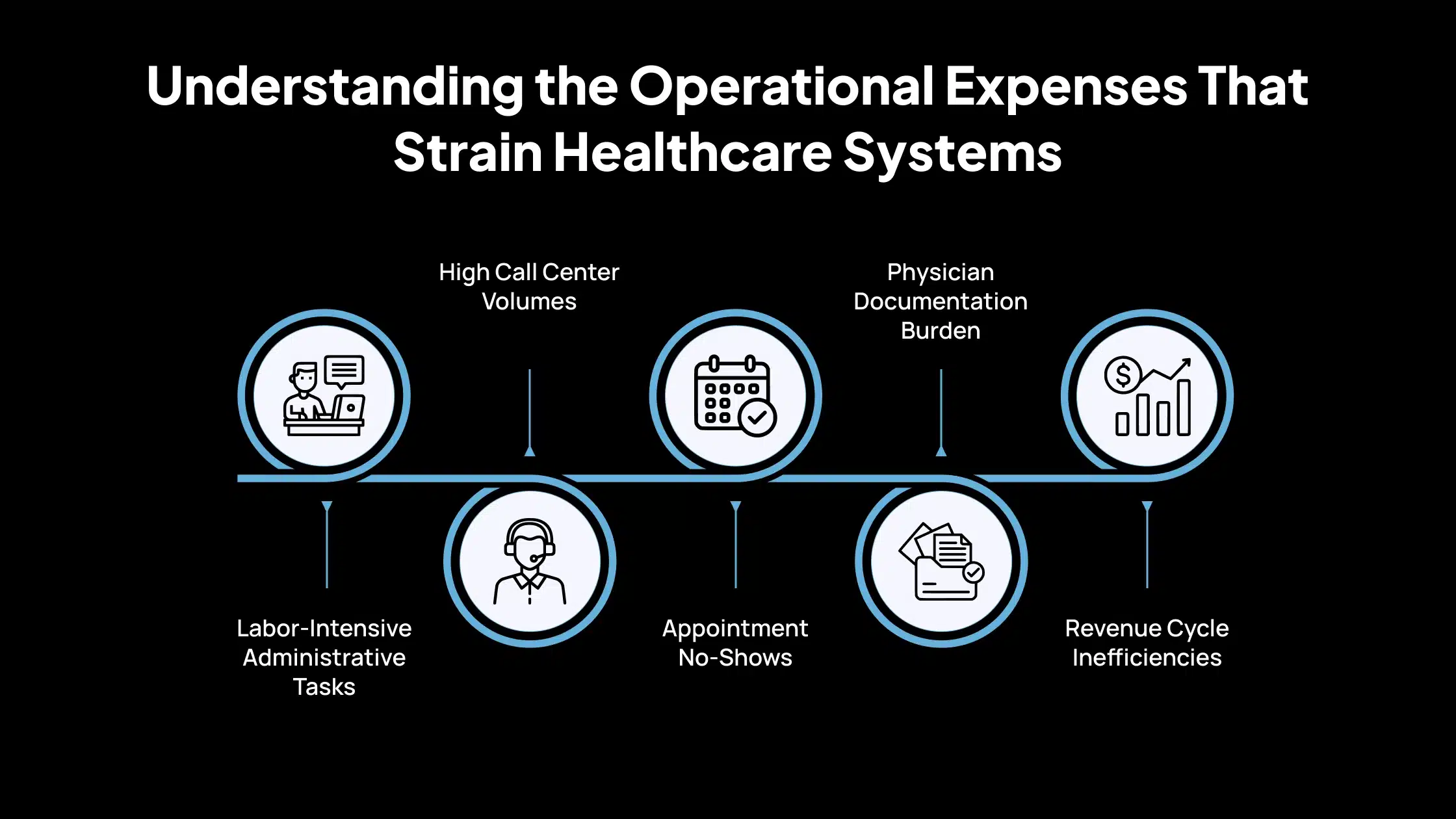
Below are the major operational factors that contribute to rising costs in hospitals and healthcare systems
Labor-Intensive Administrative Tasks
Hospitals rely heavily on administrative staff to handle patient intake, scheduling, billing, claims processing, and other back-office functions. These tasks are repetitive and time-consuming, yet essential for daily operations.
According to a study from the Commonwealth Fund,, administrative costs account for approximately 25% to 30% of total hospital spending in the United States. This figure includes salaries for non-clinical staff, making administrative overhead a significant burden on hospital budgets.
High Call Center Volumes
Hospital call centers handle a high volume of incoming and outgoing calls for appointment booking, cancellations, insurance inquiries, and general information. Maintaining a round-the-clock staff to handle these calls increases labor costs.
A typical mid-sized hospital can receive up to 1,500 calls per day, and staffing a call center to handle this volume requires multiple full-time employees. Each agent costs an average of $35,000 to $50,000 annually, excluding benefits and training costs.
Appointment No-Shows
Missed appointments are a direct source of revenue loss and underutilization of hospital resources. Studies have shown that no-show rates in outpatient settings range from 15% to 30%, depending on the specialty and location. Each missed appointment can result in a financial loss of $200–$300 per slot, leading to substantial annual losses for hospitals and clinics.
Physician Documentation Burden
Physicians spend a significant portion of their working hours on documentation, including entering notes into Electronic Health Records (EHRs), preparing charts, and coding for billing.
The American Medical Association notes that for every hour of direct patient care in ambulatory practice, physicians often spend nearly two hours on EHR and other desk/clerical work during that same office day. This not only limits the number of patients they can see but also contributes to physician burnout, indirectly increasing operational costs through reduced productivity and higher turnover.
Revenue Cycle Inefficiencies
Delays and errors in billing, insurance verification, and claims processing can significantly impact a hospital’s cash flow. Approximately 9% of claims are initially denied by payers, often due to incomplete or inaccurate documentation. Each denied claim can cost a hospital between $25 and $118 to rework. Additionally, fragmented systems and manual follow-ups extend the revenue cycle, delaying payments and increasing operational overhead.
AI Voice Agents in Healthcare: How They Transform Hospital Communication
AI voice agents are automated systems that use artificial intelligence to understand, process, and respond to human speech in real-time. Unlike basic voice response systems, these agents are capable of engaging in natural, context-aware conversations. They are designed to handle tasks such as scheduling, patient queries, and data collection, without human intervention.
Essential Components of AI Voice Agents
| Component | Function |
| Speech Recognition (ASR) | Converts spoken language into text using AI models trained for medical terms. |
| Natural Language Understanding (NLU) | Interprets the intent behind a user’s spoken words and extracts relevant data. |
| Dialogue Management | Manages the flow of the conversation, including multi-turn and contextually relevant interactions. |
| Text-to-Speech (TTS) | Converts text responses into human-like speech using natural voice synthesis. |
| Backend Integration | Connects with hospital systems, including EHR, CRM, scheduling, and billing platforms. |
Conventional IVR systems operate using pre-recorded prompts and require users to respond by pressing numbers. These systems are rigid, with limited ability to understand or adapt to natural language. In contrast, AI voice agents can interpret spoken language, understand user intent, and carry out dynamic conversations. They support multi-turn interactions, personalization, and integration with real-time data sources, making them far more versatile and efficient.
Types of AI Voice Agents
- Inbound Voice Agents: Handle incoming calls from patients for appointment scheduling, general inquiries, and service information.
- Outbound Voice Agents: Make proactive calls for appointment reminders, medication adherence, post-discharge follow-ups, and patient satisfaction surveys.
- Ambient Voice Agents: Operate in the background during clinical encounters to capture conversations between physicians and patients for documentation purposes.
- Scribe Agents: Convert live or recorded clinical dialogue into structured notes that can be directly entered into EHRs, reducing the need for manual documentation by physicians.
The Role of AI Voice Agents for Cost Reduction in Modern Healthcare
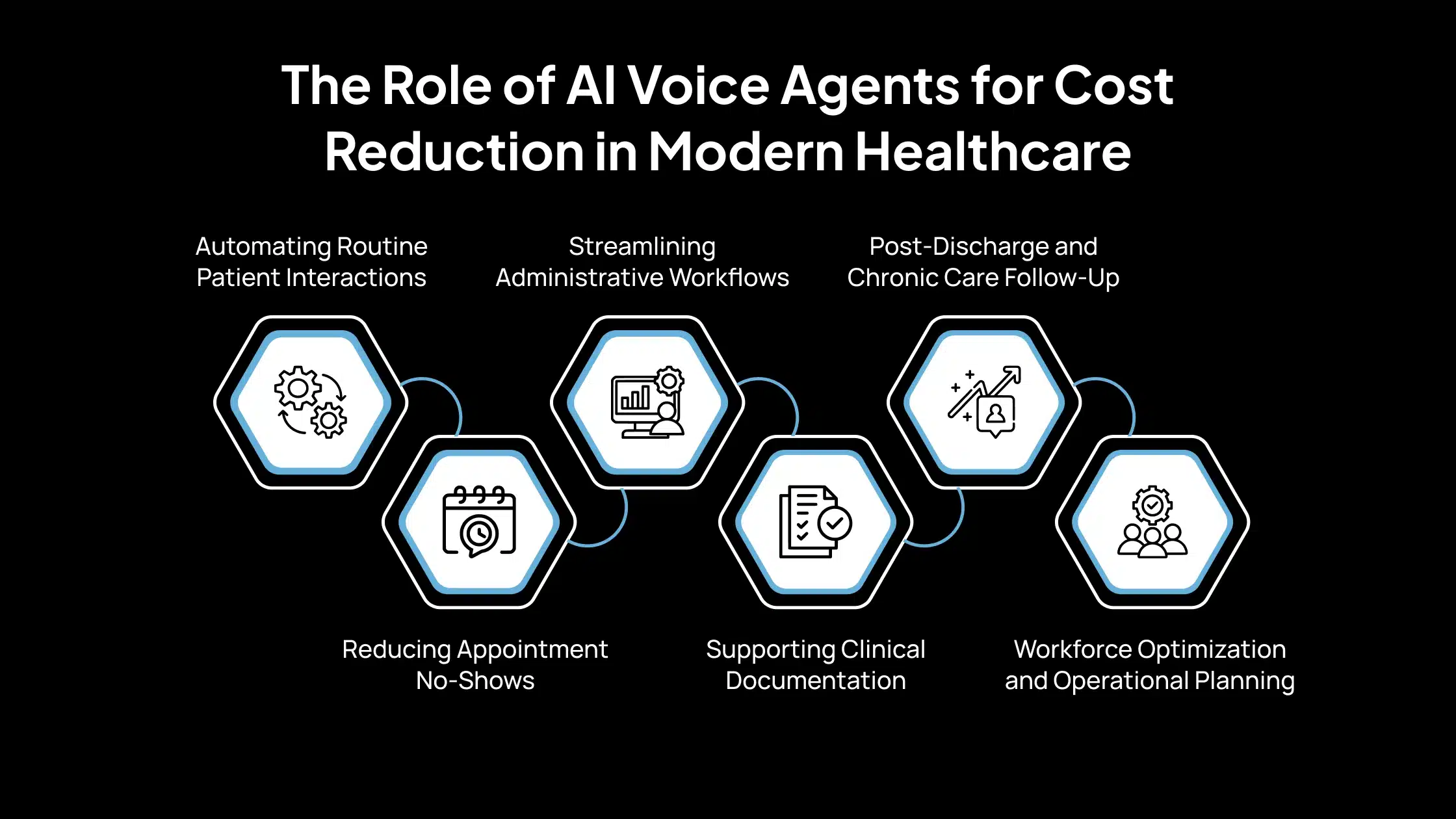
The following areas highlight how AI voice agents for cost reduction optimize hospital workflows and eliminate unnecessary costs.
Automating Routine Patient Interactions
Hospitals receive thousands of routine calls each day for tasks like appointment booking, rescheduling, and cancellations. AI voice agents can handle these interactions efficiently, without the need for human intervention.
They also manage frequently asked questions such as visiting hours, directions, and documentation requirements. By operating 24/7, these agents ensure that patients can receive assistance at any time, without overloading staff. This reduces the need for large call center teams and helps cut operational costs.
Reducing Appointment No-Shows
AI voice agents can send automated appointment reminders and request confirmations from patients. If a patient cannot attend, the agent can immediately offer rescheduling options.
This dynamic rescheduling helps keep appointment slots filled and reduces idle time for doctors and staff. As a result, hospitals experience fewer missed appointments and better utilization of clinical resources, contributing to revenue preservation and cost reduction.
Streamlining Administrative Workflows
Administrative processes, such as pre-registration, insurance eligibility verification, and handling billing-related inquiries, are repetitive and time-consuming. AI voice agents can automate these tasks by gathering necessary information directly from patients and validating data through system integrations.
This reduces manual entry, minimizes human error, and speeds up processing times. As a result, administrative staff can be reallocated to more complex tasks, leading to improved operational efficiency.
Supporting Clinical Documentation
Ambient AI voice agents can capture conversations between physicians and patients during clinical visits. These agents transcribe and structure the dialogue in real time, producing draft notes that physicians can quickly review and approve.
This reduces the time spent on documentation after patient visits, known as “pajama time,” and allows doctors to focus more on patient care. Over time, this improves productivity and reduces physician fatigue, leading to better clinical and operational outcomes.
Post-Discharge and Chronic Care Follow-Up
AI voice agents are capable of conducting routine follow-up calls after patients are discharged. They can remind patients to take medications, monitor symptoms, and identify warning signs. If concerning symptoms are reported, the system can escalate the case to clinical staff for further evaluation.
This proactive outreach helps prevent avoidable readmissions and supports better long-term health outcomes. It also ensures efficient use of care resources by focusing human effort where it’s needed most.
Workforce Optimization and Operational Planning
By analyzing interaction data, AI voice agents can help forecast call volumes and service demands across different times and departments. This allows hospital administrators to make informed staffing decisions, avoiding overstaffing during slow periods and understaffing during peak times.
AI systems also help balance workloads across departments by routing tasks based on availability and capacity. These capabilities improve resource allocation and reduce unnecessary labor costs.
Measuring ROI: Essential Metrics That Define the Impact of AI Voice Agents
Measuring the return on investment (ROI) of AI voice agents is crucial for evaluating their effectiveness and justifying the cost of implementation. The following key performance indicators help quantify the operational and financial impact:
Containment Rate (Fully Automated Calls)
Containment rate refers to the percentage of calls that are handled entirely by the AI voice agent without needing human intervention. A high containment rate indicates the system is successfully managing routine queries.
For example, a containment rate of 70% means that 7 out of 10 calls are resolved without staff involvement, reducing workload and labor costs.
Cost Per Call (Before vs. After)
Cost per call is a direct measure of operational expense. In a manual setup, the cost includes salaries, training, and overhead for call center agents. AI voice agents significantly reduce this cost by automating high-volume interactions.
Comparing the average cost per call before and after deployment provides a clear view of the savings achieved.
Reduction in FTEs for Call Centers
Full-time equivalents (FTEs) represent the number of staff required to manage call volumes. By handling routine calls, AI voice agents reduce the demand for call center personnel.
A reduction in FTEs either lowers staffing costs or allows for the reallocation of staff to more critical tasks, thereby improving overall resource efficiency.
Decrease in No-Show Rates
AI voice agents send appointment reminders, confirm attendance, and offer rescheduling options. This proactive engagement helps reduce no-shows.
A lower no-show rate leads to improved appointment utilization and reduced revenue losses due to missed visits. Tracking this metric highlights improvements in scheduling efficiency.
Improvement in Physician Throughput
When voice agents support documentation or handle pre-visit workflows, physicians can spend more time with patients. This leads to an increase in the number of patients seen per day, referred to as physician throughput. Measuring the change in daily or weekly consultation volumes helps quantify productivity gains.
Billing Accuracy and Claim Denial Reduction
Errors in billing information and incomplete documentation are significant causes of claim denials. AI voice agents that support insurance verification and data collection help reduce these errors. Fewer denied claims translate to faster reimbursements and improved cash flow. Tracking denial rates before and after implementation provides insight into financial efficiency.
AI Voice Agents in Hospitals: Implementation Factors and Potential Obstacles
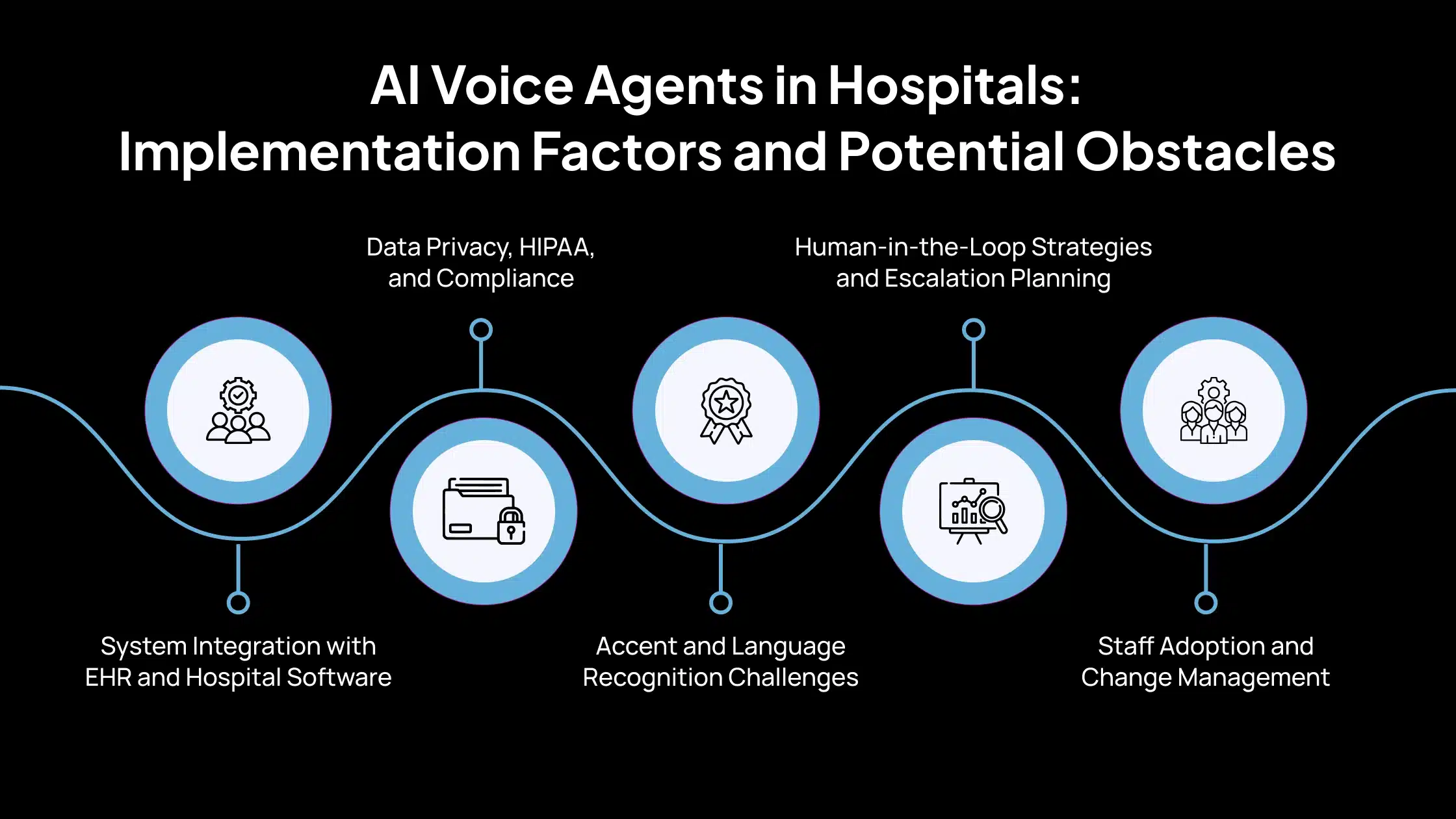
Before deploying AI voice agents, hospitals should consider the practical challenges that can influence performance and adoption. Below are the critical considerations that hospitals must evaluate to ensure a smooth and compliant implementation of AI voice agents.
System Integration with EHR and Hospital Software
A major challenge in deploying AI voice agents is ensuring seamless integration with existing hospital systems like Electronic Health Records (EHR), appointment scheduling platforms, billing systems, and CRMs.
These systems often employ different architectures, data formats, and APIs, which can complicate connectivity and interoperability. Without proper integration, the AI agent cannot access or update patient data in real time, limiting its functionality. Successful implementation requires robust API support, vendor collaboration, and alignment of IT infrastructure.
Data Privacy, HIPAA, and Compliance
AI voice agents in healthcare must operate under strict data privacy regulations, including HIPAA in the U.S. and similar laws in other regions. These regulations govern the collection, storage, processing, and sharing of patient data.
Voice agents must have built-in encryption, secure data handling protocols, and detailed access controls to prevent unauthorized access. Non-compliance can lead to legal consequences and a loss of patient trust, so ensuring regulatory compliance is a critical step in the implementation process.
Accent and Language Recognition Challenges
Hospitals serve patients and staff from diverse linguistic and cultural backgrounds. AI voice agents must accurately understand a wide range of accents, dialects, and languages to function effectively. Inconsistent speech recognition can lead to communication breakdowns or incorrect task execution.
Addressing this requires continuous training of speech models using real-world data from diverse users, and possibly offering multilingual support to accommodate different patient populations.
Human-in-the-Loop Strategies and Escalation Planning
AI voice agents cannot and should not handle all situations independently. Some interactions require human judgment, such as complex medical inquiries or emotionally sensitive scenarios.
A robust escalation system must be in place to transfer calls or tasks to human staff when necessary. This ensures service quality and patient safety. Clearly defined thresholds and workflows should govern when and how such escalations occur, maintaining a smooth user experience.
Staff Adoption and Change Management
Introducing AI into hospital operations can face resistance from staff who fear job displacement or are unfamiliar with the technology. Successful implementation requires a structured approach to change management, including staff training, clear communication of benefits, and ongoing support.
Employees should be shown how AI voice agents can reduce their routine workload and improve efficiency, rather than replace them. Involving staff early in the planning process helps build trust and encourages adoption.
Avahi AI Voice Agents: Purpose-Built Automation for Modern Healthcare
What if your clinic could handle every routine patient call without putting anyone on hold? What if your front-desk team could focus on people, not paperwork? With Avahi AI Voice Agents, that’s not just possible, it’s already happening.
Avahi AI Voice Agents offer a reliable voice automation layer that integrates with core systems to handle routine patient interactions at scale.
- Purpose-Built for Healthcare Workflows
Avahi’s voice agents are engineered with healthcare-specific intent models, allowing accurate handling of appointment scheduling, insurance inquiries, referrals, and intake coordination across medical, dental, and specialty care practices.
- Real-Time Scheduling and Transactional Automation
The system supports live scheduling, cancellations, and rescheduling without human intervention, minimizing hold times and reducing patient drop-offs.
- Integrated No-Show Management
Automated follow-up messages and reminders reduce missed appointments, optimizing provider utilization and ensuring predictable scheduling patterns.
- Priority Triage & Escalation Handling
Urgent issues are identified using contextual intent detection and routed to designated staff in real time, improving care responsiveness.
- Operational Load Redistribution
By automating common front-desk queries and administrative workflows, Avahi frees up staff resources for more value-driven patient support activities.
- High-Throughput Readiness
Whether in fast-paced urgent care centers or multi-location dental practices, Avahi scales to meet communication demands while maintaining SLA compliance and data integrity.
Discover Avahi’s AI Platform in Action
At Avahi, we empower businesses to deploy advanced Generative AI that streamlines operations, enhances decision-making, and accelerates innovation—all with zero complexity.
As your trusted AWS Cloud Consulting Partner, we empower organizations to harness the full potential of AI while ensuring security, scalability, and compliance with industry-leading cloud solutions.
Our AI Solutions Include
- AI Adoption & Integration – Utilize Amazon Bedrock and GenAI to Enhance Automation and Decision-Making.
- Custom AI Development – Build intelligent applications tailored to your business needs.
- AI Model Optimization – Seamlessly switch between AI models with automated cost, accuracy, and performance comparisons.
- AI Automation – Automate repetitive tasks and free up time for strategic growth.
- Advanced Security & AI Governance – Ensure compliance, detect fraud, and deploy secure models.
Want to unlock the power of AI with enterprise-grade security and efficiency? Start Your AI Transformation with Avahi Today!
Frequently Asked Questions
1. How do AI voice agents for cost reduction help hospitals save money?
AI voice agents for cost reduction automate repetitive tasks, such as appointment scheduling, billing queries, and follow-ups. By reducing the need for manual labor, hospitals can lower staffing costs, minimize administrative errors, and increase efficiency across departments, all of which contribute to measurable cost savings.
2. Can AI voice agents for cost reduction decrease appointment no-show rates?
Yes. AI voice agents for cost reduction send automated reminders, confirm appointments, and offer real-time rescheduling. This proactive engagement significantly reduces no-show rates, which in turn improves physician utilization and prevents revenue loss from missed consultations.
3. Are AI voice agents for cost reduction compliant with healthcare data regulations?
Most modern AI voice agents designed for cost reduction are intended to meet healthcare compliance standards, such as HIPAA. They include secure data handling, encryption, and audit controls, ensuring patient data is protected while automating operational workflows.
4. What hospital processes benefit most from AI voice agents for cost reduction?
The most impacted areas include call center operations, pre-registration, insurance verification, billing, and clinical documentation. By streamlining these high-volume workflows, AI voice agents enable cost reduction, freeing up staff time and reducing operational delays.
5. How quickly can hospitals see ROI from AI voice agents for cost reduction?
Hospitals often begin to see ROI within 6 to 12 months after implementation. The savings come from lower call center costs, reduced documentation burden, fewer no-shows, and more efficient resource allocation, all driven by AI voice agents for cost reduction.