





If you are choosing between Google Cloud and AWS, most comparisons read the same: a long feature grid, a pricing table, and a shrug at the end.
That is not useful when you have a real workload and a real decision to make.
This comparison is written for one reader with a growing AI product deciding where to run and scale.
We look at services, scale, AI model access, and the factor that actually decides it for most AI teams, which is capacity. Then we cover when and how to migrate from Google Cloud to AWS.
The short version: both Google Cloud Platform (GCP) and AWS are capable, but for a production AI product that needs to scale reliably, AWS is the stronger default. Here is why.
TL;DR: Google Cloud vs AWS
|
Google Cloud vs AWS: The Quick Comparison
Both platforms can run almost any workload. The differences that matter for a scaling AI product are breadth, model access, and capacity, and that is where AWS pulls ahead.
| Dimension | AWS | Google Cloud |
|---|---|---|
| Market position | Market leader, widest adoption and maturity | Third of the big three |
| Service breadth | 200+ services, the broadest catalog of any cloud | Focused catalog, strong in data and analytics |
| AI model access | Bedrock: Anthropic + OpenAI + more, one interface | Gemini and Vertex AI |
| Capacity to scale | Deep capacity; not throttled for consumer features | Capacity can shift to consumer products (e.g. Nano Banana) |
| Ecosystem and talent | Largest partner marketplace and certified-pro community | Smaller, growing ecosystem |
| Cost approach | Deep optimization; custom silicon for cheaper inference | Competitive per-unit pricing on some AI workloads |
| Best fit | Production AI products scaling broad workloads | Data-heavy, analytics-first teams |
Service Breadth and Maturity: AWS Leads
AWS launched in 2006 and remains the most mature, widely adopted cloud, with the broadest and deepest catalog of services.
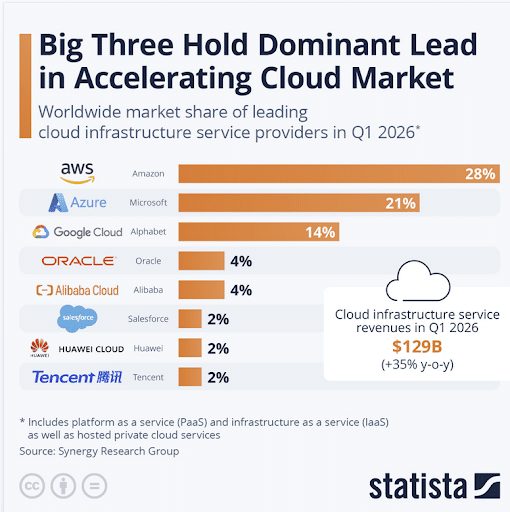
According to Synergy Research Group, Amazon still holds the largest share of the cloud infrastructure market, ahead of Microsoft and Google.
That breadth matters for a growing product. When you need a new capability, it usually already exists as a managed AWS service, rather than something you have to build or stitch together.
It also shows up in hiring and support: AWS has the largest community of certified professionals and the biggest partner marketplace, so finding people and help is easier.
Google Cloud has genuine strengths in data and analytics. But for a team that wants the widest set of production-ready building blocks under one roof, AWS is the path of least resistance.
AI and Machine Learning: Broadest Model Access on AWS
This is where the decision matters most for an AI product, and it is where AWS has quietly built a strong lead.
Amazon Bedrock puts a range of foundation models behind one managed interface. It now includes both Anthropic and OpenAI models, which gives AWS arguably the broadest frontier-model access of any cloud.
That matters in practice: you can pick the right model for each task and switch between them without re-plumbing your stack.
AWS also runs custom silicon (Trainium and Inferentia) built for cost-effective training and inference, on top of the broadest GPU selection. SageMaker remains a comprehensive end-to-end ML platform.
Google Cloud has Vertex AI and Gemini, and they are capable. But if model flexibility and the ability to scale inference economically are central to your roadmap, Bedrock’s range and AWS’s compute depth are hard to beat.
The Deciding Factor for AI Workloads: Capacity
Here is the point that should weigh most heavily. For a growing AI product, the question is which platform can give you the capacity to scale, reliably, when your usage spikes.
When Your Provider Throttles You
Every provider has finite serving capacity. When its own high-volume consumer features compete for that compute, paying API customers can get throttled.
The recent example: when Google launched Nano Banana, its consumer video content creation tool, usage exploded, and capacity that had served paying customers got pulled toward the surge.
Those customers did not change anything. Their responses just got slower during peak demand.
This is the risk that does not show up in a feature grid. Your reliability becomes partly hostage to a provider’s own product priorities.
Why Capacity Favors AWS
AWS’s scale is the practical advantage. Its capacity and infrastructure depth mean a scaling AI workload can get the headroom it needs without being squeezed when something else on the platform gets popular.
That is the difference between a provider you fit around and a provider that fits around you.
For a product whose growth depends on staying fast under load, capacity you can rely on is worth far more than a marginal price difference.
GCP vs AWS Pricing: What Actually Matters
On pricing, there is no honest universal winner on sticker price alone. Both price compute, storage, and transfer differently, and both offer committed-use discounts.
Give Google Cloud its due here. On some AI workloads, particularly training on TPUs, GCP can deliver better price-performance than comparable GPU instances on AWS. That is a genuine advantage, and most honest comparisons land on it.
But a per-unit price edge is the wrong thing to optimize for if you are running a product. It is easily wiped out by a workload that cannot get the capacity it needs, or by engineering time lost to throttling and re-tuning. The cheapest training hour does not help if inference stalls under load.
AWS also offers deep optimization paths, from committed-use and spot pricing to custom Trainium and Inferentia chips that bring down inference cost at scale.
What actually moves your bill is how well the workload is built: right-sized compute, caching, and managed services that avoid paying for idle capacity. For a scaling AI product, total cost and reliable capacity matter more than the headline rate.
When to Migrate From Google Cloud to AWS
Migration is a response to a constraint. It makes sense when something concrete is holding you back and the move resolves it.
Here’s when to move:
- You are being throttled. If a provider’s capacity decisions are slowing your product, especially to feed its own consumer features, that is a direct hit to growth a migration can fix.
- Your costs are structurally high and not improving. If you have optimized and the economics still do not work, the platform itself may be the constraint.
- You have outgrown the credits game. As you scale, managing multiple environments costs more than the credits save, and you need to commit to the platform that can carry you long term.
If none of these is true, you may not need to move, and a good partner will tell you so. The point is to migrate for a reason, with AWS as the destination that removes the constraint.
How to Migrate Without Betting the Business
The mistake is treating migration as one giant all-or-nothing cutover.
The lower-risk path is to rebuild one workload on AWS first, the one most affected by your constraint, and measure it against your current setup before moving anything else.
If the capacity, cost, and latency are better, the rest of the workloads follow. If they are not, you have risked one workload, not the company.
This is how we approach it at Avahi. As an AWS Premier Tier Services Partner, we rebuild your existing GCP or Gemini solution on AWS rather than asking you to start from scratch.
Real Migration: How Sanas Moved 150 Million Voice Files From Azure to AWS in One Week
Sanas builds AI-powered accent translation, and their product depends on GPU-scalable infrastructure for training voice models.
Their Azure environment was not keeping up due to reliability and capacity constraints that were slowing model iteration and limiting scalability for paying customers.
We ran the migration as a MAP engagement, which included:
- Used Terraform IaC to build the new environment (ECS cluster, S3, Lambda, and Elastic Beanstalk).
- Migrated 150 million SQL and Postgres files using four DataSync agents.
- Integrated Multi-AZ CloudFront and CloudWatch for improved reliability and observability.
The entire migration finished in one week. 50 percent faster than planned!
The result: faster model-training cycles, improved scalability for the translation service, and a security posture built on IAM least-privilege and Secrets Manager. For a product whose growth depends on staying fast under load, the platform change paid for itself immediately.
Where AWS Funding Fits
Here is the part most comparisons cannot offer. Through our Strategic Collaboration Agreement (SCA) with AWS, we at Avahi can fund the migration proof of concept. Eligible companies may receive a no-cost PoC depending on your project.
That means you can rebuild one workload on AWS and compare it against Google Cloud with real numbers before committing.
Want to compare your own workload on AWS before you decide? Start with a funded PoC.
Make the Call With Avahi
Google Cloud and AWS are both capable platforms, but for a growing AI product the decision usually comes down to capacity, model access, and reliability at scale.
On all three, AWS is the stronger default, and the best way to prove it is on your own workload, not a feature grid.
At Avahi, we rebuild GCP and Gemini workloads on AWS as a Premier Tier Services Partner, and through our SCA with AWS, the proof of concept can be funded.
Start with a funded PoC and make the call on evidence. Eligible companies may receive a no-cost PoC depending on your project.
FAQs: Google Cloud vs AWS
Is AWS or Google Cloud Better?
It depends on the workload. For a production AI product that has to scale, AWS is the stronger default: the broadest service catalog, the widest model access through Amazon Bedrock, and the deepest capacity for traffic spikes. Google Cloud suits data-heavy and training-heavy teams on Vertex AI.
Is Google Cloud Cheaper Than AWS?
It can be on some AI workloads, especially training on Google’s TPUs, where GCP can win on price-performance. But a per-unit edge is easily erased by capacity limits, throttling, and re-tuning time. For production inference at scale, total cost and reliable capacity matter more than the rate.
Are Google’s TPUs Better Than AWS for AI?
For some training workloads, TPUs offer excellent price-performance, a genuine Google Cloud strength. For serving a production AI product, the bigger factors are model flexibility, reliable capacity, and inference economics, where AWS Bedrock and Inferentia chips are hard to beat under real traffic.
What Is the Difference Between AWS Bedrock and Vertex AI?
Vertex AI is Google Cloud’s platform built around Google’s own models like Gemini. Amazon Bedrock is broader: it puts Anthropic, OpenAI, Meta, and other providers behind one managed interface, so you can pick the right model per task and switch without re-plumbing. That range is AWS’s main AI edge.
Why Do AI Startups Migrate From Google Cloud to AWS?
Most often because of capacity. When a provider throttles paying customers to keep its own consumer features fast, growth gets capped no matter how well the app is tuned. AWS’s scale and capacity depth are the main reason teams move, alongside model access through Bedrock and cheaper inference.
What Is the AWS Equivalent of Gemini?
Amazon Bedrock is the closest equivalent, and broader in scope. Rather than a single model family, it provides managed access to many models, including Anthropic, OpenAI, and Meta, behind one interface with shared security, governance, and cost controls. You choose the best model per task.
Is It Hard to Migrate From GCP to AWS?
It does not have to be. The lower-risk approach is to rebuild one workload on AWS first, the one most affected by your constraint, then measure capacity, cost, and latency against your current setup. You migrate the rest only if the numbers justify it, rather than risking a single big-bang cutover.
Can Avahi Fund a GCP-to-AWS Migration?
Yes. At Avahi, we are an AWS Premier Tier Services Partner, and through our Strategic Collaboration Agreement (SCA) with AWS, we can fund the migration proof of concept. Eligible companies may receive a no-cost PoC depending on the project, so you can rebuild one workload and compare against GCP.