


Reserved Instances, Spot pricing, and Savings Plans typically cut compute costs versus equivalent Heroku Performance dynos at mid-market scale, and post-move AWS cost optimization keeps the savings compounding.
Move to Amazon RDS for PostgreSQL or Aurora for multi-AZ deployments, read replicas at scale, and smooth version upgrades. Heroku itself migrated its own Postgres fleet to Amazon Aurora for exactly these scaling and reliability gains.
AWS Control Tower landing zones give you VPC architecture, IAM, encryption, and AWS Config compliance checks for SOC2, HIPAA, and PCI from day one.
Amazon Bedrock, SageMaker, and Redshift open the AI and ML toolchain Heroku add-ons cap. Most of our migrations become the foundation for the AI workloads the move was for in the first place.
We deliver Terraform or AWS CDK at project handover so you can audit, edit, and extend with no lock-in.

From Heroku concept to AWS equivalent.
Most of our engagements use ECS Fargate for the compute layer (the smoothest dyno equivalent), RDS for Postgres, and ElastiCache for Redis as the standard baseline. Containerization and CodePipeline integration are scoped during discovery.
| Heroku concept | AWS equivalent | Notes |
|---|---|---|
| Dynos | Amazon ECS with Fargate | Closest match to the dyno model: serverless containers, auto-scaling, no server management. |
| Heroku Postgres | Amazon RDS for PostgreSQL or Aurora | Direct managed PostgreSQL replacement. Multi-AZ, read replicas, version flexibility. |
| Heroku Redis | Amazon ElastiCache for Redis | Managed Redis with clustering, encryption in transit and at rest. |
| Heroku Kafka | Amazon MSK | Managed Kafka. Or migrate to SNS + SQS for simpler messaging patterns. |
| Buildpacks | Dockerfiles | Containerize once, deploy anywhere. No more slug size limits. |
| Heroku Pipelines | AWS CodePipeline + CodeBuild | Or keep GitHub Actions with AWS DevOps and CI/CD integration. Your call. |
| Config Vars | AWS Secrets Manager + SSM Parameter Store | Encrypted at rest, IAM-controlled, rotated automatically. |
| Heroku Router | Application Load Balancer | HTTP/HTTPS routing, SSL termination, WAF integration. |
| Heroku Scheduler | Amazon EventBridge + Lambda | Serverless scheduling. Pay only for invocations. |
Inventory every app, dyno tier, add-on, and Postgres database using AWS Application Discovery Service. Output: workload map, 7-Rs strategy per app, and a TCO comparison versus your current Heroku bill.
Multi-account architecture provisioned via AWS Control Tower with IAM, VPC, encryption, CloudTrail, and AWS Config guardrails for SOC2, HIPAA, or PCI compliance.
AWS App2Container converts dynos for ECS Fargate. AWS Database Migration Service replicates Heroku Postgres to Amazon RDS. Heroku Redis moves to ElastiCache, Pipelines to CodePipeline, Config Vars to Secrets Manager.
Right-size compute, apply Savings Plans, set up CloudWatch monitoring and AWS Config compliance checks, hand over runbooks. Optional AWS Managed Services via Avahi's AWS MSP Competency.
Fast Migration Without a Long Hiring Cycle
Most growth-stage Heroku migrations move fast from kickoff to production cutover, without the months it takes to hire and onboard an in-house AWS team. We scope your migration during discovery so you know what you are getting before any contract is signed.
AWS Premier Tier Expertise Without Hiring a Heroku-to-AWS Engineer
Hiring a senior AWS engineer with Heroku migration experience takes 3 to 6 months and locks you into one person's skillset. We bring 200+ AWS certifications and six AWS Competencies on day one, including AWS Migration and the AWS Managed Service Provider competency.
AWS-Funded Migrations for Eligible Companies
Eligible companies may receive partial or full AWS funding for their migration assessment and proof of concept depending on projected AWS consumption and project scope. We assess eligibility during the discovery call before any cost discussion.
Production Migration, Not Just Generated Terraform
Qovery and Porter generate Infrastructure-as-Code in minutes. Validating, hardening, and operating it is still on your engineering team. We deliver a complete, production-grade migration with security baseline, CI/CD, monitoring, runbooks, and team enablement.
End-to-End Ownership, PoC to Production to Managed Services
One team from assessment through optimization. No handoffs mid-project. Post-migration, our AWS MSP Competency team can run your environment, or we hand over full IaC and documentation if you want to operate it internally.
Abstract Security runs a real-time threat-detection pipeline processing up to 50 terabytes a day. Sustaining that throughput on x86 compute had become a material cost at scale, and the stack included specialized third-party components (Red Panda and ClickHouse) with no margin for an ARM compatibility gap.
We ran a structured, three-phase migration of the EKS-based platform from x86 to AWS Graviton, front-loading a full compatibility assessment across application code, build pipelines, and third-party dependencies before provisioning anything. ARM-compatible containers were built through existing GitHub Actions workflows, and the full stack was load-tested at production throughput.
50TB/day throughput validated on Graviton at performance equivalent to x86
~20 EKS instances migrated
100% of in-scope services, including Red Panda and ClickHouse, running on ARM64
zero mid-execution blockers · measurable compute-cost reduction at scale.
Masterworks ran a machine-learning application, a donor-propensity model that helps clients target fundraising campaigns, on a hosted SaaS platform. The provider's licensing model made the application increasingly hard to operate profitably as Masterworks grew its client base, and a contract renewal was approaching.
We rebuilt the workload on AWS using Amazon SageMaker to create, train, and deploy the models, with AWS Glue, Amazon S3, and AWS Step Functions supporting the data and orchestration layer.
A lower-cost hosting model on AWS for the machine-learning application, with a scalable platform to create, train, and retrain models as Masterworks expands its client base.
We are an AWS Premier Tier Services Partner with six AWS Competencies and 200+ cloud launches delivered, including complex production migrations validated at full throughput before cutover. Eligible companies may receive a funded assessment depending on the project.

CTO, RetailPro
120 plus Heroku migrations delivered
94 percent of projects exceed savings targets within three months
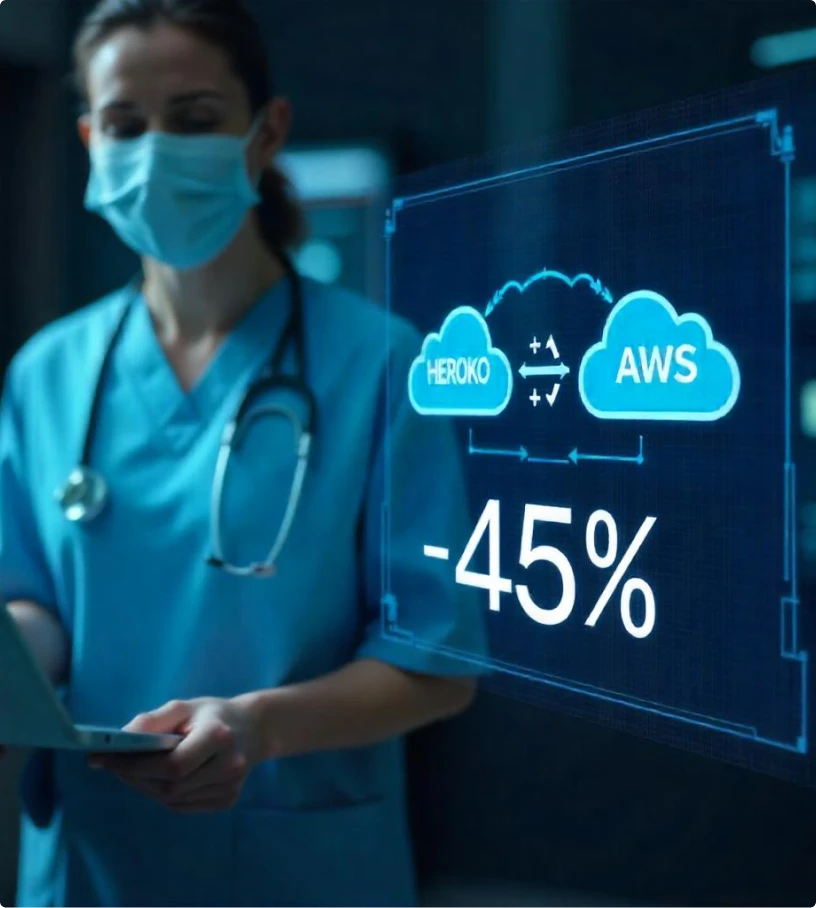
Rising dyno costs and limited add-on flexibility slowed feature delivery
Avahi rehosted containers to Amazon ECS Fargate, migrated Postgres to Amazon RDS, and automated CI/CD with CodePipeline
Annual savings of four hundred fifty thousand dollars, deploy time cut from thirty minutes to five, and uptime improved to 99.99 percent
At Avahi, we migrate growth-stage SaaS teams from Heroku to AWS efficiently. Our 4-stage process covers discovery, landing zone, migration, and optimization, cutting hosting costs, boosting compliance, and improving scalability. We deliver production-ready environments, with potential funding available for eligible companies' assessments.
Amazon ECS with AWS Fargate is the closest equivalent to a Heroku dyno: serverless containers with auto-scaling and no server management. For teams that want a more PaaS-like experience, AWS Elastic Beanstalk is the most Heroku-feeling alternative. We default to ECS Fargate for most migrations because it balances Heroku-like simplicity with full AWS-native scaling and observability.
AWS Database Migration Service (DMS) replicates Heroku Postgres to Amazon RDS for PostgreSQL or Aurora PostgreSQL with near-zero downtime cutover. For smaller databases, a pg_dump and restore pair works fine; for production systems, DMS continuous replication is the standard path. We handle schema mapping, sequence sync, and the cutover playbook so your team only pauses writes for the brief switchover window.
Heroku migration solutions fall into three categories: DIY automation tools (Qovery, Porter) that generate Terraform but leave validation and operations to your team; in-house engineering migrations that take 3 to 6 months and pull senior engineers off product; and AWS Premier Tier partner-led migrations like ours that deliver a complete production environment fast, with AWS funding available for eligible companies. The right fit depends on your team's AWS depth, your compliance requirements, and whether you need ongoing managed services.
Migration scope is set during discovery and depends on your Heroku footprint (number of apps, dyno tiers, Postgres database size, add-on count, and integration complexity). Eligible companies may receive partial or full AWS funding for the migration assessment and proof of concept, which can offset migration costs depending on projected AWS consumption. We scope the exact engagement before any contract is signed.
It depends on your footprint. Smaller single-app workloads move faster; multi-region or refactor-heavy environments take longer. At Avahi, we scope your migration during discovery before any contract is signed, and our methodology aligns with AWS's own recommended migration framework so the path to cutover is clear from the start.
Cutovers happen during low-traffic windows and are validated in staging first, so customers stay unaffected.
Yes. We replicate or improve your pipelines with CodeBuild, GitHub Actions, or the tool you prefer.
Encryption, logging, and least-privilege IAM are baked in from day one to meet strict regulatory needs.
Optional managed services keep your new AWS environment secure, optimized, and cost-efficient.