


Avahi delivered the VA for Pros Chatbot, an AI-powered conversational interface designed specifically for professional hunting and fishing guides. The chatbot enables guides to create bookings, look up client information, and query business metrics through natural language, replacing the need to navigate complex dashboard menus with simple conversational interactions like “What’s my revenue this month?” or “Show me bookings for John Smith.”
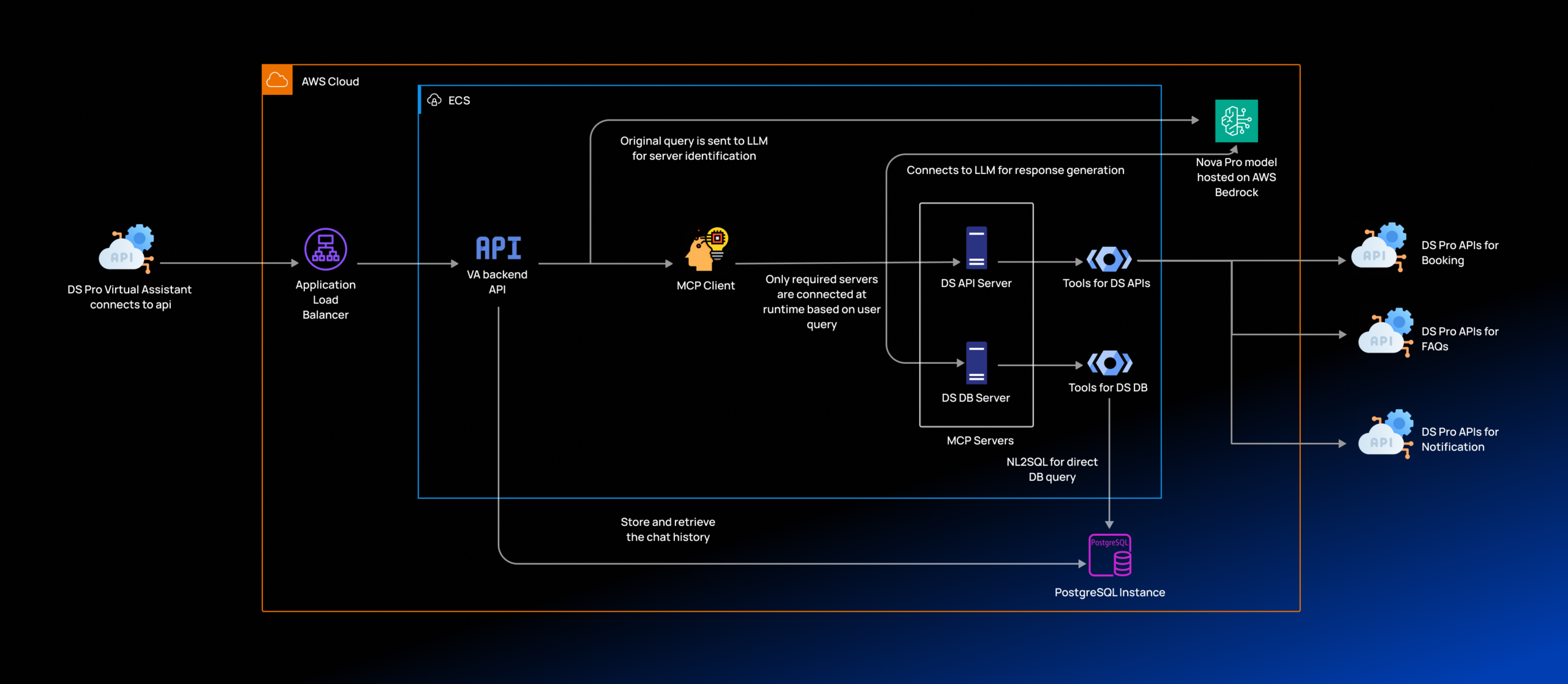
The solution architecture is built on a multi-agent framework powered by the Model Context Protocol (MCP). When a guide submits a natural language query, the system routes it through Claude Sonnet 4 via Amazon Bedrock, which classifies the query as either an informational inquiry or an actionable request. Informational queries trigger the NL-to-SQL engine, which passes the database schema and field value mappings to the LLM at query time, generating accurate PostgreSQL queries against the production RDS database. Action queries, such as booking creation, are routed to Amazon Nova Premier, which orchestrates MCP tool calls to execute the appropriate backend API operations.
The NL-to-SQL engine represents a key technical innovation. Rather than relying on pre-trained models or hardcoded query templates, the system dynamically injects the full database schema and enumeration mappings into the LLM context at query time. This approach means the chatbot adapts to database changes, including new tables, modified fields, and updated enum values, by updating schema files alone, with no code changes required. Business rule safeguards are embedded directly into prompts with conditional logic for known edge cases, ensuring data integrity across a complex 50+ table production schema.
Security was a critical design priority. User identity is extracted directly from the bearer token in each request rather than from the request body, eliminating the risk of client-side manipulation and enforcing a zero-trust approach to data access. Guide-specific data isolation is enforced at the query generation layer through automatic guide_id filtering, ensuring each professional only accesses their own data. Revenue calculations include deleted_at IS NULL filters to exclude canceled trips and return accurate financial figures. CORS whitelisting limits access to authorized Digital Sportsman domains, and JWT tokens stored in AWS Secrets Manager authenticate all API requests.
The backend runs as a containerized service on Amazon ECS with Fargate, with a CI/CD pipeline built on GitHub Actions that automates Docker image builds, pushes to Amazon ECR, and deploys updated ECS task definitions. Amazon CloudWatch provides logging, health monitoring, and alerting across the infrastructure. Conversational context is maintained in a dedicated PostgreSQL table on Amazon RDS, preserving session history across interactions for contextual continuity.
During implementation, Avahi identified and resolved a critical chatbot tone issue within 24 hours. The VA for Pros initially responded with customer-facing language that was not aligned for a professional guide audience, being verbose and unfocused. Through rapid prompt tuning, the team transformed the chatbot’s communication style to be professional, concise, and tailored to the outdoor industry context, with follow-up clarification questions for ambiguous requests such as “For what time period?”

Avahi delivered the VA for Pros Chatbot, an AI-powered conversational interface designed specifically for professional hunting and fishing guides. The chatbot enables guides to create bookings, look up client information, and query business metrics through natural language, replacing the need to navigate complex dashboard menus with simple conversational interactions like “What’s my revenue this month?” or “Show me bookings for John Smith.”
The solution architecture is built on a multi-agent framework powered by the Model Context Protocol (MCP). When a guide submits a natural language query, the system routes it through Claude Sonnet 4 via Amazon Bedrock, which classifies the query as either an informational inquiry or an actionable request. Informational queries trigger the NL-to-SQL engine, which passes the database schema and field value mappings to the LLM at query time, generating accurate PostgreSQL queries against the production RDS database. Action queries, such as booking creation, are routed to Amazon Nova Premier, which orchestrates MCP tool calls to execute the appropriate backend API operations.
The NL-to-SQL engine represents a key technical innovation. Rather than relying on pre-trained models or hardcoded query templates, the system dynamically injects the full database schema and enumeration mappings into the LLM context at query time. This approach means the chatbot adapts to database changes, including new tables, modified fields, and updated enum values, by updating schema files alone, with no code changes required. Business rule safeguards are embedded directly into prompts with conditional logic for known edge cases, ensuring data integrity across a complex 50+ table production schema.
Security was a critical design priority. User identity is extracted directly from the bearer token in each request rather than from the request body, eliminating the risk of client-side manipulation and enforcing a zero-trust approach to data access. Guide-specific data isolation is enforced at the query generation layer through automatic guide_id filtering, ensuring each professional only accesses their own data. Revenue calculations include deleted_at IS NULL filters to exclude canceled trips and return accurate financial figures. CORS whitelisting limits access to authorized Digital Sportsman domains, and JWT tokens stored in AWS Secrets Manager authenticate all API requests.
The backend runs as a containerized service on Amazon ECS with Fargate, with a CI/CD pipeline built on GitHub Actions that automates Docker image builds, pushes to Amazon ECR, and deploys updated ECS task definitions. Amazon CloudWatch provides logging, health monitoring, and alerting across the infrastructure. Conversational context is maintained in a dedicated PostgreSQL table on Amazon RDS, preserving session history across interactions for contextual continuity.
During implementation, Avahi identified and resolved a critical chatbot tone issue within 24 hours. The VA for Pros initially responded with customer-facing language that was not aligned for a professional guide audience, being verbose and unfocused. Through rapid prompt tuning, the team transformed the chatbot’s communication style to be professional, concise, and tailored to the outdoor industry context, with follow-up clarification questions for ambiguous requests such as “For what time period?”