




TL;DR
|
Your phone lines might be open, but is your practice truly reachable, responsive, and efficient?
In the modern healthcare landscape, how you manage patient communication can have a direct impact on satisfaction, operational efficiency, and revenue. The traditional call center model, while familiar, is being increasingly challenged by AI voice agents, automated systems that handle routine tasks, such as scheduling, prescription refills, and basic queries, with speed and consistency.
Studies show that 80% of patients prefer digital communication over traditional methods when interacting with healthcare providers and brands.
With rising patient demands, staffing challenges, and the push for 24/7 availability, practices are re-evaluating how they engage with patients over the phone.
In this blog, we’ll compare AI voice agents and call centers across essential performance metrics, including cost, speed, accuracy, scalability, and patient experience, to help you determine which model delivers a better ROI for your practice.
Traditional Call Centers Explained: The Core Components You Should Know
Traditional call centers rely on human agents to manage customer interactions, which occur over phone calls, emails, or live chats. These agents are responsible for addressing customer inquiries, resolving issues, processing orders, and providing real-time support. They operate within a structured environment that emphasizes high-quality service and customer satisfaction.
Here is a list of some of the essential components of traditional call centers:
1. Agent Salaries and Benefits
One of the most significant costs in traditional call centers is the compensation of agents. Salaries, bonuses, and benefits (like health insurance, retirement contributions, and paid time off) contribute to the ongoing expenses of maintaining a human workforce.
The more agents needed to handle customer interactions, the higher these costs become. For example, a large call center with hundreds of agents can incur substantial payroll expenses, which can have a direct impact on profitability.
2. Training and Onboarding Costs
Traditional call centers must invest heavily in training and onboarding new agents. This process involves familiarizing them with the company’s products, policies, customer service protocols, and software tools.
Training can take weeks, and for more complex roles, it may require more extended periods to ensure agents are fully prepared to handle customer issues effectively. Additionally, this investment is recurring, as high employee turnover often necessitates constant recruitment and retraining, resulting in ongoing costs for the business.
3. Infrastructure and Technology Investments
Call centers require a significant investment in physical infrastructure, including office space, workstations, telephony systems, computers, and software. The technology used for managing calls, emails, and chats must also be maintained and upgraded regularly to stay efficient and secure.
Additionally, companies often require specialized software to manage customer relationship management (CRM), workforce management, call routing, and reporting systems. These upfront and ongoing technology costs are essential for maintaining the center’s operational efficiency.
4. Management and Operational Overhead
Managing a traditional call center involves overseeing a large team of agents, ensuring that service levels are met, and addressing operational challenges such as scheduling, performance monitoring, and quality assurance.
Supervisors and managers are responsible for ensuring that customer issues are addressed promptly and that agents adhere to company protocols and procedures. Additionally, operational costs include utilities (such as electricity and internet) and other overheads associated with running a physical office space. The complexity of managing a large team often leads to increased operational expenses and challenges in optimizing performance.
Traditional Call Center Challenges That Impact Growth and Service Quality
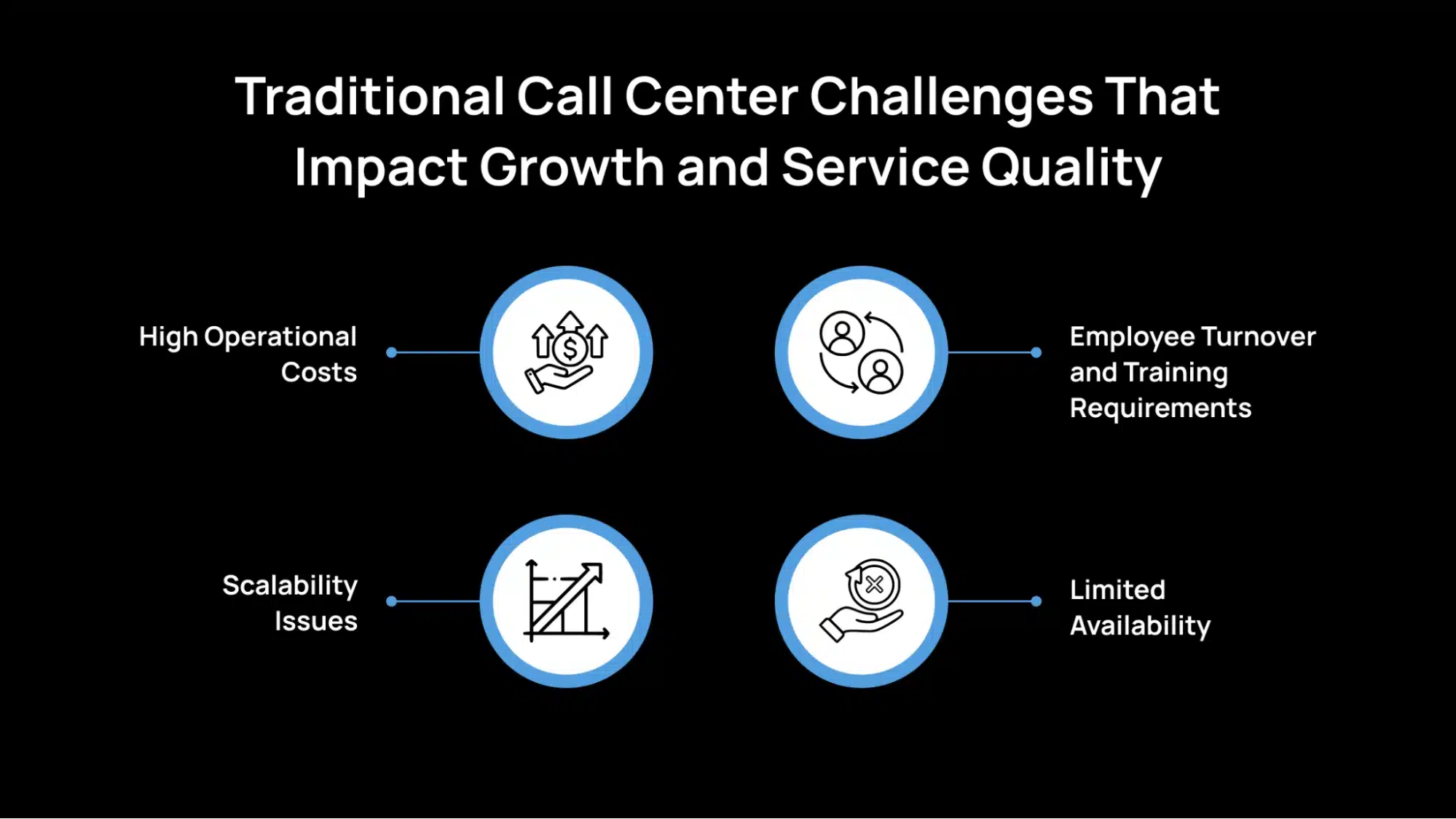
Below are the most common challenges associated with traditional call centers that affect operational efficiency, scalability, and patient experience.
1. High Operational Costs
Traditional call centers have high fixed and variable costs, making them expensive to operate. Agent salaries, training costs, infrastructure investments, and overhead expenses contribute to these costs.
These ongoing costs make it difficult for businesses to scale their operations efficiently, especially when demand fluctuates. In contrast, AI-powered systems can help reduce these costs by automating many of the tasks traditionally handled by human agents.
2. Scalability Issues
Scaling a traditional call center can be a slow and costly process. To handle increased call volumes, companies must hire additional staff, invest in more infrastructure, and train new agents to manage the workload effectively.
This process can take time, leading to potential service disruptions during periods of rapid growth or unexpected spikes in demand. Scaling with AI or automation can often be faster and more cost-effective, as systems can handle a greater number of interactions without requiring significant increases in human resources.
3. Employee Turnover and Training Requirements
High employee turnover is a common challenge in traditional call centers. The repetitive nature of the work, combined with the pressure of meeting performance targets, can lead to burnout and dissatisfaction among agents.
As a result, call centers often experience significant turnover, leading to increased recruitment and training costs. Furthermore, frequent turnover disrupts customer service continuity, as new agents must constantly be trained to replace those who leave. Training programs, as mentioned earlier, are both time-consuming and costly, further straining the company’s resources.
4. Limited Availability
Traditional call centers operate within fixed hours, often from 9 a.m. to 5 p.m., which limits their ability to serve customers in different time zones or provide support outside of business hours.
Although some call centers extend hours or operate on weekends, staffing the center 24/7 can be expensive due to the need for additional shifts, higher wages for night hours, and the logistical challenges of managing a round-the-clock operation.
In contrast, AI-driven solutions offer continuous availability without the need for breaks or shifts, ensuring that customers receive support at any time.
Exploring AI Voice Agents: What Makes Them Smarter Than Traditional Support
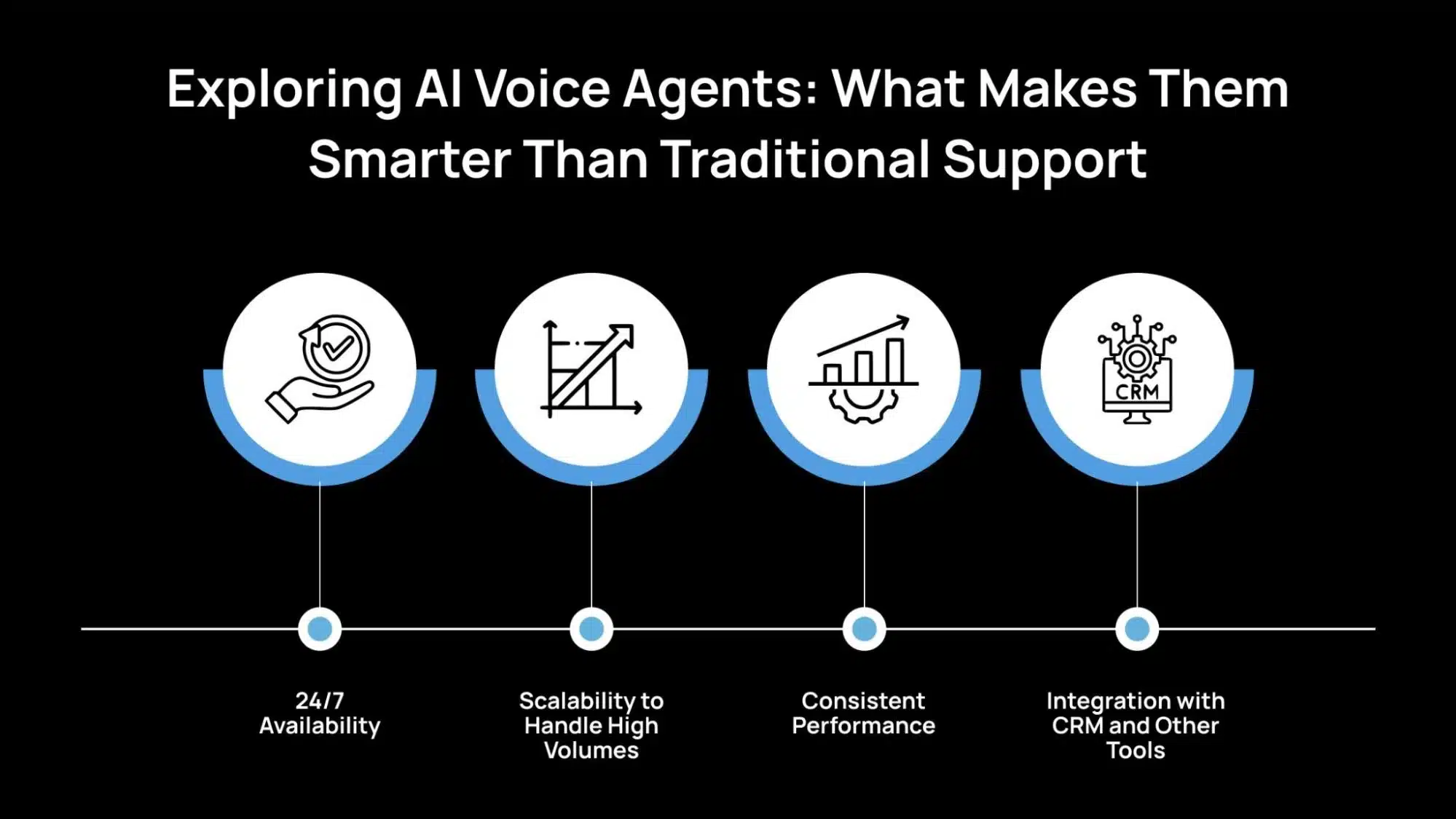
AI voice agents are automated systems powered by artificial intelligence that handle customer interactions using advanced technologies, such as natural language processing (NLP) and machine learning (ML).
These systems are designed to simulate human-like conversations with customers, assisting with voice, chat, or text. By understanding and responding to customer queries, AI voice agents can handle a wide range of tasks, from answering simple questions to resolving complex issues, often with minimal human intervention. Here is a list of some of the essential features of AI voice agents:
1. 24/7 Availability
Unlike traditional human agents who are limited by working hours and require breaks, AI systems can provide continuous support at any time of day or night.
This ensures that customers can reach out and receive help whenever they need it, regardless of time zones or business hours. It also reduces the need for companies to staff night shifts or weekend shifts, lowering labor costs.
2. Scalability to Handle High Volumes
AI voice agents can handle a large number of customer interactions simultaneously. Whether it’s during peak hours or a sudden surge in customer requests, AI systems can scale effortlessly to manage higher volumes of interactions without compromising quality.
This ability to scale without adding extra human resources makes AI voice agents highly efficient and cost-effective, especially during periods of high demand.
3. Consistent Performance
AI voice agents consistently maintain a high level of performance. Unlike human agents, who may experience fatigue or performance fluctuations due to workload or stress, AI systems deliver uniform service quality.
They can handle hundreds or even thousands of interactions simultaneously, ensuring that every customer receives the same level of attention and accuracy, regardless of the volume of requests. This consistency in performance helps improve the overall customer experience.
4. Integration with CRM and Other Tools
AI voice agents can be integrated with customer relationship management (CRM) systems and other business tools, allowing them to provide personalized service.
They can access customer data, purchase history, and previous interactions, enabling them to tailor responses and provide more relevant solutions. This integration also ensures a smooth handoff between the AI agent and human agents when needed, improving the efficiency and continuity of customer service.
Why AI Voice Agents Matter: Core Advantages Every Business Should Know
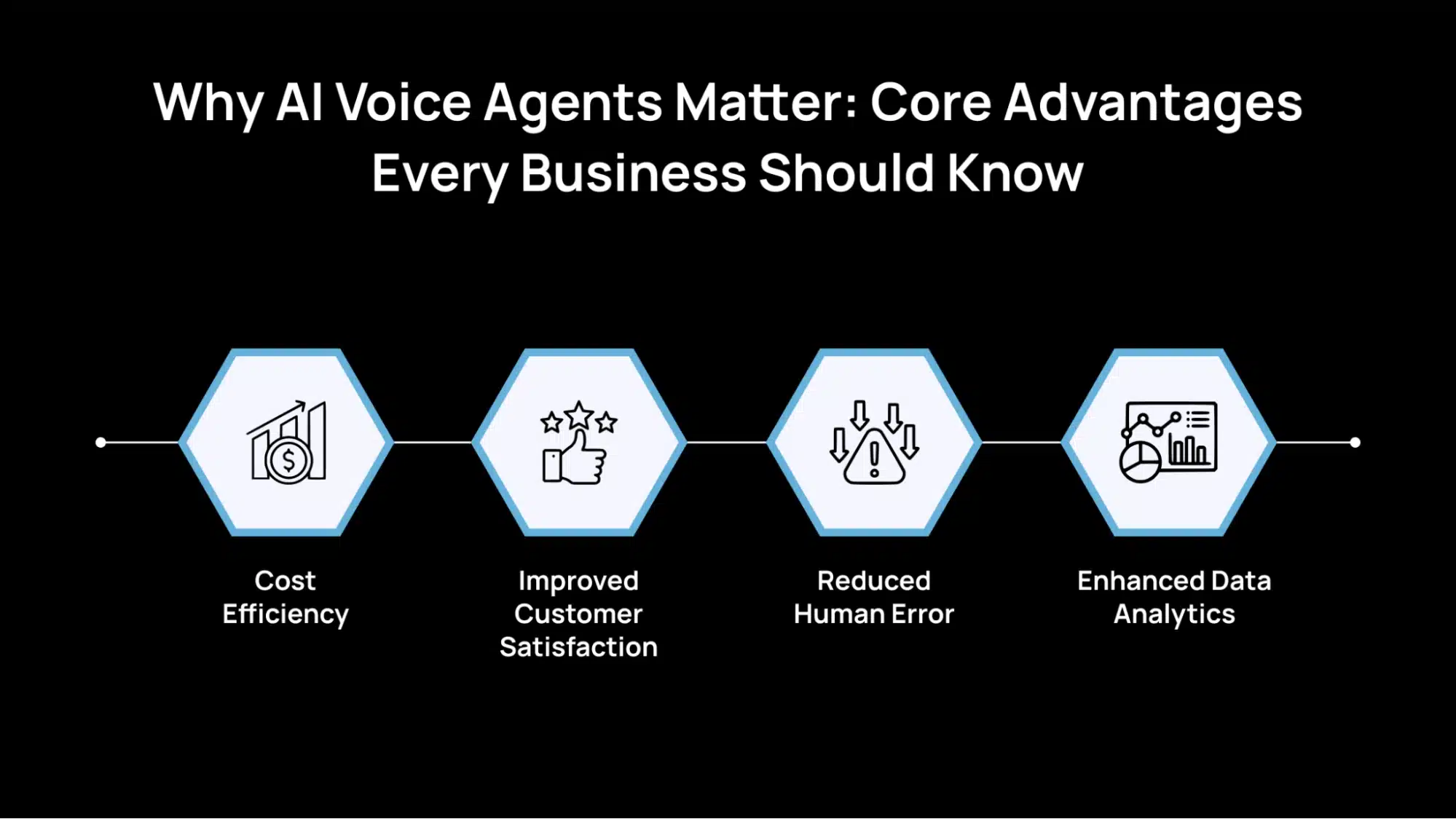
Below are the key benefits of AI voice agents that help businesses improve efficiency, reduce costs, and enhance customer experience.
1. Cost Efficiency
AI voice agents can significantly reduce the cost of customer service operations. By automating routine tasks, such as answering frequently asked questions or processing basic inquiries, businesses can reduce the need for human agents to handle these tasks.
This enables companies to allocate their human resources to more complex and higher-value activities, ultimately reducing operational costs and increasing profitability.
2. Improved Customer Satisfaction
AI voice agents contribute to improved customer satisfaction by offering quick, accurate, and personalized responses. Customers appreciate the ability to interact with a system that understands their needs and provides solutions in real time.
Additionally, since AI systems are available 24/7, customers are more likely to receive the support they need when they need it, leading to higher satisfaction levels.
3. Reduced Human Error
AI voice agents eliminate the risk of human error, a common issue in traditional call centers. Since AI systems follow predefined algorithms and data-driven decision-making processes, they consistently and accurately respond every time. This reduces the chances of miscommunication or mistakes that can lead to customer frustration or dissatisfaction.
4. Enhanced Data Analytics
AI voice agents collect and analyze large amounts of data from customer interactions. This data can be used to generate valuable insights into customer behavior, preferences, and pain points.
By understanding these trends, businesses can make informed decisions about product offerings, marketing strategies, and customer service improvements. Furthermore, AI systems can provide real-time reporting, allowing companies to track performance metrics and optimize operations.
AI Voice Agents vs. Traditional Call Center Solutions: ROI Metrics Comparison
This section compares essential ROI metrics between traditional call centers and AI voice agents. The goal is to highlight how AI can provide better value by examining cost efficiency, performance metrics, and scalability.
1. Cost Per Interaction
Traditional Call Centers
The average cost per interaction in traditional call centers is approximately $0.60 per minute. This includes expenses such as agent salaries, training, infrastructure, and operational overhead. Since agents are paid by the hour, the costs increase with the length of each interaction. Higher volumes and longer calls further increase these costs.
AI Voice Agents
In contrast, AI voice agents can handle interactions at a significantly lower cost, averaging around $0.08 per minute. This reduced cost is due to the automation of many tasks that would otherwise require human agents. The minimal need for infrastructure and overhead means businesses can achieve more with less, offering better cost efficiency.
2. First Call Resolution (FCR)
Traditional Call Centers
Traditional systems resolve 25% of complex queries on the first call. This lower FCR rate can result in multiple follow-up interactions, leading to increased costs and customer dissatisfaction. The need for human intervention and escalations further delays the resolution of issues.
AI Voice Agents
AI systems excel in First Call Resolution (FCR), handling ~65% of complex queries without escalation. AI agents are capable of analyzing customer data and resolving issues quickly and accurately, reducing the need for escalation to human agents. This improves overall efficiency, ensuring that customers receive solutions more rapidly and enhancing both productivity and customer satisfaction.
3. Average Handle Time (AHT)
Traditional Call Centers
In traditional call centers, Average Handle Time (AHT) tends to be longer, averaging 9.5 minutes per call. This extended time is often due to issues like caller drop-offs, multiple transfers, and the time it takes to locate customer information. Repeated steps in a call usually contribute to inefficiency.
AI Voice Agents
AI voice agents have a much shorter AHT, averaging 3.8 minutes per call. AI systems can access customer information instantly and follow a streamlined process to resolve queries quickly. As a result, AI agents minimize delays caused by human error or rerouting, leading to faster and more efficient service.
4. Customer Satisfaction (CSAT)
Traditional Call Centers
Customer satisfaction with traditional call centers generally averages around 62%. This is often due to factors such as long wait times, inconsistent service quality, and human errors that can lead to customer frustration.
AI Voice Agents
AI voice agents report significantly higher Customer Satisfaction (CSAT), with over 85% of interactions leading to positive outcomes. AI systems provide consistent and prompt responses, reduce customer wait times, and offer personalized experiences, all of which contribute to enhanced customer satisfaction. The ability to handle inquiries 24/7 also plays a crucial role in improving customer satisfaction levels.
5. Scalability
Traditional Call Centers
Traditional call centers face scalability limitations because they rely on human agents to handle calls. To scale up operations, businesses need to hire and train additional staff, which takes time and incurs extra costs. There are also physical constraints, as call centers require more office space and equipment to accommodate a growing team.
AI Voice Agents
AI systems can scale effortlessly, handling thousands of simultaneous interactions without requiring additional resources. As demand increases, AI systems can manage the volume without significant investments in infrastructure or personnel. This ability to scale quickly and efficiently is one of the primary advantages of AI over traditional methods.
AI Voice Agents vs. Traditional Call Center Solutions: Comparing Essential Features
Below is a clear comparison of AI voice agents and traditional call centers across key areas, including cost, efficiency, scalability, and patient experience.
| Key Area | Traditional Call Centers | AI Voice Agents |
| Cost & ROI | High costs (salaries, training, turnover) | Lower costs, clear ROI through reduced staffing |
| Efficiency & Speed | Manual processes slow down operations | Fast automation, instant data access |
| Availability & Accessibility | Limited to business hours | 24/7 availability for patients |
| Accuracy & Consistency | Prone to human error and inconsistent service | High accuracy and consistent performance |
| Scalability & Flexibility | Requires more staff and training for scaling | Scales instantly without extra resources |
| Patient Experience | Personalized, but with long wait times and inconsistent service | Instant answers, less empathy for complex issues |
| Staff Experience & Burnout | High burnout due to repetitive tasks | Reduces burnout by automating routine tasks |
| HIPAA Compliance & Security | Dependent on human adherence to protocols | Built-in HIPAA compliance with secure data handling |
Making the Right Choice for Your Practice: AI Voice Agents vs. Traditional Call Centers
Choosing between AI voice agents and traditional call centers depends on your practice’s unique needs, resources, and patient preferences. Here’s a breakdown to guide your decision:
Consider AI Voice Agents if:
- You experience high call volumes and need to manage them efficiently.
- Staffing costs or turnover are a concern, and you want to reduce reliance on human agents.
- Providing 24/7 patient access is crucial for your practice, particularly for scheduling and addressing basic inquiries.
- Routine tasks, such as appointment scheduling, prescription refills, and simple queries, should be automated to improve efficiency.
- Reducing staff burnout is a priority, allowing your team to focus on more complex and meaningful patient interactions.
Consider Traditional (or Hybrid) if:
- Your practice has low call volume, making it more feasible to rely on human agents.
- Patient preference leans strongly towards human-only interactions, especially for all types of calls.
- You deal with highly complex or sensitive calls that require detailed, nuanced human judgment and emotional intelligence.
Choose Hybrid Approach:
- Many practices find success with a hybrid approach. Using AI agents to handle routine tasks and initial triage, while escalating more complex issues to human agents.
- This model uses the strengths of both AI and human agents, ensuring that patients receive prompt service for simple tasks and personalized attention for more complex matters.
By assessing your practice’s needs, you can select the most efficient and cost-effective solution to enhance your patient experience.
Why Avahi AI Voice Agents Are Ideal for Modern Healthcare Operations
Managing patient communication efficiently is critical for healthcare providers. Avahi AI Voice Agents provide a dependable and scalable solution designed to handle the high volume and complexity of routine patient calls, freeing up clinical teams to focus on delivering care.
1. Designed Specifically for Healthcare Needs
Avahi’s AI voice agents are built with healthcare workflows in mind. From appointment scheduling to handling insurance queries, the system is trained to manage the various types of interactions that occur daily in medical, dental, specialty, and urgent care settings.
2. Real-Time Call Management and Scheduling
The system can book, reschedule, or cancel appointments instantly, reducing administrative overhead and ensuring patients receive timely assistance without waiting on hold.
3. Reduces No-Shows with Automated Follow-Ups
By sending out reminders and follow-up messages, the AI agent helps reduce missed appointments, improving patient attendance and maintaining a consistent schedule for providers.
4. Prioritizes Urgent Cases
The voice agent identifies and escalates urgent issues directly to human staff, ensuring that critical patient needs are not delayed or overlooked.
5. Alleviates Staff Workload and Strain
By automating repetitive and time-consuming tasks, such as answering routine questions and verifying referrals, Avahi reduces the burden on front-desk teams, allowing them to focus on higher-priority tasks.
6. Supports High-Demand Care Environments
Whether it’s a busy dental office, behavioral health clinic, or urgent care center, Avahi adapts to fast-paced environments where timely and accurate communication is essential.
Avahi AI Healthcare Voice Agents are strategic enablers that help healthcare providers deliver better patient experiences while managing operations more efficiently.
Discover Avahi’s AI Platform in Action
At Avahi, we empower businesses to deploy advanced Generative AI that streamlines operations, enhances decision-making, and accelerates innovation—all with zero complexity.
As your trusted AWS Cloud Consulting Partner, we empower organizations to harness the full potential of AI while ensuring security, scalability, and compliance with industry-leading cloud solutions.
Our AI Solutions Include
- AI Adoption & Integration – Utilize Amazon Bedrock and GenAI to Enhance Automation and Decision-Making.
- Custom AI Development – Build intelligent applications tailored to your business needs.
- AI Model Optimization – Seamlessly switch between AI models with automated cost, accuracy, and performance comparisons.
- AI Automation – Automate repetitive tasks and free up time for strategic growth.
- Advanced Security & AI Governance – Ensure compliance, detect fraud, and deploy secure models.
Want to unlock the power of AI with enterprise-grade security and efficiency? Start Your AI Transformation with Avahi Today!
Frequently Asked Questions
1. What are the main differences between AI voice agents and traditional call centers?
AI voice agents and traditional call centers primarily differ in terms of automation and cost efficiency. AI voice agents handle tasks like appointment scheduling and basic inquiries automatically, providing 24/7 service with lower operational costs. In contrast, traditional call centers rely on human agents, which often leads to higher costs, longer wait times, and limited availability. AI voice agents are ideal for high call volumes and routine tasks, while traditional call centers are better suited for complex or highly sensitive customer interactions.
2. Can AI voice agents replace traditional call centers?
While AI voice agents can significantly reduce the need for human agents, they don’t fully replace traditional call centers, especially for complex or sensitive issues. The best approach often involves using AI voice agents in a hybrid model alongside conventional call centers, where AI handles routine tasks and escalates complicated issues to human agents, ensuring both efficiency and personalized care.
3. Are AI voice agents more cost-effective than traditional call centers?
Yes, AI voice agents are typically much more cost-effective than traditional call centers. AI systems automate routine tasks, reducing the need for a large staff. With AI handling calls at a fraction of the cost compared to human agents, the ROI is clearer, especially for practices with high call volumes or limited budgets. By reducing staffing and operational expenses, AI voice agents provide a substantial cost-saving advantage over traditional call centers.
4. How do AI voice agents improve patient experience compared to traditional call centers?
AI voice agents enhance the patient experience by providing instant responses and 24/7 availability, thereby eliminating the long wait times standard in traditional call centers. With AI, patients can get answers or schedule appointments at any time, which boosts accessibility and satisfaction. While traditional call centers may offer more empathy for complex cases, AI voice agents prove beneficial for efficiently handling routine tasks.
5. What is the best choice for a medical practice: AI voice agents or traditional call centers?
The decision between AI voice agents and traditional call centers depends on factors such as call volume, patient preferences, and the complexity of the tasks. If your practice experiences high call volume, needs to provide 24/7 availability, and aims to reduce operational costs, AI voice agents are a great choice. However, if your patients require more personalized care or have complex needs, traditional call centers or a hybrid approach may be more suitable.