





TL;DR
|
In 2025, recruitment is changing fast. Around 87% of companies worldwide are already using some form of AI in their hiring process.
If you’re handling recruitment today, whether you’re in HR, Talent Acquisition, or leading hiring strategy, voice AI recruitment software is increasingly becoming the backbone of modern hiring.
As applicant volumes grow and competition for top talent sharpens, conventional methods are straining under pressure. Manual screenings, scheduling calls, chasing follow-ups; these processes slow you down. They can lead to delays, candidate drop‑outs, or poor experiences for applicants.
That’s where voice AI comes in. By automating early-stage screening and interviews, seamlessly integrating with your existing systems, and delivering a consistent candidate experience, voice AI stands out as a powerful tool when technology and adoption rates are high.
However, not all tools perform the same. Before committing, launching an AWS proof of concept can help ensure the platform scales efficiently within your cloud infrastructure. In this blog, you’ll find a practical buyer’s checklist, and we will walk you through what to watch out for when evaluating voice AI recruitment software so you can adopt the right AI for your organization.
How Voice AI Recruitment Software Transforms Candidate Interactions?
Voice AI recruitment software uses artificial intelligence to handle candidate interactions via voice. It combines speech recognition, natural language processing (NLP), and text-to-speech technology to engage with candidates. This software can conduct everything from initial screening calls to full-fledged interviews, making the hiring process faster and more efficient.
How AI Interviews Work
- AI interviews involve the system asking candidates questions. These questions can either be live or pre-recorded voice prompts.
- As candidates respond, their answers are captured in real-time, either in voice or text format.
- The AI then processes and analyzes these responses to evaluate the candidate’s suitability for the role.
Use Cases of Voice AI Recruitment Software
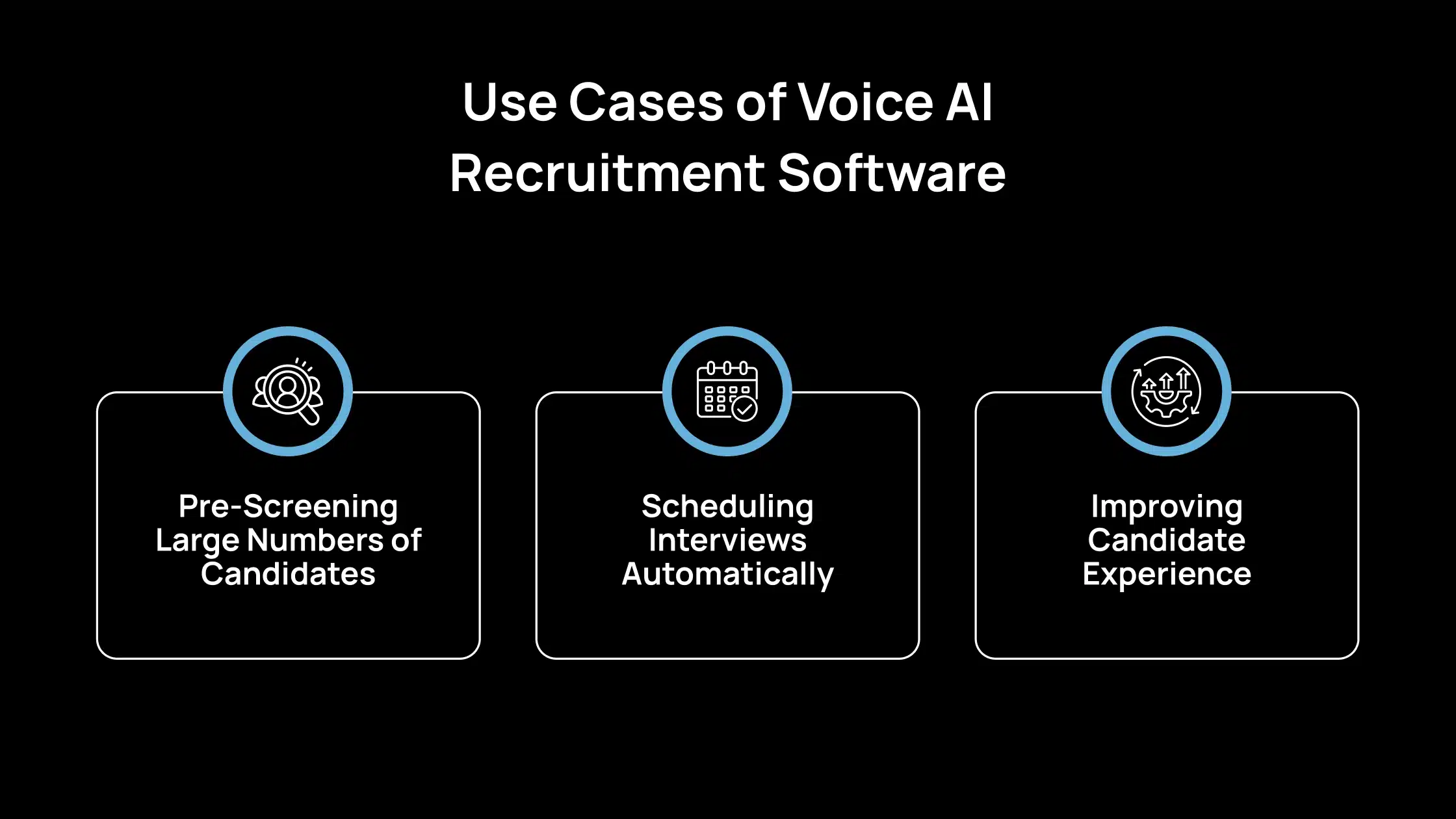
Here is a list of key use cases where Voice AI recruitment software can significantly enhance the hiring process, improving efficiency and candidate experience.
1. Pre-Screening Large Numbers of Candidates
One of the key benefits of voice AI recruitment software is its ability to handle large volumes of candidates quickly. It filters out unqualified individuals early in the process, saving your team time and effort.
Instead of manually reviewing resumes or scheduling calls with every candidate, the AI can take over this initial stage. This ensures only the most qualified candidates reach the next step.
2. Scheduling Interviews Automatically
Voice AI software doesn’t just interview candidates, it can also handle the logistics. It can automatically schedule interviews, send reminders, and follow up with candidates. This reduces the burden on your HR team and keeps things moving smoothly.
3. Improving Candidate Experience
Voice AI recruitment software offers 24/7 availability, meaning candidates can interact with the system at their convenience.
With AI, there’s no need for candidates to wait for scheduling confirmations or manual responses. The quicker turnaround time helps create a better candidate experience, particularly for those applying to multiple companies.
Why ATS Integration Matters for Voice AI Recruitment Software?
An Applicant Tracking System (ATS) is a software application designed to manage recruitment processes. It helps with posting job openings, collecting and organizing applications, parsing resumes, and tracking candidates through various stages of the hiring process. Essentially, it streamlines and centralizes your hiring pipeline.
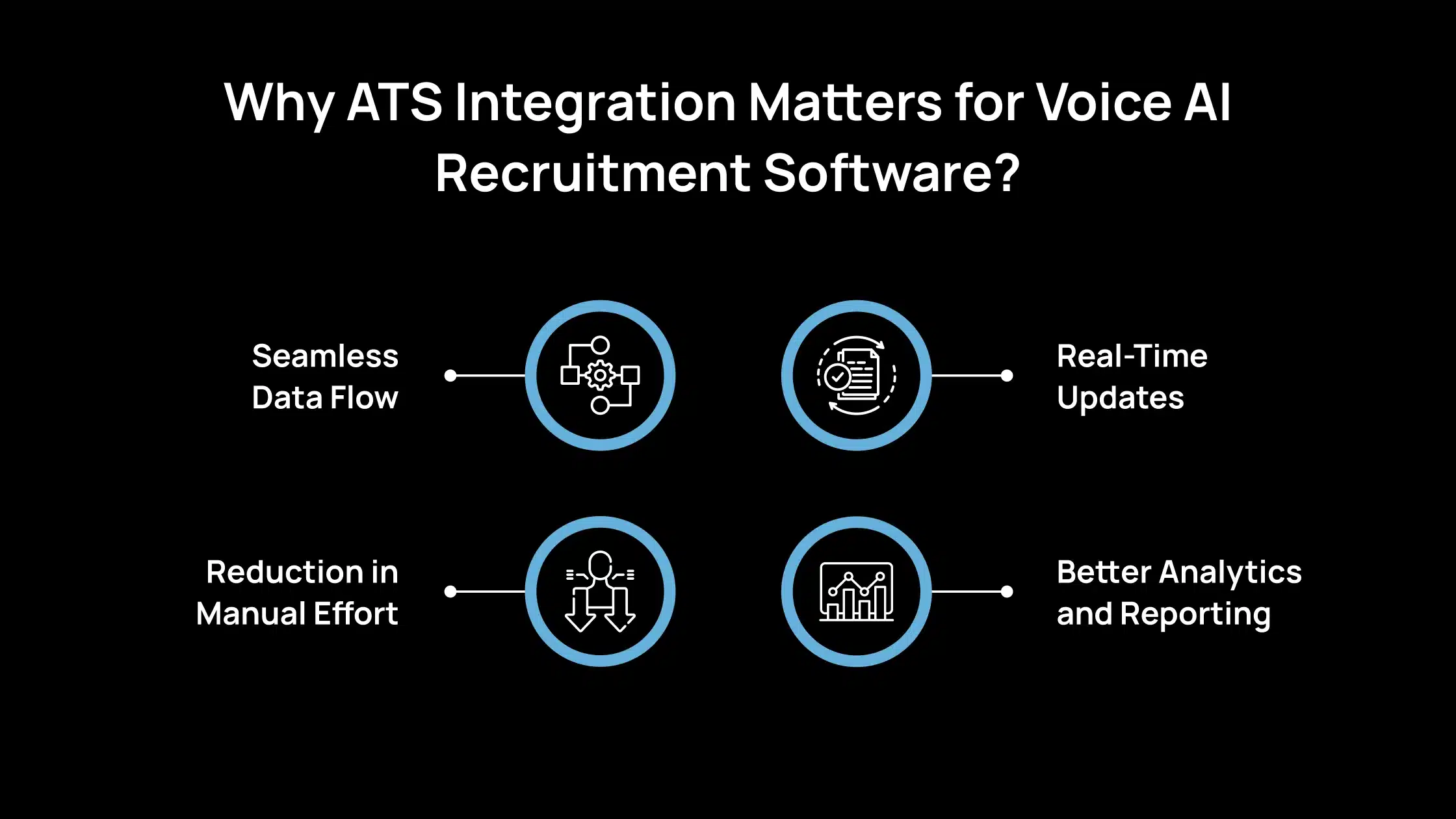
Integrating voice AI recruitment software with your ATS can provide significant advantages by creating a seamless, efficient recruitment process. Here’s how:
1. Seamless Data Flow
When voice AI and your ATS are integrated, candidate data, interview responses, assessments, and feedback all stay within the same system.
This ensures that your recruitment team can access a unified set of information without needing to search through multiple platforms or manually transfer data between systems. By keeping everything in one place, you ensure consistency and accuracy in your hiring process.
2. Reduction in Manual Effort
Without integration, recruiters often need to copy and paste candidate data from one platform to another or export/import information across different systems. With ATS integration, this is no longer necessary.
The AI system automatically feeds all relevant data (such as candidate details, interview feedback, and scores) directly into your ATS. This reduces manual entry errors and saves time, letting your team focus on what matters most: making hiring decisions.
3. Real-Time Updates
One of the key benefits of an integrated system is that updates occur in real time. Once an AI interview is complete, the candidate’s status, score, and notes can be reflected in the ATS immediately.
This ensures that recruiters and hiring managers have the most up-to-date information, enabling them to make decisions without delays. The integration streamlines communication within the recruitment team, reducing miscommunication and lag time in the process.
4. Better Analytics and Reporting
Integrating voice AI with your ATS provides a clear advantage in reporting and analytics. An integrated system combines data from multiple stages of the hiring process, sourcing, screening, interviews, and hiring, into one easy-to-view dashboard.
This consolidated view helps you measure key performance metrics such as time-to-hire, quality-of-hire, and candidate flow. These insights enable data-driven decisions that can improve overall recruitment strategies and refine processes over time.
Risks Associated with Poor or Missing Integration in Recruitment Systems
While integration offers significant benefits, poor or missing integration can lead to several challenges:
-
Fragmented Workflows
Without seamless integration, your recruitment team could end up working with disconnected systems. This means manually switching between tools, which slows the process and increases the risk of missing important candidate details.
-
Manual Errors
When candidate data is transferred manually between systems, there’s a higher risk of errors, such as duplicate records or misplaced information. This can cause confusion, delays, and even lead to hiring the wrong candidate.
-
Data Duplication
If the data isn’t automatically synced between the voice AI software and the ATS, you could end up with multiple versions of the same candidate’s information, which complicates candidate tracking and creates unnecessary clutter.
-
Poor Candidate Experience
If the system isn’t well integrated, candidates may receive inconsistent communication. For example, they might receive a rejection email even though they haven’t completed their AI interview, or their interview feedback might not be updated in the system in time. This inconsistency can harm the candidate’s experience and your employer brand.
Core Features to Evaluate When Buying Voice AI Recruitment Software
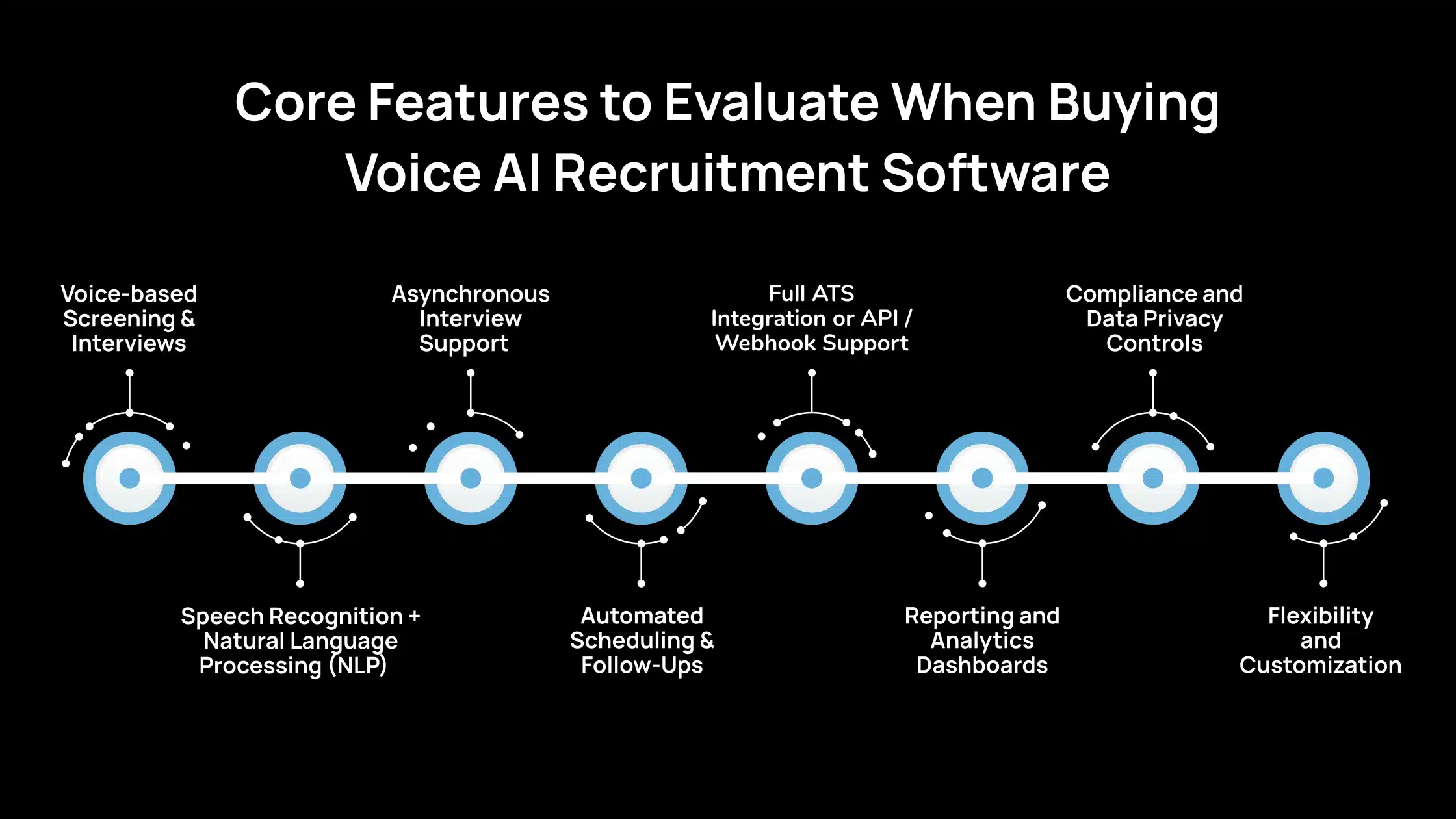
When selecting voice AI recruitment software, it’s crucial to choose a tool with the right features. Below are the key capabilities that will enhance your hiring process, improve efficiency, and ensure you’re getting the most out of the software.
Voice-based Screening & Interviews
Voice-based screening and interviews enable automating the initial stages of the recruitment process. Candidates can interact with the AI, either in live interviews or via pre-recorded questions.
This feature saves recruiters valuable time by automatically filtering out unqualified candidates early on. It also ensures a consistent experience for all applicants, reducing bias and improving efficiency.
Speech Recognition + Natural Language Processing (NLP)
Speech recognition and NLP are essential for accurately capturing and interpreting spoken candidate responses. These technologies enable the system to understand verbal responses, even when delivered in different accents or with varying speech patterns.
This ensures that every candidate’s response is fairly evaluated, providing an unbiased assessment and enabling the AI to gauge the content of their answers effectively.
Asynchronous Interview Support
Asynchronous interview support allows candidates to respond to questions at their convenience. With pre-recorded queries and the ability to respond on their own time, candidates are less likely to experience scheduling conflicts.
For recruiters, this flexibility allows them to review responses at their convenience, making the process more efficient for both parties.
Automated Scheduling & Follow-Ups
Automated scheduling and follow-ups reduce manual tasks for recruiters. Voice AI can automatically send interview invitations, reminders, and follow-up emails to candidates.
This streamlines communication, ensuring that candidates are engaged throughout the process without requiring additional effort from HR teams. It also ensures that no interviews or communications are missed due to manual oversight.
Full ATS Integration or API / Webhook Support
Full integration with your Applicant Tracking System (ATS) ensures that candidate data, interview results, and workflow statuses are automatically synced with your existing recruitment infrastructure.
This eliminates the need for manual data entry or exporting/importing candidate information across platforms, reducing errors and saving time. Integration also helps maintain a central hub for all recruitment data, making it easier to track and manage candidates throughout the hiring process.
Reporting and Analytics Dashboards
An integrated reporting and analytics dashboard helps track key performance indicators such as time-to-hire, quality-of-hire, and candidate engagement.
This data allows you to measure the effectiveness of your recruitment efforts, identify bottlenecks, and optimize your hiring strategies. By having clear visibility into these metrics, you can make data-driven decisions that improve the overall recruitment process.
Compliance and Data Privacy Controls
Voice AI recruitment software must comply with data privacy regulations, ensuring that all candidate information is stored and processed securely and in compliance.
This feature is significant for building trust with candidates and ensuring legal compliance with data protection laws, such as GDPR. With proper data privacy controls in place, candidates can feel confident that their information is being handled responsibly.
Flexibility and Customization
Flexibility and customization are essential for tailoring the interview process to meet the specific needs of each role or organization. The software should allow you to create custom question templates, adjust interview flows based on the position being hired for, and scale to accommodate different hiring volumes.
This ensures that your hiring process remains relevant and efficient, regardless of the type or volume of roles you’re recruiting for.
Additional Factors to Weigh Before Choosing Voice AI Recruitment Software
Even if a tool ticks feature boxes, there are other factors to evaluate for a good long-term fit:
- Scalability and Volume Handling: Can the tool handle small-scale hiring and high-volume hiring with equal efficiency? Good voice‑AI software should scale up if hiring volume spikes.
- Candidate Experience & Accessibility: Ensure that the voice‑AI interactions are natural, easy to use, available across geographies/time zones, and don’t disadvantage candidates with accents, varied languages, or limited technology.
- Human Oversight & Fairness: While AI can speed up screening, final hiring decisions, especially for critical roles, should remain human-driven to maintain fairness, judgment, and reduce bias.
- Implementation Complexity & Setup Time: Evaluate how long onboarding and integration will take (with existing ATS), how steep the learning curve is for hiring teams, and whether support/training is provided.
- Transparency & Explainability: Since AI is involved in screening/interviewing, ensure the software provides clear reporting on how evaluations are made; this helps in compliance, fairness, and internal audits.
- Cost vs ROI / Value Metrics: Analyze not only subscription/licensing cost, but also value in terms of time saved, reduction in time-to-hire, improved hiring quality, reduced manual workload, etc.
- Data Privacy, Security & Compliance: Especially if hiring globally — ensure candidate data is stored/transferred securely; compliance with regional data protection laws is critical.
- Vendor Support & Future‑proofing: Given the rapid evolution of AI tools, ensure the vendor updates the software, supports new languages and features, and evolves with hiring needs.
Steps to Evaluate and Select the Right Voice AI Recruitment Software
Selecting the right voice AI recruitment software requires a thorough evaluation process. Below are the key steps to help you make an informed decision based on your organization’s specific needs and goals.
|
Optimizing Recruitment with AI: The Benefits of Avahi’s Voice Agent for HR Teams
For HR and talent acquisition teams, speed, consistency, and trust are everything. Whether you’re coordinating interviews across time zones or handling a surge of candidate inquiries, your systems must not only move fast but also operate securely and in line with your organization’s compliance standards.
This is where Avahi’s AI Voice Agent becomes a valuable tool for talent acquisition teams. Here’s how this supports modern HR and Talent Acquisition teams:
- Always-on responsiveness
No missed calls or delayed replies. Candidates receive instant, human-like support, which is critical for fast-moving hiring pipelines that rely on secure and reliable service availability. - Secure handling of candidate data
With compliance-aligned processes, the AI agent ensures candidate information flows through your ATS/CRM safely and consistently, reducing the risk of data mishandling. - Reduced administrative workload
Repetitive tasks like scheduling, reminders, and initial screening are automated—helping teams meet recruitment SLAs without sacrificing data governance. - Improved audit readiness
Every interaction is logged, traceable, and aligned with the security controls required by modern compliance frameworks. - Better candidate experience, powered by secure automation
Candidates receive timely answers, while your team stays focused on meaningful conversations, rather than paperwork or coordination.
For HR leaders operating in competitive hiring markets, pairing AI automation with strong compliance foundations (such as ISO 27001 or SOC 2) ensures both speed and trust, so your team delivers great candidate experiences without creating new security risks.
Discover Avahi’s AI Platform in Action
At Avahi, we empower businesses to deploy advanced Generative AI that streamlines operations, enhances decision-making, and accelerates innovation—all with zero complexity.
As your trusted AWS Cloud Consulting Partner, we empower organizations to harness the full potential of AI while ensuring security, scalability, and compliance with industry-leading cloud solutions.
Our AI Solutions Include
- AI Adoption & Integration – Leverage Amazon Bedrock and GenAI to Enhance Automation and Decision-Making.
- Custom AI Development – Build intelligent applications tailored to your business needs.
- AI Model Optimization – Seamlessly switch between AI models with automated cost, accuracy, and performance comparisons.
- AI Automation – Automate repetitive tasks and free up time for strategic growth.
- Advanced Security & AI Governance – Ensure compliance, detect fraud, and deploy secure models.
Want to unlock the power of AI with enterprise-grade security and efficiency? Start Your AI Transformation with Avahi Today!
Frequently Asked Questions
1. What is Voice AI Recruitment Software?
Voice AI recruitment software automates candidate interactions, including screening, interviews, and scheduling, using speech recognition and natural language processing (NLP) to improve hiring efficiency.
2. How Does ATS Integration Benefit Voice AI Recruitment Software?
ATS integration ensures seamless data flow between voice AI and your applicant tracking system, reducing manual data entry, ensuring real-time updates, and improving recruitment efficiency.
3. Why is Voice AI Important for Candidate Experience?
Voice AI offers 24/7 availability and instant responses, improving candidate experience by reducing wait times and providing personalized, efficient communication throughout the recruitment process.
4. How Does Voice AI Ensure Data Security and Compliance?
Voice AI recruitment software, such as Avahi, adheres to compliance standards like ISO 27001 and SOC 2, ensuring secure handling of candidate data and minimizing risks of data breaches.
5. How Can Voice AI Improve HR Productivity?
Voice AI automates administrative tasks like scheduling, reminders, and screening, allowing HR teams to focus on strategic hiring decisions and improving recruitment SLAs.