TL;DR
|
A fast-growing e-commerce company deploys an AI system to manage customer support, order tracking, and delivery coordination. At first, everything works smoothly. But as orders increase, customer messages pile up, supply chains fluctuate, and delivery routes change every hour, the system begins to struggle.
Responses slow down. Errors increase. Customers complain. Not because the AI is weak, but because one single agent is trying to manage everything alone.
This is the reality many organizations face today.
Modern business environments are no longer predictable or straightforward. They are dynamic, data-heavy, and constantly changing. Yet many AI solutions are still built around single-agent systems, in which a single autonomous agent is responsible for observing the environment, making decisions, and executing actions. This design imposes severe limitations as complexity increases.
Single-agent systems often fail to scale, struggle with real-time adaptation, and break down when multiple processes need to run in parallel. When everything depends on one decision-maker, the entire system becomes fragile.
This is where AI agents, especially multi-agent systems, make a difference.
AI agents are autonomous systems that perceive their environment, make decisions, and act to achieve defined goals. While single-agent systems work well for simple, isolated tasks, they fall short in complex environments that require coordination, specialization, and continuous learning.
Let’s explore why these systems are far more effective in navigating modern challenges than their single-agent counterparts.
Understanding the Core Functions of AI Agents
AI agents are autonomous systems designed to perceive their environment, make decisions, and act to achieve specific objectives. These systems are crucial in automating tasks, enhancing efficiency, and solving problems in various industries. As you explore AI agents, it’s essential to grasp their key characteristics and how they operate.
An AI agent is a system that operates independently, perceives its surroundings, and makes decisions to achieve a goal. These agents can respond to environmental changes, plan for the future, and learn from experience to improve their actions over time. Essential characteristics of AI agents include:
- Autonomy: The ability to function and make decisions without human intervention.
- Reactivity: Responding to changes in the environment based on pre-set rules or conditions.
- Proactivity: Anticipating future needs and taking action to achieve goals, even before a situation arises.
- Learning: Adapting and improving behavior over time based on feedback and new experiences.
Types of AI Agents
AI agents come in different types, each serving a unique purpose and function. Here’s a breakdown of the three primary types:
- Reactive Agents
These agents respond to changes in their environment according to predefined rules or conditions. They are effective for simple tasks that require immediate responses. - Deliberative Agents
Deliberative agents plan and make decisions based on long-term goals. They rely on reasoning and prediction, considering future consequences before taking action. - Learning Agents
These agents improve their performance over time by learning from experiences and feedback. They adapt to new situations and enhance their decision-making processes based on past outcomes.
Components of an AI Agent
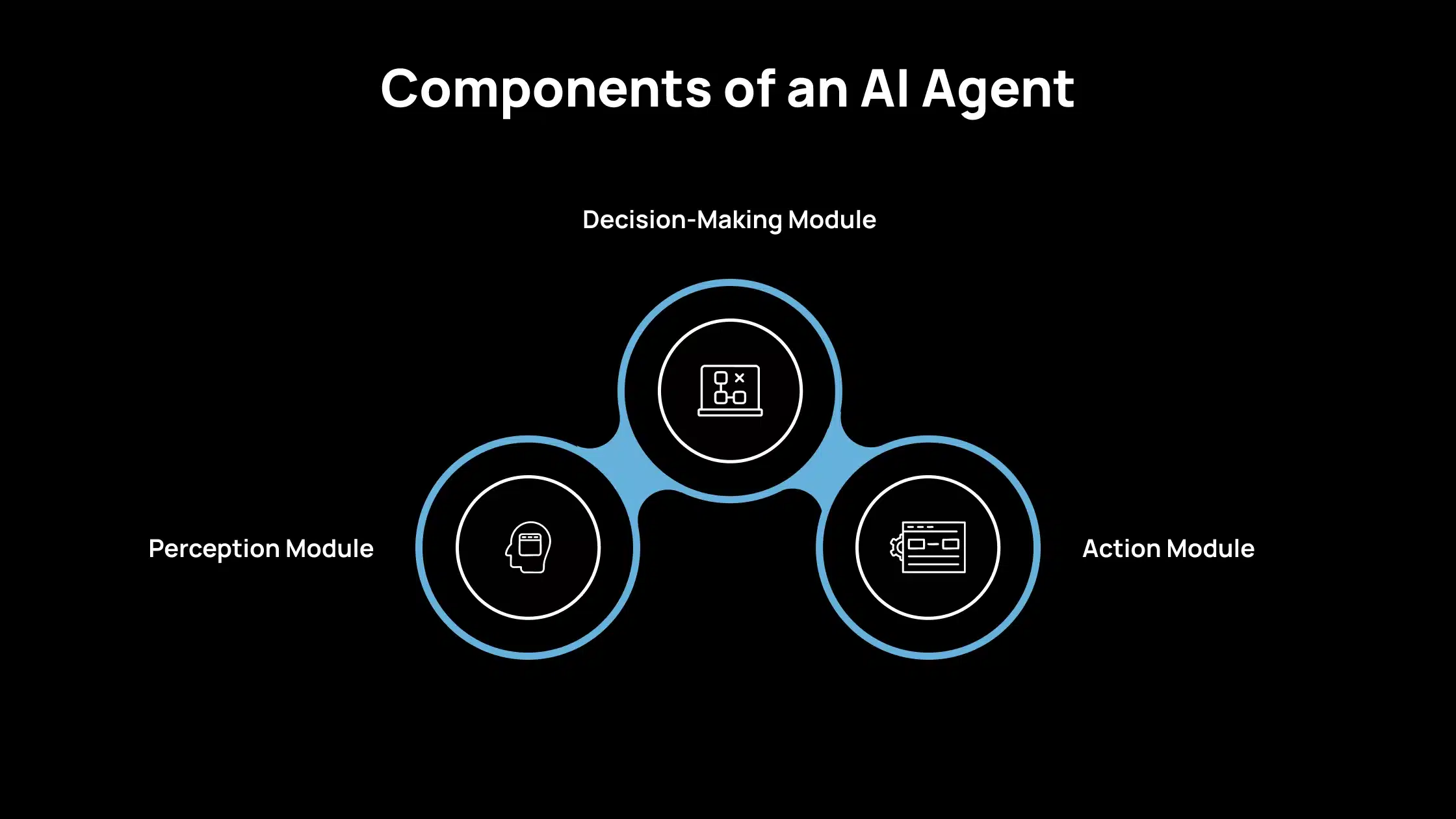
An AI agent functions through three key components that work together to enable autonomous action:
- Perception Module: This module gathers data from the agent’s environment through sensors or other input methods. It allows the agent to understand its surroundings and react accordingly.
- Decision-Making Module: This component uses algorithms to process the data from the perception module and decide the best course of action. The decision-making process is essential for the agent to achieve its goals effectively.
- Action Module: The action module executes the agent’s decisions. It translates the chosen actions into real-world tasks, such as moving, speaking, or interacting with other systems.
An Overview of Single-Agent Systems and Their Functions
Single-agent systems are built around a single autonomous agent that makes decisions independently, without interaction or collaboration with other agents. These systems are designed to perform specific tasks independently, often without the complexity of multiple agents working together.
A single-agent system consists of a single agent that perceives its environment, makes decisions, and carries out actions. Unlike multi-agent systems, these systems operate in isolation, with no need to coordinate with other agents or entities.
Examples of Single-Agent Systems
1. Robotic Process Automation (RPA)
RPA systems automate repetitive tasks, such as data entry or processing, using a single software agent. These tasks are executed independently, without requiring communication with other systems or agents.
2. Autonomous Vehicles (in isolated environments)
In controlled environments, autonomous vehicles operate as single agents. They make driving decisions based solely on data from their sensors, such as cameras and radar, without needing to collaborate with other vehicles or systems.
Why Single-Agent Systems Fall Short in Complex Environments?
Single-agent systems are limited in handling complex, dynamic environments. These systems are designed for simplicity and efficiency, but they often fall short when faced with unpredictable, multifaceted problems. Let’s break down why single-agent systems struggle in such environments and how multi-agent systems can offer better solutions.
1. Unpredictability of Dynamic Systems
Single-agent systems are not built to handle rapid changes or unpredictability. They typically rely on predefined actions or simple decision-making processes, making them ill-suited for environments that require quick adaptation.
Consider a robot navigating through a crowded public space. It must adjust its movements and decisions in real-time based on constantly changing conditions. A single-agent system may struggle to navigate efficiently in this scenario, as it can’t quickly process and respond to all variables simultaneously.
2. Multi-Agent Interaction
Complex problems often require more than one agent to tackle them. In such cases, cooperation and resource sharing between multiple agents are essential to achieving the goal.
For instance, in logistics, multiple systems working together can optimize the movement of goods across a network. Similarly, autonomous vehicles benefit from communication between different cars and infrastructure to improve safety and traffic flow.
3. Handling Conflict and Competition
Single-agent systems also struggle in scenarios where there’s conflict or competition. In these situations, agents must interact, sometimes competing for resources or strategic advantage. Single-agent systems cannot handle such dynamics effectively because they lack the ability to engage with other agents meaningfully.
For example, in strategy games or auctions, multiple AI agents often compete for resources, requiring sophisticated strategies and interaction. A single-agent system cannot replicate this level of complexity.
4. Task Specialization and Distribution
Some tasks require a broad range of specialized skills that a single agent cannot provide. Multi-agent systems can deploy specialized agents to handle distinct aspects of the task, thereby increasing efficiency and effectiveness.
In manufacturing or supply chain management, different agents can specialize in inventory management, transportation, and quality control. This division of labor allows for faster, more efficient completion of complex tasks that a single-agent system would find challenging to manage.
The Role of Multi-Agent Systems in Modern Technologies
A multi-agent system consists of multiple agents that interact to achieve objectives. These agents can either collaborate towards a common goal or work on separate tasks that complement the overall system. Multi-agent systems are designed to address complex problems, where multiple agents improve efficiency and effectiveness.
Advantages of Multi-Agent Systems
1. Collaboration
In a multi-agent system, agents can exchange information, share knowledge, and pool resources. This collaboration enhances decision-making by combining each agent’s strengths and expertise.
2. Distributed Control
Tasks can be divided among multiple agents, making it easier to scale the system. This distributed approach enables more efficient task management, especially in large-scale, high-complexity systems.
3. Robustness
Multi-agent systems are more resilient to failures. If one agent encounters an issue or stops functioning, other agents can take over the tasks, ensuring the system continues to operate smoothly without significant disruptions.
4. Flexibility
These systems can dynamically adjust to changes in the environment or tasks. If one part of the system needs to change or adapt, other agents can shift their focus, making multi-agent systems more adaptable to new situations.
Real-World Examples of Multi-Agent Systems
1. Autonomous Vehicles in a Smart City
In a smart city, autonomous vehicles communicate with each other, traffic management systems, and infrastructure. By working together, they optimize traffic flow, improve safety, and reduce congestion.
2. Robotic Swarms
In industries such as warehousing and agriculture, robotic swarms consist of multiple robots working in coordination. Each robot performs a specific task, such as moving items or monitoring crops, improving overall efficiency and productivity.
3. AI in Healthcare
In healthcare, multi-agent systems can coordinate various elements, such as patient care, medical devices, and diagnostic tools. By enabling communication between these components, the system improves patient outcomes and streamlines processes.
Why Multi-Agent Systems Outperform Single-Agent Systems?
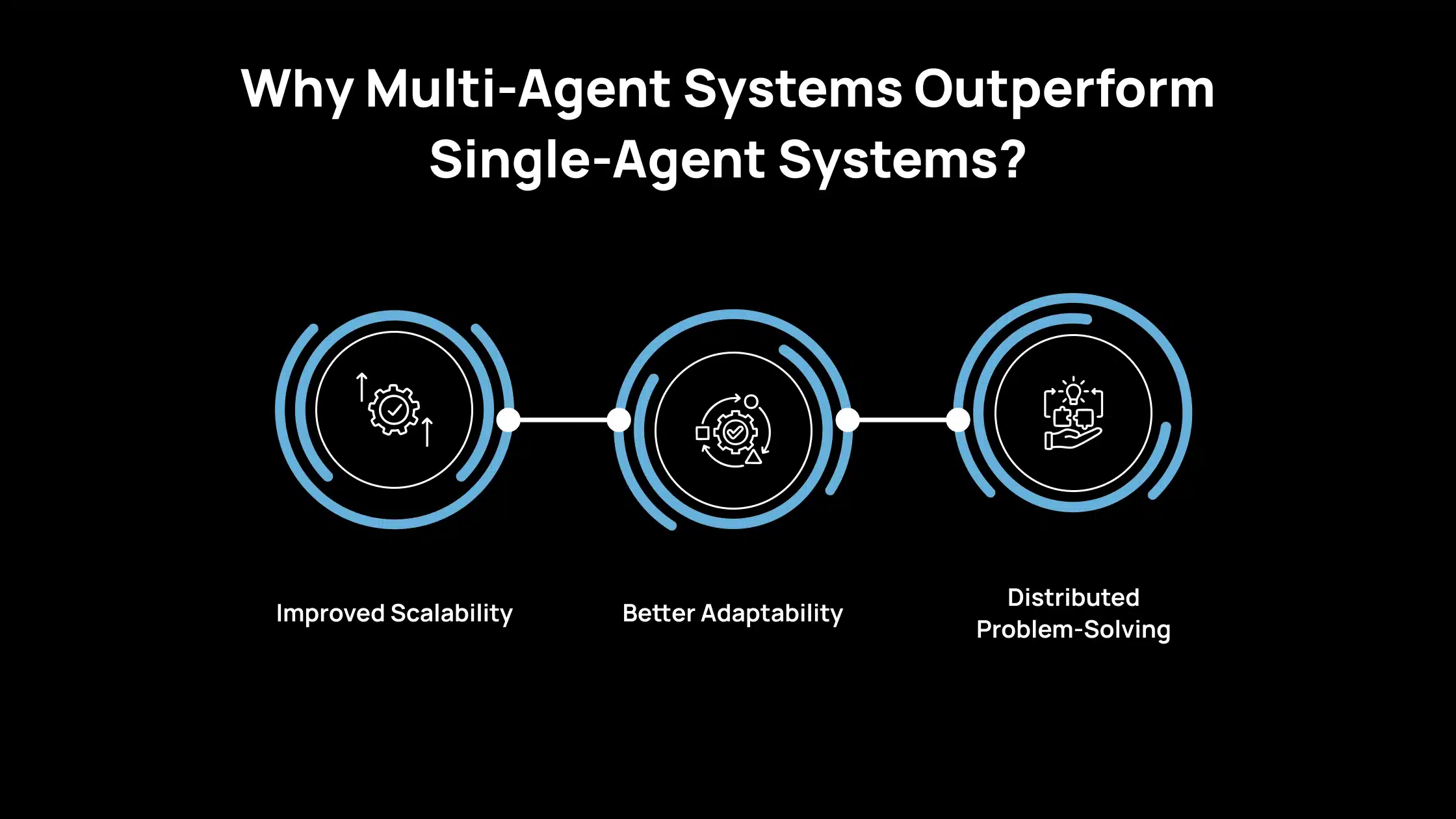
When solving complex problems, multi-agent systems offer clear advantages over single-agent systems. These advantages stem from their ability to collaborate, adapt, and scale, making them highly effective for handling dynamic environments and large-scale tasks. Let’s explore these advantages in detail.
1. Improved Scalability
Multi-agent systems are designed to scale effectively, which is critical for handling complex tasks or large environments. Unlike single-agent systems, which can become overwhelmed when handling more data or larger tasks, multi-agent systems can distribute the workload across multiple agents. This makes it easier to manage growing complexities.
For instance, in a smart city, multiple agents can manage different aspects of urban infrastructure such as traffic control, energy distribution, and waste management. Each agent focuses on a specific task, ensuring that the entire system can grow and adapt as the city’s needs expand.
2. Better Adaptability
The ability to adapt to environmental changes is essential for tackling real-world challenges. Multi-agent systems excel at this because the agents work together to monitor and respond to shifting conditions. Instead of being limited to a predefined set of responses, they can interact, share data, and adjust their strategies in response to real-time changes.
Consider autonomous vehicles operating in a busy urban environment. Individual vehicles (agents) must constantly adjust their speed, route, and behavior in response to the movement of other cars, pedestrians, and traffic signals. Through communication and cooperation, the vehicles can quickly adapt to new conditions, ensuring safety and efficiency.
3. Distributed Problem-Solving
Multi-agent systems allow tasks to be broken down into smaller, more manageable components. Each agent can specialize in a specific aspect of the task, improving overall efficiency and reducing the time required to complete the problem. This distributed problem-solving approach ensures that the system can tackle significant, complex issues more effectively than a single-agent system.
For example, in a manufacturing plant, multiple robots (agents) can work in parallel on different stages of the production process. One robot may handle assembly, another could focus on quality control, and another on packaging. This specialization not only speeds up production but also increases the overall quality and precision of the work.
By working together, agents can distribute tasks, adapt to changing environments, and take on larger projects, making them highly valuable across a wide range of industries.
Understanding the Differences Between Single-Agent and Multi-Agent Systems
Here is a list of crucial differences that highlight how single-agent and multi-agent systems operate and their unique capabilities.
| Aspect | Single-Agent System | Multi-Agent System |
| Task Management and Complexity | Handles one task at a time with limited interaction. | Handles complex, multi-faceted problems by dividing tasks and collaborating. |
| Adaptability and Scalability | Limited adaptability in changing environments. | Can adapt more easily to changes and scale to handle larger environments. |
| Collaboration vs Isolation | Works alone, without inter-agent communication. | Agents collaborate, communicate, and share knowledge to achieve goals. |
How Avahi Helps You Turn AI Into Real Business Results?
If your goal is to apply AI in practical ways that deliver measurable business impact, Avahi offers solutions designed specifically for real-world challenges. Avahi enables organizations to quickly and securely adopt advanced AI capabilities, supported by a strong cloud foundation and deep AWS expertise.
Avahi AI solutionsdelivers business benefits such as:
- Round-the-Clock Customer Engagement
- Automated Lead Capture and Call Management
- Faster Content Creation
- Quick Conversion of Documents Into Usable Data
- Smarter Planning Through Predictive Insights
- Deeper Understanding of Visual Content
- Effortless Data Access Through Natural Language Queries
- Built-In Data Protection and Regulatory Compliance
- Seamless Global Communication Through Advanced Translation and Localization
By partnering with Avahi, organizations gain access to a team with extensive AI and cloud experience committed to delivering tailored solutions. The focus remains on measurable outcomes, from automation that saves time and reduces costs to analytics that improve strategic decision-making to AI-driven interactions that elevate the customer experience.
Discover Avahi’s AI Platform in Action
At Avahi, we empower businesses to deploy advanced Generative AI that streamlines operations, enhances decision-making, and accelerates innovation—all with zero complexity.
As your trusted AWS Cloud Consulting Partner, we empower organizations to harness the full potential of AI while ensuring security, scalability, and compliance with industry-leading cloud solutions.
Our AI Solutions Include
- AI Adoption & Integration – Leverage Amazon Bedrock and GenAI to Enhance Automation and Decision-Making.
- Custom AI Development – Build intelligent applications tailored to your business needs.
- AI Model Optimization – Seamlessly switch between AI models with automated cost, accuracy, and performance comparisons.
- AI Automation – Automate repetitive tasks and free up time for strategic growth.
- Advanced Security & AI Governance – Ensure compliance, detect fraud, and deploy secure models.
Want to unlock the power of AI with enterprise-grade security and efficiency?
Start Your AI Transformation with Avahi Today!
Frequently Asked Questions
1. What is the main difference between single-agent and multi-agent systems?
The main difference lies in the number of agents involved and the nature of their interactions. A single-agent system operates with one agent that perceives its environment, makes decisions, and takes actions independently. It works in isolation and handles specific tasks without collaboration.
On the other hand, a multi-agent system involves multiple agents that can interact, collaborate, or even compete with each other to achieve common or separate goals. This collective decision-making process allows multi-agent systems to handle more complex tasks and adapt to dynamic environments more effectively.
2. How do multi-agent systems improve scalability?
Multi-agent systems are inherently more scalable than single-agent systems because they can divide tasks among multiple agents. Each agent is responsible for a specific part of the overall task, enabling the system to handle larger, more complex tasks as needed.
This distributed approach makes it easier to scale up or down based on the environment or the problem’s size and complexity. In contrast, single-agent systems often struggle to scale due to limited processing power and a lack of collaboration with other agents.
3. Are multi-agent systems more flexible than single-agent systems?
Yes, multi-agent systems are generally more flexible than single-agent systems. This flexibility stems from agents’ ability to work together, share information, and adapt to environmental changes.
If one agent encounters an issue or a task change, other agents in the system can adjust their actions accordingly, allowing the system to continue functioning smoothly. Single-agent systems, however, typically operate according to a fixed set of rules and are less able to adapt to dynamic or unexpected conditions.
4. In what real-world scenarios are multi-agent systems used?
Multi-agent systems are widely used in various industries where tasks are complex and require coordination. For example, in autonomous vehicles, multiple cars work together, communicating with each other and the traffic infrastructure to improve traffic flow and safety.
Similarly, in warehousing, robotic swarms are deployed to coordinate tasks such as picking and moving items, thereby significantly increasing efficiency. Multi-agent systems are also used in healthcare, where agents (medical devices, diagnostic tools, etc.) collaborate to improve patient care and outcomes.
5. Can single-agent systems handle dynamic environments?
Single-agent systems are limited in their ability to handle dynamic environments. While they perform well-defined tasks efficiently under stable conditions, they struggle when the environment changes unpredictably or requires real-time adjustments.
Since they lack the ability to collaborate with other agents or adapt quickly to changes, they can become less effective in environments that require constant monitoring and decision-making. Multi-agent systems, by contrast, are better suited to such dynamic conditions, as they allow agents to adjust and cooperate in response to changing inputs.