


Hiring globally is no longer the future; it’s your reality. And the biggest challenge you face isn’t finding talent.
It’s speaking their language at scale without slowing down your hiring process. A survey found that over 73% of companies expect more than half of new hires to be international by 2026.
At the same time, global teams are under pressure to move faster. One article reports that 60% of companies said their time-to-hire increased in 2024, up from 44% the previous year.
This creates a real problem. You need to interview candidates in different languages, across different time zones, and at high volume, but your team can’t keep up manually.
How do you handle multilingual candidate interviews at scale without sacrificing quality, fairness, or speed? That’s where AI-driven interview systems are reshaping the hiring process.
They help you screen candidates in multiple languages, maintain consistency, and move faster, all while reducing cost and manual effort. In this blog, you’ll learn exactly how to handle multilingual candidate interviews at scale, the challenges to expect, the tools that make the process easier, and the best practices used by fast-growing global teams.
TL;DR
|
The Hidden Difficulties in High-Volume Multilingual Interviews
As soon as your hiring expands internationally, multilingual interviews turn into one of your biggest operational hurdles. Here are some of the challenges your team might be experiencing while hiring candidates:
1. Operational Challenges
Coordinating interviews across countries slows everything down. You’re juggling different working hours, holidays, and availability windows, which makes even simple scheduling feel stretched and unpredictable.
You don’t always have someone who speaks the candidate’s preferred language, especially for less common languages. This forces you to rely on external help or assess candidates in a language they’re not entirely confident in, which hurts accuracy.
When interviews happen in different languages with different people, the experience naturally varies. The tone, the depth of questions, and the evaluation style shift from one interviewer to another, making comparisons uneven.
2. Communication and Cultural Challenges
A candidate’s fluency can interfere with how you judge their actual skills. Strong candidates might look weaker if they struggle to express themselves, and fluent candidates might seem more capable than they are.
People communicate differently across cultures; some are direct, some are reserved, some avoid self-promotion. These differences affect how answers come across and can skew your impression if you’re not familiar with the context.
Even with good intentions, it’s easy to favor candidates who sound more fluent or confident. Small language-related cues can influence your perception, leading to uneven evaluations.
3. Compliance and Documentation Challenges
You need to demonstrate that every candidate was treated fairly, regardless of the language used. Keeping the process consistent across regions becomes more challenging when each interview occurs under different conditions.
Accurate transcripts, translations, and secure storage add extra layers of work. Important details can get lost if the data isn’t captured cleanly or if your team can’t review it in a common language.
When hiring decisions are questioned, you must provide clear interview records. Multilingual interviews make it more complicated to track what was asked, how answers were interpreted, and why certain decisions were made.
Common Approaches to Multilingual Hiring and Their Limitations
Here are some of the conventional hiring methods that many teams rely on, along with the limitations that arise when trying to scale them.
1. Human Translators
Hiring translators for every interview adds up quickly. You’re paying per session, and the costs rise even more when you’re dealing with multiple languages or large hiring rounds.
Translators aren’t always available when you need them. You end up waiting for their schedules to align with the candidate’s, which slows down your hiring timeline and creates unnecessary gaps.
Even skilled translators can unintentionally shift meaning. The candidate’s tone, intent, or context may not always carry through exactly as spoken, which affects how you interpret their answers.
2. Bilingual Hiring Managers/Recruiters
Your bilingual team members can only interview a limited number of candidates before they become overloaded. As hiring grows, their bandwidth becomes a bottleneck.
Inconsistency in evaluation standards
When different bilingual interviewers handle different languages, the style and depth of questioning naturally vary. This makes it hard for you to compare candidates fairly.
Being bilingual doesn’t always mean someone understands technical terms or role-specific language. This can lead to incomplete evaluations, especially for specialized positions.
3. Using Standard Interview Questionnaires
Static questionnaires don’t react to what a candidate says. You miss opportunities to dig deeper, clarify answers, or explore areas that matter for the role.
Real conversations reveal how someone thinks and communicates. A list of fixed questions can’t capture those nuances, which limits your understanding of the candidate.
Even with a standard list, someone still has to run the interview, interpret the answers, and score them. It doesn’t lighten your workload or help you scale.
What AI Candidate Screening Means for Your Hiring Process?
AI candidate screening is a process that utilizes artificial intelligence to review a candidate’s responses.
The system analyzes what the candidate says, whether through voice or text, using language models, natural language processing, and speech recognition. Instead of relying on manual review, the AI helps you assess key information quickly and consistently. Here is how AI candidate screening works:
1. Collects Candidate Data via Voice or Text
You set up an interview or questionnaire, and candidates respond in their preferred format. The AI captures everything they say or type and converts it into structured data you can review.
2. Evaluates Skills and Communication Ability
The system breaks down responses to understand what the candidate knows, how they communicate, and whether their answers match the role’s requirements. It can also detect tone, clarity, confidence, and patterns that influence job fit.
3. Generates Structured Scoring Reports for Recruiters
After analyzing the responses, the AI produces a clear report. You get scores, highlighted strengths, potential concerns, and a summary of how well the candidate aligns with the role. This allows you to make quicker decisions without screening every detail manually.
How to Handle Multilingual Candidate Interviews at Scale Without Slowing Hiring?
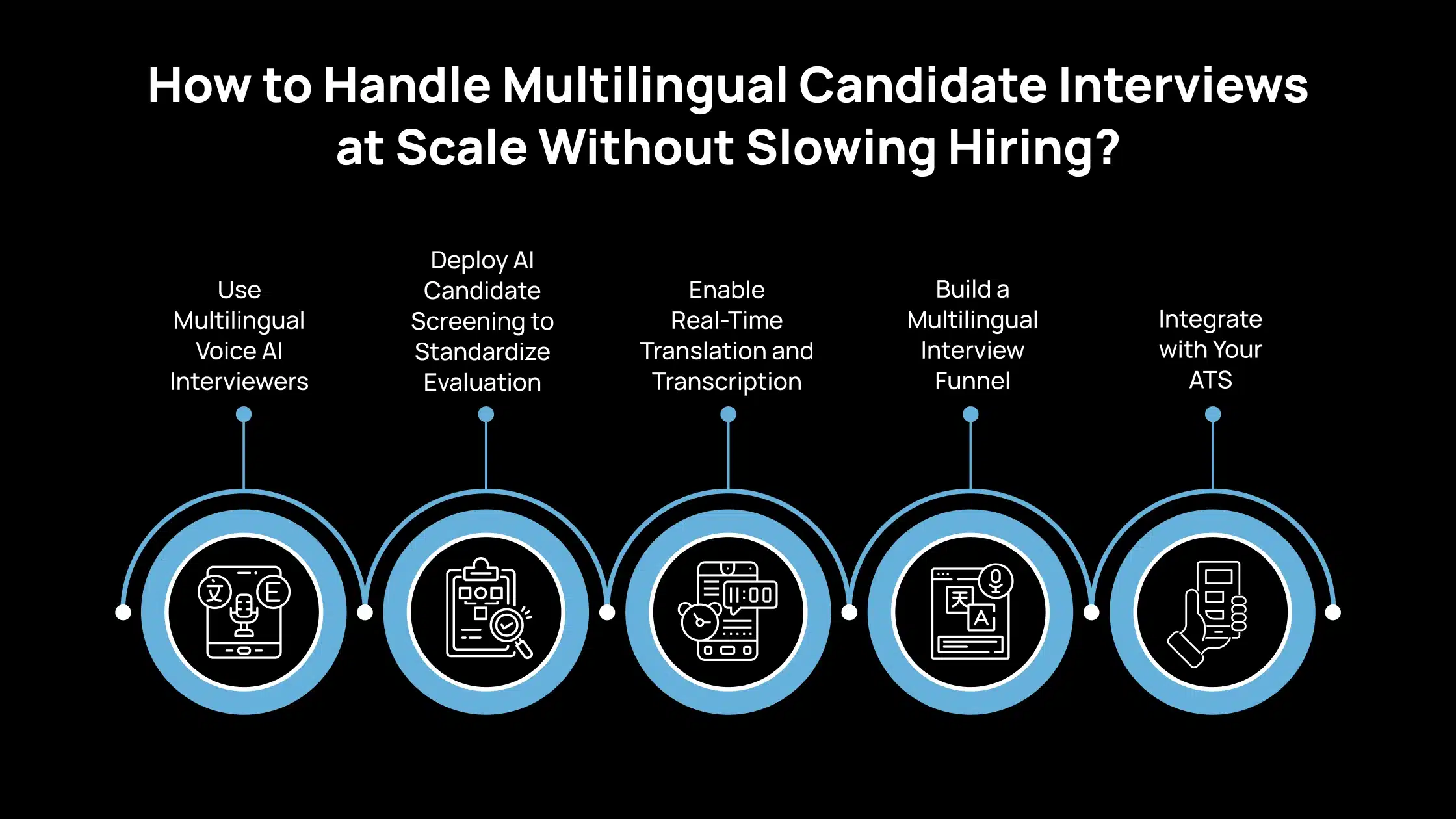
Here is how AI enables you to scale multilingual interviews while keeping your hiring process organized and objective.
1. Use Multilingual Voice AI Interviewers
A multilingual voice AI interviewer can speak with candidates in their preferred language. This eliminates the need for language-specific interviewers, allowing you to handle large volumes without slowing down.
The system adjusts follow-up questions based on the candidate’s responses. This creates a smoother experience and gives you more accurate insights than scripted questionnaires.
You don’t need to schedule or coordinate interviews across regions. The AI handles the first round consistently, and your team steps in only when needed.
2. Deploy AI Candidate Screening to Standardize Evaluation
AI evaluates candidates using the same criteria, regardless of the language they speak. This helps you compare applicants fairly without worrying about differences in interviewer style or interpretation.
You can use ready-made evaluation templates tailored to different roles. This ensures that every candidate is asked relevant questions and assessed against clear benchmarks.
You can define what success looks like for each position, including skills, competencies, and experience levels. The AI scores candidates against these standards, providing you with structured and predictable results.
3. Enable Real-Time Translation and Transcription
AI records and transcribes everything the candidate says, which helps you review the exact wording without language limitations.
Your team can read interviews in a common language, even if the candidate spoke in a different one. This keeps everyone aligned and removes guesswork.
Having full transcripts and accurate translations gives you a reliable record of each interview. This supports fair hiring practices and helps meet compliance requirements.
4. Build a Multilingual Interview Funnel
Here’s how a scalable multilingual interview funnel works at each stage:
| Stage | How It Works |
| AI-powered pre-screening | Automatically verifies identity, eligibility, and basic skills before candidates move to interviews. |
| Voice AI screening interview | Candidates complete a full interview in their preferred language, ensuring scalability and consistency. |
| Automated scoring and ranking | AI evaluates responses and ranks candidates based on predefined criteria, highlighting the most qualified profiles. |
| Recruiter review of top candidates | Your team reviews transcripts, scores, and insights for the strongest candidates, reducing manual effort. |
| Human final interview (optional) | Human interviewers speak only with the top candidates, improving efficiency without lowering hiring quality. |
5. Integrate with Your ATS
Sync interview recordings, transcripts, and scores. All interview data is directly imported into your ATS, ensuring that nothing is lost and everything is easily accessible.
Based on scores and interview results, candidates can automatically move to the next stage, receive follow-up tasks, or be shortlisted. Every stage becomes connected. You avoid manual tracking and keep the hiring process organized across languages and regions.
6. Maintain Cultural Neutrality and Reduce Bias
Using broad and diverse training data helps the AI understand different communication styles and cultural norms, reducing misinterpretation.
Clear scoring guidelines ensure that all candidates are evaluated on the same criteria, rather than on language fluency or cultural communication differences. Regular checks help you confirm that the AI is evaluating candidates fairly and that outcomes remain consistent across languages and regions.
Practical Benefits of Scaling Multilingual Interviews With AI
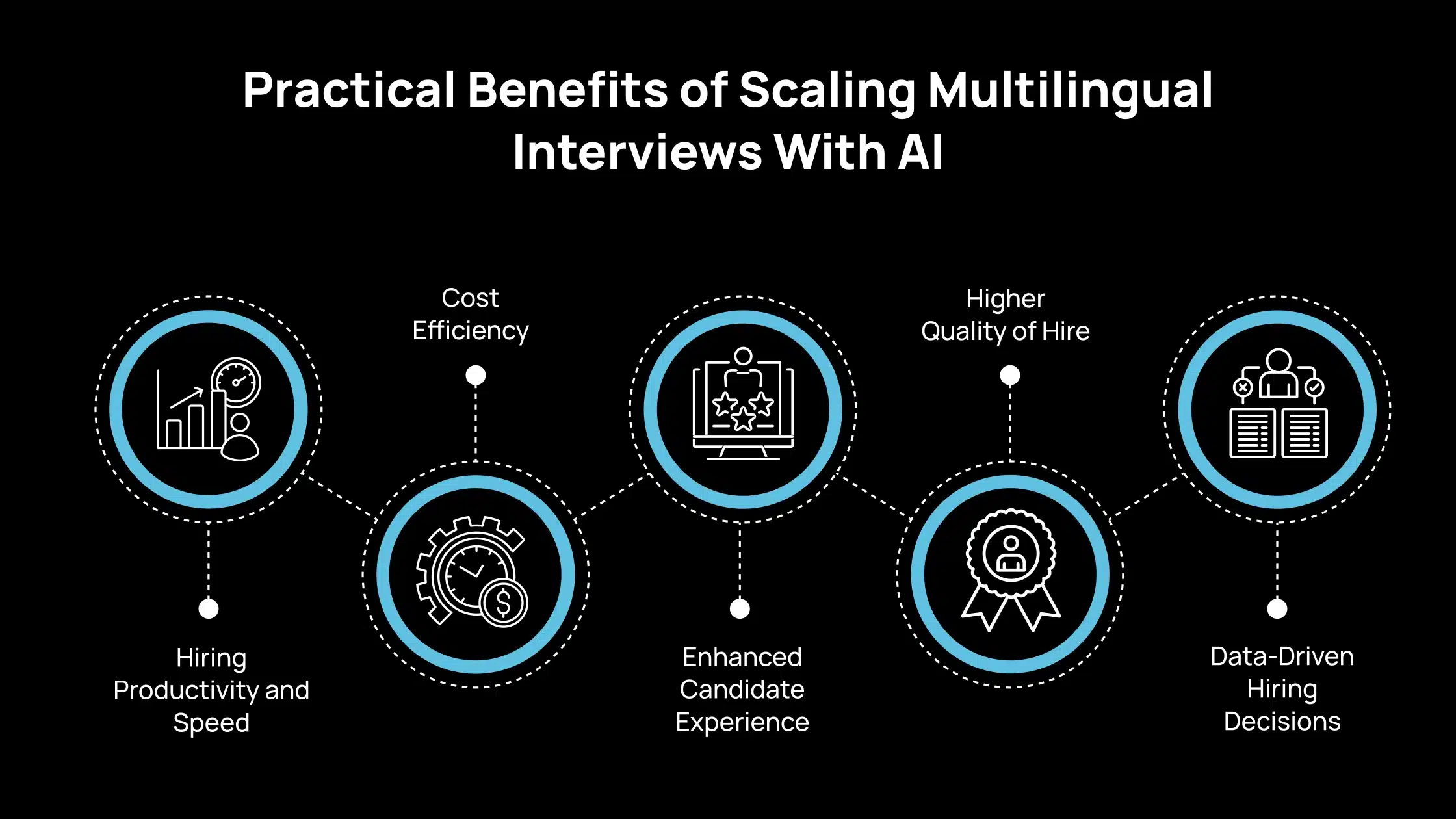
Here is how AI helps you scale multilingual interviews while improving speed, consistency, and hiring quality:
1. Hiring Productivity and Speed
You can handle far more interviews simultaneously when you use AI tools for multilingual screening.
Firms report that AI in recruitment cuts time-to-hire by around 33%. For you, that means less time waiting for candidates, quicker decisions, and faster movement through your hiring pipeline.
2. Cost Efficiency
Using AI for multilingual interviews lowers costs in several areas: fewer translators, fewer interviewer hours, and less administrative overhead.
One study found organizations reduced cost-per-hire by up to 30-40% after implementing AI screening tools. That means you spend less for the same (or better) candidate volume and quality.
3. Enhanced Candidate Experience
Candidates feel more comfortable when interviewed in their native language, and you can offer interviews anytime (24/7) because AI systems don’t need breaks.
Surveys indicate that approximately 64-67% of HR leaders believe AI enhances the candidate experience. Providing faster feedback and smoother interviews helps you maintain a stronger employer brand and keep candidates engaged.
4. Higher Quality of Hire
AI systems can identify subtle signals, such as clarity of responses, reasoning ability, and alignment with role requirements, and apply consistent scoring across candidates and regions.
Research shows AI tools improve quality of hire metrics; for instance, some firms report a 43% increase in hire quality when using AI. That means better-fit candidates, fewer mismatches, and stronger outcomes from the hiring process.
5. Data-Driven Hiring Decisions
When you use AI for multilingual interviews, you generate structured data: interview transcripts, scores, and insights.
Dashboards and analytics provide visibility and trend tracking. AI-driven analytics improve decision-making. With these tools, you move from gut-feel hiring to data-backed choices, which helps you scale hiring more reliably.
Real-World Use Cases & Industry Applications for Multilingual AI Interviews
Here’s where multilingual AI interviews make a real difference and how different industries benefit from them:
| Sector | How It Helps |
| Global BPOs & Customer Support Centers | Handles large volumes of multilingual interviews and evaluates communication skills. |
| Logistics & Delivery Services | Speeds up onboarding across regions and simplifies hiring for non-English-speaking roles. |
| Healthcare Staffing | Confirms language proficiency for patient-facing roles and supports accurate compliance records. |
| Tech Startups Expanding to New Markets | Enables fast hiring across APAC, LATAM, MENA, and EU without language limitations. |
| Education & Training Providers | Screens tutors, instructors, and creators in multiple languages with standardized evaluations. |
Best Practices to Implement a Scalable Multilingual AI Interview System
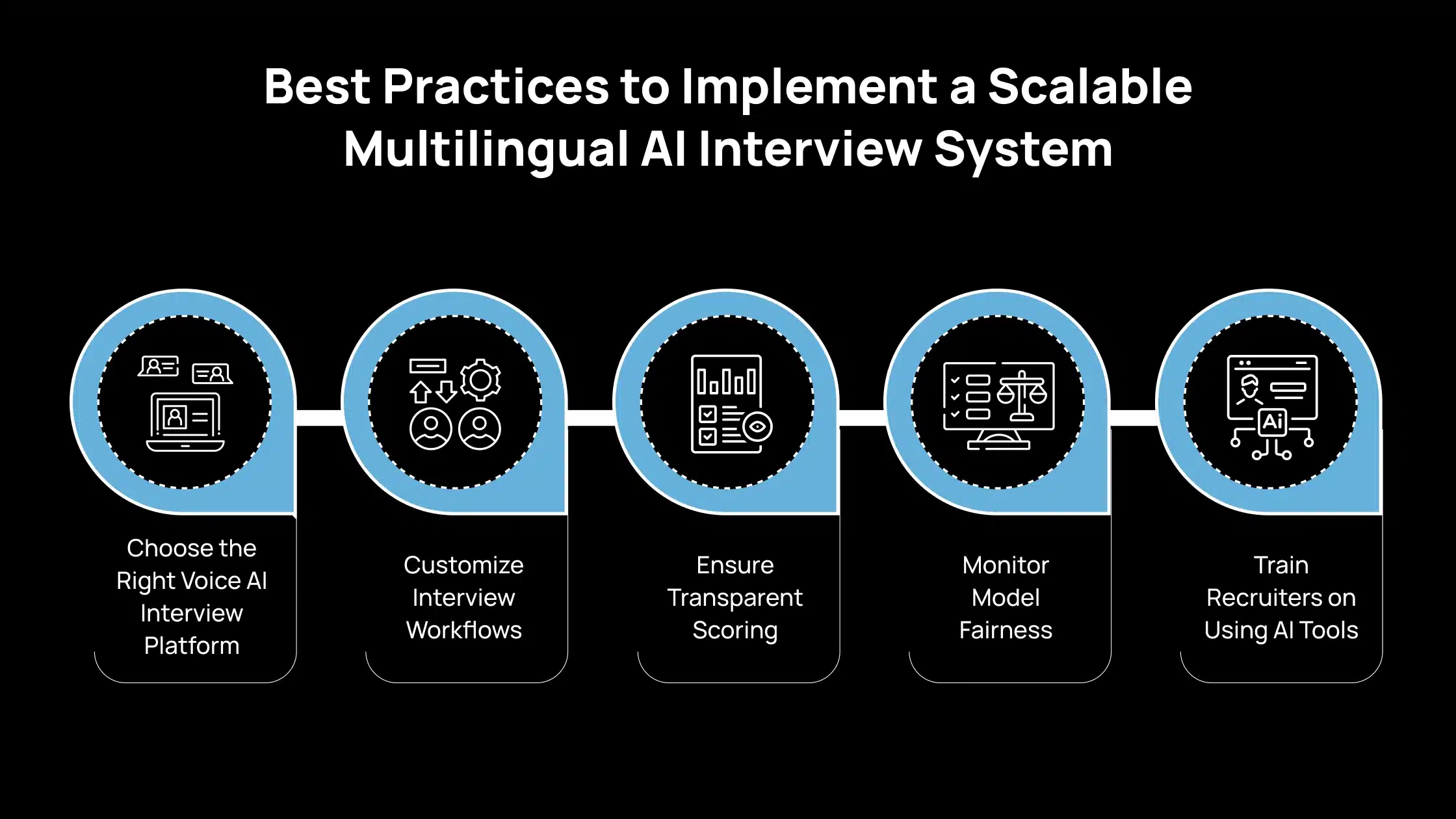
Here are the best practices that help you build a scalable, consistent, and reliable multilingual AI interview system:
1. Choose the Right Voice AI Interview Platform
You need a system that can understand and translate different languages without losing meaning. Accurate translation ensures you evaluate what candidates actually meant, not what the software guessed.
Ensure the platform supports the languages you currently hire for and the ones you may need in the future. This keeps you flexible as your hiring expands into new regions. The platform should be able to handle a large number of interviews simultaneously. If it slows down or crashes during peak hiring, it disrupts your entire process.
Since you’re collecting voice data and personal information, the platform must follow strict privacy and security standards. This protects your candidates and keeps your process compliant.
2. Customize Interview Workflows
Create interview flows tailored to each job. Candidates should only answer questions that match the skills and responsibilities of the role they’re applying for.
Include prompts that reveal how candidates think, react, and solve problems. These questions help you understand real-world behavior, not just technical knowledge. Use targeted questions to evaluate job-specific skills. This helps you quickly identify candidates who meet the core requirements.
3. Ensure Transparent Scoring
Define what “good,” “average,” and “poor” answers look like. This removes guesswork and ensures every candidate is judged against the same standards.
Determine which competencies are most important and assign them clear weightage. This helps the AI evaluate candidates in a manner that reflects the role’s priorities. The system should display how candidates performed in key areas, such as communication, technical knowledge, and problem-solving. These reports help your team make informed decisions quickly.
4. Monitor Model Fairness
Check that candidates aren’t being scored higher or lower based on fluency, accent, or communication style. Your AI model should focus on content, not language comfort.
Review actual interview transcripts to verify that the AI is accurately interpreting responses. This helps you catch issues early. Regular audits show whether certain languages or regions are being evaluated differently. This helps you maintain a fair, consistent process across all candidates.
5. Train Recruiters on Using AI Tools
Your team needs to understand what the scores and insights mean so they can make accurate decisions. Proper training prevents misreading or over-relying on data.
AI can screen candidates, but your team should still validate final decisions. This balance ensures the process remains efficient while preserving human judgment. Recruiters, hiring managers, and technical teams should collaborate to refine questions, scoring rubrics, and workflows. Shared input leads to a stronger system overall.
The Role of Avahi AI Voice Agents in Modern Recruiting
In 2025, speed and availability are critical in recruitment. Missed candidate calls, delayed responses, or scheduling bottlenecks can result in lost great hires.
This is where Avahi’s AI Voice Agent becomes a valuable tool for talent acquisition teams.
- It acts as an extension of your recruiting process, qualifying candidate inquiries, scheduling interviews, and routing calls to recruiters when needed, all while ensuring a seamless, human-like experience.
- For recruitment teams handling high volumes or operating across multiple time zones, Avahi’s voice AI helps maintain consistent engagement, even outside of business hours.
- It reduces administrative load by managing repetitive candidate interactions, including confirming availability, handling FAQs, logging candidate data into your CRM or ATS, and sending reminders.
Recruiters spend more time on meaningful conversations and less on coordination, while candidates get fast, professional responses anytime they call.
Discover Avahi’s AI Platform in Action
At Avahi, we empower businesses to deploy advanced Generative AI that streamlines operations, enhances decision-making, and accelerates innovation—all with zero complexity.
As your trusted AWS Cloud Consulting Partner, we empower organizations to harness the full potential of AI while ensuring security, scalability, and compliance with industry-leading cloud solutions.
Our AI Solutions Include
- AI Adoption & Integration – Leverage Amazon Bedrock and GenAI to Enhance Automation and Decision-Making.
- Custom AI Development – Build intelligent applications tailored to your business needs.
- AI Model Optimization – Seamlessly switch between AI models with automated cost, accuracy, and performance comparisons.
- AI Automation – Automate repetitive tasks and free up time for strategic growth.
- Advanced Security & AI Governance – Ensure compliance, detect fraud, and deploy secure models.
Want to unlock the power of AI with enterprise-grade security and efficiency? Start Your AI Transformation with Avahi Today!
Frequently Asked Questions
1. How do you handle multilingual candidate interviews at scale without slowing down the hiring process?
You can handle multilingual interviews at scale by utilizing tools such as voice AI interviewers and AI candidate screening. These systems conduct interviews in multiple languages, score responses automatically, and remove the need for human interviewers in early stages. This keeps your process fast, consistent, and manageable even during high-volume hiring.
2. What is AI candidate screening, and how does it help with multilingual hiring?
AI candidate screening evaluates candidate responses using natural language processing and speech recognition. It helps you compare candidates fairly across languages and regions by providing standardized scoring, clear reports, and structured insights. This makes multilingual hiring more accurate and more efficient.
3. Can a voice AI interviewer replace human interviewers?
A voice AI interviewer doesn’t replace humans entirely but handles the initial screening stage. It conducts interviews, asks follow-up questions, and evaluates responses in multiple languages. Your team steps in only for the final rounds. This reduces workload and ensures consistency across all multilingual interviews.
4. How does AI ensure fairness in multilingual candidate assessments?
AI improves fairness by scoring candidates using the same criteria regardless of language. When combined with diverse training datasets and regular audits, AI can help reduce bias associated with fluency, accent, or cultural communication styles. This helps you maintain a consistent and equitable multilingual hiring process.
5. What are the main benefits of using AI for multilingual interviews?
Utilizing AI enables faster screening, lower costs, and a better candidate experience. You can conduct interviews in candidates’ native languages, administer assessments 24/7, and obtain structured data for informed decision-making. This makes it easier to manage multilingual candidate interviews at scale while improving the overall quality of hire.