

TL;DR
|
By the time you schedule a first screen, your best applicant has already taken another call.
Most teams are dealing with more applicants than their recruiters can reasonably screen, and the slowest part is still the first mile: basic fit checks, the same early questions repeated dozens of times, and the scheduling back-and-forth that drags everything out.
When that time is locked up, applicants, hiring managers, and candidates wait, and candidates quietly move on. In 2025 benchmarks, even “fast” US hiring lanes like tech and media average around 20 days to hire, while professional services sit closer to 47 days, and some engineering and defense roles stretch past 60 days. The longer that first mile takes, the more your funnel leaks.
If your recruiters are spending hours to reach basic yes/no clarity, and candidates are leaving while they wait, what part of your process needs human judgment, and what part just needs to run faster and more consistently?
That’s the gap an AI voice agent for recruiting is built to fill. A voice-based AI interviewer doesn’t replace your team or make final decisions. It handles the repeatable front-end work: structured first-round screens, knockout checks, and scheduling handoffs, then hands the outcome to recruiters with transcripts and rubric-aligned summaries. It shortens the slowest step in the funnel without weakening fairness or control.
In this blog, you’ll get a plan to deploy a voice-based AI interviewer the right way, what to automate first, what to avoid, how to stay aligned with US compliance, and how to prove impact before you scale.
Understanding AI Voice Agent for Recruiting and Core Capabilities
An AI voice agent for recruiting is software that talks with candidates by phone or in a browser, asks job-relevant questions, records responses, and produces a structured output recruiters can use. It is built for early-stage screening and coordination, not final hiring decisions.
Here is the list of core capabilities you should expect while deploying AI voice agents:
1. Structured Interview Delivery
The AI voice agent should run a consistent interview script that is mapped directly to the job rubric. It asks the same core questions for every candidate, so screening stays uniform. The agent also uses branching logic.
If a candidate meets a requirement, it moves to the next question. If they do not, it either asks a clarifying follow-up or routes the candidate out based on predefined rules. This approach helps maintain the same screening standard across recruiters, teams, and locations.
2. Eligibility And Knockout Checks
The system should handle early rule-based filters that determine basic fit. It can confirm work authorization, required licenses or certifications, willingness to work specific shifts, location readiness, and alignment with the pay range.
These checks are simple but high-impact because they remove mismatched candidates before the recruiter spends time. The recruiter then focuses only on candidates who clear the minimum requirements.
3. Availability Capture And Scheduling Support
A voice agent should collect candidate availability during or right after the screen. It records preferred time slots and can push them into the ATS or a scheduling tool.
This reduces delays caused by email back-and-forth. It is especially useful for high-volume hiring where candidates often apply after business hours and expect quick follow-up.
4. Transcription, Summaries, And Scoring
The agent should automatically generate a full transcript of the conversation. It should also produce a short, structured summary that highlights relevant answers and flags concerns.
Based on the rubric, it assigns a score or places the candidate into a recommendation bucket, such as pass, review, or fail. Recruiters should be able to see the reasoning behind the output through transcripts and rubric mapping, not just a final score.
5. ATS Routing And Status Updates
The tool should automatically write screening results back into the ATS. It can move candidates forward when they meet the threshold, and it should flag borderline cases for a recruiter to review. It must also log outcomes clearly so teams can audit decisions later. Many AI-powered interview solutions, including tools that focus intensely on this ATS-linked routing, because it makes the screening workflow scalable in practice.
Placement of an AI Voice Agent for Recruiting Across Funnel Stages
| Funnel Stage | When It Happens | Purpose | Output / What Recruiters Get |
| Post-application screening (first mile) | Immediately after apply | Validate basic fit fast- Cut unreviewed backlog | Eligible candidates routed forward- Ineligible tagged for rejection review |
| Pre-recruiter interview qualification | Before the live recruiter screen | Collect rubric-based evidence- Build shortlist with context | Transcript + score summary- Clear pass/review/fail buckets- Recruiter can override |
| Scheduling and reminders | During or after screening | Reduce back-and-forth- Improve show-up and completion | Captured availability- Auto reminders sent- Drop-offs re-engaged |
Selecting the Right First Use Cases for an AI Voice Agent for Recruiting
Starting with the right roles and tasks keeps your 90-day rollout realistic, compliant, and measurable. You want early wins in areas where a voice-based AI interviewer can be consistent and clearly job-related.
Best Starting Roles For An AI Voice Agent For Recruiting
- If you are hiring many people for the same role, screening questions are usually repeatable. The AI voice agent can ask the same job-linked questions for every candidate, helping you reduce recruiter load without changing the hiring standard.
- When candidates expect a phone screen, switching to a voice agent feels natural. It also means your rubric is likely already designed for verbal screening, so you can move faster without redesigning the process.
Best Starting Tasks For AI-Powered Interview Solutions
- Use the agent to confirm basics like work authorization, shift readiness, location fit, and pay range alignment. These are clear, rule-based filters, so the screening decision is easy to explain and audit.
- The agent can run short, rubric-mapped questions about experience and role-specific behaviors. This gives you consistent evidence before a recruiter steps in, and it helps you shortlist faster with fewer subjective gaps between screeners.
- Let the agent collect availability during the screen and push it into your ATS or scheduling tool. This reduces lag between application and next steps, which matters in competitive US hiring markets.
Choosing Between Building and Buying AI-Powered Interview Solutions
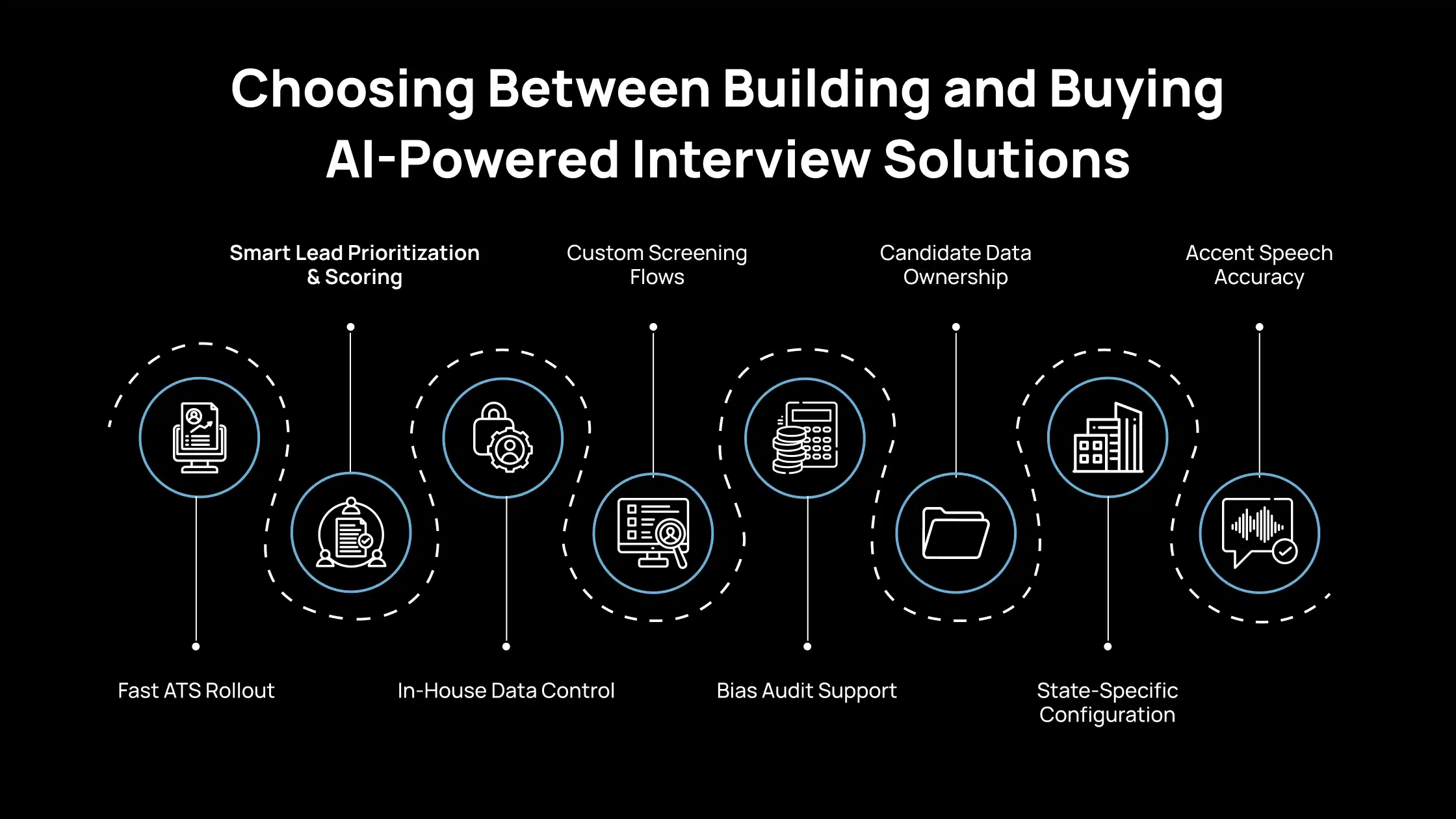
You are choosing between speed and control. Start with what you need to launch in 90 days, then work backward.
1. Fast ATS Rollout
If your timeline is tight, buying saves weeks of engineering and testing. Most established vendors already integrate with common ATS platforms, so candidate invites, score writeback, and stage updates work out of the box. That makes it easier to pilot without creating new manual work.
2. Vendor Compliance Support
Hiring tools are increasingly scrutinized for bias and transparency. Vendors operating in this space typically provide audit logs, model documentation, and reporting templates aligned with EEOC expectations and state rules. This reduces the burden on your HR and legal team during rollout.
3. In-House Data Control
If you hire in healthcare, finance, government, or defense-adjacent roles, you may not be able to send voice recordings or transcripts outside your environment. Building lets you control storage, retention, and access fully, and helps you meet internal security policies without depending on vendor terms.
4. Custom Screening Flows
Some roles require very specific screening logic, or your hiring spans multiple languages with different competency models. If vendors cannot support those workflows without heavy compromise, building may be the safer path. This is common in large global firms that need consistent but localized screening across regions.
5. Bias Audit Support
You need tools that let you test screening outcomes by protected class and show whether the AI is creating unfair patterns. In the US, that is not optional. Ask how often audits are run, what metrics they use, and whether you can access the raw data for your own review.
6. Candidate Data Ownership
Voice interviews produce sensitive personal data. Your agreement should state that you own the audio, transcripts, and scores, and that the vendor cannot use them to train models unless candidates have given explicit consent. If this point is vague, treat it as a risk.
7. State-Specific Configuration
The tool must support different notice and consent flows depending on location. For example, NYC roles may require bias audit disclosure and candidate notice; Illinois requires consent for AI analysis; and California gives candidates the right to access and delete personal data. If the system cannot route candidates into the correct compliance flow, don’t pilot it.
8. Accent Speech Accuracy
Screening breaks down if transcripts are inaccurate. Ask for measured accuracy across accents common in your candidate pool, and test with real samples during pilot. If transcription quality is uneven, scoring will also be unreliable, even with a strong rubric.
How to Design an AI Interviewer Experience That Fits Your Process?
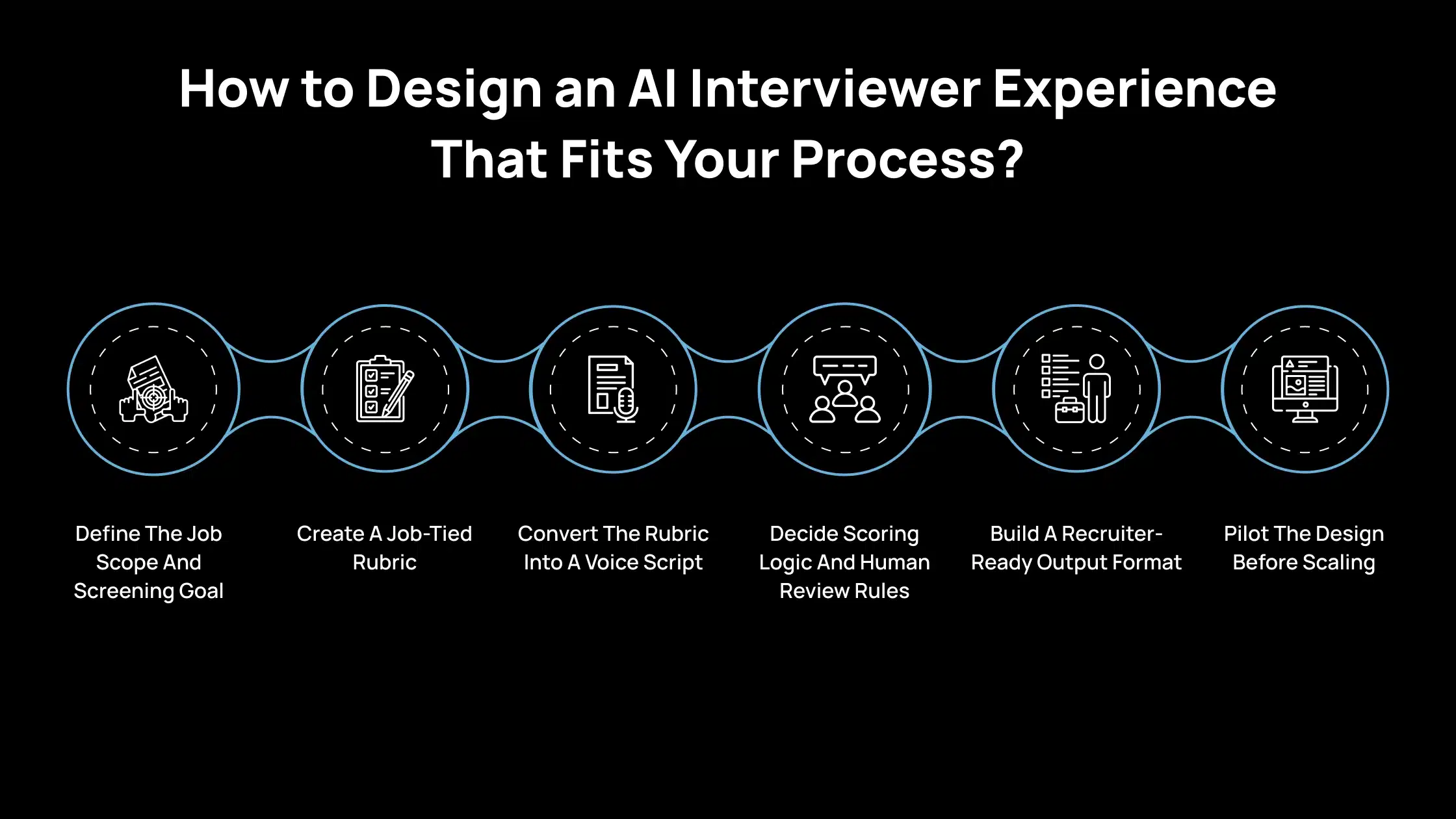
Here is how to define the interview flow, scoring, and human review rules before deployment.
Step 1: Define The Job Scope And Screening Goal
Choose a role where early phone screening already makes sense. Be clear whether the voice agent is for first-mile screening, pre-recruiter qualification, or scheduling support.
Decide what “qualified enough to move forward” means for this role. This prevents over-screening and keeps the script tight.
Step 2: Create A Job-Tied Rubric
List must-have requirements. These are non-negotiables, such as authorization, certifications, shift fit, location, or minimum years of experience. Each must-have should map to a clear yes/no gate.
Define competency areas. Identify 3 to 5 job-relevant competencies (example: customer handling, troubleshooting, teamwork). Avoid vague traits that you can’t measure from voice answers.
Set a simple scoring scale. Keep scoring consistent across competencies, like 1–3 or 1–5, with short definitions for each level. Decide thresholds upfront. Create clear buckets:
- Pass: meets must-haves and scores above the target range.
- Review: meets must-haves but mixed competency scores.
- Fail: misses a must-have or scores consistently low.
Step 3: Convert The Rubric Into A Voice Script
Open with a short line saying this is an AI voice interview, how data is used, and that a recruiter will review results. Keep it plain and direct.
Write short, job-specific questions. Each question should map to one rubric item. Avoid multi-part questions. Aim for clarity over depth. Add allowed follow-ups. Define 1–2 follow-ups per question, probing only when needed. Follow-ups must stay within the rubric scope.
Set timing and retry rules. Decide the maximum response time per question and how many repeats a candidate can request. This keeps the experience consistent and fair.
Step 4: Decide Scoring Logic And Human Review Rules
Apply hard gates first. If a must-have fails, the agent flags the candidate for reject-review instead of auto-rejecting. Map AI scoring to the rubric. The agent should score only against the predefined scale. No extra criteria, no hidden weighting.
Require recruiter review for edge cases. A recruiter must check any candidate in the “review” bucket. Document override reasons to keep an audit trail.
Step 5: Build A Recruiter-Ready Output Format
Standardize what recruiters see. Provide three items only: transcript, summary, and rubric scorecard. Keep summaries factual, not interpretive. Include a one-line recommendation.
Pass, review, or fail with the specific rubric reason, so triage is fast.
Step 6: Pilot The Design Before Scaling
Run a parallel screening set. For a small batch, let recruiters screen as usual while the voice agent also runs. Compare outcomes. Tune thresholds, not questions first. If a mismatch happens, adjust scoring cutoffs before rewriting the script. Check for consistency issues. Watch for drop-offs, unclear questions, or transcription errors. Fix these before full rollout.
Common Pitfalls To Avoid When Deploying An AI Voice Agent For Recruiting

Here is the list of mistakes that commonly derail early pilots in the US. Avoiding them keeps your rollout compliant, credible, and easier to scale.
1. Maintain Human Oversight
In the US, the EEOC treats AI screening tools like any other selection procedure. If the tool creates an adverse impact, the employer is responsible, even if a vendor built it. Keep recruiters in the decision loop, require review for rejects or borderline cases, and document overrides.
2. Complete Bias Audit First
If your roles are based in New York City, Local Law 144 applies when an automated tool substantially assists hiring decisions. You must complete an independent bias audit within the last year, publish a summary, and give candidates notice before using the tool. If you skip this, you risk enforcement action and having to stop the pilot midstream.
3. Get Consent and Deletion Ready
Local laws require notice and consent when AI analyzes recorded interviews, and they give candidates the right to request the deletion of their recordings. Even if your tool is voice-based rather than video, Illinois regulators and courts will expect similar safeguards. Build a simple consent step and a documented deletion workflow for Illinois candidates from day one.
4. Limit Data Retention Strictly
Under the CPRA, California applicants have privacy rights similar to those of consumers, including the right to access and delete their data. Holding interview audio or transcripts “just in case” increases compliance exposure and security risk. Set retention limits tied to hiring purposes, enforce scheduled deletions, and honor California data requests promptly.
5. Pilot One Role First
Early scoring thresholds will be imperfect. If you pilot across multiple roles before tuning, you won’t know whether issues come from the rubric, the script, or the model. Start with one high-volume role, calibrate using real outcomes, then expand only after the first role shows stable pass-through and low false rejects.
Why Avahi AI Voice Agents Are Valuable for Modern Hiring Teams?
In 2025, speed and availability are critical in recruitment. Missed candidate calls, delayed responses, or scheduling bottlenecks can result in lost great hires.
This is where Avahi’s AI Voice Agent becomes a valuable tool for talent acquisition teams.
- It acts as an extension of your recruiting process, qualifying candidate inquiries, scheduling interviews, and routing calls to recruiters when needed, all while ensuring a seamless, human-like experience.
- For recruitment teams handling high volumes or operating across multiple time zones, Avahi’s voice AI helps maintain consistent engagement, even outside of business hours.
- It reduces administrative load by managing repetitive candidate interactions, including confirming availability, handling FAQs, logging candidate data into your CRM or ATS, and sending reminders.
Recruiters spend more time on meaningful conversations and less on coordination, while candidates get fast, professional responses anytime they call.
Discover Avahi’s AI Platform in Action
At Avahi, we empower businesses to deploy advanced Generative AI that streamlines operations, enhances decision-making, and accelerates innovation—all with zero complexity.
As your trusted AWS Cloud Consulting Partner, we empower organizations to harness the full potential of AI while ensuring security, scalability, and compliance with industry-leading cloud solutions.
Our AI Solutions Include
- AI Adoption & Integration – Leverage Amazon Bedrock and GenAI to Enhance Automation and Decision-Making.
- Custom AI Development – Build intelligent applications tailored to your business needs.
- AI Model Optimization – Seamlessly switch between AI models with automated cost, accuracy, and performance comparisons.
- AI Automation – Automate repetitive tasks and free up time for strategic growth.
- Advanced Security & AI Governance – Ensure compliance, detect fraud, and deploy secure models.
Want to unlock the power of AI with enterprise-grade security and efficiency? Start Your AI Transformation with Avahi Today!
Frequently Asked Questions
1. Will an AI voice agent for recruiting replace recruiters?
No. The agent handles repeatable early-stage tasks, such as first-round screening and scheduling. Recruiters still review outputs, make decisions, and run deeper interviews. The tool is meant to reduce admin load, not remove human judgment from hiring.
2. What hiring stages are safest to automate first?
Start with post-application screening and pre-recruiter qualification. These stages rely on structured, job-linked questions and clear eligibility checks. Avoid final-round interviews early on, as they require context-heavy evaluation and pose a higher legal risk if automated.
3. How do we make sure the AI voice agent screens fairly?
Fairness comes from three things: a job-tied rubric, consistent scoring thresholds, and ongoing adverse impact testing. Run parallel screens during the pilot, compare AI outcomes with recruiter decisions, and adjust cutoffs when false rejects show up. Keep a human review step for borderline cases.
4. What data should we store from voice interviews, and for how long?
Store only what you need to support hiring decisions: transcripts, rubric scores, and minimal metadata. Keep audio only if required for review or audit. Set a retention period tied to hiring purpose and delete on schedule, especially for candidates who request removal under privacy rules.
5. How do we know if the pilot is working before scaling?
Look for measurable changes in early funnel efficiency and quality. The key signals are faster time to shortlist, high completion rates for voice screens, stable pass-through quality to recruiter interviews, and low recruiter override rates caused by scoring errors. If those are consistent for one role, you are ready to expand.