


TL;DR
|
What if your software could not only assist you, but also independently complete tasks, coordinate systems, and achieve business goals on its own? This is the shift that agentic AI platforms are enabling. Instead of waiting for instructions at every step, these systems can plan, decide, and execute workflows across your tools and infrastructure.
This shift is happening faster than most organizations expect. Recent industry research highlights how quickly autonomous AI capabilities are becoming part of core business systems:
McKinsey estimates that up to 60–70% of employee work activities could be partially automated using AI technologies, especially tasks involving data processing, reporting, and coordination.
Organizations are no longer evaluating AI only for insights; they are deploying it to execute real work.
However, choosing the right agentic AI platform is not straightforward. Some platforms are designed for experimentation, while others are built for enterprise deployment, product integration, or workflow automation. Each platform differs in reasoning capability, integration support, scalability, and deployment flexibility.
If you choose the right platform, you can automate complex workflows, improve operational efficiency, and reduce manual coordination across systems. If you choose the wrong one, you may face integration challenges, scalability limitations, and increased operational overhead.
This blog will help you evaluate the best agentic AI platforms based on your specific use case, technical requirements, and long-term scalability needs, so you can make an informed, practical decision.
What is Agentic AI?
Agentic AI refers to AI systems that can independently plan, make decisions, use tools, and execute multi-step tasks to achieve a defined goal. Instead of responding to a single prompt, these systems can manage a sequence of actions, adjust their approach based on results, and continue until the objective is completed.
For example, instead of only answering a question, an agentic system can retrieve data from your database, analyze it, generate a report, and send it to the appropriate system without requiring manual intervention at each step.
This capability makes agentic AI suitable for workflow automation, operational tasks, internal tooling, and complex business processes.
Types of Agentic AI Platforms
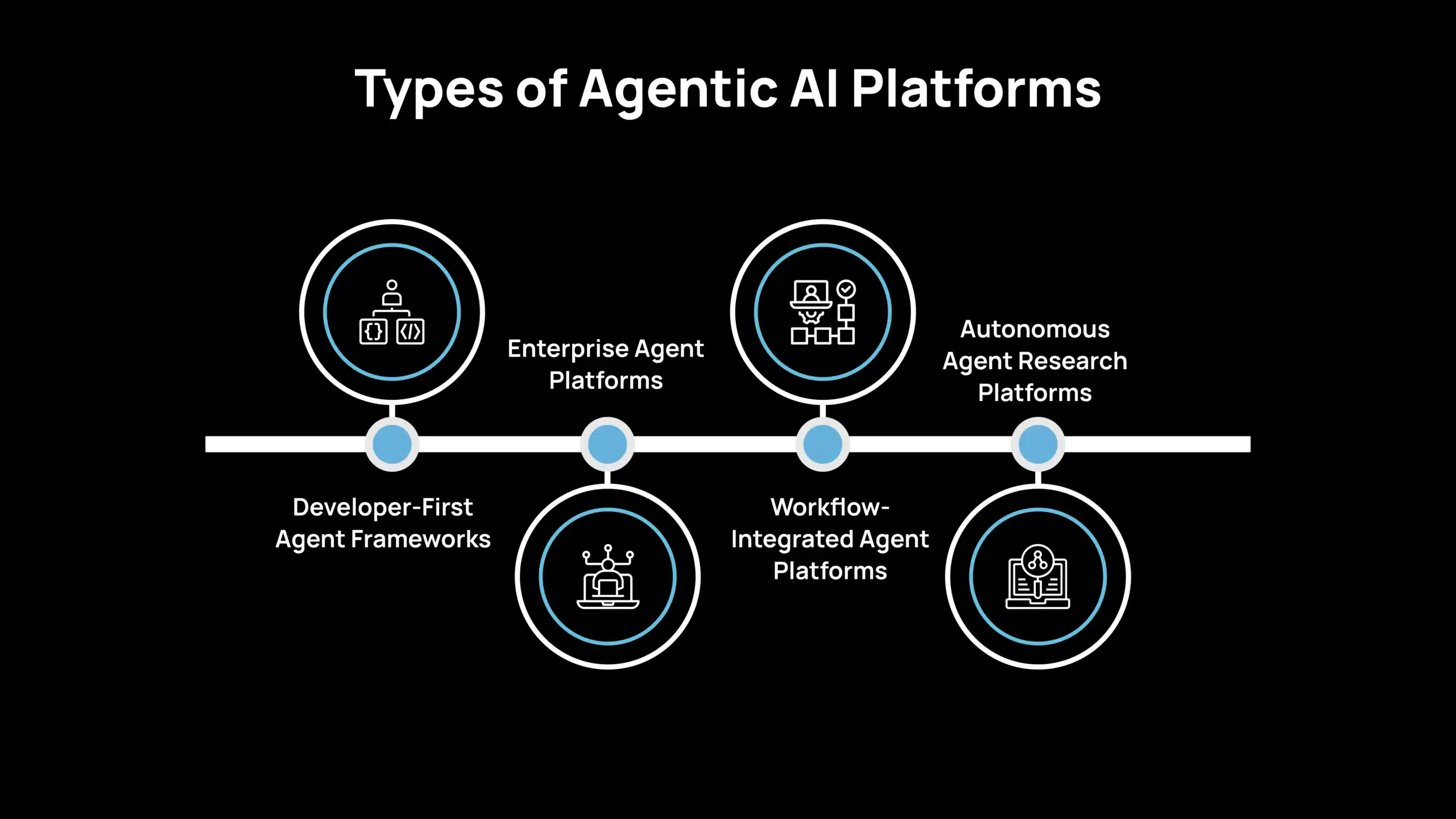
Some platforms are built for developers who need full control, while others focus on enterprise deployment or workflow automation. The classification below helps you identify which category aligns with your technical capabilities and business requirements.
1. Developer-First Agent Frameworks
If you are building custom agents or deeply integrating AI into your product or internal systems, developer-first frameworks offer the highest level of flexibility and control. These platforms allow you to define agent logic, tool usage, memory, and orchestration via code, making them suitable for complex, customized implementations. However, you are responsible for infrastructure, deployment, and system reliability.
Important characteristics:
- High flexibility for custom agent development.
- Code-centric implementation with full architectural control.
- Requires infrastructure setup and engineering support.
- Supports multi-agent orchestration and tool chaining.
- Enables custom memory and execution logic.
These platforms are best suited for building internal automation systems, developing custom AI-powered SaaS products, and supporting research or advanced agent development that requires full flexibility and architectural control.
2. Enterprise Agent Platforms
If you plan to deploy agents across business operations, enterprise agent platforms provide production-ready capabilities with built-in governance, security, and monitoring. These platforms focus on reliability, scalability, and integration with enterprise systems, making them suitable for operational use.
Important characteristics:
- Built-in governance, compliance, and access controls.
- Native integrations with enterprise tools (CRM, ERP, communication platforms).
- Monitoring, logging, and observability features.
- Secure and scalable deployment options.
- Designed for production reliability.
These platforms are best suited for enterprise workflow automation, customer support automation, sales and operations automation, and improving internal productivity through automated processes.
3. Workflow-Integrated Agent Platforms
If your goal is to automate workflows without heavy engineering involvement, workflow-integrated platforms provide agent capabilities through low-code or no-code interfaces. These platforms allow business teams to deploy agents faster and integrate them directly into existing workflows.
Important characteristics:
- Low-code or no-code implementation.
- Visual workflow builders with agent capabilities.
- Native integration with business and productivity tools.
- Faster deployment with minimal engineering effort.
- Designed for operational workflow automation.
These platforms are best suited for marketing automation, customer operations workflows, internal task and process automation, and business team-driven automation initiatives that require minimal engineering effort.
4. Autonomous Agent Research Platforms
If you are experimenting with advanced agent behavior or building prototypes, research-oriented platforms provide flexibility for testing and development. These platforms support experimental features but may lack production-level reliability and governance.
Important characteristics:
- Supports experimental and advanced agent architectures.
- Enables multi-step planning and autonomous execution testing.
- High flexibility for prototyping and research.
- Limited enterprise governance and monitoring capabilities.
- Not always optimized for production deployment.
These platforms are best suited for research and experimentation, prototyping agent-based systems, testing new agent architectures, and evaluating feasibility before moving to production deployment.
Core Capabilities to Evaluate in Agentic AI Platforms
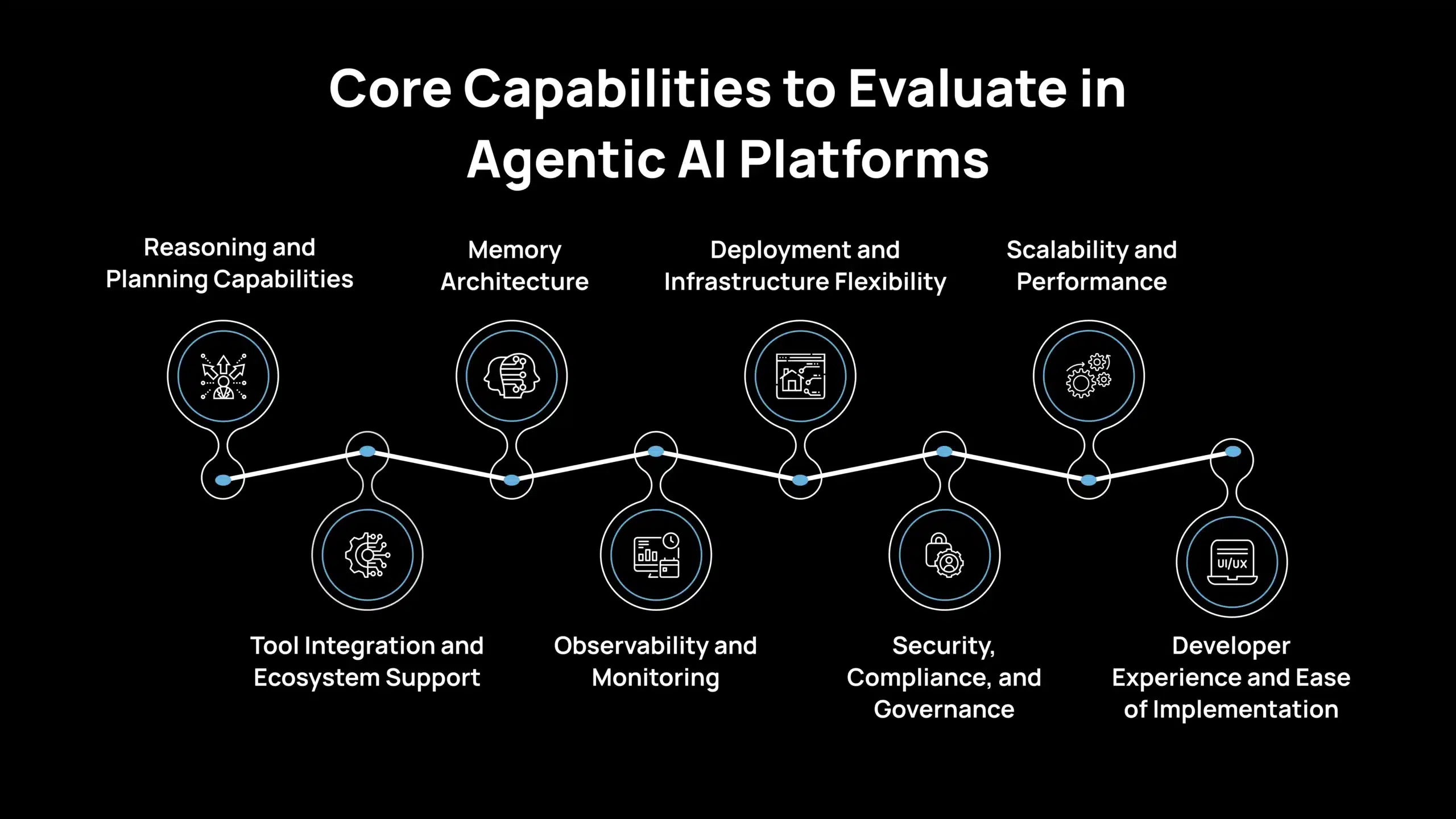
Here is a list of technical and operational capabilities to focus on before making a decision.
1. Reasoning and Planning Capabilities
The reasoning and planning capability determines how effectively the agent can understand goals and execute complex tasks. This is the foundation of agentic behavior. A capable platform allows agents to break down large objectives into smaller steps, execute them in sequence, and adjust their approach based on results.
You should evaluate whether the platform can manage multi-step execution without requiring manual intervention. The agent should be able to maintain context across steps and continue working until the task is complete. It should also handle failures gracefully by retrying tasks, selecting alternative approaches, or requesting additional information when needed.
Questions you should ask:
- Does the platform support autonomous multi-step planning?
- Can agents adjust their actions based on intermediate results?
- Does the system provide reliable reasoning across complex workflows?
This capability is critical if you want agents to perform meaningful automation beyond simple responses.
2. Tool Integration and Ecosystem Support
Agentic AI creates real value only when it can interact with your business systems. Tool integration allows agents to retrieve information, update records, trigger workflows, and perform operational tasks.
You should evaluate whether the platform supports integration with your existing infrastructure, including databases, APIs, communication tools, and business software. Platforms that provide native connectors can reduce implementation time, while support for custom tools allows deeper integration.
Without strong tool integration, agents cannot perform real actions and will be limited to generating responses rather than executing tasks.
3. Memory Architecture
Memory enables agents to retain and use information across tasks. This improves consistency, efficiency, and decision quality. A robust memory architecture enables agents to maintain context, recall relevant information, and avoid unnecessary repetition.
You should understand how the platform handles different types of memory and whether it supports persistent storage.
Memory types to evaluate:
- Short-term memory to manage the current session context
- Long-term memory to store persistent knowledge and past interactions
- Retrieval-based memory to access relevant information when needed
Memory is especially important for customer support, operational automation, and workflows that require continuity over time.
4. Observability and Monitoring
Observability allows you to understand what your agents are doing and identify issues when they occur. Since agent behavior is probabilistic, you need visibility into execution steps, tool usage, and decision-making processes.
Without observability, debugging and maintaining agents in production becomes difficult. Observability ensures reliability, improves performance, and helps you maintain operational control over agent behavior.
5. Deployment and Infrastructure Flexibility
Deployment flexibility determines how easily the platform can integrate into your existing infrastructure. Some platforms are cloud-hosted, while others allow self-hosted or hybrid deployment.
You should evaluate whether the platform aligns with your infrastructure, security requirements, and scalability goals. Some of the considerations are:
- Risk of vendor lock-in
- Ability to control infrastructure and data access
- Latency and performance implications
Deployment flexibility is particularly important if you operate in regulated environments or require infrastructure control.
6. Security, Compliance, and Governance
If you are deploying agentic AI in business operations, security and governance are essential. Agents often interact with sensitive data and critical systems, so you need proper access controls and monitoring.
You should evaluate whether the platform provides mechanisms to protect data, control access, and maintain compliance. These features are critical for enterprise deployments and regulated industries.
7. Scalability and Performance
As your usage grows, the platform must handle increasing workloads efficiently. Scalability ensures that agents can operate reliably across multiple workflows, users, and systems.
You should evaluate whether the platform can support concurrent agent execution without performance degradation. Scalability is important for long-term adoption and operational reliability.
8. Developer Experience and Ease of Implementation
The ease of implementation affects how quickly your team can deploy and maintain agents. A platform with good developer experience reduces integration time and improves long-term maintainability.
You should evaluate how easy it is to build, deploy, and manage agents using the platform. A strong developer experience reduces implementation risk and accelerates deployment.
How to Choose the Best Agentic AI Platform Based on Your Use Case
You should choose an agentic AI platform based on what you want the agent to do in your business, not based on popularity or feature lists alone. Here is how you can choose the best agentic AI platform for your needs:
Use Case 1: Enterprise Workflow Automation
If your goal is to automate internal business processes such as operations, reporting, or cross-system coordination, you need a platform designed for enterprise reliability and governance. These workflows often involve sensitive data, multiple systems, and compliance requirements, so platform stability and control are essential.
You should prioritize:
- Governance, access control, and auditability.
- Strong security and data protection capabilities.
- Native integrations with enterprise tools and infrastructure.
- Monitoring, logging, and execution visibility.
You should avoid:
- Experimental or research-oriented platforms.
- Platforms without enterprise-grade monitoring or governance.
Use Case 2: Building AI-Powered SaaS Products
If you are building AI-powered features into your software product, you need a platform that gives you flexibility and full control over agent behavior. Your agents must integrate with your product architecture, scale with user growth, and support customization based on your application requirements.
You should prioritize:
- Flexible agent configuration and customization.
- Scalability to support growing user workloads.
- Full API access and integration control.
- Ability to integrate with your existing product infrastructure.
You should avoid:
- Closed platforms with limited customization.
- Platforms that restrict deployment or integration flexibility.
Use Case 3: Customer Support Automation
If you want to automate customer support tasks, your agent must reliably access customer data, maintain context, and respond quickly. Support agents need to retrieve information from CRM systems, knowledge bases, and internal tools to resolve user issues effectively.
You should prioritize:
- Native integration with CRM systems and support tools.
- Reliable tool execution and data access.
- Persistent memory for maintaining customer context.
- Fast response times and low latency.
These capabilities ensure agents can reliably support real customer interactions.
Use Case 4: Internal Productivity Automation
If your goal is to automate internal tasks such as reporting, data retrieval, or workflow coordination, ease of implementation and operational efficiency are key considerations. These use cases often focus on improving team productivity rather than building customer-facing systems.
You should prioritize:
- Easy deployment and implementation.
- Integration with internal productivity and business tools.
- Cost-efficient operation at scale.
- Minimal infrastructure management requirements.
These platforms help you automate repetitive tasks without introducing unnecessary complexity.
Use Case 5: Research and Experimental Agents
If you are exploring agentic AI capabilities, testing architectures, or building prototypes, flexibility and support for experimentation are more important than production stability. You need a platform that allows you to test planning strategies, tool usage patterns, and agent coordination models.
You should prioritize:
- Flexibility to experiment with agent logic and workflows.
- Support for advanced planning and reasoning features.
- Multi-agent coordination capabilities.
- Ability to test and iterate quickly.
You should avoid:
- Highly restrictive enterprise platforms.
- Platforms that limit customization and experimentation.
Evaluation Framework for Selecting the Best Agentic AI Platforms
You can compare platforms using the following criteria:
| Evaluation Criteria | What You Should Evaluate |
| Platform type | Whether it is developer-focused, enterprise-ready, or workflow-integrated |
| Deployment options | Cloud-hosted, self-hosted, or hybrid deployment flexibility |
| Tool integrations | Support for APIs, databases, CRM systems, and internal tools |
| Memory support | Availability and reliability of short-term and long-term memory |
| Observability | Access to logs, execution traces, and debugging tools |
| Security | Data protection, access control, and governance features |
| Scalability | Ability to handle increasing workloads and concurrent agents |
| Ease of use | Documentation quality, SDK availability, and implementation complexity |
| Best suited for | Alignment with your specific use case and deployment goals |
Common Mistakes to Avoid When Choosing an Agentic AI Platform
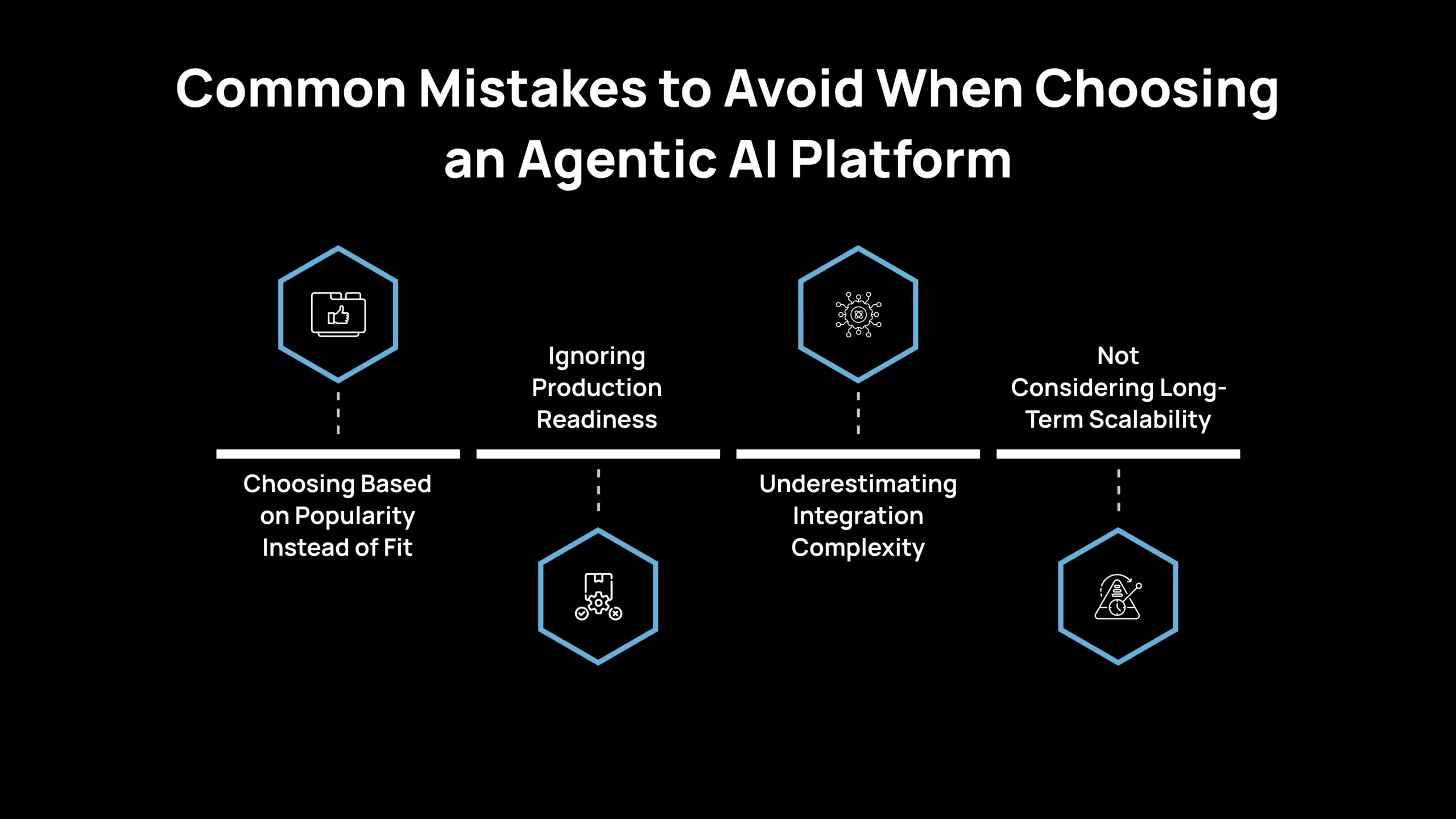
Many organizations select platforms based on incomplete evaluations, leading to implementation challenges and operational limitations. Avoiding common mistakes helps you choose a platform that supports long-term success.
1. Choosing Based on Popularity Instead of Fit
You should not choose a platform simply because it is widely discussed or frequently recommended. Popular platforms may not align with your infrastructure, integration requirements, or deployment goals.
Instead, you should evaluate whether the platform supports your specific workflows, systems, and scalability needs.
2. Ignoring Production Readiness
Some platforms are designed primarily for experimentation and may lack features required for production deployment. Using such platforms in operational environments can create reliability issues.
Common risks include limited monitoring and observability, lack of debugging tools, and inconsistent execution reliability. You should ensure the platform provides production-grade stability before deploying agents in operational workflows.
3. Underestimating Integration Complexity
Agentic AI systems depend heavily on integrations with your existing tools and infrastructure. The implementation effort required to connect systems can vary significantly between platforms.
You should evaluate the availability of native integrations, ease of connecting APIs and databases, and support for custom tool implementation. Platforms with strong integration support reduce implementation time and operational complexity.
4. Not Considering Long-Term Scalability
Your agent usage will likely grow over time, so you need a platform that can scale with your needs. Choosing a platform without a scalable architecture can lead to performance issues and increased costs.
You should consider the scalability of the infrastructure and execution environment, the flexibility to migrate or expand the deployment, and the risk of vendor lock-in. This ensures your platform can support future growth.
How Avahi Helps You Turn AI Into Real Business Results?
If your goal is to apply AI in practical ways that deliver measurable business impact, Avahi offers solutions designed specifically for real-world challenges. Avahi enables organizations to quickly and securely adopt advanced AI capabilities, supported by a strong cloud foundation and deep AWS expertise.
Avahi AI solutions deliver business benefits such as:
- Round-the-Clock Customer Engagement
- Automated Lead Capture and Call Management
- Faster Content Creation
- Quick Conversion of Documents Into Usable Data
- Smarter Planning Through Predictive Insights
- Deeper Understanding of Visual Content
- Effortless Data Access Through Natural Language Queries
- Built-In Data Protection and Regulatory Compliance
- Seamless Global Communication Through Advanced Translation and Localization
By partnering with Avahi, organizations gain access to a team with extensive AI and cloud experience committed to delivering tailored solutions. The focus remains on measurable outcomes, from automation that saves time and reduces costs to analytics that improve strategic decision-making to AI-driven interactions that elevate the customer experience.
Discover Avahi’s AI Platform in Action
At Avahi, we empower businesses to deploy advanced Generative AI that streamlines operations, enhances decision-making, and accelerates innovation, all with zero complexity.
As your trusted AWS Cloud Consulting Partner, we empower organizations to harness the full potential of AI while ensuring security, scalability, and compliance with industry-leading cloud solutions.
Our AI Solutions Include
- AI Adoption & Integration – Leverage Amazon Bedrock and GenAI to Enhance Automation and Decision-Making.
- Custom AI Development – Build intelligent applications tailored to your business needs.
- AI Model Optimization – Seamlessly switch between AI models with automated cost, accuracy, and performance comparisons.
- AI Automation – Automate repetitive tasks and free up time for strategic growth.
- Advanced Security & AI Governance – Ensure compliance, detect fraud, and deploy secure models.
Want to unlock the power of AI with enterprise-grade security and efficiency?
Start Your AI Transformation with Avahi Today!
Frequently Asked Questions
1. What are the best agentic AI platforms available today?
The best agentic AI platforms support autonomous task execution, tool integration, memory management, and scalable deployment. The right platform depends on your use case: enterprise automation, SaaS integration, workflow automation, or research and prototyping.
2. How do you choose the best agentic AI platforms for your business?
You should choose the best agentic AI platforms based on your specific requirements, including integration with your existing tools, scalability, deployment flexibility, security controls, and reasoning capabilities. Always prioritize platforms that align with your infrastructure and long-term operational goals.
3. What features should you evaluate in the best agentic AI platforms?
When evaluating the best agentic AI platforms, you should focus on reasoning and planning capabilities, tool integrations, memory architecture, observability, security, scalability, and ease of implementation. These features determine whether the platform can reliably support real-world automation.
4. Are open-source or enterprise solutions better among the best agentic AI platforms?
Open-source agentic AI platforms offer more flexibility and customization, making them suitable for developers and product teams. Enterprise platforms offer stronger governance, security, and monitoring, making them better suited for production deployment and business automation.
5. Why are businesses adopting the best agentic AI platforms?
Businesses are adopting the best agentic AI platforms to automate complex workflows, reduce manual effort, improve operational efficiency, and enable systems to execute tasks autonomously across tools and infrastructure. This helps organizations scale operations more efficiently.