

TL;DR
|
The way businesses scale is changing, and adding more people is no longer the most effective way to grow.
Across industries, companies are facing the same reality: costs are rising, talent is harder to find, and expectations for speed and efficiency are higher than ever. At the same time, AI is no longer limited to generating content or automating simple tasks; it is beginning to take on execution, decision-making, and continuous optimization.
Recent industry trends reflect this shift. A growing number of organizations report that AI-driven systems are improving productivity by 20–40% across operational workflows, based on industry research from firms like McKinsey. At the same time, global surveys continue to highlight persistent talent shortages in specialized roles, making it difficult to scale teams at the pace business demands.
This creates a clear inflection point. The question is no longer whether to adopt AI, but how to use it to drive real business outcomes.
Agentic AI represents this next phase. It moves beyond assistance to autonomous execution, where systems can plan, act, and improve toward defined goals. Instead of relying entirely on human effort to manage processes end-to-end, businesses can now deploy AI that actively participates in operations.
For decision-makers, this shift changes the foundation of growth. It is no longer about how many people are on the team, but about how effectively work gets done. This blog will explore how Agentic AI for enterprises enables you to scale faster, reduce costs, and drive outcomes without increasing headcount.
What Agentic AI Means for Your Business
If you are exploring how AI can move beyond content generation and actually drive outcomes, Agentic AI represents the next step. It refers to AI systems that can independently plan, take action, and continuously improve toward a defined business goal, without needing constant human direction.
Agentic AI systems are autonomously signed to plan, act, and iterate autonomously. It is capable of not only responding to the following fixed rules. These systems operate in a loop: they assess a goal, decide the next step, execute it, evaluate the result, and adjust accordingly.
For you, this means shifting from using AI as a tool to using AI as an active operator within your workflows.
How Agentic AI Differs from Other AI Approaches
You may already be using automation or generative AI. Agentic AI builds on both, but goes further in capability and business impact.
1. Regular Automation (Rules-Based)
You define fixed rules and workflows. The system follows “if-this-then-that” logic. It cannot adapt beyond what you pre-program.
For example, “If a lead fills a form, send an email.”You get efficiency, but limited flexibility. Any change requires manual updates. For example, “If a lead fills a form, send an email.”
2. Generative AI (Content Creation)
The system creates text, images, or code based on prompts. It responds to you but does not act independently.
For example, writing emails, blogs, or reports. You improve productivity while still managing the process and decisions.
3. Agentic AI (Decision + Execution Loops)
The system sets sub-tasks, makes decisions, and executes actions. It continuously evaluates outcomes and refines its approach.
For example, “Improve lead conversion rate” or “Reduce support resolution time.”You delegate outcomes, not just tasks. The AI becomes a semi-autonomous contributor to your business operations.
Why Agentic AI Is Becoming a Strategic Priority for Enterprises?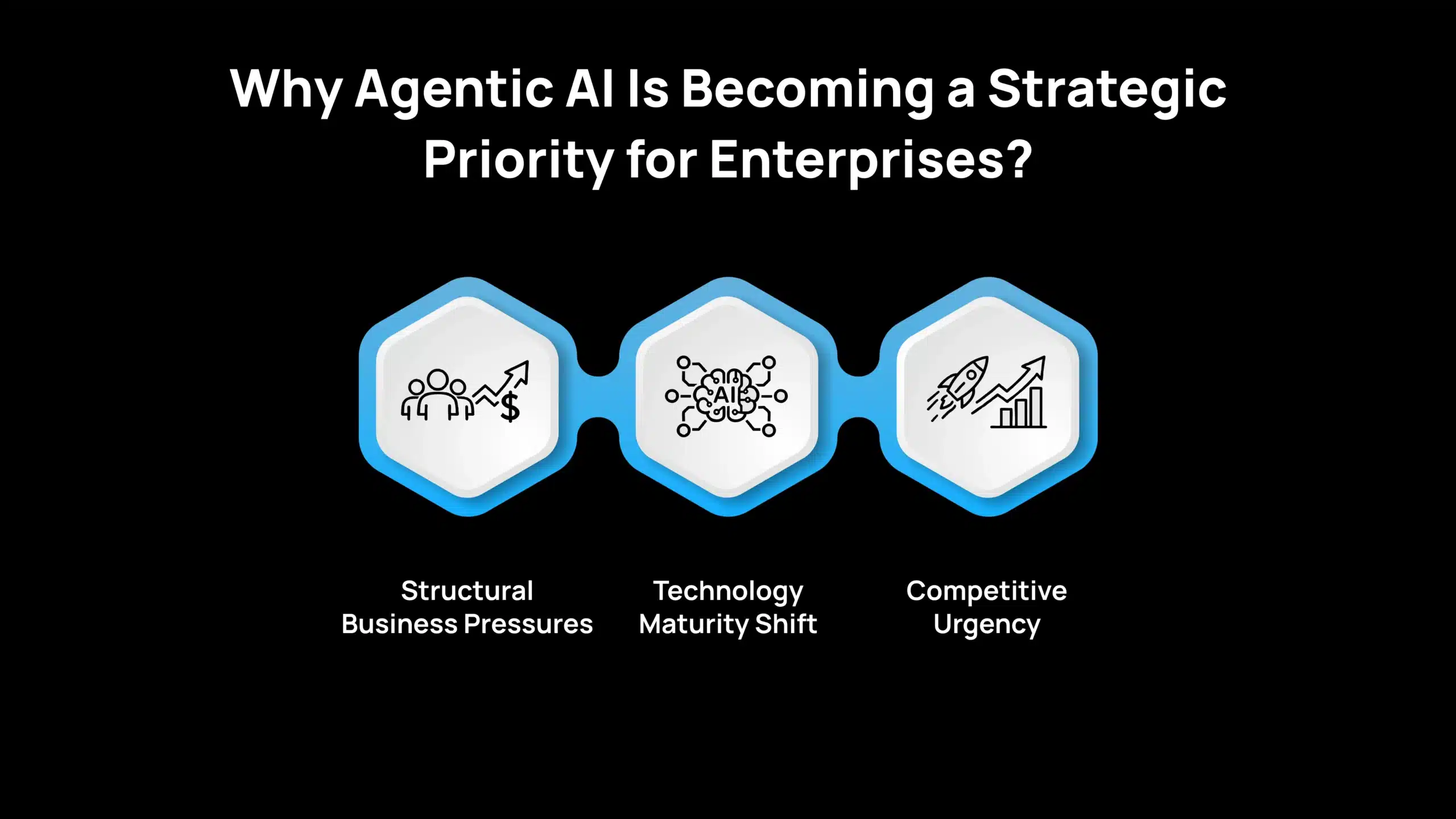 Here is why this transition is happening now and directly where it is.
1. Structural Business Pressures
You are likely already experiencing rising operational costs and constraints on scaling teams. Salaries for skilled roles, especially in data, marketing, and engineering, continue to rise, while access to qualified talent remains limited. In India and globally, companies report persistent gaps in hiring for specialized roles, even after extended recruitment cycles.
At the same time, you are under pressure to improve margins without expanding headcount or resorting to layoffs. This creates a gap between the work that needs to be done and the resources available to carry it out.
Agentic AI addresses this by allowing you to scale output without proportionally increasing team size. Instead of hiring additional specialists, you can deploy AI systems that handle multi-step workflows, reducing dependency on scarce and expensive talent.
2. Technology Maturity Shift
What makes this moment different is that the technology is finally capable of supporting autonomous execution at scale. Large Language Models (LLMs) have evolved from simple text generators into systems capable of reasoning, planning, and interacting with tools. When combined with orchestration frameworks, they can now manage multi-step workflows with minimal supervision.
At the same time, the widespread adoption of API-first SaaS platforms, such as CRMs, marketing tools, analytics systems, and internal dashboards, has made integration significantly easier. Most of your business systems are already connected or can be connected.
This means you no longer need to build complex infrastructure from scratch. You can plug Agentic AI into your existing stack, enabling it to retrieve data, trigger actions, and operate across systems in real time. The barrier to implementation has dropped substantially compared to even two years ago.
3. Competitive Urgency
If you delay adoption, you are not standing still; you are falling behind competitors who are already leveraging these systems. Early adopters are seeing measurable advantages in execution speed and cost efficiency.
For example, in marketing, AI-assisted systems have contributed to 10–25% reductions in customer acquisition costs (CAC) by continuously optimizing targeting, timing, and messaging.
You are also competing on responsiveness. Customers now expect faster replies, personalized interactions, and seamless experiences across channels. Agentic AI enables near real-time decision-making and action, allowing you to respond faster than traditional team-dependent processes.
The result is a widening gap. Organizations adopting Aoperate are achieving higher speed, lower costs, and better customer experiences, while others struggle to keep pace with manual or semi-automated workflows.
High-Impact Use Cases Where Agentic AI Drives Immediate ROI
Agentic AI delivers the most value in functions that involve repetitive decision-making, multi-step workflows, and coordination across systems. The following areas deliver the fastest, most measurable returns when implemented correctly.
1. Marketing and Growth
In marketing, Agentic AI moves beyond content creation to execution and continuous optimization. It can autonomously plan campaigns, define target segments, allocate budgets, generate creatives, and launch campaigns across channels. These systems also monitor performance in real time and adjust variables such as messaging, audience targeting, and spend allocation.
For SEO, Agentic AI enables end-to-end content pipelines, from keyword research and topic clustering to content generation, publishing, and performance tracking. It continuously refines strategy based on ranking data and user behavior.
This reduces dependence on external agencies and accelerates execution cycles, leading to more efficient budget utilization.
2. Sales
In sales, Agentic AI enhances both efficiency and conversion quality. Lead qualification agents can analyze incoming leads, score them based on predefined and learned criteria, and prioritize high-intent prospects.
Follow-ups can be automated with a high degree of personalization, using context from previous interactions, CRM data, and behavioral signals. These systems can also schedule meetings, send reminders, and re-engage dormant leads.
Additionally, Agentic AI can maintain CRM hygiene by updating records, tracking deal progress, and generating pipeline forecasts based on real-time data.
3. Customer Support
Customer support functions benefit significantly from Agentic AI due to their structured yet repetitive nature. AI agents can handle multi-step issue resolution by understanding queries, retrieving relevant information, and issuing actions such as providing refunds, status updates, or troubleshooting steps.
They can triage incoming tickets, categorize them based on urgency and complexity, and escalate only when necessary. Integration with knowledge bases allows these systems to provide accurate, context-aware responses. This ensures consistent service quality while reducing response times.
4. Operations
Operational workflows often involve coordination across multiple tools and stakeholders. Agentic AI can manage vendor communications, track deliverables, and ensure timelines are met without constant manual follow-ups.
It can also automate workflows across systems, triggering actions, updating statuses, and resolving dependencies in real time. Internal reporting agents can compile data from various sources and generate structured reports with minimal human input. This reduces friction in day-to-day operations and improves overall process efficiency.
5. Finance and Admin
In finance and administrative functions, Agentic AI can automate routine yet critical processes. Invoice processing systems can extract, validate, and record data with high accuracy. Expense auditing agents can flag anomalies, enforce policy compliance, and reduce the risk of errors or fraud.
Financial reporting can also be streamlined, with AI generating summaries, highlighting key trends, and preparing reports for decision-making.
This results in lower administrative overhead and more efficient financial operations, allowing teams to focus on strategic tasks rather than routine processing.
Comparing Agentic AI and Hiring: What Drives Better Business Outcomes
As enterprises look to scale efficiently, the decision is shifting from adding headcount to investing in systems that deliver greater output with lower incremental cost.
| Category | Hiring Employees | Agentic AI Systems |
| Cost Structure | Salary, benefits, onboarding, training, and infrastructure | Subscription costs, initial setup, and integration expenses |
| Scalability Model | Linear scaling (more work = more hires) | Parallel scaling (multiple tasks handled simultaneously) |
| Productivity Output | Limited by working hours and individual capacity | Continuous operation with high-volume task execution |
| Time to Productivity | Several months (hiring, onboarding, ramp-up time) | Days to weeks (deployment, configuration, optimization) |
| Flexibility | Role-specific, requires re-hiring or retraining | Easily reconfigured for new tasks or workflows |
| Consistency | Varies by individual performance and fatigue | High consistency across tasks and processes |
| Management Overhead | Requires supervision, performance reviews, and coordination | Requires monitoring systems and periodic optimization |
| Error Handling | Human judgment isnt prone to inconsistency | Rule-based + learning loops improve over time |
| Hidden Costs | Attrition, rehiring, training gaps, and team dependencies | Maintenance, monitoring, and occasional system tuning |
How to Build and Scale Agentic AI Capabilities in Your Enterprise
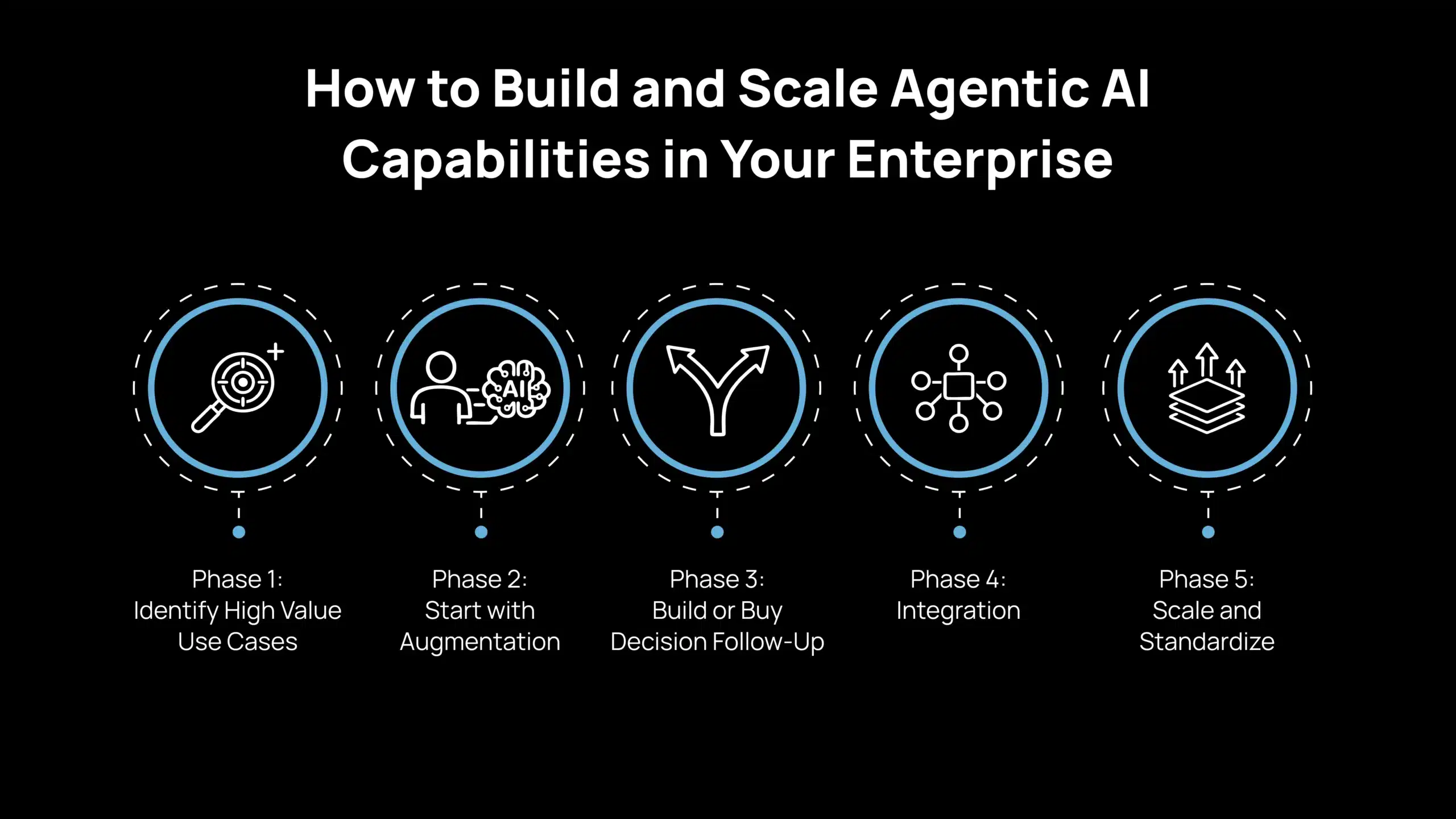
Adopting Agentic AI requires a structured approach that balances speed with control. The focus should be on delivering measurable outcomes early, while building a foundation for long-term scalability and governance.
Phase 1: Identify High Value Use Cases
The first step is to prioritize areas where Agentic AI can deliver immediate and measurable impact. The most suitable role involves repetitive tasks but still requires decision-making, such as campaign execution, lead qualification, or support ticket handling.
Functions with high labor costs and operational inefficiencies should be evaluated first, as they offer the strongest ROI potential. Each selected use case should also have clearly defined success metrics, such as reduced turnaround time, cost savings, or improved conversion rates.
This phase ensures that initial efforts are focused on business-critical outcomes rather than experimental use cases.
Phase 2: Start with Augmentation
Instead of fully replacing existing workflows, the initial implementation should focus on augmenting teams. Hybrid models, where AI systems handle execution and humans provide oversight, reduce risk and improve adoption.
Pilot programs can be launched within specific teams or functions to validate performance in real-world conditions. These pilots help identify gaps, refine workflows, and build internal confidence before broader rollout. This approach allows controlled experimentation while maintaining operational stability.
Phase 3: Build or Buy Decision
At this stage, a clear decision must be made between adopting off-the-shelf solutions or building custom Agentic AI systems. Pre-built tools offer faster deployment and lower upfront investment, making them suitable for standard use cases.
Custom-built agents, on the other hand, provide greater flexibility and alignment with internal processes but require higher investment in development and maintenance.
Vendor evaluation should include criteria such as integration capabilities, scalability, security standards, customization options, and ongoing support. This ensures alignment with both current needs and future expansion plans.
Phase 4: Integration
The effectiveness of Agentic AI depends heavily on its ability to operate within the existing technology ecosystem. Integration with core systems, such as CRM, ERP, and marketing platforms, is essential for enabling real-time data access and action execution.
Establishing reliable data pipelines ensures that the AI system can retrieve, process, and act on accurate information. Poor data quality or fragmented systems can limit performance and reduce trust in outcomes.
This phase focuses on embedding AI into operational workflows rather than treating it as a standalone tool.
Phase 5: Scale and Standardize
Once initial implementations demonstrate success, the focus should shift to scaling across functions and standardizing usage. Developing internal playbooks helps ensure consistent deployment, usage patterns, and performance benchmarks.
Governance policies must also be established to address areas such as data security, accountability for decisions, and performance monitoring. Clear guidelines reduce risk while enabling broader adoption across the organization. This phase transforms Agentic AI from a series of isolated initiatives into a core operational capability.
The Future of Work: What CEOs Should Prepare For
The shift toward Agentic AI is not just a technology upgrade; it is a fundamental change in how work is structured, measured, and scaled. Leadership decisions will increasingly revolve around capability building rather than team expansion.
1. Shift from Headcount to Capability
Traditional growth models have relied on increasing headcount to drive output. This approach is becoming less efficient as labor costs rise and productivity gains plateau. The emerging model focuses on capability per employee, where a smaller team is augmented by AI systems that extend execution capacity.
Organizations such as Shopify and Klarna have publicly used AI to improve productivity without proportionally increasing hiring. In Klarna’s case, AI-driven customer support systems have handled a significant share of queries, reducing the need for large support teams while maintaining service levels.
This shift requires redefining how performance is measured, from output per employee to output per system (human + AI combined).
2. AI–Human Collaboration Models
The future operating model is not AI replacing humans, but AI working alongside them in structured workflows. AI systems handle execution, data processing, and repetitive decision-making, while human teams focus on strategy, oversight, and exception handling.
For example, in marketing teams, AI can manage campaign execution and optimization loops, while humans define positioning, creative direction, and strategic priorities. In sales, AI can qualify leads and manage follow-ups, allowing teams to focus on closing high-value deals.
Companies like Microsoft are already embedding AI copilots into everyday workflows, enabling employees to operate with significantly higher efficiency. This model shifts roles from “doing tasks” to managing and guiding intelligent systems.
3. New Organizational Structures
As Agentic AI takes over execution-heavy workflows, organizations are moving toward leaner team structures. Smaller, cross-functional teams can now achieve what previously required larger departments.
This does not reduce the importance of talent it increases the importance of high-leverage roles that can design, supervise, and optimize AI-driven processes. The result is a structure where fewer people drive greater outcomes, supported by scalable AI systems.
Early adopters in the technology and e-commerce sectors are already demonstrating a shift, where companies can launch products, run campaigns, and manage operations that were previously not feasible.
How Avahi Helps You Turn AI Into Real Business Results?
If your goal is to apply AI in practical ways that deliver measurable business impact, Avahi offers solutions designed specifically for real-world challenges. Avahi enables organizations to quickly and securely adopt advanced AI capabilities, supported by a strong cloud foundation and deep AWS expertise.
Avahi AI solutions deliver business benefits such as:
- Round-the-Clock Customer Engagement
- Automated Lead Capture and Call Management
- Faster Content Creation
- Quick Conversion of Documents Into Usable Data
- Smarter Planning Through Predictive Insights
- Deeper Understanding of Visual Content
- Effortless Data Access Through Natural Language Queries
- Built-In Data Protection and Regulatory Compliance
- Seamless Global Communication Through Advanced Translation and Localization
By partnering with Avahi, organizations gain access to a team with extensive AI and cloud experience committed to delivering tailored solutions. The focus remains on measurable outcomes, from automation that saves time and reduces costs to analytics that improve strategic decision-making to AI-driven interactions that elevate the customer experience.
Discover Avahi’s AI Platform in Action
At Avahi, we empower businesses to deploy advanced Generative AI that streamlines operations, enhances decision-making, and accelerates innovation, all with zero complexity.
As your trusted AWS Cloud Consulting Partner, we empower organizations to harness the full potential of AI while ensuring security, scalability, and compliance with industry-leading cloud solutions.
Our AI Solutions Include
- AI Adoption & Integration – Leverage Amazon Bedrock and GenAI to Enhance Automation and Decision-Making.
- Custom AI Development – Build intelligent applications tailored to your business needs.
- AI Model Optimization – Seamlessly switch between AI models with automated cost, accuracy, and performance comparisons.
- AI Automation – Automate repetitive tasks and free up time for strategic growth.
- Advanced Security & AI Governance – Ensure compliance, detect fraud, and deploy secure models.
Want to unlock the power of AI with enterprise-grade security and efficiency?
Start Your AI Transformation with Avahi Today!
Frequently Asked Questions
1. How can Agentic AI create measurable ROI for enterprises?
Agentic AI improves ROI by automating multi-step workflows, reducing labor costs, increasing execution speed, and continuously optimizing outcomes.
2. What are the best use cases to start with Agentic AI?
The most effective starting points are repetitive, decision-heavy workflows such as campaign execution, lead qualification, customer support, and reporting.
3. How is Agentic AI different from generative AI in business applications?
Generative AI creates content, while Agentic AI takes action—planning, executing, and improving workflows to achieve business goals.
4. What is the cost comparison between Agentic AI and hiring employees?
Agentic AI typically entails lower incremental costs and scales more quickly, whereas hiring increases fixed costs and scales linearly with headcount.
5. What should enterprises consider before implementing Agentic AI?
Enterprises should focus on use-case selection, integration with existing systems, data quality, and on defining clear success metrics before deployment.