

TL;DR
|
Enterprise adoption of artificial intelligence has accelerated rapidly in the past few years. Recent research shows that 78% of organizations now use AI in at least one business function, a significant increase compared to adoption levels just a few years ago.
Despite this growth, most implementations remain focused on isolated capabilities such as analytics, automation, or generative content.
Consider a logistics enterprise using AI to analyze supply chain performance. The system can identify delays, predict demand fluctuations, and summarize operational reports. Yet when disruptions occur, human teams still coordinate the response. Analysts interpret the insights, operations managers adjust delivery schedules, and procurement teams contact vendors. The AI system provides intelligence, but the execution still relies on manual coordination.
This gap highlights the next challenge in enterprise AI strategy. Organizations have successfully deployed models that generate insights, but operational decision-making remains fragmented across systems and teams.
Industry forecasts indicate that the next wave of AI will focus on systems capable of executing actions rather than simply producing insights. Gartner predicts that 40% of enterprise applications will embed task-specific AI agents by 2026, signaling a shift toward autonomous, agent-driven architectures.
For enterprises planning long-term AI investments, the question is no longer whether to adopt AI. The focus has shifted to how AI architectures evolve to support scalable, autonomous business operations.
How Enterprise AI Has Expanded Across Multiple Technology Phases
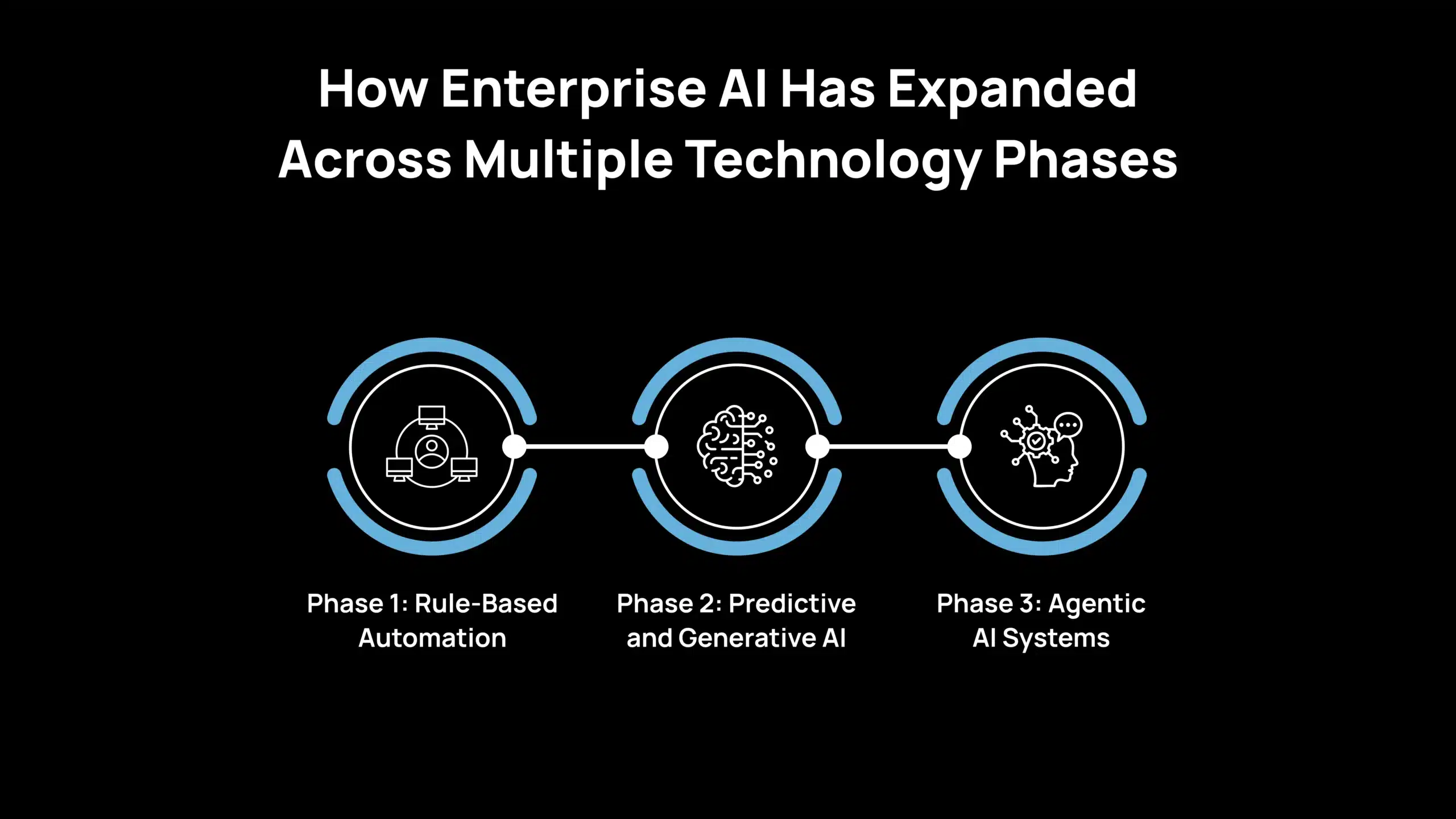
Enterprise AI did not emerge as a fully autonomous capability. Most organizations have progressed through several stages of AI maturity, each expanding the role of automation and intelligence within business operations. Early automation focused on executing predefined instructions. Later advancements introduced machine learning models capable of analyzing data and generating insights.
Today, enterprises are entering a new phase where AI systems can coordinate tasks and execute workflows across business systems.
Phase 1: Rule-Based Automation
The earliest form of enterprise automation relied on rule-based systems that executed repetitive tasks according to predefined logic. These technologies automated structured workflows that previously required manual intervention.
Common examples include:
- Robotic Process Automation (RPA) systems automate repetitive digital tasks such as data entry and form processing.
- Business rule engines that enforce predefined decision rules within enterprise software.
- Workflow automation platforms are used to manage approval processes, notifications, and task routing.
These systems operate on deterministic logic, meaning they follow explicit instructions written by developers or system administrators.
Typical characteristics include:
- Execution of predefined rules and workflows.
- Automation of repetitive operational tasks.
- Limited ability to interpret context or adapt to new inputs.
Rule-based automation significantly improved operational efficiency across finance operations, HR processing, and customer service workflows. However, these systems were not designed to handle complexity or variability.
Several limitations eventually became clear:
- Brittle systems: Minor changes in input formats or business rules could break workflows.
- No contextual reasoning: Systems could not interpret unstructured data or adapt to unexpected scenarios.
- Limited integration: Automation often remained confined to individual applications without coordination across enterprise systems.
These constraints necessitated more intelligent systems capable of learning from data.
Phase 2: Predictive and Generative AI
The second phase of enterprise AI introduced machine learning and generative AI models capable of analyzing large volumes of data, identifying patterns, and generating insights or content.
Unlike rule-based systems, these models learn from historical data and continuously improve as more data becomes available.
Major capabilities introduced during this phase include:
- Predictive analytics that forecasts trends, demand patterns, or operational risks.
- Recommendation systems that personalize user experiences or suggest next actions.
- Conversational AI is used in virtual assistants and customer support systems.
- Content generation is powered by large language models capable of producing text, summaries, and reports.
These capabilities significantly expanded the scope of AI within enterprise workflows.
Common enterprise applications include:
- AI-powered customer support assistants that handle common queries.
- Automated marketing content generation for campaigns and product descriptions.
- Document summarization systems are used in legal, financial, and research environments.
- Data analytics platforms that surface insights for business decision-making.
Organizations are increasingly using AI across multiple business functions, with operations, marketing, and service functions leading adoption.
Despite these advancements, most AI deployments in this phase remain model-centric. AI systems generate insights, predictions, or recommendations, but humans still coordinate the actions needed to implement them.
This creates several limitations:
- Model-centric architectures that focus on prediction rather than execution.
- Human-driven workflows where employees translate AI insights into operational actions.
- Limited autonomy prevents AI systems from independently coordinating multi-step processes.
These constraints have driven the emergence of the next stage of enterprise AI evolution.
Phase 3: Agentic AI Systems
Agentic AI represents the next stage in enterprise AI architecture. Instead of functioning only as analytical models, agentic AI systems operate as autonomous agents capable of planning, reasoning, and executing tasks.
Agentic AI systems are designed to:
- Reason about goals and available data.
- Plan multi-step workflows required to achieve those goals.
- Interact with external systems and APIs across enterprise infrastructure.
- Execute actions autonomously within defined operational boundaries.
This architecture allows AI to move beyond generating insights toward managing processes.
In traditional generative AI systems, interaction is primarily prompt-driven. A user asks a question, the model generates an answer, and a human decides what to do next.
Agentic AI changes this interaction model. Instead of responding to prompts alone, agents can:
- Evaluate business objectives
- Determine the actions required to achieve those objectives
- Interact with APIs or enterprise platforms
- Coordinate tasks across multiple systems
This transition shifts AI from advisory intelligence to operational execution.
As enterprise systems become more interconnected and data-driven, agentic AI architectures allow organizations to automate complex workflows that previously required human coordination. This capability is increasingly central to enterprise AI strategies focused on scalability, operational efficiency, and faster decision-making.
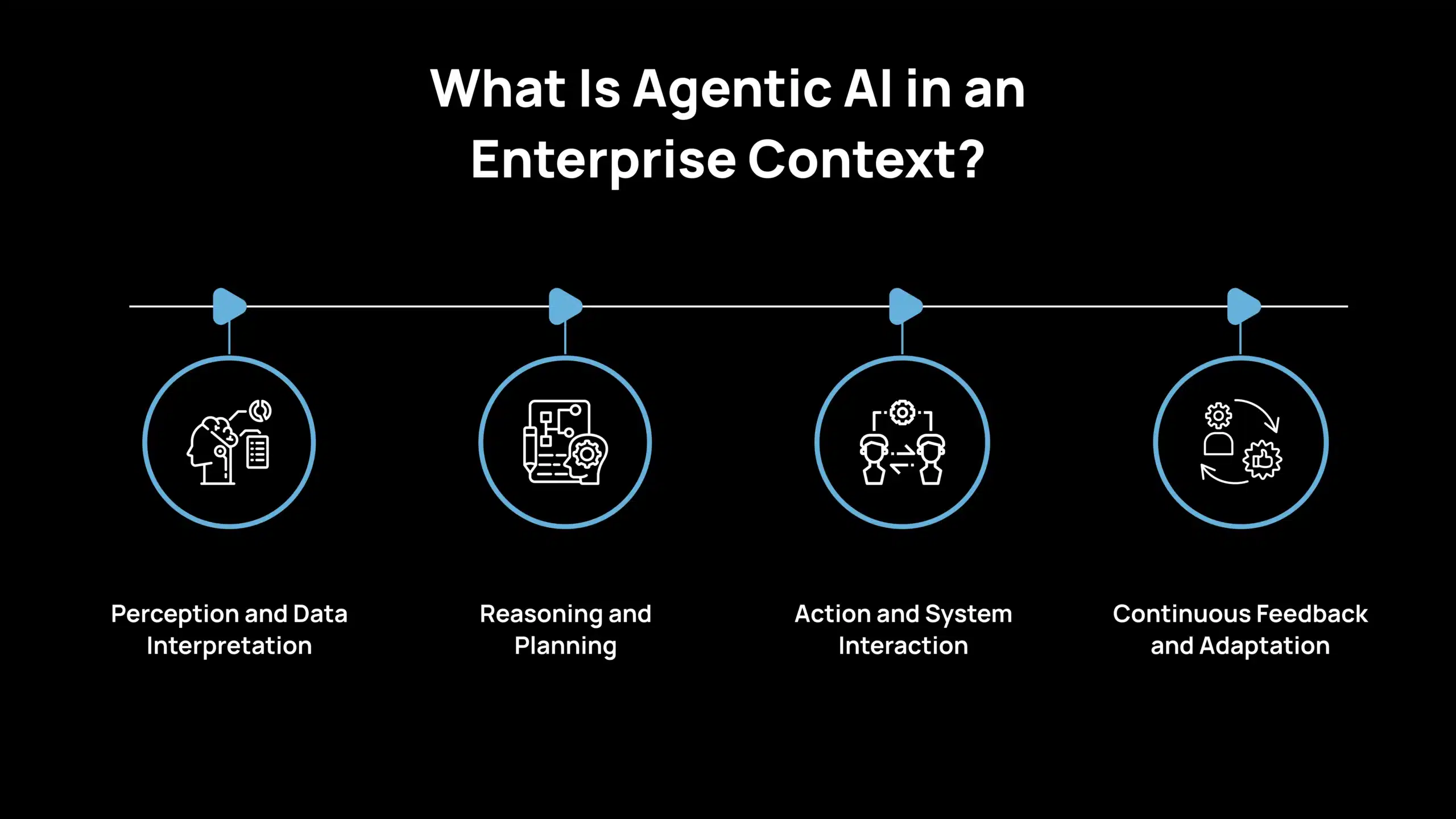
What Is Agentic AI in an Enterprise Context?
| Agentic AI refers to a class of artificial intelligence systems capable of autonomous reasoning, planning, and action execution within enterprise environments. |
These systems operate as goal-driven software agents that analyze data, determine appropriate actions, and interact with business systems to complete multi-step tasks without continuous human direction.
Within an enterprise environment, agentic AI functions as an operational layer that connects intelligence with execution. These systems integrate large language models, data pipelines, orchestration frameworks, and application interfaces to perform complex tasks that typically require human coordination.
Gartner forecasts that by 2028, at least 15 percent of day-to-day business decisions will be made autonomously through agentic AI systems, compared with almost none in 2024. This shift reflects increasing enterprise demand for AI that can move beyond analysis and actively manage operational processes.
Perception and Data Interpretation
Agents continuously gather and interpret data from enterprise sources such as operational databases, knowledge repositories, application logs, and external APIs. This capability allows the system to maintain awareness of changing business conditions and operational metrics.
Reasoning and Planning
Once data is interpreted, the system evaluates objectives and determines the sequence of actions required to achieve them. Reasoning engines and large language models help agents analyze context, evaluate constraints, and prioritize tasks.
For example, an agent supporting supply chain operations may evaluate inventory levels, demand forecasts, and vendor performance before determining whether to adjust procurement schedules.
Action and System Interaction
Agentic AI systems can interact directly with enterprise platforms to execute decisions. This may involve triggering workflows, updating records, sending notifications, or coordinating actions across multiple applications such as ERP, CRM, or logistics platforms.
Continuous Feedback and Adaptation
Many agentic architectures incorporate feedback loops that allow agents to evaluate outcomes and adjust future actions. This continuous learning process improves operational performance over time and enables systems to adapt to changing conditions.
In practice, agentic AI allows organizations to move beyond AI that simply produces insights. Instead, enterprises can deploy systems that monitor environments, coordinate decisions, and execute multi-step processes across business operations. This capability ensures scalable AI-driven automation and is increasingly becoming a central component of modern enterprise AI strategies.
Why Conventional AI Architectures Limit Enterprise Growth
Many organizations have deployed machine learning models, generative AI tools, and analytics platforms that generate valuable insights. However, most enterprise AI implementations still rely on architectures built around individual models rather than coordinated operational systems. As organizations scale their AI initiatives, this model-centric approach begins to reveal structural limitations.
Conventional AI architectures typically follow a simple interaction flow where a user submits a query and the AI model produces a response. While effective for tasks such as analytics, content generation, or knowledge retrieval, these systems rarely execute actions across enterprise workflows. AI outputs often remain advisory, requiring human teams to interpret results and coordinate the next steps across multiple platforms.
Several limitations emerge from this approach:
- No workflow execution: AI systems provide insights but cannot initiate multi-step business processes or operational tasks.
- Fragmented AI environments: Multiple AI tools operate independently, creating data silos and inconsistent decision logic.
- Human bottlenecks: Employees must translate AI insights into actions, slowing decision cycles and limiting automation at scale.
These constraints prevent AI from functioning as an integrated operational capability. Agentic AI architectures address this gap by enabling systems to coordinate workflows, interact with enterprise platforms, and autonomously execute actions.
Where Agentic AI Fits in an Enterprise Growth Roadmap
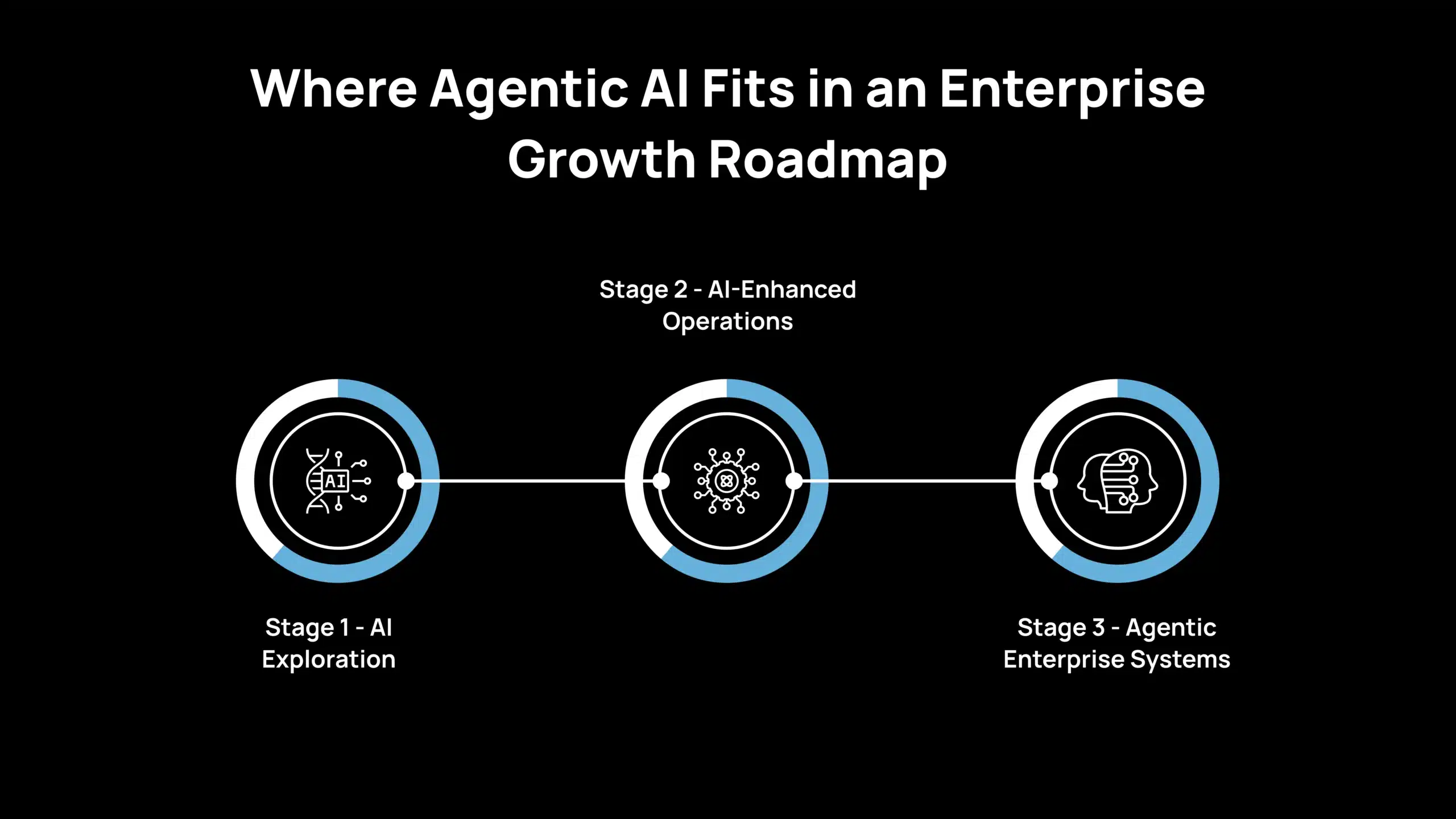
Adopting agentic AI requires more than deploying advanced models. Organizations must align AI capabilities with their broader technology and business strategy to scale automation effectively. Enterprise AI maturity typically evolves through three stages.
Stage 1 – AI Exploration
Organizations experiment with AI through proof-of-concept projects and pilot deployments. Common initiatives include chatbots, document analysis tools, and internal assistants that improve knowledge access or reporting. This stage helps teams understand AI capabilities and identify potential use cases, but systems remain isolated and limited in operational impact.
Stage 2 – AI-Enhanced Operations
AI begins integrating with enterprise workflows. Organizations automate repetitive tasks, support decision-making with predictive analytics, and connect AI systems with business platforms. Cloud AI infrastructure, data pipelines, and governance frameworks become critical to scaling adoption.
Stage 3 – Agentic Enterprise Systems
AI evolves into autonomous operational systems. Agentic AI manages workflows, analyzes data continuously, and coordinates actions across enterprise platforms, enabling digital workforces that operate business processes with minimal human intervention.
Core Architecture of Agentic AI Systems
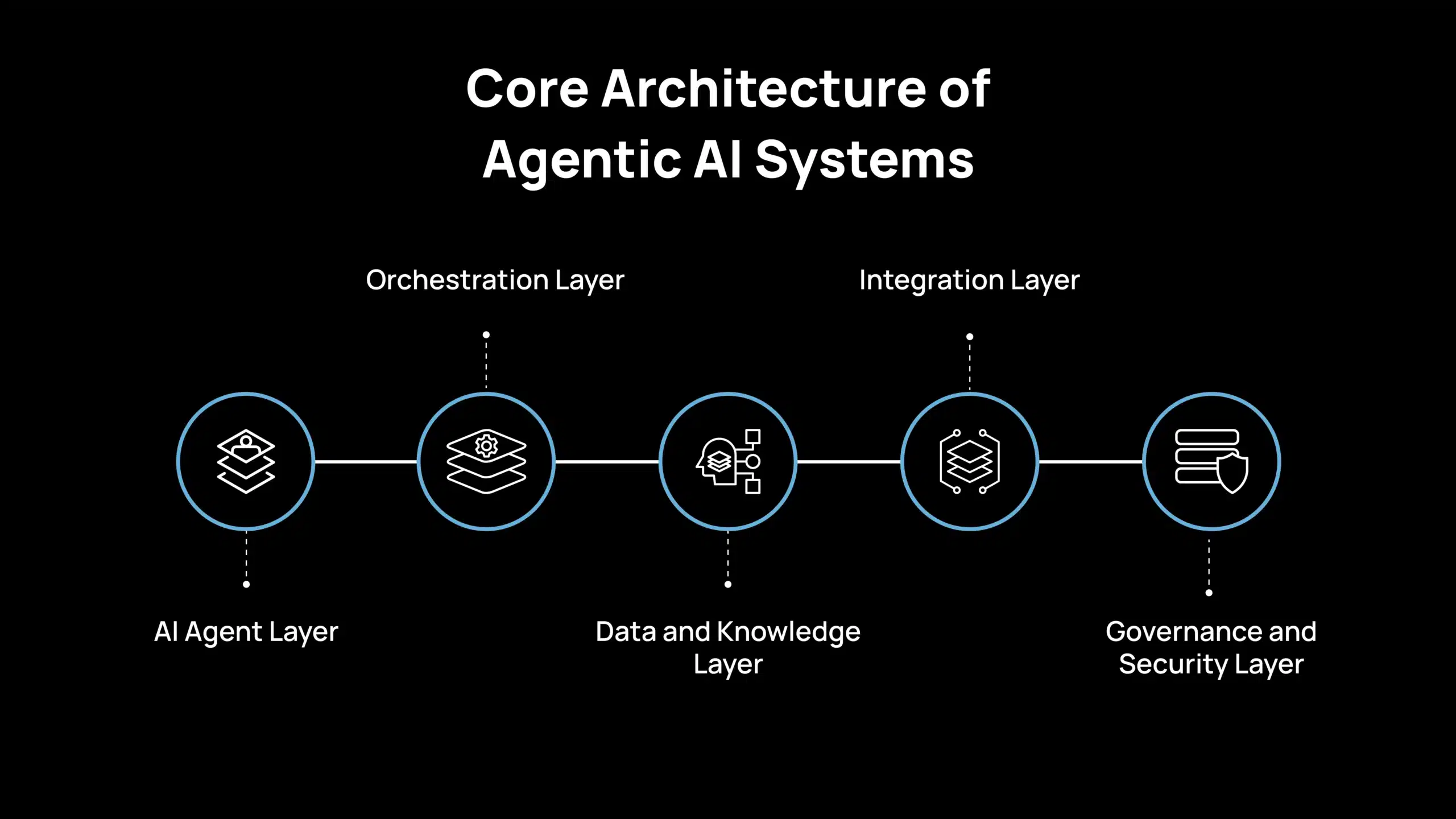
Implementing agentic AI requires a layered architecture that supports autonomous decision-making and coordination across enterprise systems.
These architectures typically include several interconnected components.
AI Agent Layer
The AI agent layer consists of specialized agents responsible for specific operational functions. Each agent is designed to interpret data, make decisions, and execute actions within its defined domain.
Examples include:
- Customer service agents who manage support requests and customer interactions
- Financial analysis agents that monitor financial performance and detect anomalies
- IT monitoring agents that oversee infrastructure health and performance
Specialized agents allow organizations to distribute intelligence across different operational domains.
Orchestration Layer
The orchestration layer coordinates the activities of multiple agents and ensures that workflows execute in the correct sequence.
Primary responsibilities include:
- Task distribution between agents
- Workflow planning and prioritization
- Coordination between systems and agents
This layer functions as the operational control center for the agentic system.
Data and Knowledge Layer
AI agents require contextual intelligence to make effective decisions. The data and knowledge layer provides the structured and unstructured data needed to support reasoning and planning.
Typical components include:
- Enterprise data lakes
- Knowledge graphs
- Vector databases used for semantic search and contextual retrieval
These systems ensure that agents have access to relevant information across the enterprise environment.
Integration Layer
The integration layer connects AI agents with enterprise platforms and operational systems.
Common integrations include:
- Enterprise Resource Planning (ERP) systems
- Customer Relationship Management (CRM) platforms
- Supply chain management software
- External APIs and third-party services
This connectivity allows agents to execute actions directly within business applications.
Governance and Security Layer
Governance and security frameworks are critical for enterprise adoption of agentic AI.
Organizations must ensure that autonomous systems operate within defined boundaries and comply with regulatory requirements.
Capabilities typically include:
- Access control mechanisms
- Model monitoring and performance tracking
- Compliance and auditing systems
- Explainability features that allow teams to understand AI decisions
Explainable AI and strong oversight frameworks help maintain trust in autonomous systems while reducing operational risks.
Practical Enterprise Use Cases for Agentic AI
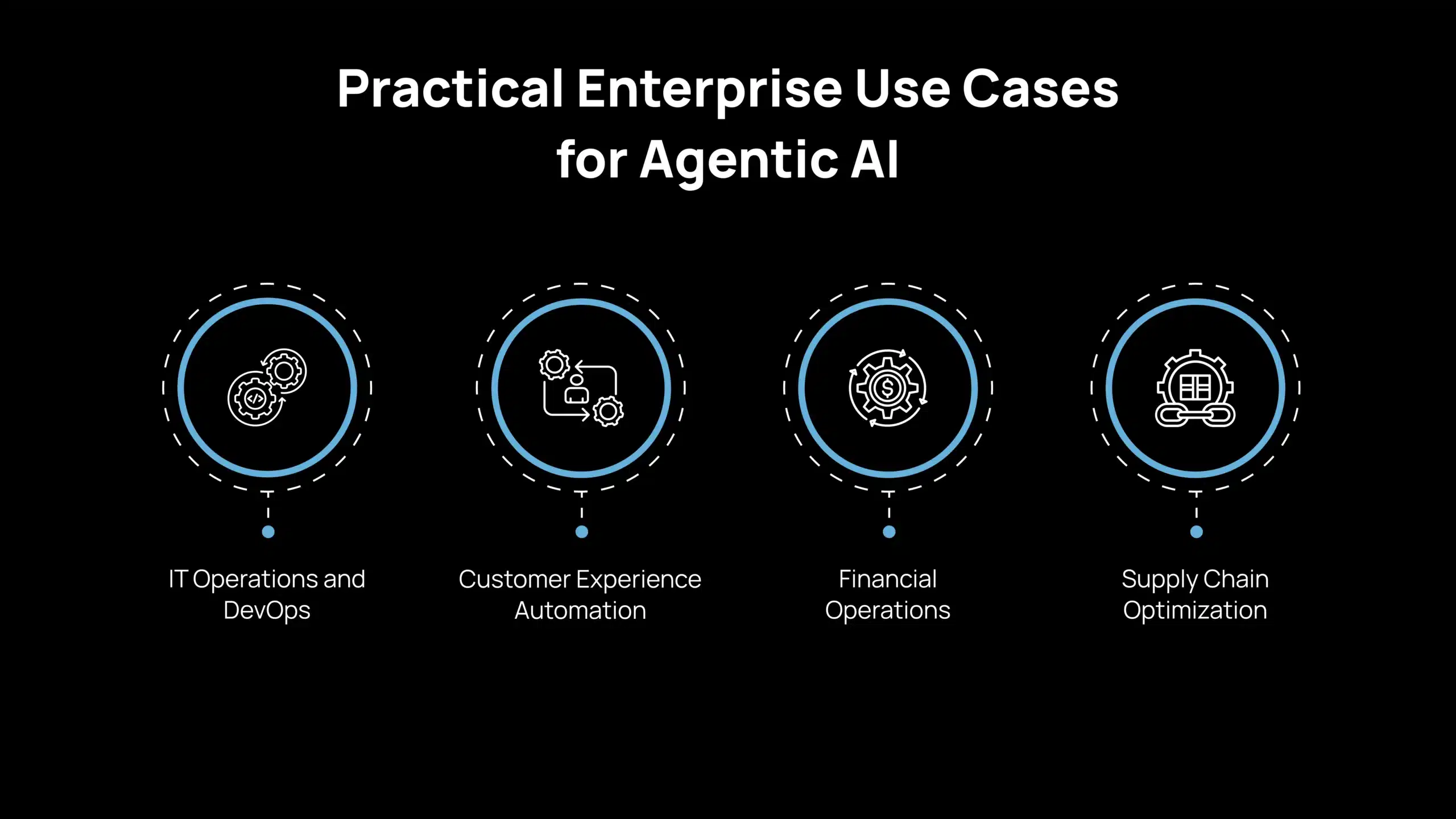
Agentic AI is already being applied across multiple enterprise functions where complex workflows and large data volumes require continuous decision-making.
IT Operations and DevOps
IT operations teams manage complex infrastructure environments across cloud platforms, applications, and network systems.
Agentic AI can monitor infrastructure performance and respond to operational incidents automatically.
Typical actions include:
- Detecting anomalies in system performance
- Restarting services or allocating resources
- Creating incident tickets and notifying engineers
IT operations are among the earliest adopters of agentic AI technologies, due to the need for continuous monitoring and rapid response.
Customer Experience Automation
Customer service operations increasingly rely on AI agents to handle interactions across digital channels.
Agentic systems can manage multiple aspects of the customer experience, including:
- Answering customer queries
- Providing order updates
- Coordinating service resolution
AI agents can also analyze customer sentiment, prioritize urgent issues, and escalate complex cases to human agents when necessary.
Financial Operations
Financial teams must process large volumes of transactions and maintain strict oversight of financial activities.
Agentic AI can support functions such as:
- Fraud detection and anomaly identification
- Financial forecasting and performance monitoring
- Expense monitoring and compliance checks
These capabilities allow organizations to identify financial risks earlier and improve operational efficiency.
Supply Chain Optimization
Supply chains involve multiple variables, including demand fluctuations, supplier performance, and logistics constraints.
Agentic AI systems can coordinate multiple supply chain activities simultaneously.
Agents can manage tasks such as:
- Monitoring inventory levels
- Adjusting logistics plans
- Forecasting demand patterns
This coordination enables faster responses to supply chain disruptions and improves overall operational efficiency.
Operational Benefits of Agentic AI for Enterprises
Organizations that integrate agentic AI into their enterprise architecture gain significant operational and strategic advantages.
- Operational efficiency: Automates complex workflows and reduces manual coordination, lowering operational costs and accelerating processes.
- Scalability: Enables automation to run in parallel across departments, allowing organizations to handle larger workloads without increasing manual effort.
- Continuous decision intelligence: Continuously analyzes enterprise data to deliver faster insights and support proactive operational adjustments.
- Competitive advantage: Improves agility and innovation speed, helping organizations respond quickly to market changes and business opportunities.
These capabilities allow enterprises to scale AI-driven operations while maintaining efficiency, adaptability, and stronger strategic decision-making.
Challenges Enterprises Must Address Before Deploying Agentic AI
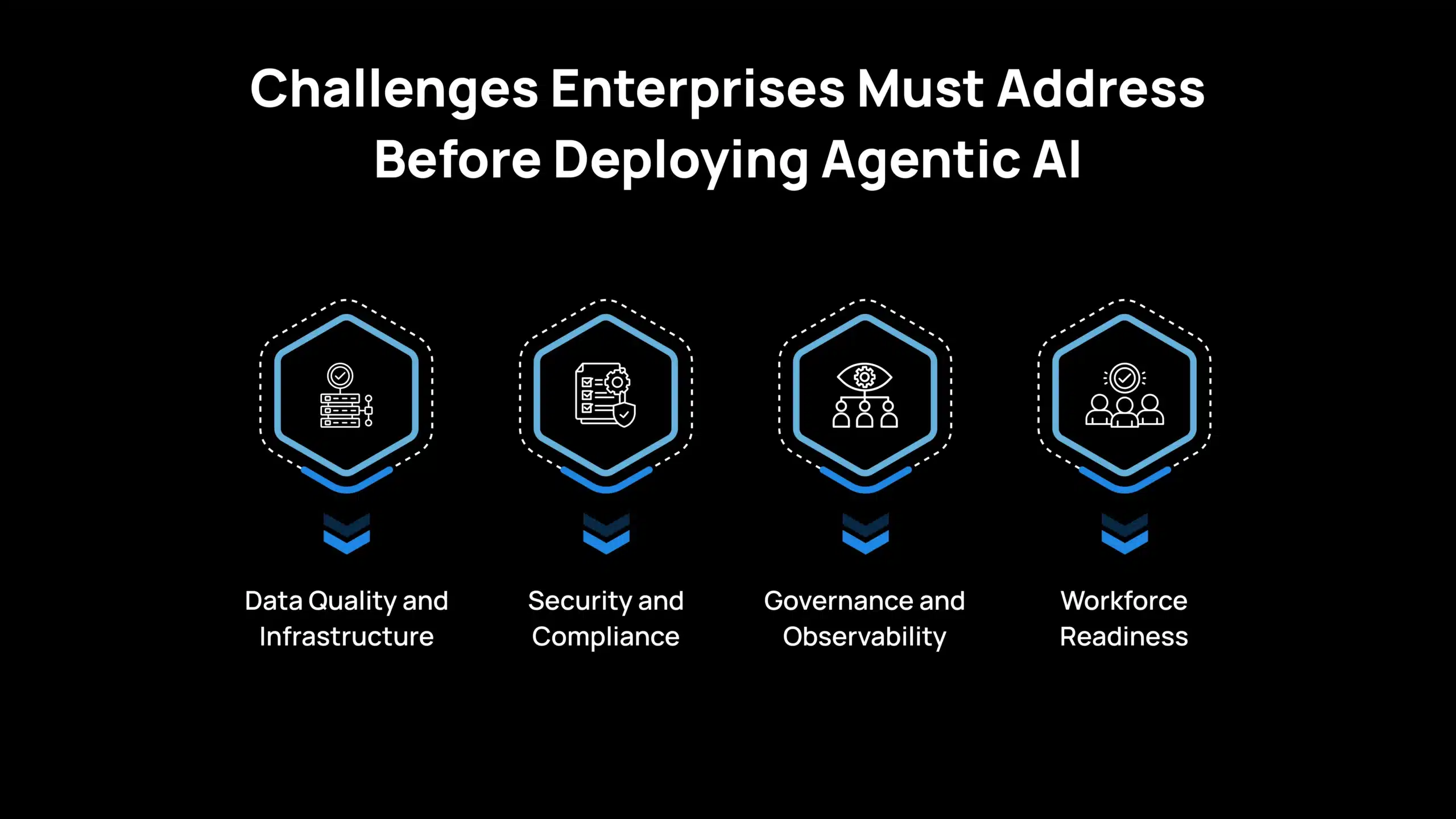
Despite its potential, implementing agentic AI requires careful planning and governance.
Data Quality and Infrastructure
AI agents rely heavily on high-quality enterprise data.
Organizations must ensure:
- Structured data environments
- Reliable data pipelines
- Governance frameworks for data management
Security and Compliance
Agentic AI interacts with sensitive enterprise systems. Strong security measures are essential.
Organizations must implement:
- Access controls
- Continuous monitoring
- Auditing capabilities
Governance and Observability
Many agentic AI initiatives fail due to weak governance frameworks.
Research suggests that nearly 40 percent of agentic AI projects may be canceled because of unclear business value or inadequate risk controls.
Establishing observability and governance frameworks early helps prevent these issues.
Workforce Readiness
Adopting agentic AI introduces new organizational roles.
Enterprises may require specialists such as:
- AI orchestration specialists
- AI governance leads
- Automation architects
These roles ensure that agentic systems operate effectively within enterprise environments.
How Avahi Helps You Turn AI Into Real Business Results?
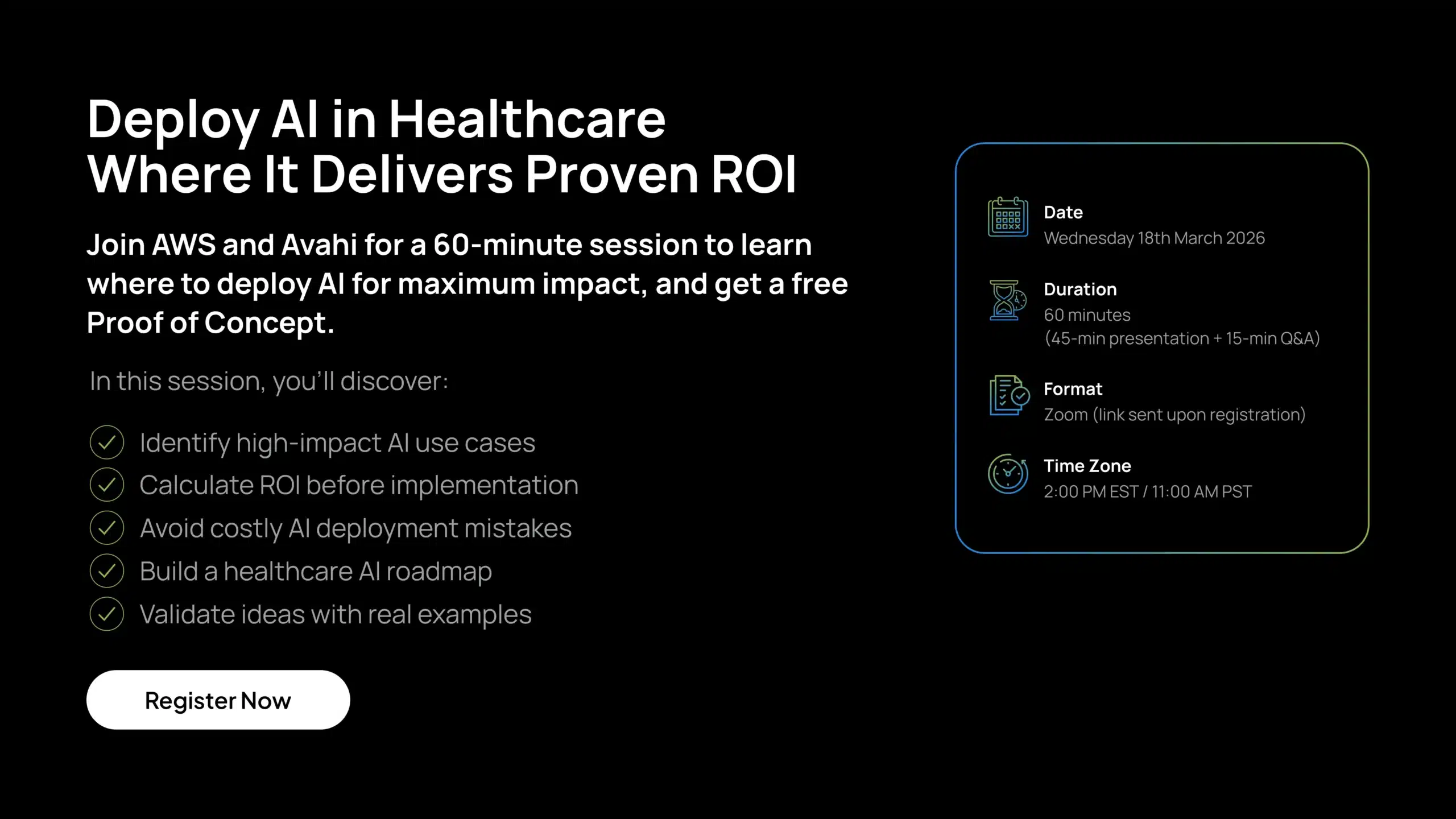
If your goal is to apply AI in practical ways that deliver measurable business impact, Avahi offers solutions designed specifically for real-world challenges. Avahi enables organizations to quickly and securely adopt advanced AI capabilities, supported by a strong cloud foundation and deep AWS expertise.
Avahi AI solutions deliver business benefits such as:
- Round-the-Clock Customer Engagement
- Automated Lead Capture and Call Management
- Faster Content Creation
- Quick Conversion of Documents Into Usable Data
- Smarter Planning Through Predictive Insights
- Deeper Understanding of Visual Content
- Effortless Data Access Through Natural Language Queries
- Built-In Data Protection and Regulatory Compliance
- Seamless Global Communication Through Advanced Translation and Localization
By partnering with Avahi, organizations gain access to a team with extensive AI and cloud experience committed to delivering tailored solutions. The focus remains on measurable outcomes, from automation that saves time and reduces costs to analytics that improve strategic decision-making to AI-driven interactions that elevate the customer experience.
Discover Avahi’s AI Platform in Action
At Avahi, we empower businesses to deploy advanced Generative AI that streamlines operations, enhances decision-making, and accelerates innovation, all with zero complexity.
As your trusted AWS Cloud Consulting Partner, we empower organizations to harness the full potential of AI while ensuring security, scalability, and compliance with industry-leading cloud solutions.
Our AI Solutions Include
- AI Adoption & Integration – Leverage Amazon Bedrock and GenAI to Enhance Automation and Decision-Making.
- Custom AI Development – Build intelligent applications tailored to your business needs.
- AI Model Optimization – Seamlessly switch between AI models with automated cost, accuracy, and performance comparisons.
- AI Automation – Automate repetitive tasks and free up time for strategic growth.
- Advanced Security & AI Governance – Ensure compliance, detect fraud, and deploy secure models.
Want to unlock the power of AI with enterprise-grade security and efficiency? Start Your AI Transformation with Avahi Today.
Register Now!
Frequently Asked Questions
1. What is agentic AI in enterprise systems?
Agentic AI refers to autonomous AI systems capable of interpreting data, planning workflows, and executing tasks across enterprise environments. Unlike traditional AI models that generate insights, agentic systems can coordinate operational processes and trigger actions within business systems.
2. How does agentic AI differ from traditional AI automation?
Traditional AI systems focus on analytics or content generation. Agentic AI systems combine reasoning, planning, and execution capabilities, enabling them to manage workflows and interact with enterprise platforms autonomously.
3. What infrastructure is required to deploy agentic AI?
Enterprises typically require cloud AI platforms, data pipelines, orchestration frameworks, enterprise integrations, and governance systems to support agentic AI deployments.
4. What industries benefit most from agentic AI?
Industries with complex operational workflows benefit the most, including logistics, finance, healthcare, manufacturing, and technology operations.
5. How can enterprises start implementing agentic AI?
Organizations typically begin with pilot deployments in areas such as IT operations, customer support, or analytics before expanding agentic systems across broader operational environments.
6. Is agentic AI safe for enterprise environments?
Yes, when implemented with strong governance frameworks, monitoring systems, and compliance controls, agentic AI can operate securely within enterprise environments. Proper oversight ensures systems function within defined boundaries and regulatory requirements.