

For any company with active production workloads, a migration is a real-money risk, not a routine IT task.
A move that stalls mid-cutover, leaks data, or doubles its budget hits revenue, customers, and trust at the same time.
The good news is that the failure modes are well understood and avoidable.
Here, we walk through the ten challenges that derail cloud migrations most often, what causes each one, and the concrete mitigation that defuses it, so you can pressure-test your plan before a single workload moves.
TL;DR
- The biggest cloud migration risks: cost overruns, security exposure, integration breakage, downtime, and skills gaps.
- Vendor lock-in, legacy compatibility, and weak governance compound the impact when ignored upfront.
- Mitigation hinges on dependency mapping, phased cutover, security-first design, and ongoing cost monitoring.
- At Avahi, we’re an AWS Premier Tier partner that cuts risk across planning, execution, and post-migration phases. Get your cloud migration assessment.
Cloud Migration Risk Matrix (At-a-Glance)
| Challenge | Business Impact | Likelihood | Primary Mitigation |
|---|---|---|---|
|
Cost overruns |
High | Very High |
FinOps tooling, reserved instances, ongoing rightsizing |
|
Data security and privacy |
Severe | High |
Encryption at rest and in transit, least-privilege IAM, DLP |
|
Compatibility |
Medium | High |
Application assessment, refactoring, containerization |
|
Integration |
Medium | High |
Pre-migration dependency mapping, API standards |
|
Data governance |
High (regulated) | Medium |
Centralized policies, lineage tracking, classification |
|
Vendor lock-in |
Medium | Medium |
Open standards, portable architectures, exit clauses |
|
Legacy system compatibility |
High | Medium |
Phased replatforming or replacement |
|
Scalability and performance |
Medium | Medium |
Right-sizing, auto-scaling config, load testing |
|
Skills gap |
High | Very High |
Partner engagement, training, cross-functional teams |
|
Data migration errors |
Severe | Medium |
Pilot migrations, validation, rollback plans |
What Causes Cloud Migrations to Fail?
Cloud migrations fail when assumptions made on day one collide with production reality. Most failures are not technical at root; they are planning failures that surface late, when they are expensive to fix.
At Avahi, our AWS cloud migration services catch these before cutover.
The most common root causes of failure are:
- Poor planning and an unrealistic timeline.
- Dependency blind spots that surface only at cutover.
- Underestimated cost and no spend visibility.
- A shortage of in-house cloud expertise.
- Weak governance and no rollback plan.
The 7 R’s of Cloud Migration (and Which Ones Invite the Most Risk)
Your migration strategy shapes which risks dominate. A lift-and-shift carries little refactor risk but invites cost overruns if you do not right-size afterward, while a full refactor trades short-term timeline risk for long-term payoff.
AWS expanded Gartner’s original 5 R’s framework into today’s 7 R’s. Check out the 7 R’s migration strategies.
| Strategy | Risk Profile |
|---|---|
|
Rehost (lift-and-shift) |
Lower refactor risk, higher cost risk if not right-sized post-migration |
|
Replatform |
Moderate refactor risk, moderate cost benefit |
|
Repurchase |
Low technical risk, vendor lock-in risk |
|
Refactor |
Highest technical and timeline risk, highest long-term payoff |
|
Retire |
None (decommission) |
|
Retain |
Defers risk, does not eliminate it |
|
Relocate |
Lower disruption, limited modernization benefit |
10 Cloud Migration Challenges
Each challenge below follows the same shape: what it is, why it bites, the mitigations that defuse it, and a real-world example where useful.
1. Compatibility
Older systems, applications, and third-party software were often built without cloud integration in mind. Moving them, whether from self-hosted infrastructure or another cloud, surfaces dependencies and behaviors that complicate the migration.
Why it bites: Hidden incompatibilities turn a planned cutover into an unplanned redevelopment project.
- Assess applications against the target cloud before committing a timeline.
- Refactor code where structure or performance blocks a clean move.
- Containerize workloads so they run consistently across environments.
- Adopt managed cloud services to replace brittle self-hosted components.
2. Integration
When applications and data do not connect cleanly across on-premises and cloud environments, you get data silos, downtime, and broken workflows. Large estates carry the most integration risk because so many systems depend on each other.
Why it bites: Pre-migration dependency mapping is the single biggest miss in failed migrations, and integration is where that miss shows up.
- Map application dependencies before any workload moves.
- Define API and interoperability standards early.
- Use staged cutovers so integrations are validated in pieces, not all at once.
3. Cost Management
Cloud spend escalates quietly through unused resources and the wrong pricing models. Cost transparency across every line, from compute to training, is what keeps a migration inside its budget. For a deeper breakdown, see our guide to cloud migration costs.
Why it bites: Without spend discipline, the bill arrives after the workloads are already live and hard to unwind.
- Monitor usage and right-size resources to match real demand.
- Use reserved instances or commitment plans for predictable workloads.
- Treat FinOps as an ongoing discipline, not a one-time tool install.
4. Data Security and Privacy
Moving data exposes it to unauthorized access, breaches, and compliance gaps, both in transit and once it lands. Security has to be designed before the first byte moves, not bolted on after.
Why it bites: A single misconfiguration during transfer can become a reportable breach.
- Encrypt data at rest and in transit, with managed keys through a service like AWS KMS.
- Apply least-privilege, role-based access controls.
- Require multi-factor authentication for cloud access.
- Turn on audit logging (for example, AWS CloudTrail) from day one.
- Add Data Loss Prevention controls for sensitive data.
5. Data Governance
Keeping data accurate, consistent, and compliant gets harder when it is spread across regions and services. Distribution without governance leads to inconsistency, security gaps, and compliance exposure.
Why it bites: In regulated industries, a governance gap is a regulatory finding waiting to happen.
- Define clear policies for how data is accessed, secured, and retained.
- Track data lineage and classify data so the right controls follow it.
- Set up validation and reconciliation to keep data consistent across services.
6. Vendor Lock-in
Leaning too heavily on one provider’s proprietary services limits your flexibility to change course later. The cost is reduced negotiating room and slower adoption of better options.
Why it bites: Lock-in quietly raises your switching cost until moving becomes impractical.
- Favor open standards and portable architectures.
- Use containers and microservices so workloads stay movable.
- Combine public cloud with private or on-premises systems where it makes sense.
- Agree exit terms and data-portability clauses before you sign.
7. Legacy System Compatibility
This is distinct from general compatibility. Legacy-specific issues include mainframe and COBOL workloads, license-locked applications, and systems with no cloud-ready equivalent. These rarely move cleanly.
Why it bites: A single un-migratable legacy system can hold an entire cutover hostage.
- Assess each legacy system for cloud readiness and constraints.
- Replatform where the core can move with minor change.
- Re-architect or replace systems that cannot run in the cloud as-is.
- Use middleware to bridge legacy and cloud during the transition.
8. Scalability and Performance
Cloud scales well only when it is configured to. Misconfigured auto-scaling or under-sized resources will buckle during demand spikes, which is exactly when it matters.
Why it bites: Performance failures tend to land during peak load, in front of customers.
- Right-size resources against current and projected demand.
- Configure auto-scaling thresholds for real usage patterns and spikes.
- Monitor performance continuously and adjust.
- Load-test before go-live to find bottlenecks early.
9. Skills Gap
Migrating and running cloud infrastructure needs skills most in-house teams have not fully built yet. The gap slows delivery and raises the chance of misconfiguration.
Why it bites: The do-it-yourself route often costs more in delay and hiring lag than partner engagement does.
- Train existing staff with hands-on cloud programs.
- Engage a partner to cover the gap during and after the move.
- Form cross-functional teams so cloud knowledge spreads internally.
10. Data Migration Errors and Rollback
The real fear here is not the plan; it is what happens when data corrupts, drops, or fails validation mid-cutover. Without a tested rollback, a bad migration becomes a recovery.
Why it bites: Data loss discovered after cutover is the hardest failure to walk back.
- Run pilot migrations on non-critical data first.
- Validate and reconcile migrated data for accuracy and completeness.
- Keep a tested rollback plan ready for every cutover step.
Avahi has handled these patterns in production, from a cross-cloud Sanas Azure-to-AWS migration to a HIPAA-relevant NorthBay Healthcare deployment, so the mitigations above are field-tested, not theoretical.
How To De-Risk a Cloud Migration: A 6-Step Framework
Listing risks is not enough; you need an order to apply the fixes in. This framework is the path from a list of risks to a migration you can trust. Step one pairs naturally with a structured cloud migration checklist.
- Migration readiness assessment. Inventory workloads, map dependencies, and scope compliance before anything moves.
- Strategy selection per workload. Pick the right R for each app rather than applying one approach to everything.
- Security and governance design upfront. Set IAM, encryption, audit logging, and data classification before the first byte moves.
- Pilot migration. Move a non-critical workload first and validate end to end.
- Phased cutover with rollback plans. Never big-bang; always keep a way back.
- Post-migration cost and performance review. Right-sizing after the move often recovers a meaningful share of spend in the first 90 days.
Real World Cloud Migration Success Stories
These two migrations show the mitigations above holding up under real production pressure, one cross-cloud and one in a regulated industry.
Sanas: Azure-to-AWS, 150 Million Files
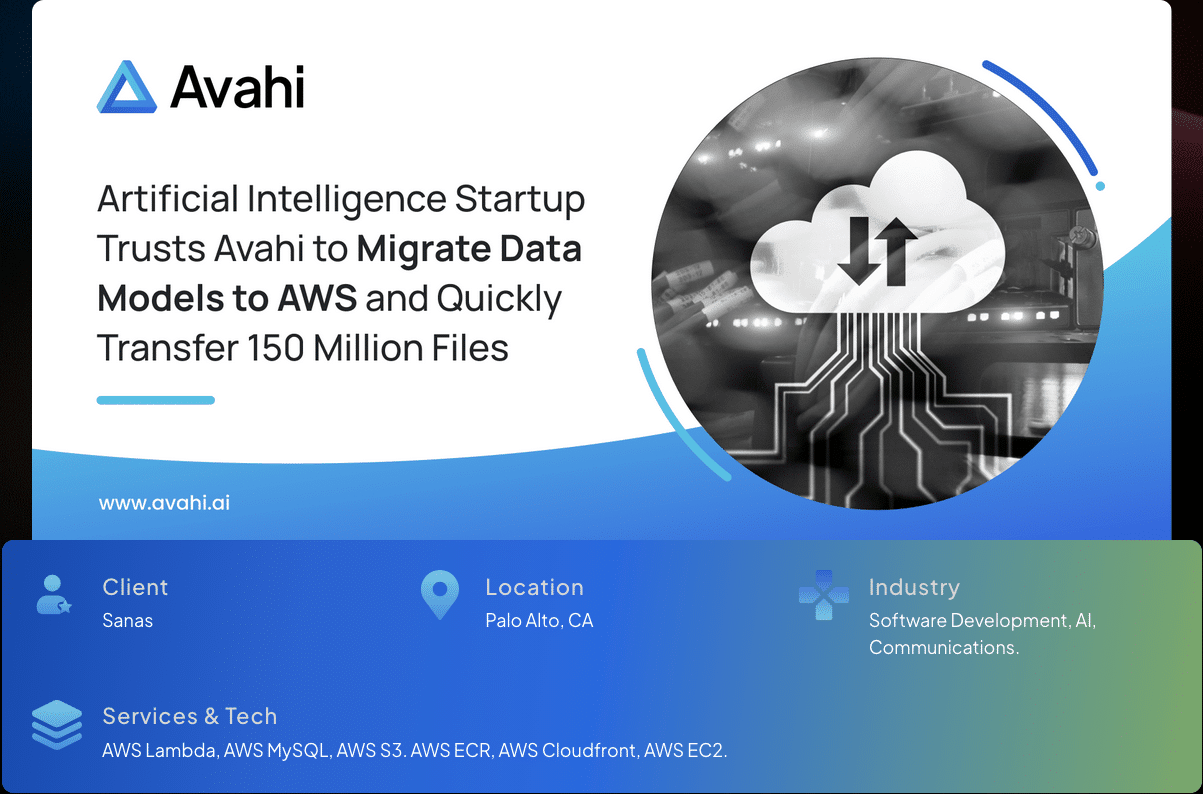
Sanas, an AI accent-translation startup, had infrastructure spread across AWS, Azure, and Google Cloud. As demand grew, it needed to consolidate on AWS and move 150 million database files off Microsoft SQL and PostgreSQL without disrupting model training.
We designed a Terraform-based architecture on Amazon ECS, piloted the transfer with AWS DataSync, then ran four parallel agents for the full move. The migration finished 50 percent faster than Sanas expected, with the training model verified before the old environment was shut down.
Read the full Sanas case study.
NorthBay Healthcare: HIPAA-Relevant Telehealth on AWS
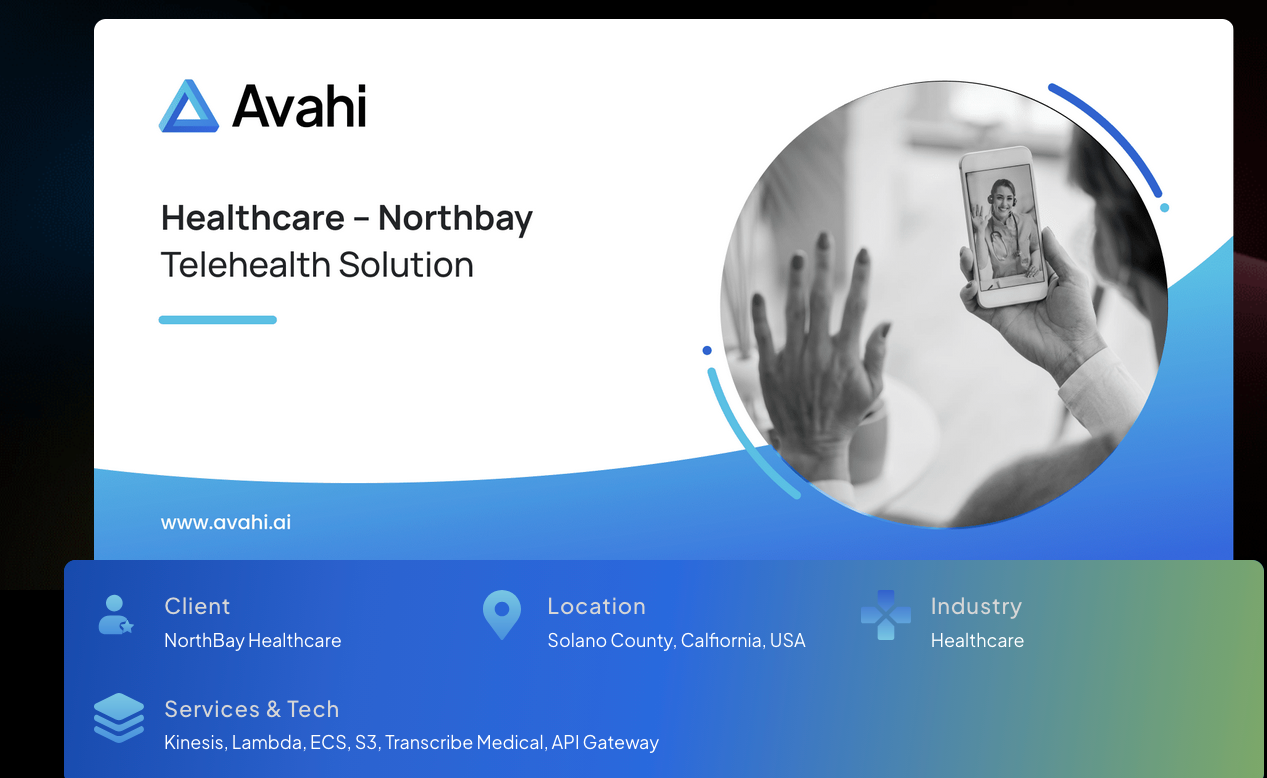
NorthBay, a Solano County nonprofit, wanted a virtual care program but lacked the in-house skills to build something secure, compliant, and integrated with its existing systems.
We delivered in two phases. Phase 1 shipped an MVP in weeks using Amazon Chime for live audio and video. Phase 2 connected the platform to scheduling and billing through serverless APIs, keeping cost low while visit volume scaled.
Read the full NorthBay Healthcare case study.
Choosing a Migration Partner: Why It Matters More Than the Tooling
Most cloud migration challenges are people and planning failures, not technology failures. The tooling matters less than the team running it.
At Avahi, we are an AWS Premier Tier Services Partner, the highest tier in the AWS Partner Network, with multiple AWS Competencies, 200+ cloud launches, and 100+ AWS certifications.
Our expert team is equipped to handle the complexities of migrating applications and data from on-premise data centers to the cloud. Our services include:
With years of experience in enterprise customer migrations, we tailor our plans to meet your needs.
Are you ready to transform your cloud strategy? Schedule your migration readiness assessment to scope your move with a senior AWS team.
Frequently Asked Questions
What Are the Biggest Challenges of Cloud Migration?
The top cloud migration challenges are system compatibility, integration breakage, cost management, data security, governance gaps, vendor lock-in, legacy system limits, scalability misconfiguration, skills gaps, and data migration errors. Each can affect the success and cost of your migration.
Why Is Compatibility a Significant Issue During Cloud Migration?
Compatibility becomes a challenge when legacy systems, outdated applications, or third-party software were not designed to run in cloud environments. That leads to integration failures, performance issues, or higher redevelopment costs. Application assessment, refactoring, or containerization are the most effective fixes.
How Does Integration Impact Cloud Migration Success?
Migration can disrupt workflows when applications or data do not connect cleanly across on-premises and cloud environments. Without dependency mapping and clear API standards, you get data silos, downtime, and access problems. Dependency mapping done before cutover is the single biggest miss in failed migrations.
Why Do Cloud Migration Costs Often Exceed Expectations?
Unexpected costs come from underused resources, inefficient pricing models, training needs, and no visibility into cloud spend. Without monitoring or cost discipline, organizations quickly exceed their budgets. FinOps practices such as reserved instances and right-sizing reduce that variance.
What Are the Data Security Risks During Cloud Migration?
Data can be exposed to unauthorized access, breaches, or compliance violations during transfer or once stored in the cloud. Without encryption at rest and in transit, least-privilege IAM, audit logging, and Data Loss Prevention, sensitive information is at real risk. Security should be designed before the first byte moves.
Can We Manage a Cloud Migration Ourselves Without a Partner?
Yes, a simple lift-and-shift of a few workloads is manageable in-house if your team has AWS-certified engineers and time to dedicate. Partner value compounds at scale, on complex dependency graphs, and in regulated environments where mistakes carry compliance consequences. Most teams underestimate the planning effort and the cost of getting it wrong.
How Does an AWS Premier Tier Partner Reduce Cloud Migration Risk?
AWS Premier Tier is the highest level in the AWS Partner Network, reflecting certified, multi-competency expertise and proven delivery. The partner owns dependency mapping, security design, phased cutover, and rollback planning across a structured four-phase process. That structure is the difference between a migration and a recovery.