TL;DR
|
Retailers lose nearly $1.1 trillion globally annually due to inventory distortion—stockouts and overstock combined. These numbers represent lost sales, frustrated customers, wasted resources, and strained profit margins.
Stockouts drive customers to competitors, while overstock ties up capital and increases storage costs. Conventional inventory management methods, often reliant on historical trends and manual oversight, struggle to keep pace with real-time market changes. This is where artificial intelligence (AI) steps in.
From predicting demand with precision to automating restocks and adjusting prices based on real-time insights, AI is helping businesses solve one of retail’s oldest challenges: maintaining the right amount of stock at the right time. In this blog, we’ll explore how AI in retail prevents stockouts and overstock by improving forecast accuracy, streamlining operations, and enabling more intelligent decision-making.
Common Inventory Challenges That Make AI in Retail a Strategic Necessity
Understanding the root causes of stock imbalances is the first step in recognizing why AI in retail is necessary. Here are a few of the challenges faced by retailers while managing inventory:
1. Stockouts: Missed Sales and Lost Customers
Stockouts occur when a product is unavailable for purchase because it is not in stock. This happens when demand is underestimated or supply chain delays prevent timely replenishment.
Seasonal spikes, promotional activity, or regional demand shifts can also catch retailers off guard. The consequences are immediate: shoppers turn to competitors, sales are lost, and customer trust weakens. In many cases, retailers are forced to restock products urgently, incurring additional logistics and supplier fees.
2. Overstock: Excess Inventory That Hurts Profitability
Overstock refers to surplus products that remain unsold for long periods. It often stems from overestimating customer demand, ordering in bulk without real-time sales insight, or failing to adjust stock levels in response to slow-moving items.
Excess inventory ties up working capital, increases warehousing expenses, and often leads to price markdowns that cut margins. In categories like fashion, beauty, or electronics, products may become obsolete before they are sold, compounding the financial loss.
3. Conventional Inventory Management: Inaccurate and Inefficient
Many retailers still depend on historical sales data to guide inventory decisions. While this approach provides a baseline, it often ignores current variables such as market shifts, local events, or external disruptions.
As a result, inventory strategies are reactive rather than proactive. Compounding the issue is the continued use of manual tracking methods. Spreadsheets and legacy systems are vulnerable to human error, outdated data, and a lack of integration, making it challenging to maintain accurate stock visibility or respond quickly to changes in demand.
Technologies Powering AI-Driven Inventory Management in Retail
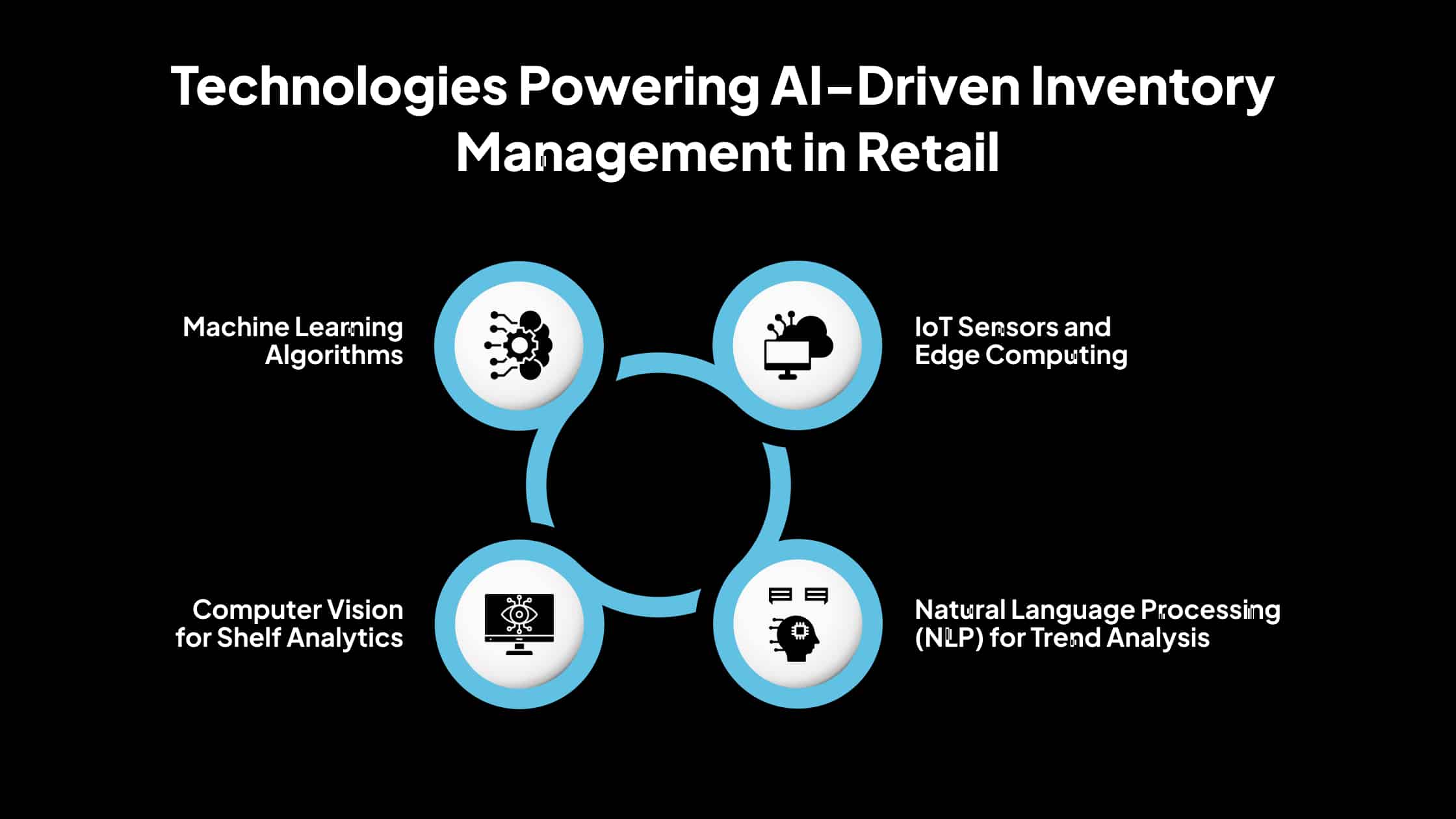
Below is a list of essential technologies that enable AI in retail to manage inventory more accurately, efficiently, and in real time.
1. Machine Learning Algorithms
Machine Learning (ML) algorithms enhance demand forecasting accuracy within retail inventory management. ML models can predict future demand by analyzing vast datasets, including historical sales, seasonal trends, promotional activities, and external factors like weather conditions. This predictive capability enables retailers to maintain optimal inventory levels, minimizing stockouts and overstocking risks.
Advanced ML techniques, such as supervised learning models, Random Forests, and Gradient Boosting Machines, are employed to identify patterns and correlations in sales data.
These models can adapt to new data inputs, allowing for continuous refinement of forecasts.
Additionally, unsupervised learning methods, like clustering algorithms, assist in segmenting products and stores based on sales behavior, facilitating more targeted inventory strategies.
2. Computer Vision for Shelf Analytics
Computer Vision (CV) technology revolutionizes shelf management by providing real-time insights into product placement and stock levels. Utilizing image recognition and deep learning algorithms, CV systems can monitor shelves to detect out-of-stock items, misplaced products, and planogram compliance issues. This continuous monitoring ensures that shelves are adequately stocked and organized, directly impacting sales and customer experience.
CV applications in retail often involve deploying cameras equipped with AI capabilities to capture and analyze shelf images. These systems can identify product SKUs, monitor inventory levels, and alert staff to restocking needs. By automating shelf audits, retailers can reduce labor costs and improve inventory accuracy.
CV data can be integrated with sales and inventory systems to provide comprehensive analytics, enabling retailers to optimize product assortments and shelf layouts based on consumer behavior and purchasing patterns.
3. IoT Sensors and Edge Computing
Integrating Internet of Things (IoT) sensors and Edge Computing in retail environments facilitates real-time inventory tracking and management.
IoT devices like RFID tags and smart shelves collect data on product movement, stock levels, and environmental conditions. This data is processed at the edge, closer to the data source, reducing latency and enabling immediate decision-making. Edge Computing allows for the rapid analysis of IoT-generated data, supporting functions like automatic replenishment, theft detection, and shelf-life monitoring.
For instance, smart shelves with weight sensors can detect when a product is removed and update inventory records in real-time. This level of automation enhances inventory accuracy and reduces the likelihood of stock discrepancies.
4. Natural Language Processing (NLP) for Trend Analysis
Natural Language Processing (NLP) enables retailers to extract actionable insights from unstructured textual data, such as customer reviews, social media posts, and market reports. By analyzing this data, NLP algorithms can identify emerging trends, consumer sentiments, and product preferences, informing inventory decisions and marketing strategies.
Sentiment analysis, a key NLP application, assesses customer opinions to determine satisfaction levels and potential issues with products or services. Topic modeling techniques can uncover prevalent themes in customer feedback, guiding product development and inventory planning. Additionally, NLP can enhance demand forecasting by incorporating qualitative data into predictive models, providing a more holistic view of market dynamics.
Optimizing Inventory with AI in Retail: Core Functions
AI in retail plays a critical role in modern inventory management by improving forecasting accuracy, enabling real-time tracking, and automating stock decisions.
1. Predictive Analytics
AI uses machine learning to analyze large volumes of past sales data, seasonal trends, customer behavior, and external factors such as holidays or weather conditions.
By examining these patterns, AI can forecast future demand more accurately than traditional methods. This helps retailers stock the right products at the right time, reducing stockouts and excess inventory.
For instance, Target uses predictive analytics to plan inventory for different locations. It factors in local weather to adjust orders for seasonal items like snow shovels or sunscreen, helping prevent gaps in availability during peak demand.
2. Real-Time Inventory Monitoring
AI systems integrated with sensors or IoT devices can track stock levels in real time across warehouses, stores, and distribution centers, providing an up-to-date view of what is available and where.
Retailers can use this information to restock shelves before running out or to shift products between locations if needed. Real-time tracking also helps detect discrepancies early, improving inventory accuracy.
For example, Walmart employs real-time inventory tracking tools that allow staff to identify low-stock items on shelves using handheld devices. This helps keep shelves stocked without waiting for manual inventory counts.
3. Automated Replenishment
AI can automate reordering by continuously monitoring inventory levels and generating purchase orders when stock drops below a certain threshold. This reduces the need for manual oversight and ensures that replenishment happens on time.
Automated systems also consider supplier lead times and minimum order quantities, helping maintain stable inventory levels with fewer delays. For Example, Zara, the fashion retailer, uses AI-based replenishment systems that automatically restock best-selling items twice weekly. The system analyzes real-time sales data and customer preferences to decide what to restock, keeping inventory fresh and relevant.
4. Dynamic Pricing and Promotions
AI tools can adjust product prices and recommend promotions based on inventory availability and demand trends.
For instance, if a product is overstocked, the system may suggest lowering the cost to encourage sales. If a product sells quickly, holding or increasing the price may be recommended to preserve margins. These adjustments help retailers manage inventory more efficiently and respond to changes in demand.
Preventing Stockouts with AI: A Smarter Approach to Inventory Gaps
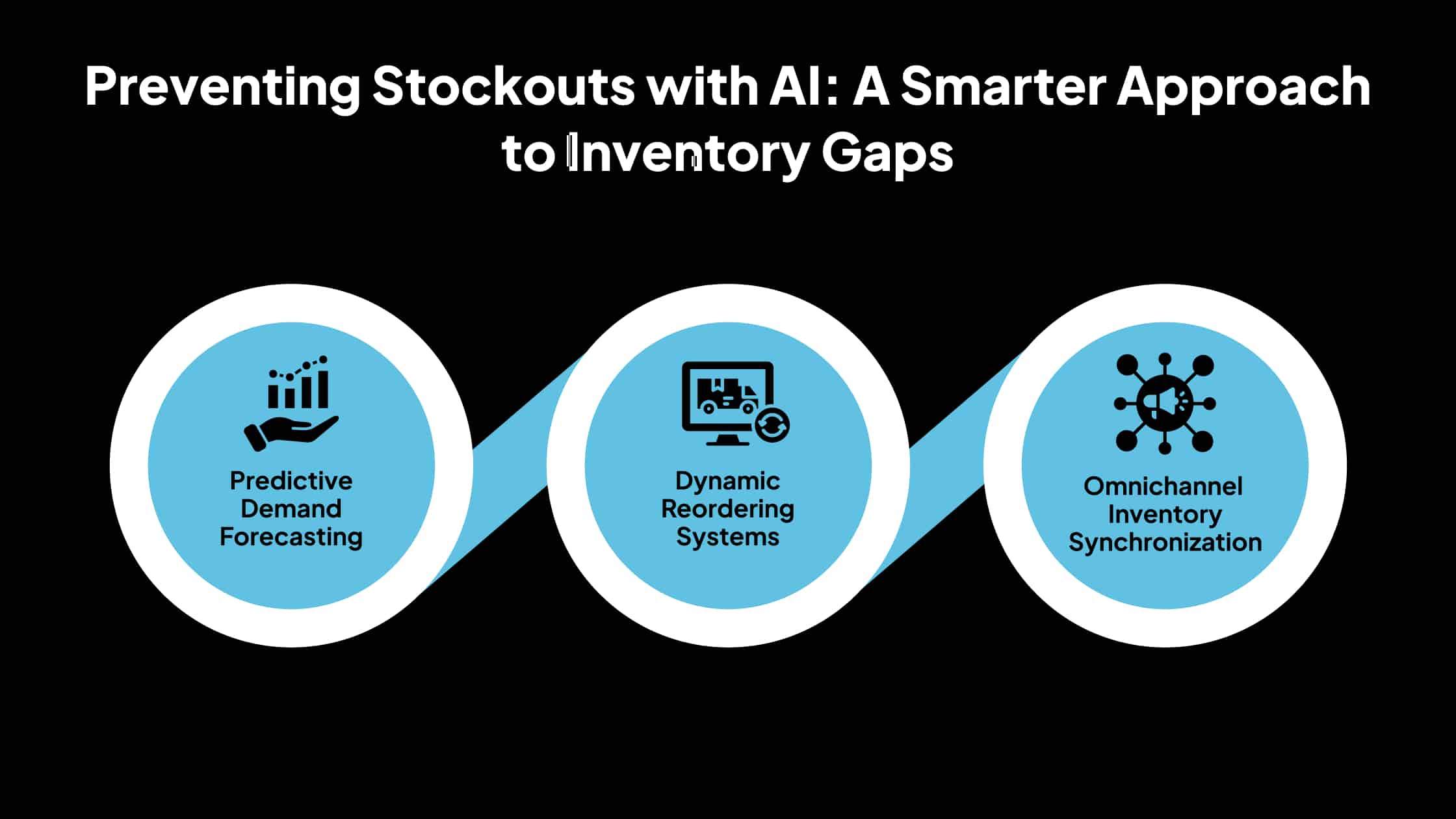
Below is an explanation of how AI in retail helps prevent stockouts by forecasting demand accurately and maintaining optimal inventory levels.
1. Predictive Demand Forecasting
AI-driven predictive demand forecasting utilizes machine learning algorithms to analyze many data sources, enabling retailers to anticipate customer demand with greater accuracy.
- Data Integration: These systems process historical sales data, seasonal trends, promotional calendars, weather patterns, and social media sentiment to identify patterns and predict future demand.
- Granular Forecasting: By analyzing store and SKU-level data, AI models can forecast demand spikes for specific products in particular locations, allowing for more precise inventory planning.
- Continuous Learning: Machine learning models adapt over time, refining their predictions as new data becomes available, which enhances forecast accuracy and responsiveness to changing market conditions.
Implementing predictive demand forecasting helps retailers maintain optimal inventory levels, reduce the likelihood of stockouts, and ensure product availability aligns with customer demand.
2. Dynamic Reordering Systems
Dynamic reordering systems utilize AI to automate replenishment, ensuring inventory levels are maintained without manual intervention.
- Automated Triggers: These systems monitor inventory in real-time and automatically generate purchase orders when stock levels approach predefined thresholds, preventing stockouts.
- Supplier Integration: AI-driven reordering systems can expedite the fulfillment process by connecting directly with suppliers, reducing lead times, and enhancing supply chain efficiency.
- Adaptive Reordering: AI models adjust reorder points and quantities based on sales velocity, seasonality, and promotional activities, ensuring inventory levels are responsive to current demand patterns.
Dynamic reordering minimizes human error, streamlines inventory management, and ensures products are replenished promptly to meet customer needs.
3. Omnichannel Inventory Synchronization
AI facilitates inventory synchronization across multiple sales channels, providing a unified view of stock levels and enhancing product availability.
- Centralized Inventory Management: By integrating data from physical stores, online platforms, and warehouses, AI systems offer real-time visibility into inventory, enabling accurate stock tracking and allocation.
- Intelligent Allocation: AI algorithms optimize inventory distribution across channels based on demand forecasts, ensuring products are available where and when customers need them.
- Seamless Customer Experience: Unified inventory data supports features like buy-online-pickup-in-store (BOPIS) and ship-from-store, enhancing customers’ convenience and satisfaction.
Omnichannel synchronization ensures consistent product availability across all customer touchpoints, reducing the risk of stockouts and improving overall service quality.
Intelligent Inventory Control: How AI Reduces Overstock in Retail
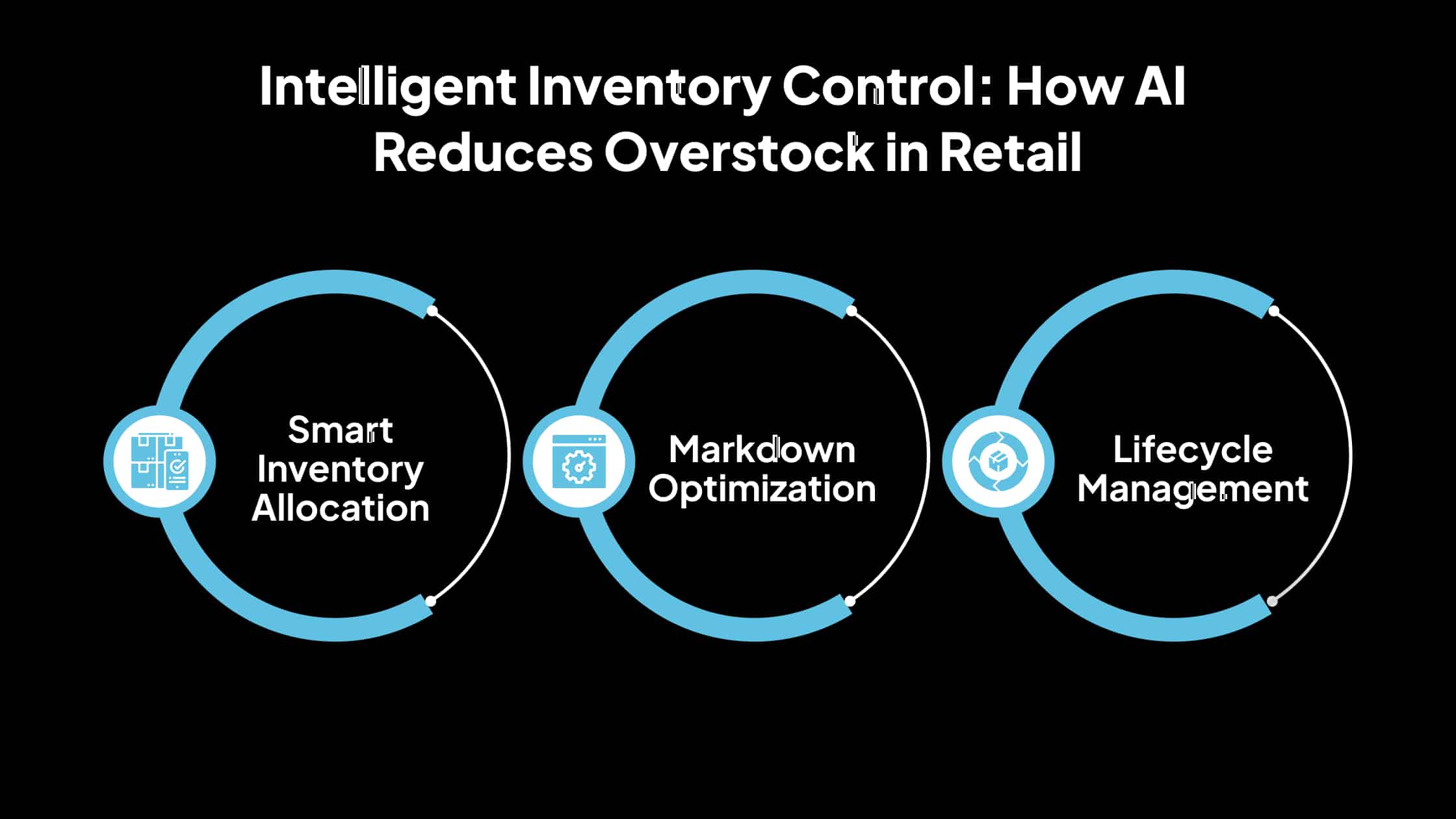
Below is an overview of how AI in retail helps reduce overstock and waste by aligning inventory levels with real-time demand and sales trends.
1. Smart Inventory Allocation
AI-driven inventory allocation utilizes machine learning algorithms to distribute stock based on real-time demand forecasts and sales data. AI systems can predict which stores will likely experience higher turnover for specific products by analyzing historical sales, regional preferences, and promotional impacts.
This ensures that inventory is allocated efficiently, reducing the likelihood of overstock in low-demand locations and stockouts in high-demand areas.
2. Markdown Optimization
AI enhances markdown strategies by analyzing vast datasets for optimal discount pricing and timing. By considering product attributes, price elasticity, and regional sales trends, AI models can recommend targeted markdowns that minimize margin loss while effectively clearing excess inventory.
3. Lifecycle Management
AI facilitates proactive lifecycle management by identifying slow-moving SKUs early in their product life. Through continuous monitoring of sales velocity, inventory turnover, and market trends, AI systems can flag underperforming products, enabling retailers to take corrective actions such as reallocation, bundling, or targeted promotions.
Advantages of Using AI for Smarter Inventory Management
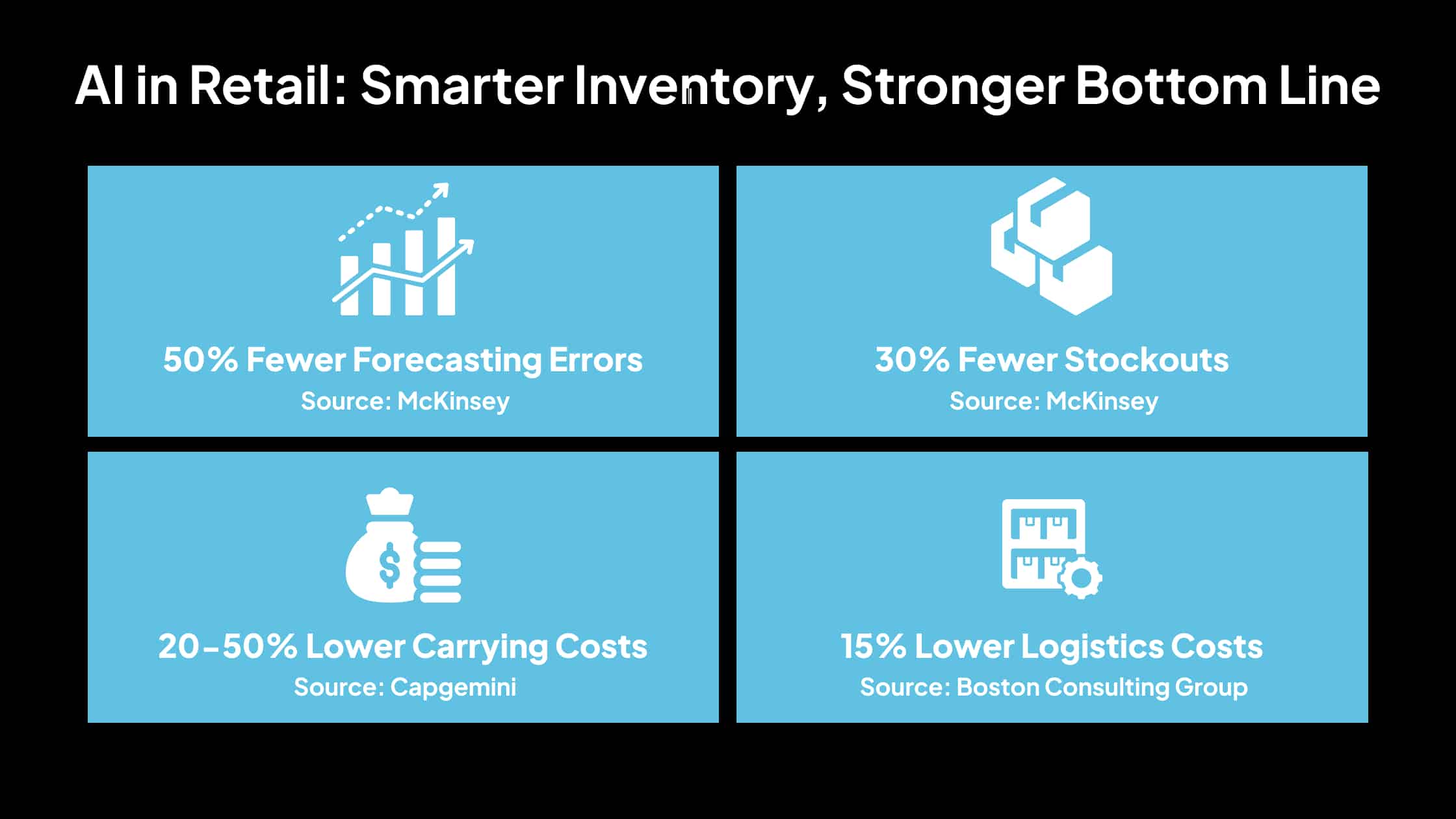
Below are the essential benefits of using AI in retail to improve inventory management, enhance accuracy, and reduce operational inefficiencies.
1. Enhanced Forecast Accuracy
AI improves demand forecasting by analyzing multiple data sources such as sales history, market trends, weather, local events, and customer behavior. This allows for more accurate predictions than conventional methods relying only on historical sales.
A McKinsey report notes that AI-driven forecasting can reduce supply chain errors by up to 50%, enabling better inventory planning and reducing the chances of ordering too much or too little.
For example, H&M adopted AI to forecast demand and align inventory more closely with local preferences. This helped the company reduce excess stock and improve turnaround times for popular items.
2. Reduced Stockouts and Overstock
By using AI to monitor inventory levels and forecast demand, retailers can maintain a better balance, avoiding product shortages and overstock situations. AI can also flag slow-moving items early and adjust reordering strategies accordingly.
According to Capgemini, retailers using AI in supply chain operations have seen up to a 30% reduction in stockouts and a 20–50% reduction in inventory carrying costs. For example, Amarra, a formal gown distributor, integrated AI tools to manage stock efficiently and achieved a 40% reduction in overstock while ensuring better availability of high-demand sizes and styles.
3. Cost Savings
Accurate forecasting and automated inventory control reduce waste and unnecessary spending. Retailers can avoid excess storage costs, markdowns on unsold items, and last-minute restocking fees.
For example, Zara’s AI-based inventory model allows it to restock only the products that are selling well, avoiding surplus. This strategy reduces the need for markdowns and lowers warehouse expenses.
4. Improved Customer Satisfaction
AI helps ensure products are available when customers need them. This reduces missed sales opportunities and creates a more reliable shopping experience, both online and in-store.
Salesforce research shows that 69% of customers say stock availability affects their loyalty to a brand. Reliable product availability directly influences repeat purchases and brand trust.
For example, Walmart uses real-time AI tracking to alert staff about low inventory on shelves. This quick response minimizes gaps and keeps popular items in stock, improving the customer experience.
The Future of AI in Inventory Management
As AI technology grows, here is a list of new trends emerging that will change how retailers manage their inventory:
1. Evolution of Autonomous Stores and Automated Micro-Fulfillment Centers
The retail industry is witnessing a shift towards autonomous stores and automated micro-fulfillment centers (MFCs), driven by advancements in AI and automation technologies.
- Autonomous Stores: These stores utilize AI-powered systems, including computer vision and sensor technologies, to enable cashier-less checkouts and real-time inventory tracking. Customers can select items and leave the store without traditional payment processes, as systems automatically detect purchases and process payments. This model enhances shopping convenience and reduces operational costs.
- Automated Micro-Fulfillment Centers (MFCs): MFCs are compact, automated warehouses near urban centers. They employ robotics and AI-driven inventory management to expedite order fulfillment, particularly for online orders. By positioning inventory closer to customers, MFCs reduce delivery times and improve supply chain efficiency.
2. Role of Generative AI in Simulating Supply and Demand Scenarios
Generative AI is a powerful tool for enhancing supply chain resilience and inventory optimization by simulating various supply and demand scenarios.
- Scenario Simulation: Generative AI models can create synthetic data to simulate “what-if” scenarios, such as sudden demand spikes or supply disruptions. This capability allows businesses to test and prepare for challenges without real-world risks.
- Inventory Optimization: Generative AI analyzes simulated scenarios to determine optimal inventory levels, reducing overstock and stockouts. It enables dynamic stock adjustment based on predicted demand patterns, enhancing overall supply chain efficiency.
3. Personalized Inventory Planning Using Customer AI Personas
AI-driven customer personas are transforming inventory planning by providing insights into individual customer preferences and behaviors.
- Customer Segmentation: AI analyzes data from various sources, including purchase history and browsing behavior, to create detailed customer personas. These personas help segment customers based on preferences, enabling targeted inventory stocking.
- Demand Forecasting: By understanding specific customer needs, retailers can more accurately forecast demand for different segments, ensuring that the right products are available at the right time and location.
Implementing personalized inventory planning through AI personas enhances customer satisfaction by aligning product availability with customer expectations, increasing sales, and reducing inventory waste.
Deploying AI Solutions in Retail: Best Practices and Considerations
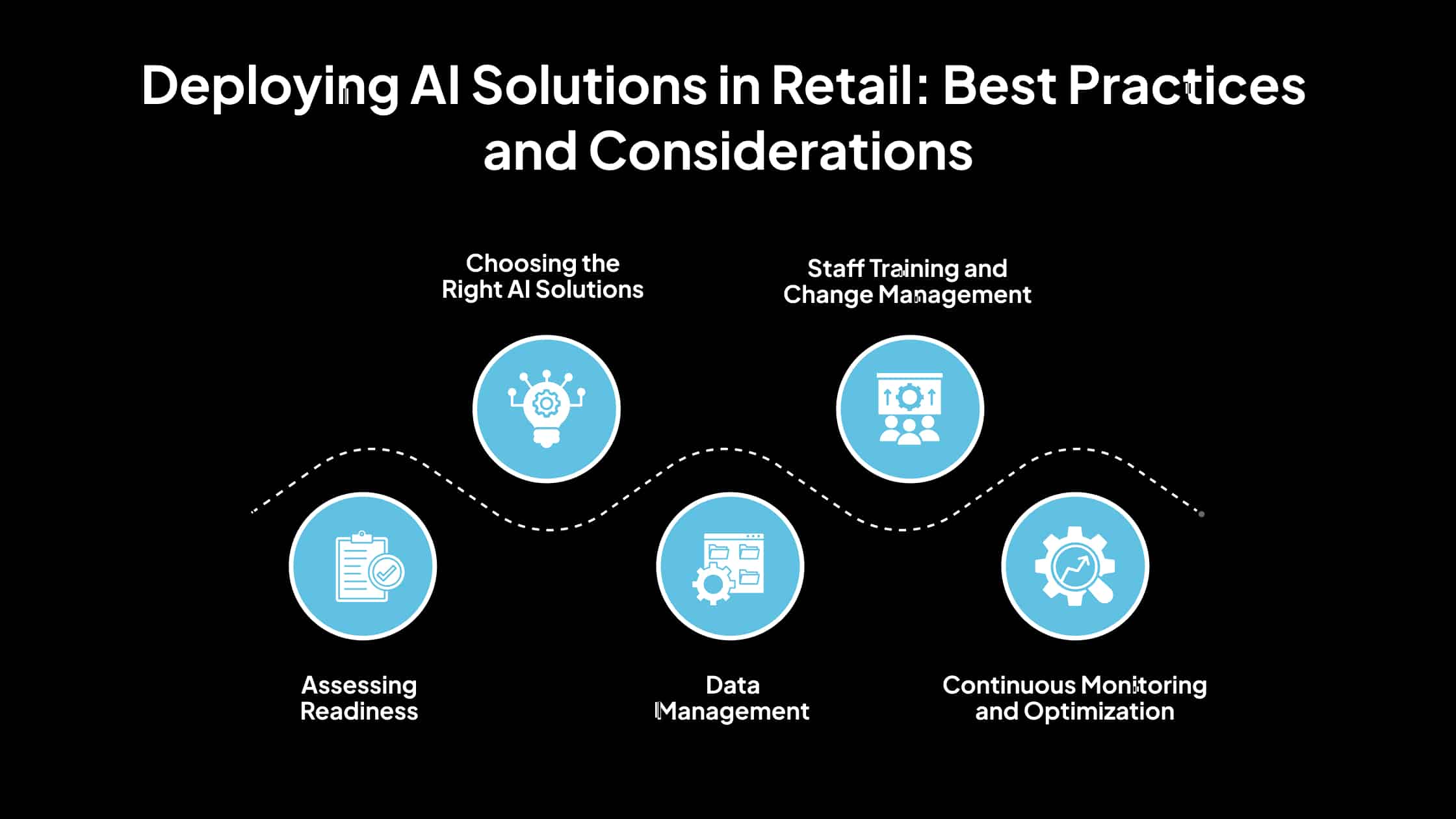
To help you get started, here are some best practices for successfully implementing AI in your retail operations.
1. Assessing Readiness
Before adopting AI tools, retailers should first evaluate their current inventory management systems. This includes identifying gaps in forecasting accuracy, tracking capabilities, and order management.
Understanding where inefficiencies exist will help determine the type of AI solution needed. A basic audit of current workflows, technology, and pain points can provide a strong foundation for planning AI implementation.
2. Choosing the Right AI Solutions
Selecting the right AI tools is critical for successful implementation. Retailers should look for scalable solutions that grow with the business, are compatible with existing software and hardware, and are supported by reliable vendors who offer integration assistance, updates, and customer service.
It’s crucial to prioritize solutions that align with your operational size and complexity, whether for a single store or a large retail chain. Organizations across sectors seek ways to deliver an intelligent, personalized experience while maintaining data privacy and operational efficiency. However, challenges like fragmented systems, rising user expectations, and the need to manage large volumes of data make this problematic.
The Avahi AI platform offers a powerful solution for helping businesses harness the full potential of artificial intelligence without needing to manage multiple disconnected tools.
Avahi’s platform enables businesses to harness artificial intelligence’s full potential without managing multiple disconnected tools.
3. Data Management
AI relies heavily on accurate and timely data. To support AI systems, retailers must collect clean, consistent data from all relevant sources, including point-of-sale systems, e-commerce platforms, and supply chain tools.
Real-time data input improves the accuracy of AI forecasts and decisions. Poor data quality can lead to incorrect recommendations and inventory issues.
4. Staff Training and Change Management
Introducing AI affects how teams manage inventory and make decisions. Employees must understand how new systems work and how to use them effectively.
Retailers should provide clear training programs and ongoing support. They should also communicate the benefits of AI clearly to reduce resistance and encourage adoption across departments.
5. Continuous Monitoring and Optimization
Once AI is in place, it is important to track its performance regularly. Retailers should review system reports, monitor key inventory metrics, and gather user feedback.
If the AI system underperforms or produces unexpected results, adjustments should be made promptly. Ongoing refinement ensures the system stays aligned with business goals and changing market conditions.
Discover Avahi’s AI Platform in Action
 At Avahi, we empower businesses to deploy advanced Generative AI that streamlines operations, enhances decision-making, and accelerates innovation—all with zero complexity.
As your trusted AWS Cloud Consulting Partner, we empower organizations to harness AI’s full potential while ensuring security, scalability, and compliance with industry-leading cloud solutions.
Our AI Solutions include
- AI Adoption & Integration – Utilize Amazon Bedrock and GenAI to enhance automation and decision-making.
- Custom AI Development – Build intelligent applications tailored to your business needs.
- AI Model Optimization – Seamlessly switch between AI models with automated cost, accuracy, and performance comparisons.
- AI Automation – Automate repetitive tasks and free up time for strategic growth.
- Advanced Security & AI Governance – Ensure compliance, fraud detection, and secure model deployment.
Want to unlock the power of AI with enterprise-grade security and efficiency? Get Started with Avahi’s AI Platform!
Frequently Asked Questions(FAQs)
1. How does AI help reduce stockouts in retail?
AI reduces stockouts by accurately forecasting demand using machine learning and real-time data inputs like past sales, weather, local events, and customer behavior. It can also automate replenishment when inventory drops below set levels, ensuring timely restocking.
2. Can AI also help prevent overstock situations?
Yes, AI identifies slow-moving inventory early and recommends actions such as markdowns, redistribution, or order adjustments. It uses real-time sales data to avoid excess inventory, reducing waste and storage costs.
3. What types of AI technologies are used in inventory management?
Retailers use various AI technologies, including machine learning for demand forecasting, computer vision for shelf analytics, IoT sensors with edge computing for real-time tracking, and NLP to extract trends from customer feedback and market sentiment.
4. How is AI different from traditional inventory management systems?
Traditional systems rely primarily on historical data and manual processes, often inaccurate and slow to adapt. AI uses predictive analytics, real-time monitoring, and automation to make proactive, data-driven decisions.
5. Is AI inventory management suitable for small retailers?
Yes. Scalable AI platforms like Avahi are designed to support both small businesses and large chains. They can integrate with existing systems and offer modular features that grow with the business.