

TL;DR
|
Automation follows instructions. Agentic AI pursues outcomes.
For years, businesses have relied on automation to streamline operations, reduce manual work, and improve efficiency. From automated workflows to robotic process automation (RPA), rule-based systems have helped organizations eliminate repetitive tasks and maintain consistent processes.
However, as business environments become more complex and data-driven, many organizations are questioning whether traditional automation alone is sufficient.
Recent industry research shows why this shift is happening. Generative AI could increase global labor productivity growth by 0.1% to 0.6% annually through 2040, depending on adoption rates and workforce transformation. At the same time, global investment in artificial intelligence continues to accelerate, with AI adoption expected to contribute more than $15 trillion to the global economy by 2030. A growing portion of this innovation focuses on Agentic AI—systems capable of reasoning, planning, and autonomously executing tasks.
This shift represents a major evolution in how organizations think about automation. Traditional automation focuses on executing predefined workflows, while Agentic AI focuses on achieving goals by analyzing situations and dynamically determining the best course of action.
For business leaders, operations teams, and technology decision-makers, the question is no longer whether to automate processes; it is how to automate them. The real question is how intelligent those systems need to be to deliver meaningful business value.
In this blog, you will explore the key differences between Agentic AI and traditional automation, understand where each approach works best, and learn how organizations can leverage both technologies to build more efficient, intelligent operations.
Understanding Traditional Automation in Modern Business Operations
Traditional automation refers to technology systems designed to execute predefined workflows and rule-based processes without deviation. These systems operate strictly according to programmed instructions and perform tasks automatically when specific conditions are triggered.
For your organization, this means automation can consistently and efficiently handle repetitive operational tasks, reducing the need for manual intervention.
Core Characteristics of Traditional Automation
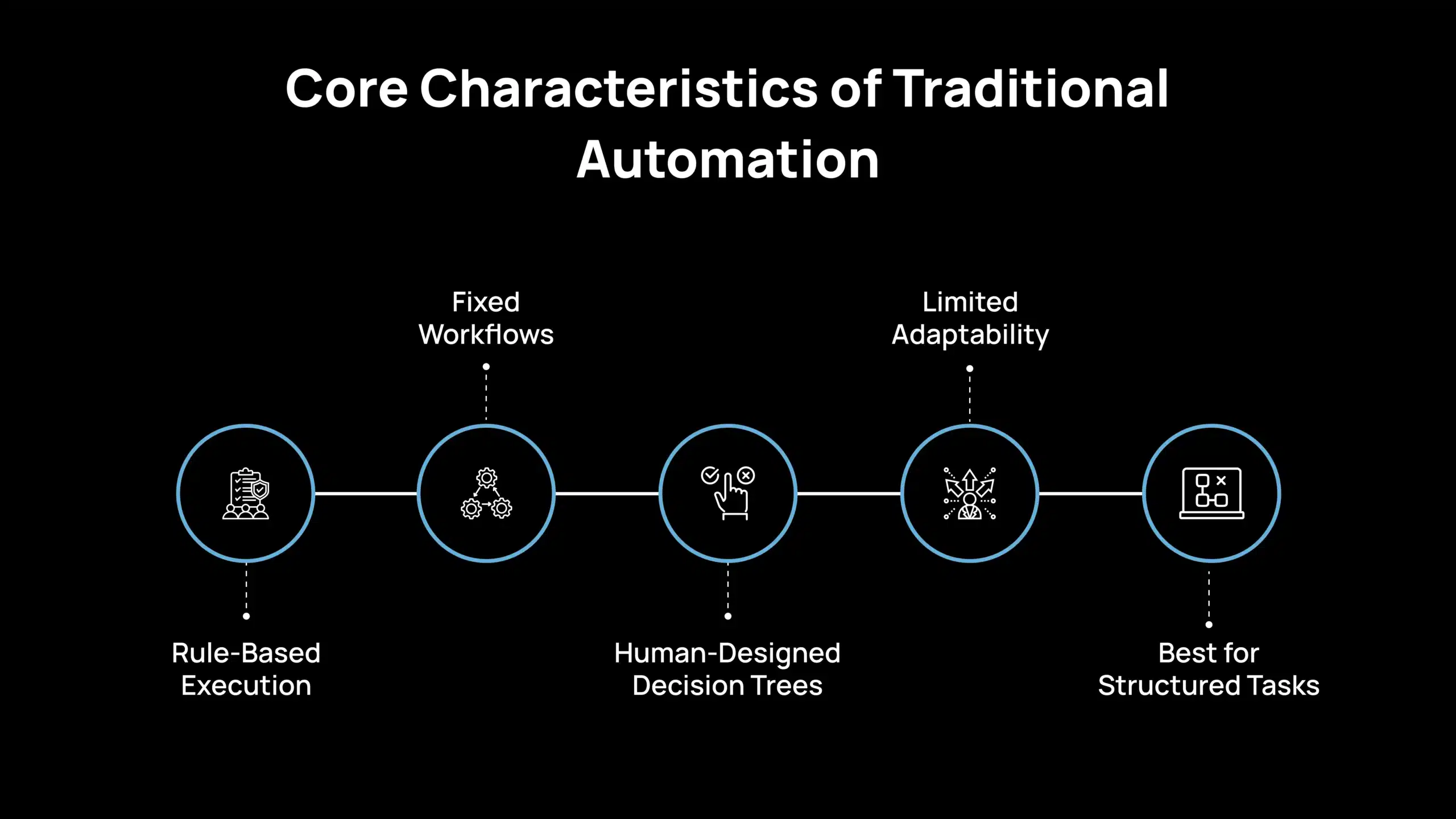
When you implement traditional automation, you typically work with systems that operate according to a fixed set of rules and workflows. These characteristics define how the technology functions.
1. Rule-Based Execution
Automation systems rely on clear “if–then” logic. For example, if a customer submits a form, the system may automatically send a confirmation email or create a record in your CRM.
2. Fixed Workflows
The steps in an automated process follow a predefined path. Once the workflow is designed, the system performs the same sequence of actions every time the trigger occurs.
3. Human-Designed Decision Trees
Your team defines the logic, conditions, and outcomes. The automation system cannot create new rules on its own. It only executes the instructions programmed into it.
4. Limited Adaptability
Traditional automation does not adapt to unexpected scenarios. If the input falls outside the predefined rules, the process may stop or require human intervention.
5. Best for Structured Tasks
Automation works most effectively when tasks are repetitive, predictable, and clearly defined. Processes that follow the same pattern every time are ideal candidates.
Examples of Traditional Automation in Business
You likely encounter traditional automation across many areas of modern organizations. Businesses rely on it to streamline operational tasks and reduce manual workload.
- Robotic Process Automation (RPA): RPA tools mimic human interactions with software systems. For example, they can log into applications, copy data between systems, and generate reports automatically.
- Workflow Automation Tools: Workflow platforms automate internal processes such as approvals, document routing, and project management steps.
- Manufacturing Automation: In manufacturing environments, machines and robotics perform repetitive tasks such as assembly, packaging, or quality checks according to predefined instructions.
- CRM Triggers and Email Sequences: Customer relationship management platforms automatically trigger emails, update customer records, or assign leads based on predefined conditions.
Business Use Cases of Traditional Automation
| Use Case | How Traditional Automation Helps |
| Invoice Processing | Automation systems extract invoice data, validate it against records, and automatically route it for approval or payment. |
| Data Entry | Automation tools transfer and synchronize information between systems, reducing manual input and minimizing errors. |
| Payroll Management | Payroll automation calculates salaries, deductions, taxes, and payments based on predefined organizational rules. |
| Automated Email Marketing | Marketing platforms send scheduled or trigger-based emails to customers based on user actions such as sign-ups or purchases. |
| IT Ticket Routing | Automation systems categorize incoming support tickets and assign them to the appropriate teams based on issue type, priority, or department. |
Understanding Agentic AI and How It Transforms Intelligent Automation
Agentic AI refers to AI systems designed as autonomous agents capable of reasoning, planning, executing tasks, and adapting dynamically to changing conditions.
These systems are built to pursue goals rather than follow fixed instructions. Once you define the objective, the AI agent determines how to achieve it by analyzing data, interacting with tools, and executing actions across systems. In practical terms, Agentic AI allows you to automate not just tasks, but entire workflows that involve decision-making and problem-solving.
Core Components of Agentic AI Systems
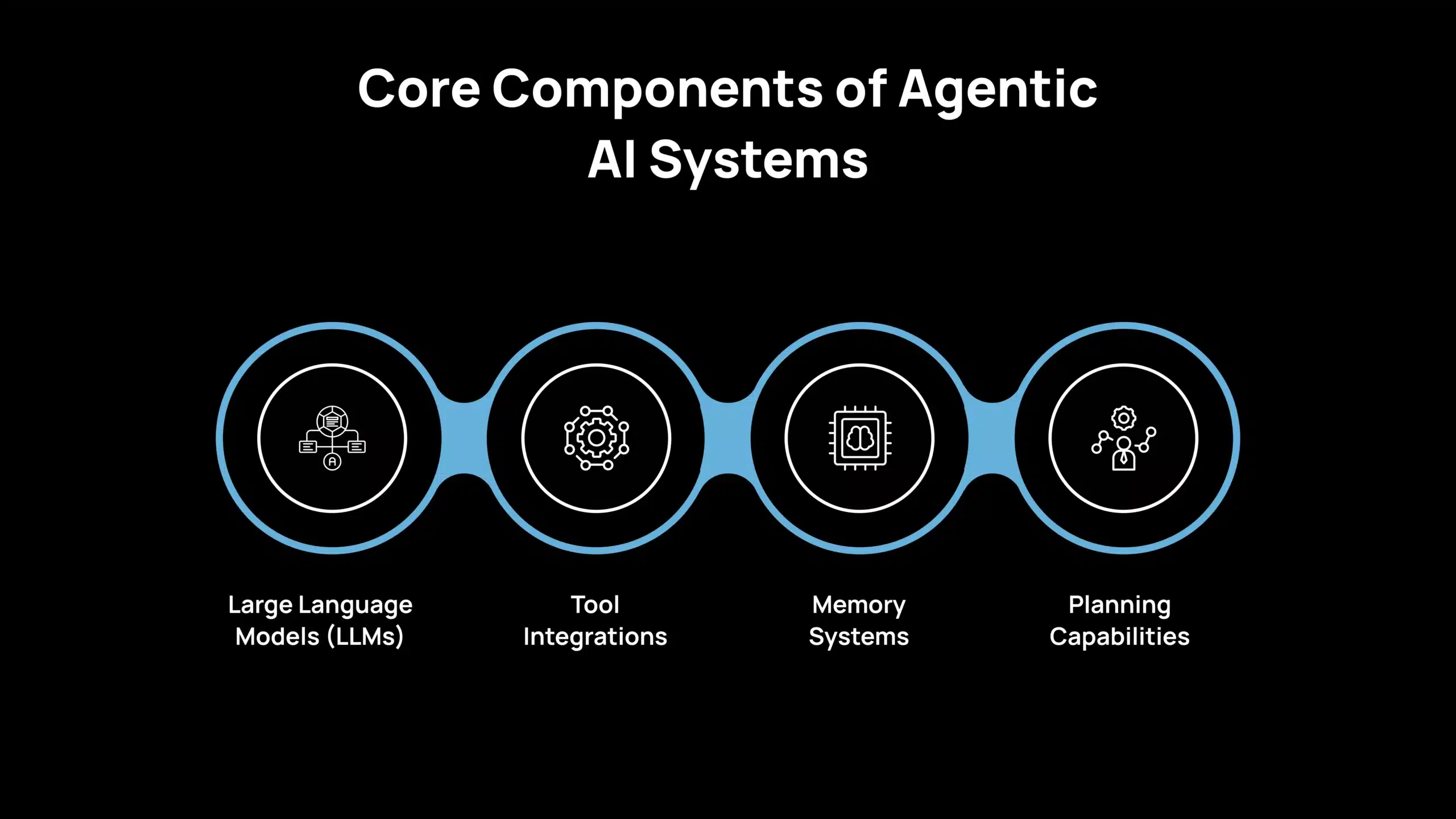
To operate autonomously, Agentic AI systems combine several advanced technologies. Each component contributes to the agent’s ability to understand context, plan actions, and interact with systems.
1. Large Language Models (LLMs)
LLMs provide the reasoning and language-understanding capabilities that enable agents to interpret instructions, analyze information, and generate responses.
2. Tool Integrations
Agents connect with external tools, APIs, and enterprise software to perform actions such as retrieving data, updating records, or triggering workflows.
3. Memory Systems
Memory allows agents to retain context across tasks, track previous interactions, and improve the accuracy of future actions.
4. Planning Capabilities
Planning systems help agents break complex objectives into smaller steps, determine execution order, and adjust strategies when conditions change.
Capabilities of Agentic AI
When you deploy Agentic AI systems, you enable capabilities that go beyond traditional automation.
- Autonomous Task Execution: Agents can complete tasks independently once a defined goal is provided. They determine the steps required and execute them without constant human guidance.
- Multi-Step Reasoning: Agents analyze problems and divide them into logical steps. This allows them to handle complex workflows rather than single repetitive tasks.
- Dynamic Decision-Making: Agents evaluate real-time information and adjust their actions when conditions change.
- Learning from Context: Through memory and contextual understanding, agents improve their responses and actions over time.
- Goal-Oriented Behavior: Instead of following fixed instructions, agents focus on achieving specific outcomes, selecting the most appropriate actions to reach the objective.
Use Cases of Agentic AI Systems in Business
| Agentic AI System | How It Helps Businesses |
| AI Research Assistants | AI agents analyze large volumes of information, summarize key insights, and generate research reports to support decision-making. |
| Autonomous Customer Support Agents | Advanced AI agents handle complete customer interactions, diagnose issues, and resolve requests without requiring constant human intervention. |
| AI Operations Managers | AI agents monitor system performance, detect operational issues, and automatically initiate corrective actions across infrastructure or applications. |
| Multi-Agent Enterprise Workflows | Multiple AI agents collaborate across departments to manage complex processes such as supply chain coordination, data analysis, or marketing operations. |
Differences Between Traditional Automation and Agentic AI
The following comparison explains the core differences that directly impact how your organization can automate workflows and manage complex operations.
1. Decision Making
Traditional Automation
When you rely on traditional automation, decision-making is entirely rule-based. Your team defines specific conditions and outcomes using predefined logic. The system simply follows those instructions every time the trigger conditions are met. If a situation falls outside the defined rules, the automation cannot respond appropriately and usually requires human intervention.
Agentic AI
With Agentic AI, decision-making is based on reasoning. The system analyzes the task context, evaluates available information, and determines the most appropriate action to achieve the goal. Instead of following fixed rules, the AI agent can assess different scenarios and make informed decisions based on the situation.
2. Flexibility
Traditional Automation
Traditional automation is rigid by design. Workflows operate exactly as programmed, and any change in the process requires manual updates to the automation rules. If business conditions change or new inputs appear, the system may fail or stop until someone modifies the workflow.
Agentic AI
Agentic AI systems are designed to be adaptive. They can adjust their actions based on new information, updated goals, or changing conditions. This flexibility allows agents to respond to unexpected inputs and continue working toward the desired outcome without requiring constant manual adjustments.
3. Task Complexity
Traditional Automation
Automation works best when tasks are simple, repetitive, and predictable. Processes such as data entry, invoice processing, and email triggers follow clear rules and structured workflows, making them ideal candidates for automation.
Agentic AI
Agentic AI can manage complex, dynamic tasks involving multiple steps, decision points, and varying inputs. Agents can break large objectives into smaller actions, coordinate across different tools, and handle tasks that require analysis and reasoning.
4. Learning Capability
Traditional Automation
Traditional automation systems do not learn from experience. Once the workflow is configured, the system executes the same process repeatedly without improving or adapting. Any changes or optimizations must be made manually by developers or operations teams.
Agentic AI
Agentic AI systems can learn from context and past interactions. Through memory systems and contextual analysis, agents can improve their task performance over time. This allows them to provide more accurate responses, better decisions, and improved workflow execution as they interact with more data.
5. Workflow Structure
Traditional Automation
Automation workflows are fixed and predefined. Each step in the process must be mapped out in advance, and the system follows the same path every time. This approach works well for stable processes but becomes difficult to maintain when workflows become more complex.
Agentic AI
Agentic AI uses dynamic planning. Instead of following a rigid sequence, the agent determines the necessary steps based on the goal and current context. This allows the system to create and adjust workflows dynamically as tasks evolve.
6. Human Intervention
Traditional Automation
Traditional automation often requires frequent human involvement when exceptions occur. If the system encounters unexpected inputs, missing data, or rule conflicts, someone must step in to resolve the issue or update the automation logic.
Agentic AI
Agentic AI systems are designed to operate with minimal human intervention. Because agents can analyze problems and adjust their approach, they can often resolve issues independently while still allowing humans to oversee critical decisions.
Why Traditional Automation Is No Longer Enough for Modern Business Operations
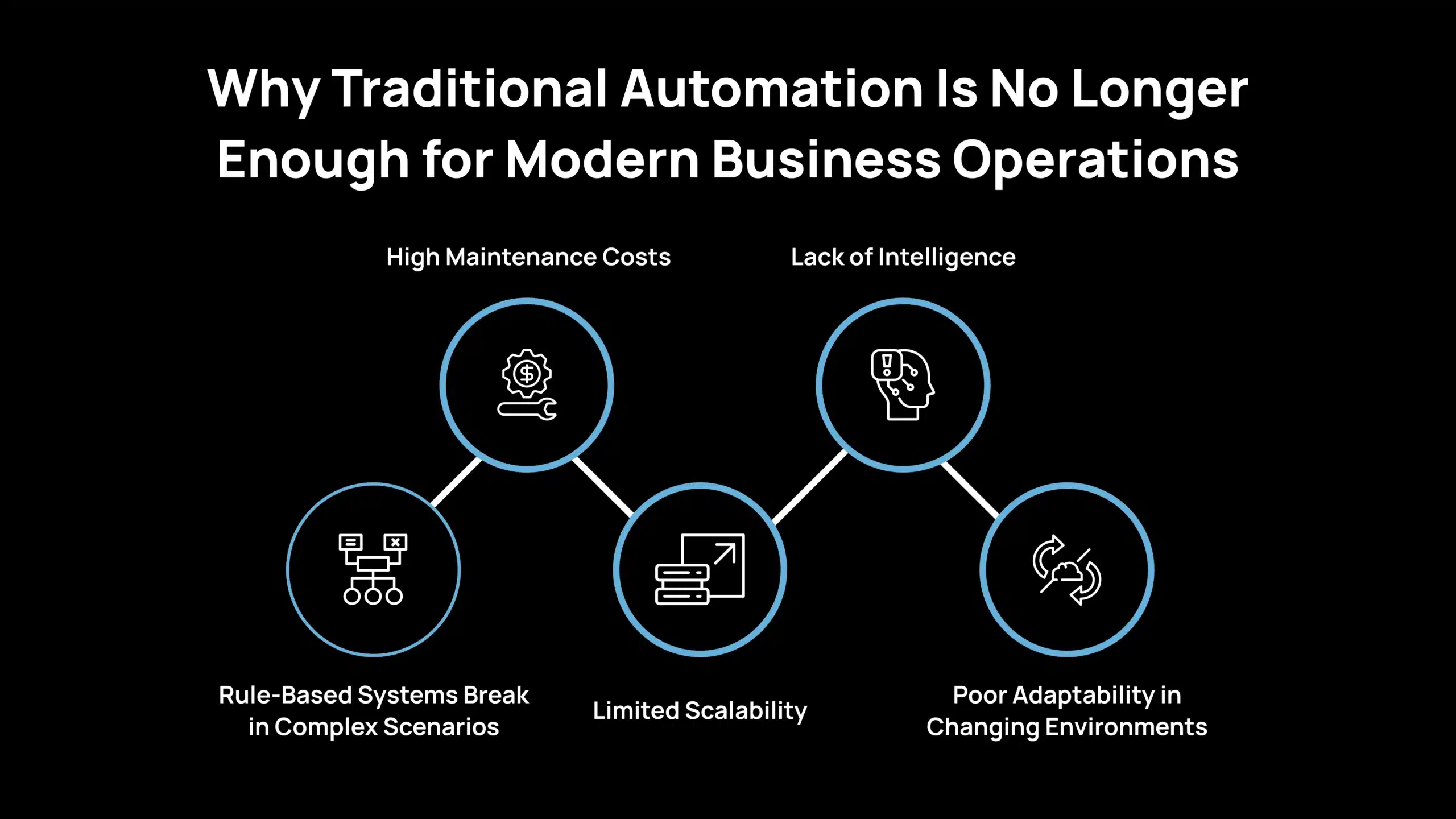
If you rely heavily on traditional automation, you may eventually notice that it performs well for repetitive tasks but struggles when processes become more complex or unpredictable. As businesses scale and workflows become more dynamic, here is why rule-based automation often reaches its practical limits.
1. Rule-Based Systems Break in Complex Scenarios
Traditional automation depends on predefined rules. This works well when processes follow a clear and predictable pattern. However, when unexpected situations occur, the system cannot interpret the context or decide how to proceed.
For example, consider an automated customer support workflow that routes tickets based on keywords. If a customer submits a request that does not match any predefined rule, the system may misclassify the issue or fail to route it correctly. A similar situation arises in financial operations when invoice-processing automation encounters invoices with unusual formats or missing data fields. Because the system cannot interpret the variation, the task often stops and requires manual review.
2. High Maintenance Costs
Automation workflows require ongoing maintenance because business processes constantly evolve. Every time a system changes, a policy is updated, or a new exception appears, the automation rules must be revised.
For instance, if your organization changes the structure of its CRM system, the workflows responsible for lead assignment, data updates, or marketing triggers may need to be rewritten. In large organizations with hundreds of automated workflows, even small system changes can require significant time from IT or operations teams.
Over time, maintaining these automation scripts can become expensive and resource-intensive, especially when multiple departments depend on them.
3. Limited Scalability
Traditional automation can become difficult to scale as business operations grow in complexity. Each new workflow or exception often requires an additional rule, script, or integration.
For example, an e-commerce company may initially automate order confirmations, payment processing, and shipping notifications. As the business grows, additional automations may be required for inventory management, fraud detection, customer segmentation, and returns processing. Eventually, the organization may end up managing hundreds of interconnected workflows.
At this point, maintaining and coordinating these systems becomes increasingly difficult. A single change in one workflow can unintentionally disrupt several others.
4. Lack of Intelligence
Traditional automation executes instructions but does not understand the information it processes. It cannot interpret meaning, analyze patterns, or make contextual decisions.
For example, in marketing automation platforms, email sequences are triggered based on predefined user actions such as downloading a guide or clicking a link. While this approach can automate communication, it cannot analyze customer intent or determine whether a prospect is genuinely interested in purchasing.
Similarly, IT monitoring systems can trigger alerts when server performance drops below a threshold, but they cannot diagnose the root cause or determine the best corrective action. Human operators must still investigate and resolve the issue. This limitation becomes more noticeable in workflows that require analysis, judgment, or interpretation.
5. Poor Adaptability in Changing Environments
Modern business environments change rapidly. New tools, customer behaviors, regulatory requirements, and operational processes constantly reshape how organizations operate.
Traditional automation systems struggle to adapt to these changes because they rely on fixed workflows. When a process changes, the automation logic must be manually updated before the system can function correctly again.
For example, during sudden market shifts or operational disruptions, companies often need to adjust customer service workflows, supply chain processes, or internal approvals. If rigid automation rules tightly control these workflows, organizations may temporarily revert to manual processes while updates are implemented.
This lack of adaptability limits the long-term effectiveness of traditional automation, especially in industries where processes evolve quickly.
Choosing the Right Automation Strategy for Modern Business Operations
Here is how you can determine whether traditional automation, Agentic AI, or a hybrid approach is the right choice for your business.
Where Traditional Automation Makes the Most Sense
- When tasks are repetitive and predictable: Processes such as data entry, invoice processing, or scheduled reporting follow consistent rules.
- When workflows are clearly defined:Tasks with fixed steps and minimal variation are ideal for rule-based automation.
- When compliance and consistency are critical: Regulatory processes often require strict adherence to predefined procedures.
- When cost efficiency is the primary goal: Traditional automation tools are typically easier and less expensive to implement.
- When human decision-making is not required: Tasks that only involve executing predefined instructions work well with automation.
Where Agentic AI Makes the Most Sense
- When workflows are complex: Processes involve multiple steps, dependencies, and changing inputs.
- When decision-making is required: Systems must analyze data and determine the best action dynamically.
- When operations involve multiple systems: Workflows need coordination across several tools and platforms.
- When adaptability is essential: Business environments require systems that can adjust to new data or unexpected events.
- When teams need operational support: AI agents can manage tasks that otherwise consume significant employee time.
Where a Hybrid Approach Works Best
- When structured tasks support complex workflows: Automation handles repetitive steps while AI manages decision points.
- When organizations want to scale operations gradually: Existing automation systems can be enhanced with AI capabilities.
- When operational efficiency and intelligence are both required: Automation ensures consistency while AI provides adaptability.
- When human oversight remains important: Automation and AI can work together while humans supervise critical decisions.
How Avahi Helps You Turn AI Into Real Business Results?
If your goal is to apply AI in practical ways that deliver measurable business impact, Avahi offers solutions designed specifically for real-world challenges. Avahi enables organizations to quickly and securely adopt advanced AI capabilities, supported by a strong cloud foundation and deep AWS expertise.
Avahi AI solutions deliver business benefits such as:
- Round-the-Clock Customer Engagement
- Automated Lead Capture and Call Management
- Faster Content Creation
- Quick Conversion of Documents Into Usable Data
- Smarter Planning Through Predictive Insights
- Deeper Understanding of Visual Content
- Effortless Data Access Through Natural Language Queries
- Built-In Data Protection and Regulatory Compliance
- Seamless Global Communication Through Advanced Translation and Localization
By partnering with Avahi, organizations gain access to a team with extensive AI and cloud experience committed to delivering tailored solutions. The focus remains on measurable outcomes, from automation that saves time and reduces costs to analytics that improve strategic decision-making to AI-driven interactions that elevate the customer experience.
Discover Avahi’s AI Platform in Action
At Avahi, we empower businesses to deploy advanced Generative AI that streamlines operations, enhances decision-making, and accelerates innovation, all with zero complexity.
As your trusted AWS Cloud Consulting Partner, we empower organizations to harness the full potential of AI while ensuring security, scalability, and compliance with industry-leading cloud solutions.
Our AI Solutions Include
- AI Adoption & Integration – Leverage Amazon Bedrock and GenAI to Enhance Automation and Decision-Making.
- Custom AI Development – Build intelligent applications tailored to your business needs.
- AI Model Optimization – Seamlessly switch between AI models with automated cost, accuracy, and performance comparisons.
- AI Automation – Automate repetitive tasks and free up time for strategic growth.
- Advanced Security & AI Governance – Ensure compliance, detect fraud, and deploy secure models.
Want to unlock the power of AI with enterprise-grade security and efficiency?
Start Your AI Transformation with Avahi Today!
Frequently Asked Questions
1. What is the main difference between Agentic AI and traditional automation?
Traditional automation follows predefined rules to complete repetitive tasks, while Agentic AI can reason, plan, and execute actions dynamically to achieve broader goals.
2. When should your organization use traditional automation instead of Agentic AI?
Traditional automation is best for predictable, rule-based processes such as data entry, payroll processing, or invoice management.
3. What types of business processes benefit most from Agentic AI?
Processes that involve decision-making, multi-step workflows, and changing inputs—such as customer support resolution, operational monitoring, and research analysis—benefit most from Agentic AI.
4. Can businesses use Agentic AI and traditional automation together?
Yes. Many organizations adopt a hybrid approach where automation handles repetitive tasks and Agentic AI manages complex workflows and decision points.
5. Is Agentic AI replacing traditional automation?
Not entirely. Traditional automation still plays an important role in structured workflows, while Agentic AI expands capabilities by enabling intelligent and adaptive operations.