

TL;DR
|
Organizations are no longer asking whether they should adopt AI—they are asking whether AI is actually delivering measurable business value.
Organizations across industries are investing heavily in artificial intelligence, yet many leaders still struggle to answer a critical question: Is AI actually delivering measurable ROI?
While reports show that over 70% of companies are experimenting with AI, far fewer can clearly demonstrate financial or operational returns from those initiatives.
This challenge becomes even more significant as agentic AI rises. Unlike conventional AI systems that generate predictions or content, agentic AI can plan tasks, make decisions, and execute workflows across multiple systems. Instead of supporting isolated tasks, these systems can automate entire operational processes.
Because of this shift from insight generation to autonomous execution, traditional ROI models are no longer enough. The value of agentic AI extends beyond cost savings to include productivity gains, workflow efficiency, improved customer experience, and revenue growth.
If you are evaluating AI investments in your organization, understanding how to measure an ROI for genetic AI is essential. In this blog, you will learn the key metrics, frameworks, and evaluation approaches that help you measure the real business impact of agentic AI.
Why Agentic AI Creates a Different Economic Value Than Conventional AI
To understand the difference clearly, you need to look at how conventional AI delivers value compared to how agentic AI operates within business environments.
Conventional AI ROI Model: Optimizing Predictions and Tasks
If your organization has already used AI in areas such as forecasting, analytics, or fraud detection, you have likely measured ROI based on improvements in accuracy or task automation. Traditional AI systems focus on producing insights or predictions that help employees make better decisions.
For example, predictive models might forecast customer churn, recommend products, or identify anomalies in financial data. These systems improve decision-making, but they typically stop at generating outputs. Human teams still need to interpret the results, decide on the next step, and execute the required actions.
Because of this structure, traditional AI ROI is usually measured through improvements such as:
- Higher prediction accuracy
- Faster data analysis and reporting
- Automation of specific repetitive tasks
- Reduction in manual effort within defined processes
While these benefits are valuable, they usually create incremental efficiency gains rather than transforming how work itself is executed.
Agentic AI ROI Model: Executing Workflows Toward Goals
Agentic AI changes the equation because these systems not only generate insights, they act on them.
When you deploy an agentic AI system, it can break down goals into smaller steps, determine which actions are required, and execute them using available tools or enterprise systems. Instead of supporting a single decision point, agentic AI can manage entire sequences of tasks within a workflow.
For example, an AI agent managing customer support operations could analyze incoming tickets, determine their priority, retrieve relevant data from internal systems, draft responses, and escalate complex cases as needed. In this scenario, the system is not simply assisting employees; it is performing meaningful operational work. This ability to move from analysis to execution is what shifts the ROI model.
The Unique Challenges of Measuring Agentic AI ROI
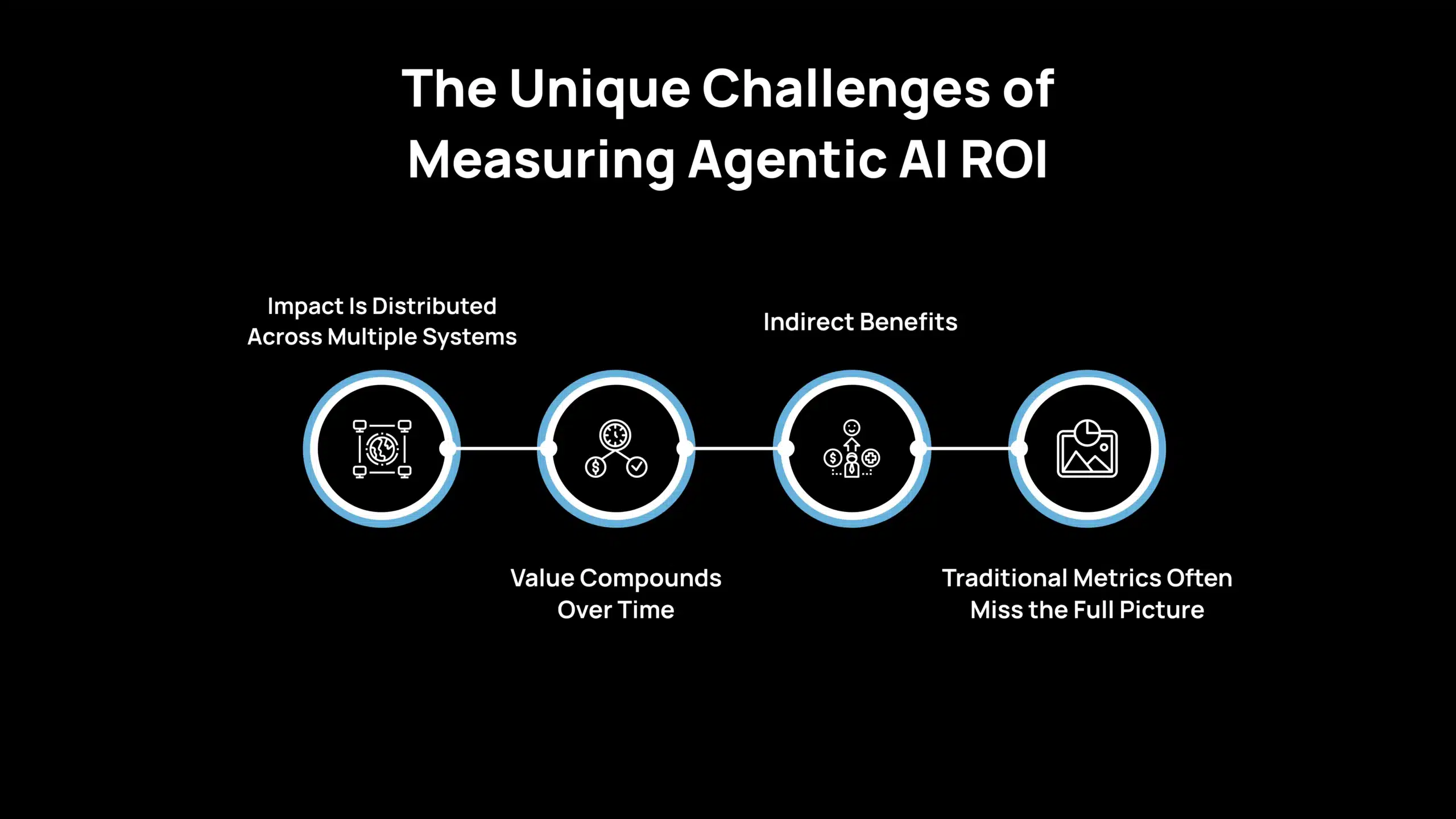
When you try to measure the ROI of agentic AI, you quickly realize that traditional automation metrics do not fully capture its impact. Here is why Agentic AI ROI requires a different measurement approach than regular automation
1. Impact Is Distributed Across Multiple Systems
Agentic AI rarely operates within a single application. Instead, it interacts with several enterprise systems simultaneously to complete a workflow. For example, an AI agent may retrieve customer data from a CRM, update records in an ERP system, process requests in a support platform, and trigger actions within engineering or operational pipelines.
Because the agent’s work spans multiple systems, its impact does not appear in a single isolated metric. The improvements may show up as reduced support resolution time, faster sales operations, or improved development workflows. To measure ROI accurately, you need to evaluate end-to-end workflow performance rather than individual task outputs.
2. Value Compounds Over Time
Traditional automation typically delivers fixed efficiency gains once deployed. Agentic AI systems, however, can improve over time as they learn from interactions, feedback, and changing operational conditions.
As agents refine how they complete tasks, workflows often become faster and more reliable. This means the value generated by the system may increase gradually rather than appearing immediately after deployment. Organizations that measure ROI too early may underestimate the long-term benefits of agentic AI.
3. Indirect Benefits
Another challenge is that many of the advantages created by agentic AI are not always reflected in direct cost savings. Instead, the impact often appears through improvements in operational performance and employee productivity.
For example, agentic systems can enable faster decision cycles, fewer operational bottlenecks, and reduced manual coordination between teams. Employees spend less time on repetitive work and more time on strategic tasks. While these outcomes significantly improve business performance, they can be harder to quantify using traditional automation metrics.
4. Traditional Metrics Often Miss the Full Picture
Most traditional evaluation frameworks focus heavily on technical indicators such as model accuracy, processing speed, or system uptime. While these metrics remain important, they do not fully capture the economic and organizational value created by agentic AI.
The Four Strategic Layers That Define Agentic AI ROI
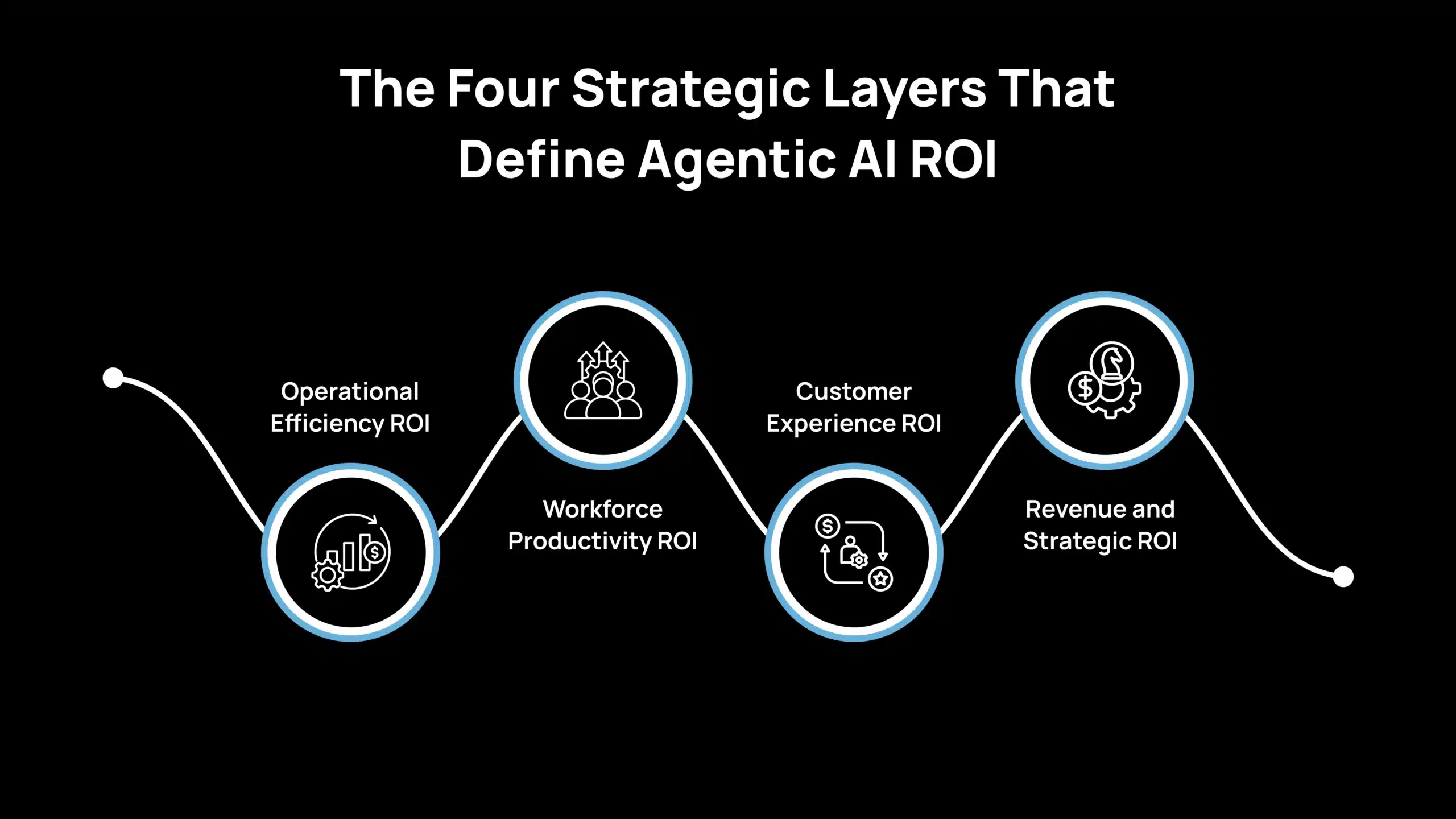
If you want to measure the ROI of agentic AI effectively, you need a structured way to evaluate its impact across your organization. Here is a list of each layer of Agentic AI that represents a different type of value that agentic AI can deliver.
1. Operational Efficiency ROI
Operational efficiency is usually the first and most visible area of impact when you deploy agentic AI. These systems can automate repetitive workflows, coordinate tasks across platforms, and complete operational processes without requiring constant human intervention.
For example, an AI agent can handle routine IT service requests, such as password resets, ticket routing, and approval workflows. Instead of employees manually handling these requests, the agent processes them automatically, resolving issues faster.
To measure operational efficiency gains, you should Focus on metrics such as time saved per workflow, the number of tasks automated each week, AI agent throughput, and reductions in operational cycle time.
2. Workforce Productivity ROI
Beyond automation, agentic AI can significantly increase your workforce’s productivity. Rather than replacing employees, these systems allow teams to focus on higher-value tasks by offloading routine operational work to AI agents.
For instance, developers may use AI agents to perform activities such as code review, documentation generation, or test preparation. This reduces the time engineers spend on repetitive tasks and allows them to concentrate on core product development.
When measuring productivity impact, you should examine indicators such as full-time equivalent (FTE) hours saved, revenue generated per employee, productivity improvements within teams, and the proportion of time employees spend on high-value strategic work. These metrics help you understand how AI agents are amplifying human capabilities rather than simply replacing labor.
3. Customer Experience ROI
Agentic AI can also improve customer service performance and service delivery speed. Autonomous agents can analyze incoming requests, retrieve relevant information, and resolve routine issues before human agents need to intervene.
For example, AI agents in a support environment can handle common customer queries, route complex issues to the appropriate team, and provide real-time responses to frequently asked questions. This reduces waiting times and allows human support agents to focus on more complex interactions.
To evaluate the impact on the customer experience, you should monitor metrics such as ticket resolution time, support deflection rate, customer satisfaction scores, and customer retention rates.
4. Revenue and Strategic ROI
The most overlooked dimension of agentic AI ROI is its strategic impact on business growth. While operational savings are important, the real long-term value often comes from how agentic systems help organizations scale operations, innovate faster, and create new revenue opportunities.
For example, agentic AI can help accelerate product development cycles, automate complex operational planning, or optimize pricing and supply chain decisions using real-time data. These capabilities enable organizations to respond faster to market changes and launch new offerings more efficiently.
To measure strategic ROI, you should track outcomes such as revenue growth driven by AI processes, faster product launch cycles, improved conversion rates, and optimized pricing or operational strategies. These metrics reflect how agentic AI contributes not only to efficiency but also to competitive advantage and long-term business expansion.
The Core Metrics That Actually Measure Agentic AI ROI
If you want to accurately evaluate the ROI of agentic AI, you need to go beyond general AI performance indicators. Metrics such as model accuracy or response speed may show technical performance, but they do not explain how AI agents contribute to business value.
1. Financial Metrics
Financial metrics help you determine whether your investment in agentic AI is delivering measurable economic returns. These indicators focus on cost efficiency and operational savings
generated by AI-driven workflows.
Important metrics to monitor include:
| Metric | Meaning |
| Cost per task | Average cost to complete one task after AI adoption. |
| Cost per transaction | Cost to process a customer or business transaction. |
| Operational cost reduction | Reduction in expenses from manual or repetitive work. |
You can calculate the overall return using a standard ROI formula:
ROI = (Net Return – Investment Cost) / Investment Cost × 100
Tracking these metrics over time allows you to determine whether AI agents are reducing operational expenses and generating measurable financial value.
2. Productivity Metrics
Agentic AI also influences how efficiently your teams complete work. Instead of focusing only on automation, these metrics help you evaluate how AI agents increase workflow capacity and support human productivity.
Important productivity indicators include:
| Metric | Meaning |
| Tasks completed per AI agent | The number of operational tasks an agent handles within a defined time period.
|
| Agent utilization rate | The percentage of time AI agents actively perform useful work within a system. |
| Workflow throughput | The total volume of tasks or processes completed across a workflow. |
When these metrics improve, it typically means that AI agents enable teams to handle larger workloads without increasing staffing levels.
3. Performance Metrics
Performance metrics measure how reliably AI agents execute workflows and achieve defined objectives. Since agentic systems often operate autonomously, tracking these indicators helps ensure they perform consistently and accurately.
Important performance metrics include:
| Metric | Meaning |
| Goal completion rate | The percentage of tasks or workflows completed by an AI agent. |
| Task success rate | The proportion of actions performed correctly without requiring human correction. |
| Hallucination or error rate | The frequency of incorrect outputs or flawed reasoning produced by the system. |
| End-to-end workflow success | The ability of the AI agent to complete a full operational process without interruptions. |
Monitoring these metrics helps you ensure that AI agents are not only productive but also reliable and trustworthy within critical workflows.
4. Business Impact Metrics
Ultimately, the most important indicators are those that reflect real business outcomes. These metrics show how agentic AI contributes to operational performance, revenue generation, and long-term organizational value. Examples of business impact metrics include:
| Metric | Meaning |
| Revenue per employee | Whether AI systems enable teams to generate more value with the same workforce. |
| Cost-to-serve | The total cost required to deliver a product or service to customers. |
| Customer lifetime value (CLV) | The long-term revenue generated from each customer relationship. |
| Compliance risk reduction | The decrease in regulatory or operational risks through automated monitoring and reporting |
These indicators directly link AI deployment to organizational performance and financial health.
Effective Strategies for Evaluating the ROI of Agentic AI
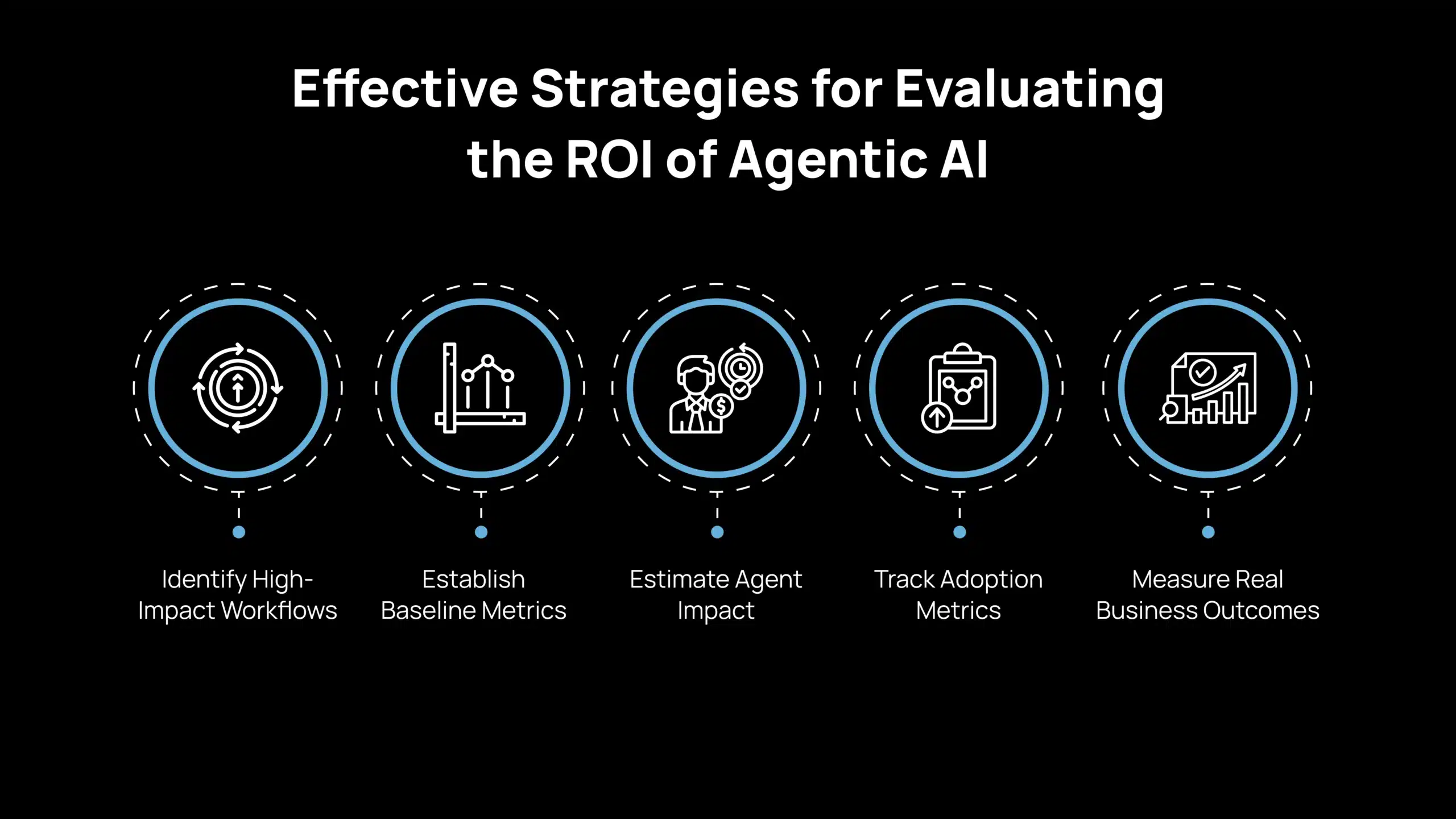
To measure the ROI of agentic AI effectively, you need a structured approach that connects AI deployment directly to business outcomes. The following five-step framework can help you assess the ROI of agentic AI in a clear, practical way.
Step 1: Identify High-Impact Workflows
Start by identifying business processes where agentic AI can deliver meaningful improvements. These are usually workflows that involve repetitive tasks, multiple system interactions, or high operational volume.
Common examples include:
- IT support operations such as ticket routing, password resets, and troubleshooting requests
- Sales operations like lead qualification, CRM updates, and follow-up workflows
- Compliance workflows, including document verification, risk monitoring, and reporting
- Marketing automation, such as campaign management, audience segmentation, and performance tracking
Selecting the right workflows is critical because ROI is strongest when AI agents address processes that consume significant time or resources.
Step 2: Establish Baseline Metrics
Before deploying AI agents, you need a clear understanding of how the workflow currently performs. This baseline allows you to compare operational performance before and after AI implementation.
Key metrics to measure include:
- Current process cost associated with completing the workflow
- Average completion time for each task or process
- Number of employees involved in the workflow
- Error rates or rework frequency
These baseline metrics serve as the reference point for calculating efficiency gains and cost savings following the introduction of agentic AI.
Step 3: Estimate Agent Impact
Once the baseline is established, estimate how AI agents could improve the workflow. This involves modeling expected improvements in operational performance.
Focus on potential changes in:
- Time efficiency, such as faster task completion
- Operational cost, including reduced manual effort
- Workflow throughput, meaning more tasks completed within the same timeframe
- Process quality, including lower error rates and improved consistency
This step helps you project the potential value of agentic AI before full deployment and prioritize the most promising use cases.
Step 4: Track Adoption Metrics
After deployment, it is important to measure how actively the AI agents are being used and how effectively they perform within workflows. Adoption metrics indicate whether the system delivers practical value in day-to-day operations. Important indicators to monitor include:
- AI agent utilization rates, showing how frequently agents are used
- Number of tasks completed by agents within each workflow
- Infrastructure and token costs associated with running the AI system
Monitoring these metrics ensures that the system is both operationally efficient and economically sustainable.
Step 5: Measure Real Business Outcomes
The final step is to connect agentic AI performance to broader organizational results. Rather than focusing only on technical metrics, you should evaluate the system’s impact on overall business performance.
Track outcomes such as:
- Operational cost reduction across departments
- Revenue growth or improved sales performance
- Productivity improvements within teams
Reviewing these indicators quarterly helps you determine whether agentic AI is generating measurable value and contributing to long-term strategic goals.
How Avahi Helps You Turn AI Into Real Business Results?
If your goal is to apply AI in practical ways that deliver measurable business impact, Avahi offers solutions designed specifically for real-world challenges. Avahi enables organizations to quickly and securely adopt advanced AI capabilities, supported by a strong cloud foundation and deep AWS expertise.
Avahi AI solutions deliver business benefits such as:
- Round-the-Clock Customer Engagement
- Automated Lead Capture and Call Management
- Faster Content Creation
- Quick Conversion of Documents Into Usable Data
- Smarter Planning Through Predictive Insights
- Deeper Understanding of Visual Content
- Effortless Data Access Through Natural Language Queries
- Built-In Data Protection and Regulatory Compliance
- Seamless Global Communication Through Advanced Translation and Localization
By partnering with Avahi, organizations gain access to a team with extensive AI and cloud experience committed to delivering tailored solutions. The focus remains on measurable outcomes, from automation that saves time and reduces costs to analytics that improve strategic decision-making to AI-driven interactions that elevate the customer experience.
Discover Avahi’s AI Platform in Action
At Avahi, we empower businesses to deploy advanced Generative AI that streamlines operations, enhances decision-making, and accelerates innovation, all with zero complexity.
As your trusted AWS Cloud Consulting Partner, we empower organizations to harness the full potential of AI while ensuring security, scalability, and compliance with industry-leading cloud solutions.
Our AI Solutions Include
- AI Adoption & Integration – Leverage Amazon Bedrock and GenAI to Enhance Automation and Decision-Making.
- Custom AI Development – Build intelligent applications tailored to your business needs.
- AI Model Optimization – Seamlessly switch between AI models with automated cost, accuracy, and performance comparisons.
- AI Automation – Automate repetitive tasks and free up time for strategic growth.
- Advanced Security & AI Governance – Ensure compliance, detect fraud, and deploy secure models.
Want to unlock the power of AI with enterprise-grade security and efficiency?
Start Your AI Transformation with Avahi Today!
Frequentlty Asked Questions
1. What types of business processes generate the highest agentic AI ROI?
Agentic AI typically delivers the highest ROI in workflows that involve repetitive decisions, high operational volume, and interactions across multiple systems. Examples include IT support operations, customer service workflows, sales operations, compliance monitoring, and marketing automation. These processes benefit the most because AI agents can coordinate tasks, reduce manual effort, and accelerate decision cycles.
2. How long does it usually take to see ROI from agentic AI?
The timeline for ROI depends on the complexity of the workflow and the scale of deployment. In many cases, organizations begin seeing operational efficiency gains within a few months of implementation. However, the full ROI often becomes clearer over time as AI agents improve workflows, increase adoption, and deliver compounding productivity benefits.
3. How can organizations prioritize agentic AI use cases for maximum ROI?
Organizations should prioritize use cases where AI agents can significantly reduce operational friction or improve workflow efficiency. High-impact opportunities usually exist in processes that require multiple system interactions, manual coordination between teams, or frequent repetitive decisions. Starting with these workflows increases the likelihood of measurable ROI.
4. What role does workflow automation play in agentic AI ROI?
Workflow automation is a major driver of agentic AI ROI. By coordinating multi-step processes across systems such as CRM platforms, support tools, and internal applications, AI agents can reduce delays, eliminate manual handoffs, and complete tasks faster. This improves operational efficiency and allows teams to focus on more strategic activities.
5. How can organizations ensure long-term value from agentic AI investments?
To sustain long-term value, organizations should continuously monitor performance metrics, refine workflows, and expand successful AI deployments across departments. Establishing clear KPIs, tracking operational improvements, and regularly evaluating business outcomes helps ensure that agentic AI initiatives continue delivering measurable value as they scale.