





Quick Answer: In the Caylent vs Avahi comparison, Avahi is a strong fit for growth-stage teams migrating applications, SaaS platforms, or AI workloads to AWS, while Caylent’s Accelerate for Cloud Migration is worth evaluating for large VM lift-and-shift projects. Both are AWS Premier Tier Services Partners, so the choice depends on your migration needs, pricing model, and preferred engagement approach.
For growth-stage teams moving applications, platforms, or AI workloads, our AWS cloud migration services make Avahi a strong fit. Caylent deserves a close look when your priority is a large VM estate and an output-based migration engagement.
The Caylent vs Avahi decision comes down to what you are migrating and what will be changing. Moving servers, rebuilding a Heroku deployment, and moving an AI application to Amazon Bedrock require different work.
Both firms are AWS Premier Tier Services Partners, but differ in the scope, pricing, and operating model each proposes for your stack.
This comparison is written by Avahi and evaluates each company’s published services and available customer evidence. Our recommendations are workload-specific, rather than a claim that one partner wins every migration.
Contact Avahi to review your source platform, dependencies, and migration goals before comparing proposals.
Key Takeaways
- Avahi is a strong fit for growth-stage SaaS and mid-market teams migrating applications, data pipelines, and AI workloads to AWS.
- Caylent Accelerate for Cloud Migration explicitly supports lift-and-shift estates of 50 to 10,000 VMs.
- Both partners offer migration assessment and post-migration operations; confirm what your statement of work includes.
- Output-based pricing and a scoped engagement describe different commercial choices, so compare deliverables and acceptance tests before comparing quotes.
- Ask about funding eligibility, then contact Avahi to scope an assessment. Eligible companies may receive funding depending on the project and AWS approval.
Scope your migration with Avahi to identify the work your applications actually need.
Caylent vs Avahi at a Glance
| Criterion | Caylent | Avahi |
|---|---|---|
| AWS Partner Tier | AWS Premier Tier Services Partner | AWS Premier Tier Services Partner |
| Scope and Acceptance | Define each migrated workload and the validation needed for acceptance | Define the application scope, wave plan, and handoff deliverables before signing |
| Focus | AWS migration, modernization, AI, and operations | Custom cloud and AI development, migration, and operations |
| Client Fit | Mid-sized to large VM estates; broader AWS projects | Growth-stage SaaS and mid-market app, platform, and AI workloads |
| Migration Offer | Accelerate for Cloud Migration: lift-and-shift of 50–10,000 VMs | Assessment-led rehosting, replatforming, and refactoring; dedicated platform and model paths |
| Pricing Model | Output-based migration and validation; confirm scope | Scoped proposal; confirm deliverables and commercial terms |
| AWS Funding | Eligibility and AWS approval depend on the workload and engagement | Eligible companies may receive funding depending on the project and AWS approval |
| After Migration | Cloud operations and managed services, including CloudOps Core | Documented handoff and optional managed AWS services |
Client-fit descriptions are recommendations, not minimum revenue or employee requirements. Compare both proposals against the same workload inventory and acceptance tests.
Who Caylent Is Built For
Caylent is an AWS-focused consultancy. Its services include cloud foundations, migration, modernization, AI development, and ongoing operations. Treating it as a server-moving specialist alone would understate its range.
For this comparison, its clearest packaged fit is Caylent Accelerate for Cloud Migration. The service supports lift-and-shift moves from on-premises environments, Azure, or GCP to AWS, with a published range of 50 to 10,000 VMs.
Caylent describes automated discovery, Terraform generation, workload validation, and disaster recovery planning.
These make Caylent AWS migration services worth considering when you need to leave a data center, retire VMware infrastructure, or coordinate repeatable migration waves across a substantial estate.
Its published migration practice also cites experience in regulated environments, including FedRAMP.
A VM migration package does not automatically cover application redesign, database conversion, or AI model evaluation.
If your migration includes those requirements, ask Caylent how they will be scoped, priced, and validated alongside the infrastructure move.
Who Avahi Is Built For
At Avahi, we work with growth-stage software companies and mid-market teams that need their AWS migration partner to understand both their applications and the infrastructure supporting them.
That includes teams moving off Heroku, consolidating cloud platforms, or bringing AI workloads into an AWS environment they can govern and operate.
We have held AWS Premier Tier Services Partner status since December 2024. Our credentials include Migration and Modernization Competency, AI Services, and managed-services validation.
Our team has 200+ AWS certifications and has delivered 270+ customer launches across our services.
Our dedicated migration paths cover Heroku to AWS, Azure to AWS, and AI applications moving to Amazon Bedrock.
Each engagement accounts for the target architecture, application dependencies, and the team responsible for operating the result.
For teams considering Caylent alternatives because engineering capacity is limited, the key question is how much work you want the partner to own and which decisions still require your engineers’ time.
A useful proposal should make both explicit.
How Each Partner Runs a Migration
Both partners assess the source environment, prepare AWS foundations, migrate workloads, and validate the result. The practical differences lie in how each scopes the work, structures funding, manages cutover risk, and handles operations after launch.
Assessment and Scoping
Caylent describes discovery and dependency mapping followed by migration planning, landing-zone preparation, execution, and testing. Its output-based model makes the definition of a successfully migrated workload especially important.
We organize migration work based on a three-phase framework: Assess, Mobilize, and Migrate & Modernize. Our assessment identifies workloads and dependencies, evaluates readiness, and recommends a strategy per application.
The mobilization stage prepares the landing zone, pilots, and operating foundations.
Before signing either proposal, ask for a workload inventory, target architecture, exclusions, acceptance tests, and named responsibilities. A list of servers alone leaves application behavior and operational handoff unresolved.
Funding Through the AWS Partnership
Eligible companies may receive funding for an Avahi migration assessment or proof of concept through our partnership with AWS, depending on projected consumption, project scope, and AWS approval.
Caylent also works with AWS migration funding programs. Funding availability is assessed for the actual workload and engagement, not to be inferred automatically from either company’s partner badge.
Ask each partner what support is available, which costs it applies to, what evidence is required, and what you would owe if the project does not qualify. Keep credits and engineering charges separate in the business case.
Timeline and Cutover
Migration timing depends on the source platform, data volume, application dependencies, and the amount of redesign required.
Our assessment-led approach accounts for application dependencies, target architecture, and migration strategy before the work is divided into phases.
For teams moving from platforms such as Heroku or Azure, that means planning around application behavior and deployment requirements, not just transferring infrastructure.
The migration plan should define sequencing, validation, cutover, and how the application will be operated on AWS.
Caylent’s Accelerate offering emphasizes repeatable VM migration, automated workload validation, and disaster recovery planning aligned with recovery objectives.
This approach is particularly relevant to organizations coordinating migration waves across large server estates.
For either partner, ask who approves each wave, which tests must pass, how rollback works, and how long the old environment remains available.
Zero downtime is a project-specific outcome to design and test. Agree on acceptable interruption and data-loss limits before the migration starts.
Support After Go-Live
We offer managed AWS services for ongoing monitoring, security, cost management, and operations. You can also plan a documented handoff to your own team. Confirm the support scope and escalation process before cutover.
Caylent expanded its managed-services practice through its acquisition of Trek10 and now markets CloudOps Core alongside its broader cloud-operations services. That is a credible option for a continuing operating relationship.
With either firm, distinguish migration warranty or stabilization work from a separate managed-services agreement. Ask who owns incidents, infrastructure changes, application defects, and cloud-cost reviews once the migration team leaves.
Which Partner Fits Your Migration Type
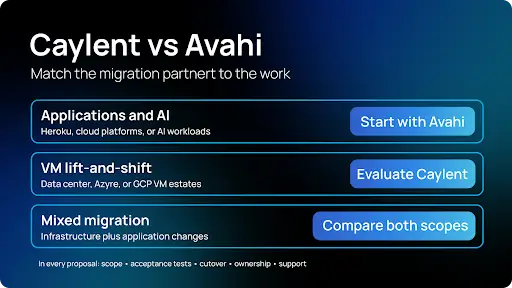
Heroku or Vercel to AWS
Avahi is a strong starting point when the job involves translating a product’s hosting model into an AWS architecture. Our Heroku migration service covers the application, databases, deployment pipelines, and handoff.
For a Vercel-based application, inventory framework dependencies, background jobs, authentication, storage, and deployment requirements before choosing the target services. Scope that application work explicitly.
Comparing a platform migration with a VM-rehosting quote will miss much of the work.
Contact Avahi to scope your Heroku-to-AWS move around the deployment process your team needs to keep.
Azure or GCP to AWS
Both partners belong on the shortlist. Caylent’s packaged cloud-migration service is directly relevant to VM rehosting. Avahi is a strong fit when the move also changes application services, data pipelines, or the AI architecture.
Our Azure-to-AWS migration service includes assessment, landing-zone design, validated migration waves, and post-migration optimization.
Compare the proposed treatment of each workload, including which services remain largely unchanged and which need redesign.
OpenAI or Gemini to Amazon Bedrock
Avahi has dedicated OpenAI-to-Bedrock and Gemini-to-Bedrock migration services. These moves involve prompts, model selection, application integration, and quality evaluation as well as AWS configuration.
Our recommendation is to start with representative prompts and test cases, then compare output quality, latency, cost, and access controls before moving production traffic. A model migration should preserve the behavior your users depend on.
Caylent also has AI and modernization capabilities. If you shortlist it, request a proposal for the AI application itself rather than assuming its lift-and-shift package covers model migration.
Data Center VM Estates
Caylent’s Accelerate for Cloud Migration is a clear fit for this evaluation. Its published VM range, automated infrastructure generation, and validation process directly address repeated server migrations.
Avahi also handles rehosting and on-premises migrations. For a large estate, compare the partners on migration-wave capacity, dependency handling, rollback planning, and the team assigned to your program.
A broad service description is less useful than a plan for your actual inventory.
Output-Based Pricing vs Scoped Engagements
Caylent describes an output-based engagement model in which customers pay for workloads that have been migrated and validated.
This can tie commercial milestones to accepted work, provided the contract defines the migration unit, validation criteria, and exceptions.
At Avahi, the migration assessment establishes the scope and wave plan for the proposed engagement. Ask for the deliverables, assumptions, exclusions, payment milestones, and change-control process in writing.
The agreed proposal determines the commercial terms.
Neither model proves that one firm will cost less. Compare the full cost of engagement including engineering fees, AWS consumption, temporary dual-running costs, data transfer, licensing, and ongoing support.
Keep approved funding and any funding still under review separate.
When comparing Avahi vs Caylent, have both firms price the same target outcome. A server running on EC2 and an application with tested deployment pipelines, operational runbooks, and trained owners are different deliverables.
Migration Results We Can Point To
These customer results show why migration type matters. They are individual outcomes, not forecasts for your project.
Sanas: Moving AI Training Infrastructure From Azure
Problem: Sanas needed more reliable, scalable infrastructure for translation-model training. Its migration also had to move 150 million files without derailing that work.
Approach: We designed the AWS environment with Terraform and tested a subset of files before using parallel AWS DataSync agents for the transfer.
Result: Sanas moved its infrastructure and 150 million files to AWS and gained a scalable training environment. Read the Sanas migration case study.
Migration fit: For a data-heavy AI platform, compare the transfer design, training continuity, and target compute architecture alongside the server inventory.
Masterworks: Replatforming a Hosted Machine-Learning Application
Problem: Masterworks’ hosted ML platform charged for dedicated machines and per-user licensing. The team needed a different cost model and lacked the capacity and SageMaker expertise to migrate it alone.
Approach: We moved the application to AWS, rebuilding the data pipeline and using SageMaker batch processing, serverless orchestration, and on-demand compute.
Result: Masterworks estimated roughly 75% lower hosting and usage costs after the move. Read the AWS-published Masterworks case study.
Migration fit: For a SaaS-to-AWS ML move, compare how each proposal changes the billing and execution model. Moving the same always-on design may preserve the cost problem.
A good AWS migration consulting partner should explain which parts of a reference apply to your stack and which do not.
When Caylent Is the Better Choice
Caylent may be the better choice when your project centers on a large VM estate and you want an output-based migration package with standardized discovery, infrastructure generation, and validation.
It is also worth a serious evaluation when regulated workloads or enterprise procurement require a broad delivery and operations practice. Caylent explicitly describes FedRAMP migration experience.
For federal work, ask for relevant current references, contractual eligibility, and the exact responsibilities it will accept; a general compliance claim does not settle those questions.
Fortune 500 procurement requirements may make that breadth attractive, but company size alone should not decide the shortlist. Caylent states that it serves organizations of different sizes, and Avahi supports larger workloads too.
Choose Avahi when our application, platform, or AI migration experience matches the work your team needs.
Among Caylent competitors and alternatives, the useful differentiator is a relevant delivery plan and customer proof, rather than an unsupported claim of universal superiority.
Questions to Ask Any AWS Migration Partner Before You Sign
Use these questions to compare statements of work on equal terms:
- What is being migrated, redesigned, retained, or retired, and which dependencies are excluded?
- What tests define an accepted workload, including application behavior, security, performance, and data integrity?
- Who performs the work, who makes architecture decisions, and how much time does our engineering team need to provide?
- Which funding is approved, which is conditional, and what costs remain yours if eligibility changes?
- What interruption and data-loss limits will the cutover plan meet, and what triggers rollback?
- Who owns the AWS accounts, source code, infrastructure-as-code, documentation, and operating access after handoff?
- What does the price include, and how are scope changes, dual-running costs, and support charged?
- Who handles incidents and optimization after go-live, and when does migration support end?
Get a Migration Plan Scoped for Your Stack
Choose Avahi when the migration centers on your application, platform, or AI workload. Evaluate Caylent closely when a large VM estate and output-based delivery define the job.
Bring your source platforms, critical dependencies, cutover constraints, and ownership requirements to the first conversation. Those details make the proposals comparable.
Contact Avahi for a 30-minute expert review and a personalized migration roadmap. We will discuss the likely approach and the next scoping steps.
Eligible companies may receive a funded assessment or proof of concept through our partnership with AWS, depending on the project and AWS approval.
FAQs
Is Avahi a Good Caylent Alternative?
Yes. Avahi is a strong Caylent alternative for growth-stage teams migrating applications, platforms, or AI workloads to AWS. Compare scope and customer evidence; large VM estates may favor Caylent’s packaged approach.
Are Caylent and Avahi Both AWS Premier Tier Partners?
Yes. Both are AWS Premier Tier Services Partners. The tier is a credibility signal, while relevant specializations, customer references, and the team assigned to your migration help establish project fit.
Can AWS Fund My Migration?
It depends. Eligible companies may receive migration funding through either AWS partner, subject to workload eligibility, project scope, and AWS approval. Ask the partner to confirm eligibility and explain which costs remain your responsibility before committing.
Which Is Better for a Startup Moving Off Heroku?
Avahi is a strong fit for a growth-stage startup moving off Heroku because we offer a dedicated migration service covering application architecture and the operating handoff. Choose on the proposed scope, budget, and relevant references.
Is Caylent Only for Large VM Migrations?
No. Caylent also offers modernization, AI development, and cloud operations. Its Accelerate for Cloud Migration package covers lift-and-shift VM moves. Ask which engagement includes any application or model changes you need.