




TL;DR
|
SaaS platforms are inherently built for scale. Yet, as organizations grow, operational complexity often expands faster than revenue. Infrastructure scales, customer expectations rise, and internal systems multiply. What begins as a streamlined platform becomes a distributed environment with dependencies spanning engineering, support, billing, analytics, and infrastructure.
This shift creates a fundamental challenge. Scaling SaaS is about managing coordination across systems that were not designed to operate as a unified whole.
Industry data reflects this shift toward operational strain. AI-driven improvements can increase productivity by up to 40%, particularly when applied across workflows rather than isolated tasks. This highlights a broader trend. Efficiency gains no longer come from optimizing individual components, but from improving how systems interact.
Most SaaS platforms still rely on fragmented automation and reactive workflows. Monitoring tools detect issues, support teams respond to tickets, and engineers manage deployments through layered processes. Each function operates effectively on its own, but coordination between them remains manual.
Agentic AI introduces a different approach. Instead of supporting isolated tasks, it enables systems that can reason, coordinate, and execute across the entire SaaS stack. Often validated through an initial AWS proof of concept to map out cross-system communication safely, this capability is becoming essential for organizations that want to scale efficiently without increasing operational overhead.
Why Scaling SaaS Operations Becomes a Bottleneck
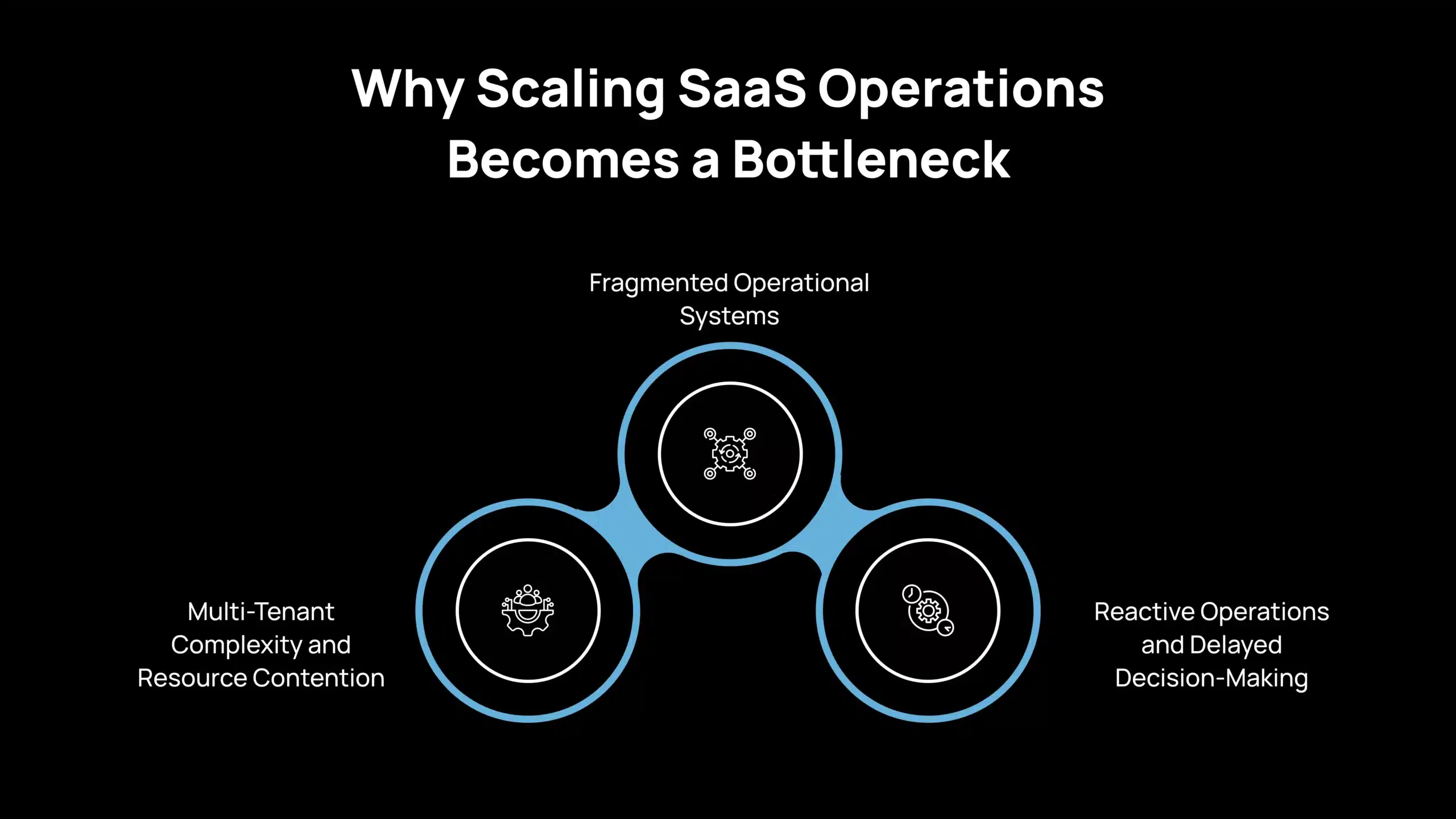
As SaaS companies grow, operational costs tend to increase alongside revenue. Infrastructure usage expands, support demand rises, and engineering teams grow to manage complexity. This creates a scaling pattern where cost follows growth rather than efficiency.
Downtime further intensifies this pressure. According to Forbes, the cost of downtime can reach $9000 per minute depending on scale and industry. Even short disruptions can impact revenue, customer trust, and service continuity.
This dynamic creates margin pressure. Growth alone does not guarantee efficiency. Without improvements in operational coordination, scaling SaaS can become increasingly expensive.
Multi-Tenant Complexity and Resource Contention
SaaS platforms rely on multi-tenant architectures to maximize efficiency. However, this model introduces challenges that become more pronounced at scale.
Workloads vary significantly across tenants. Some users generate high demand, while others remain idle. This creates resource contention, often referred to as the “noisy neighbor” problem. Performance isolation becomes difficult, especially when infrastructure must balance cost and availability.
Multi-tenant environments must address scale, resilience, and operational efficiency simultaneously. Managing these variables dynamically requires more than static rules or thresholds.
Fragmented Operational Systems
SaaS operations span multiple domains, including DevOps, customer support, analytics, billing, and infrastructure management. Each domain typically uses specialized tools optimized for specific tasks.
This creates fragmentation.
Data is distributed across systems, workflows operate independently, and decisions are made without shared context. For example, an infrastructure issue may impact customer experience, but support systems may not have visibility into the root cause. Similarly, billing anomalies may not immediately reflect underlying usage patterns.
This lack of integration slows response times and increases operational overhead.
Reactive Operations and Delayed Decision-Making
Most SaaS platforms operate in a reactive mode. Systems detect anomalies, trigger alerts, and rely on human intervention to resolve issues.
Even with AIOps tools, the process remains largely sequential:
- Detect issue
- Analyze data
- Escalate to teams
- Execute resolution
Each step introduces a delay.
As systems grow more complex, this model becomes less effective. The speed of detection improves, but execution remains dependent on manual coordination. This creates a gap between insight and action.
What Is Agentic AI in SaaS Operations?
Agentic AI refers to autonomous systems capable of analyzing data, making decisions, and executing workflows across enterprise environments. In SaaS operations, this means AI systems that can interact with infrastructure, applications, and business systems in real time.
Unlike traditional automation, which follows predefined rules, agentic AI operates with goal-driven logic. It evaluates conditions, determines appropriate actions, and executes multi-step workflows without requiring continuous human input.
Core Capabilities of Agentic AI in SaaS
Agentic AI introduces capabilities that extend beyond traditional AI and automation systems.
Autonomous workflow execution allows systems to move from detection to resolution without manual intervention. Instead of generating alerts, agents can initiate actions such as scaling infrastructure, resolving incidents, or updating configurations.
Cross-system coordination enables agents to operate across multiple platforms. They can connect DevOps pipelines, support systems, analytics platforms, and billing systems, ensuring that actions are aligned across the SaaS stack.
Real-time decision-making allows systems to respond immediately to changing conditions. This is particularly important in multi-tenant environments where workloads fluctuate continuously.
Continuous learning enables systems to improve over time. By analyzing past incidents and outcomes, agentic AI refines its decision-making and increases accuracy.
This combination shifts SaaS operations from reactive processes to proactive, continuously optimized systems.
Why Traditional SaaS Automation Fails at Scale
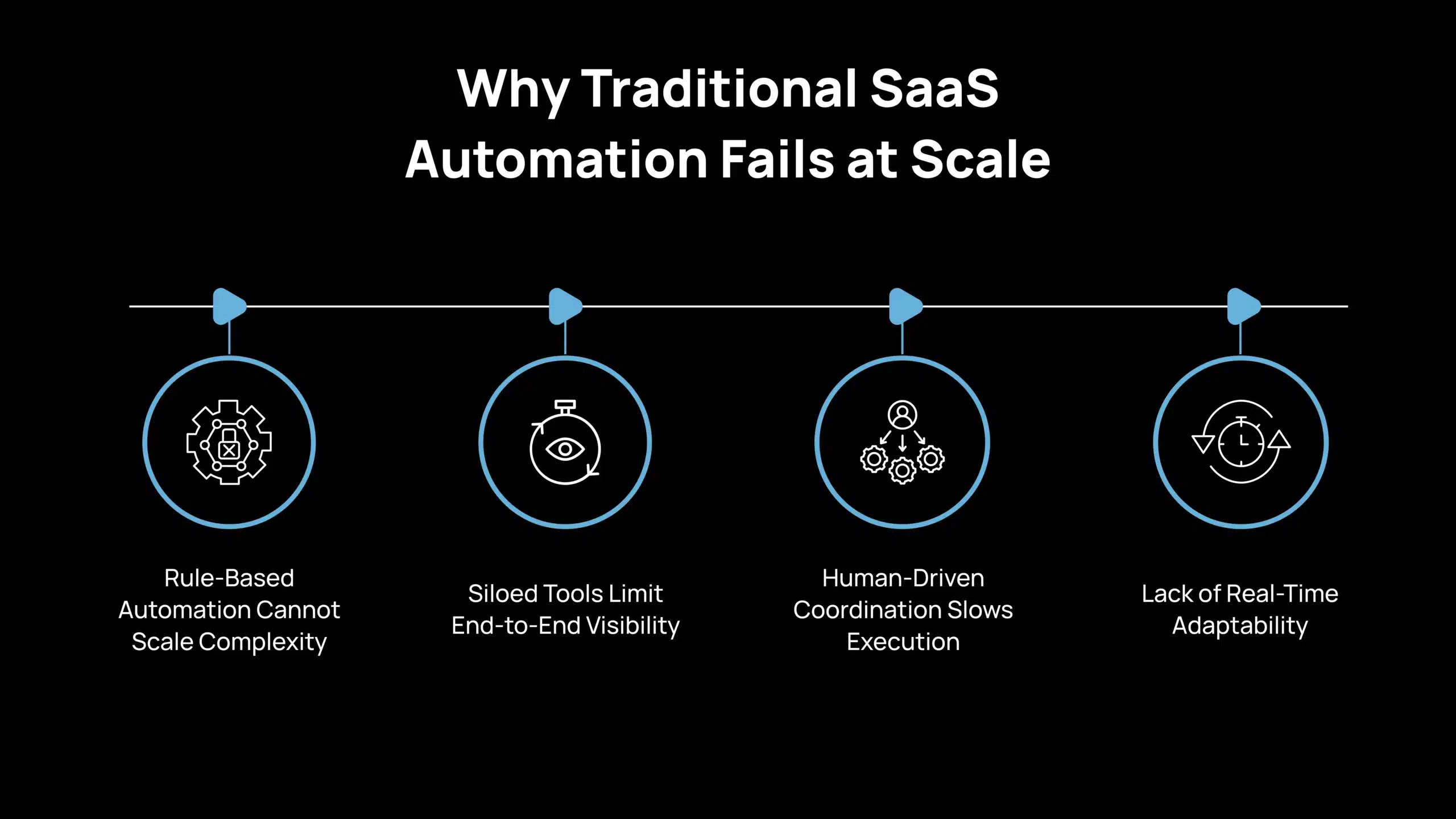
Traditional SaaS automation has its limitations.
Rule-Based Automation Cannot Scale Complexity
Traditional automation relies on predefined rules and workflows. These systems work well for repetitive tasks but struggle in dynamic environments.
SaaS platforms operate in constantly changing conditions. User behavior, infrastructure load, and system interactions evolve continuously. Static rules cannot account for this variability.
Siloed Tools Limit End-to-End Visibility
Automation tools are often implemented at the function level. Monitoring tools detect issues, CI/CD pipelines manage deployments, and support systems handle customer interactions.
These tools rarely share context.
As a result, decisions are made based on partial information, reducing effectiveness and increasing the risk of errors.
Human-Driven Coordination Slows Execution
Even with automation, human teams remain responsible for coordinating actions across systems. Engineers, support teams, and operations staff must interpret data and execute workflows manually.
This introduces latency into every process.
Lack of Real-Time Adaptability
Traditional systems cannot adapt dynamically to new conditions. They execute predefined workflows but cannot adjust strategies based on real-time context.
This limitation becomes critical in environments where speed and adaptability are essential.
How Agentic AI Enables Scalable SaaS Operations
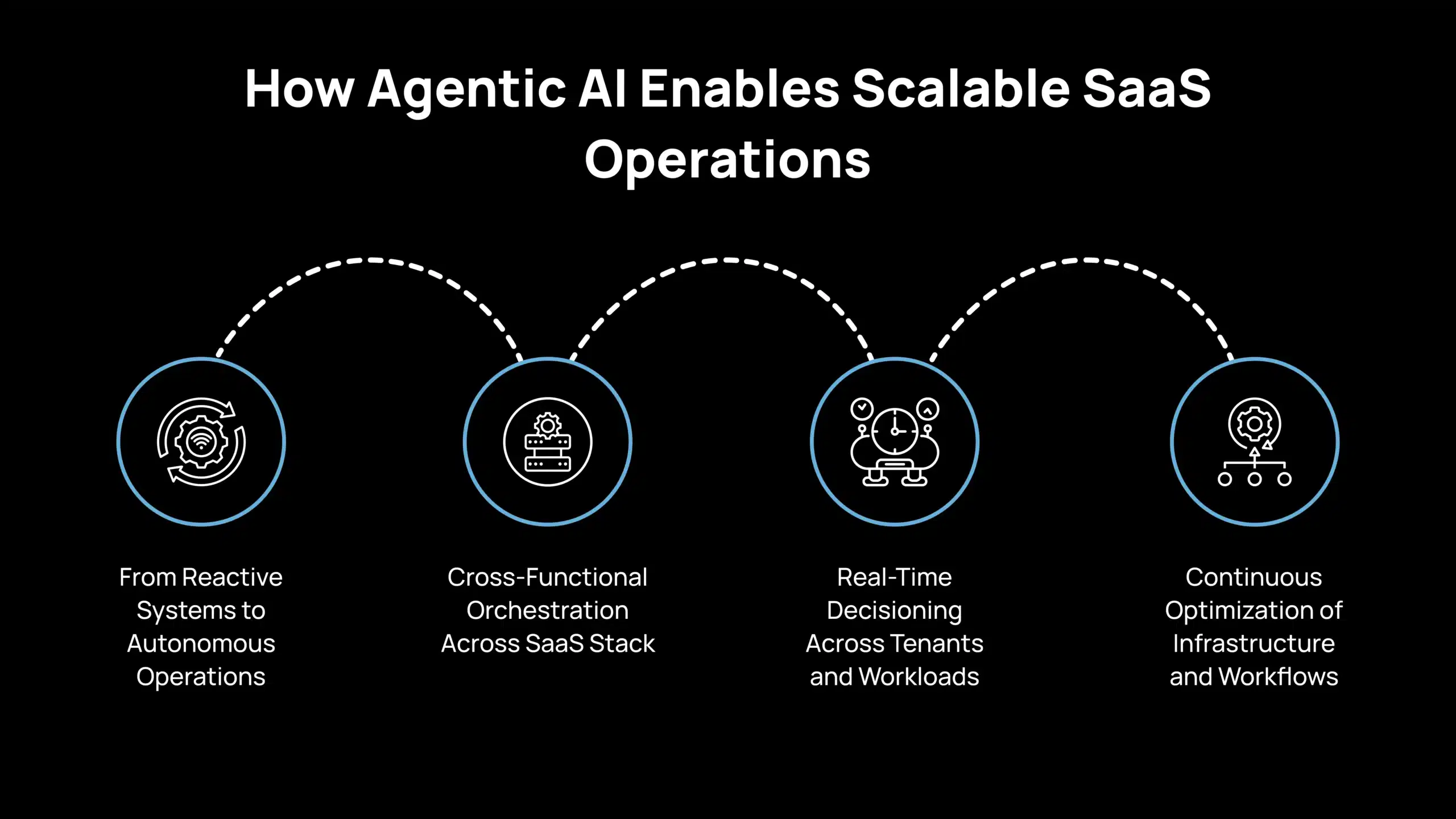
Agentic AI enables SaaS platforms to scale by moving beyond isolated automation toward coordinated, autonomous execution across systems. It connects data, decision-making, and action, allowing operations to adapt in real time while reducing manual intervention. This shift helps organizations manage complexity, improve efficiency, and maintain performance as they grow.
From Reactive Systems to Autonomous Operations
Agentic AI transforms SaaS operations by enabling systems to act independently. Instead of waiting for human intervention, agents can detect, analyze, and resolve issues in real time.
Cross-Functional Orchestration Across SaaS Stack
Agentic systems connect previously siloed domains. They coordinate actions across infrastructure, support, analytics, and business systems, ensuring alignment across operations.
Real-Time Decisioning Across Tenants and Workloads
Multi-tenant environments require dynamic resource allocation. Agentic AI enables systems to adjust in real time, balancing performance and cost across tenants.
Continuous Optimization of Infrastructure and Workflows
Agentic systems continuously refine operations. They analyze data, identify inefficiencies, and optimize workflows over time.
Core Architecture of Agentic AI for SaaS Platforms
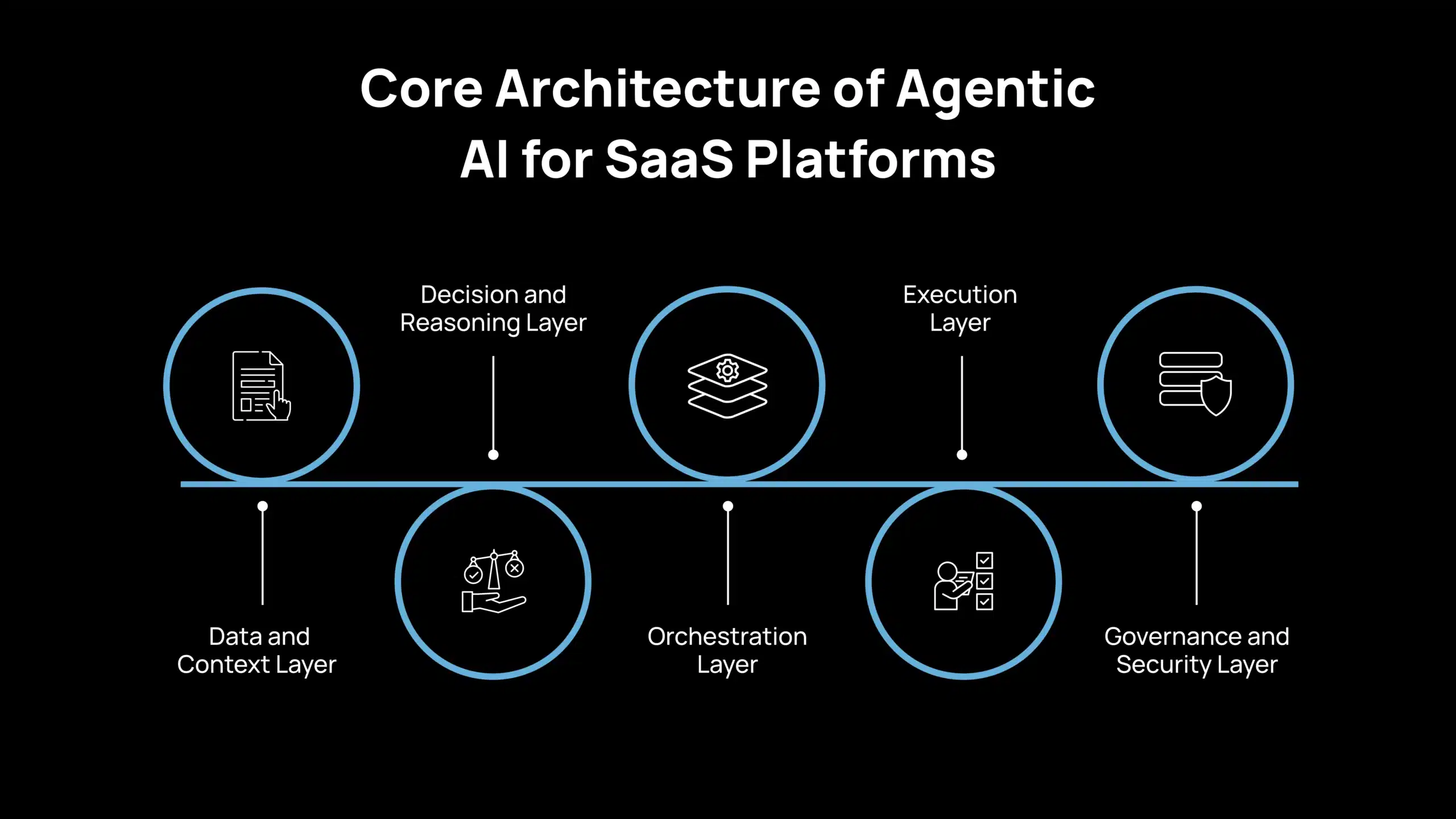
Data and Context Layer
This layer aggregates data across the SaaS environment, including logs, metrics, user behavior, and transactional data. It provides the context required for decision-making.
Decision and Reasoning Layer
AI models analyze data and determine actions. Policy engines ensure that decisions align with compliance and operational rules.
Orchestration Layer
This layer coordinates actions across systems and agents. It ensures that workflows are executed correctly and efficiently.
Execution Layer
Agents interact with SaaS systems through APIs and tools. They execute actions such as deployments, scaling, and incident resolution.
Governance and Security Layer
This layer enforces access control, compliance, and auditability. It ensures that agentic systems operate within defined boundaries.
Primary Use Cases of Agentic AI in SaaS Operations
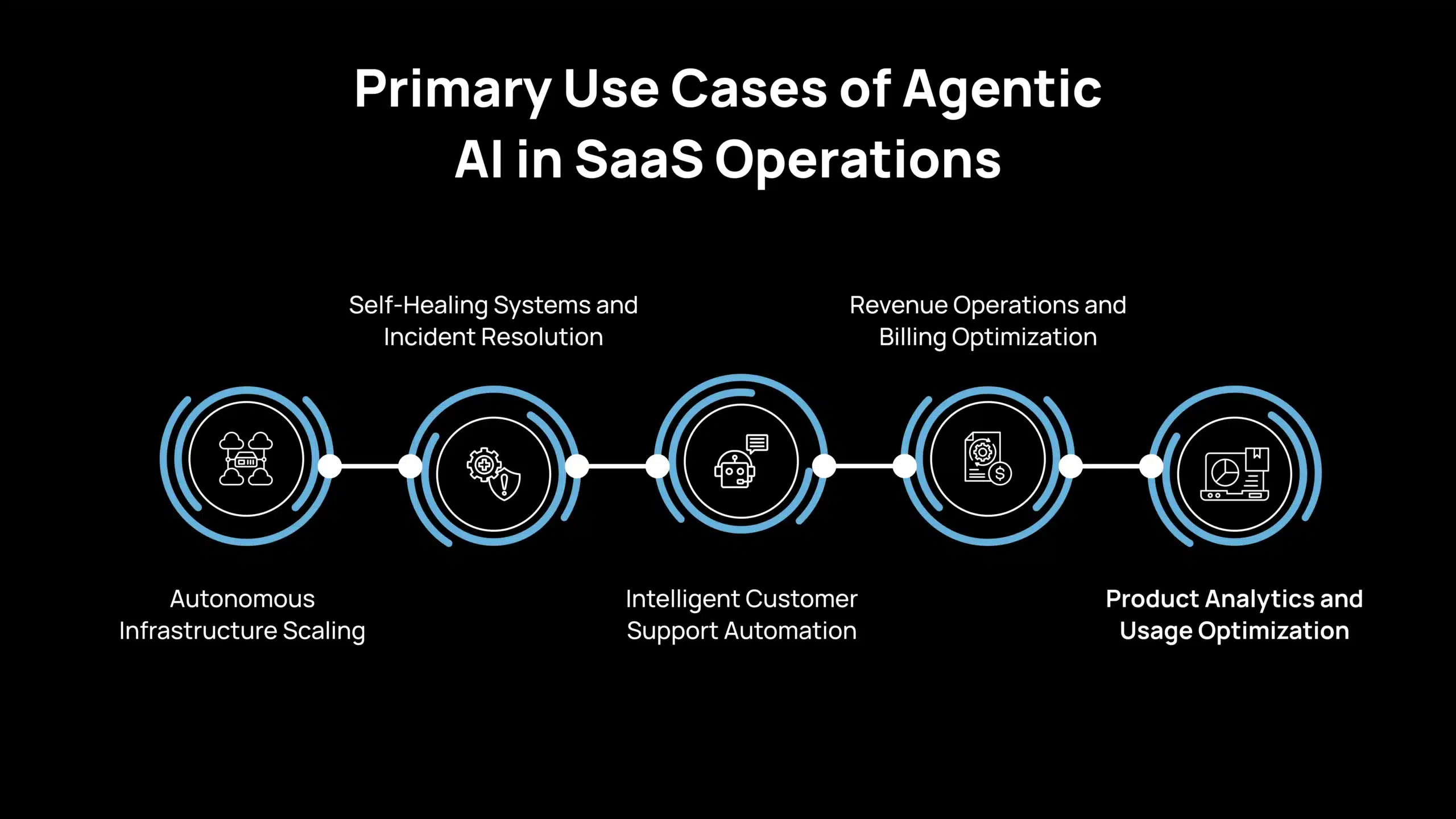
Agentic AI enables SaaS platforms to move beyond isolated automation and toward coordinated, autonomous operations. Its value becomes most visible in areas where real-time decision-making, cross-system coordination, and continuous optimization are required. These use cases demonstrate how agentic systems directly impact scalability, efficiency, and customer experience across the SaaS lifecycle.
Autonomous Infrastructure Scaling
Agentic AI allows infrastructure to scale dynamically based on real-time demand across tenants and workloads. Instead of relying on static thresholds or predefined rules, agents continuously analyze usage patterns, traffic spikes, and resource consumption.
This enables more precise scaling decisions, ensuring that performance remains consistent during peak demand while avoiding over-provisioning during low usage periods. In multi-tenant environments, agents can balance workloads across resources, reducing the risk of performance degradation caused by uneven demand. Over time, this leads to improved cost efficiency and more stable system performance.
Self-Healing Systems and Incident Resolution
Agentic systems significantly reduce downtime by enabling proactive and autonomous incident management. They continuously monitor system signals, detect anomalies, and initiate corrective actions without waiting for manual intervention.
For example, agents can restart failed services, reroute traffic, or adjust configurations based on detected issues. They can also correlate signals across logs, metrics, and traces to identify root causes more quickly than traditional monitoring systems. This reduces mean time to resolution and prevents minor issues from escalating into major outages.
Intelligent Customer Support Automation
Customer support is a critical component of SaaS operations, especially at scale. Agentic AI enhances support functions by automating routine interactions and providing real-time assistance.
Agents can handle common queries such as account issues, feature usage, and troubleshooting steps, reducing the volume of support tickets. They can also access system data to provide context-aware responses, improving accuracy and response quality. For more complex cases, agents can gather relevant information and escalate issues with complete context, enabling faster resolution by human teams.
Revenue Operations and Billing Optimization
SaaS revenue models depend heavily on accurate usage tracking and billing processes. Agentic AI can monitor usage data in real time, identify anomalies, and ensure that billing reflects actual consumption.
Agents can detect discrepancies such as unexpected usage spikes, billing errors, or revenue leakage. They can also optimize pricing strategies by analyzing customer behavior and usage trends. This improves revenue accuracy, reduces disputes, and enhances transparency for customers.
Product Analytics and Usage Optimization
Understanding how users interact with a SaaS platform is essential for improving engagement and retention. Agentic AI analyzes user behavior across features, workflows, and sessions to identify patterns and opportunities for optimization.
Agents can highlight underutilized features, detect friction points in user journeys, and recommend improvements. They can also support product teams by providing actionable insights that inform feature development and prioritization. Over time, this leads to better user experiences, increased adoption, and reduced churn.
These use cases illustrate how agentic AI transforms SaaS operations from reactive processes into continuously optimized systems, enabling organizations to scale efficiently while maintaining performance and user satisfaction.
How to Measure Success in SaaS Operations
Evaluating the impact of agentic AI in SaaS operations requires a shift toward system-level performance metrics. Organizations must measure how effectively AI improves scalability, reliability, cost efficiency, and customer experience across the entire platform.
| Metric | What It Measures |
| Mean Time to Detection (MTTD) | How quickly issues are identified across systems |
| Mean Time to Resolution (MTTR) | How efficiently incidents are resolved, reflecting operational agility |
| System Uptime and Availability | Overall platform reliability and service continuity |
| Deployment Frequency | How often are new features and updates released |
| Lead Time for Changes | Speed from code commit to production deployment |
| Change Failure Rate | Percentage of deployments that result in failures or rollbacks |
| Cost per Tenant or User | Efficiency of infrastructure and operations as the platform scales |
| Infrastructure Utilization | Effectiveness of resource allocation across workloads |
| Support Ticket Volume | Level of operational and customer-facing issues |
| Customer Churn and Retention Rates | Impact of performance and reliability on user experience |
Tracking these metrics provides a clear view of how agentic AI contributes to operational efficiency and business performance, ensuring that improvements in automation translate into measurable SaaS growth outcomes.
Implementation Roadmap for SaaS Enterprises
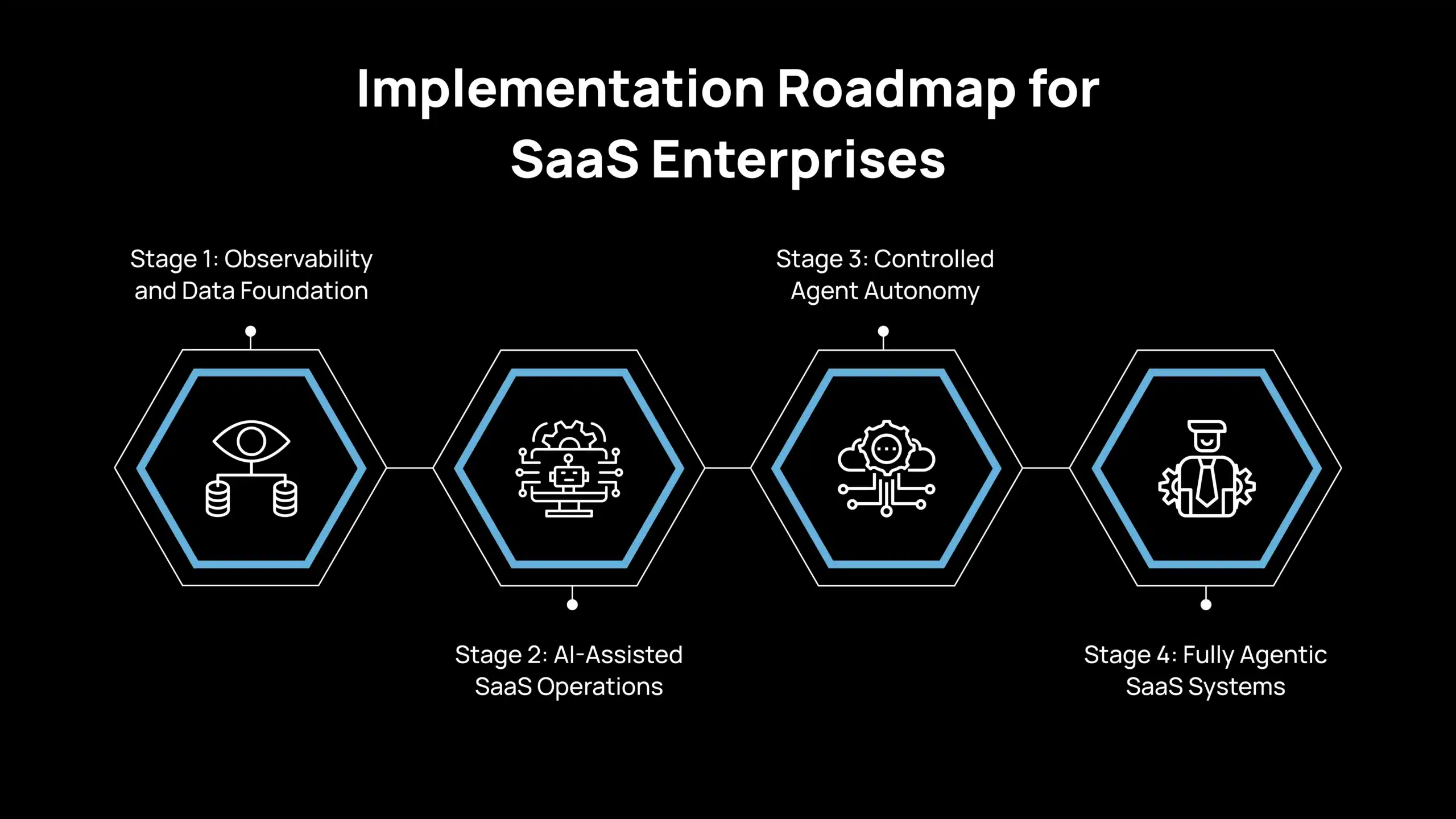
Implementing agentic AI in SaaS environments requires a structured, phased approach that balances innovation with control. Rather than moving directly to full autonomy, organizations must progressively build capabilities, validate outcomes, and establish governance.
This ensures that agentic systems integrate effectively with existing operations while delivering measurable improvements in scalability, reliability, and efficiency.
- Stage 1: Observability and Data Foundation
Establish visibility across systems and define baseline metrics.
- Stage 2: AI-Assisted SaaS Operations
Introduce AI systems as assistants while maintaining human oversight.
- Stage 3: Controlled Agent Autonomy
Allow agents to execute low-risk actions under defined constraints.
- Stage 4: Fully Agentic SaaS Systems
Enable autonomous workflow execution across the SaaS environment.
Enterprise Strategy for Scaling SaaS With Agentic AI
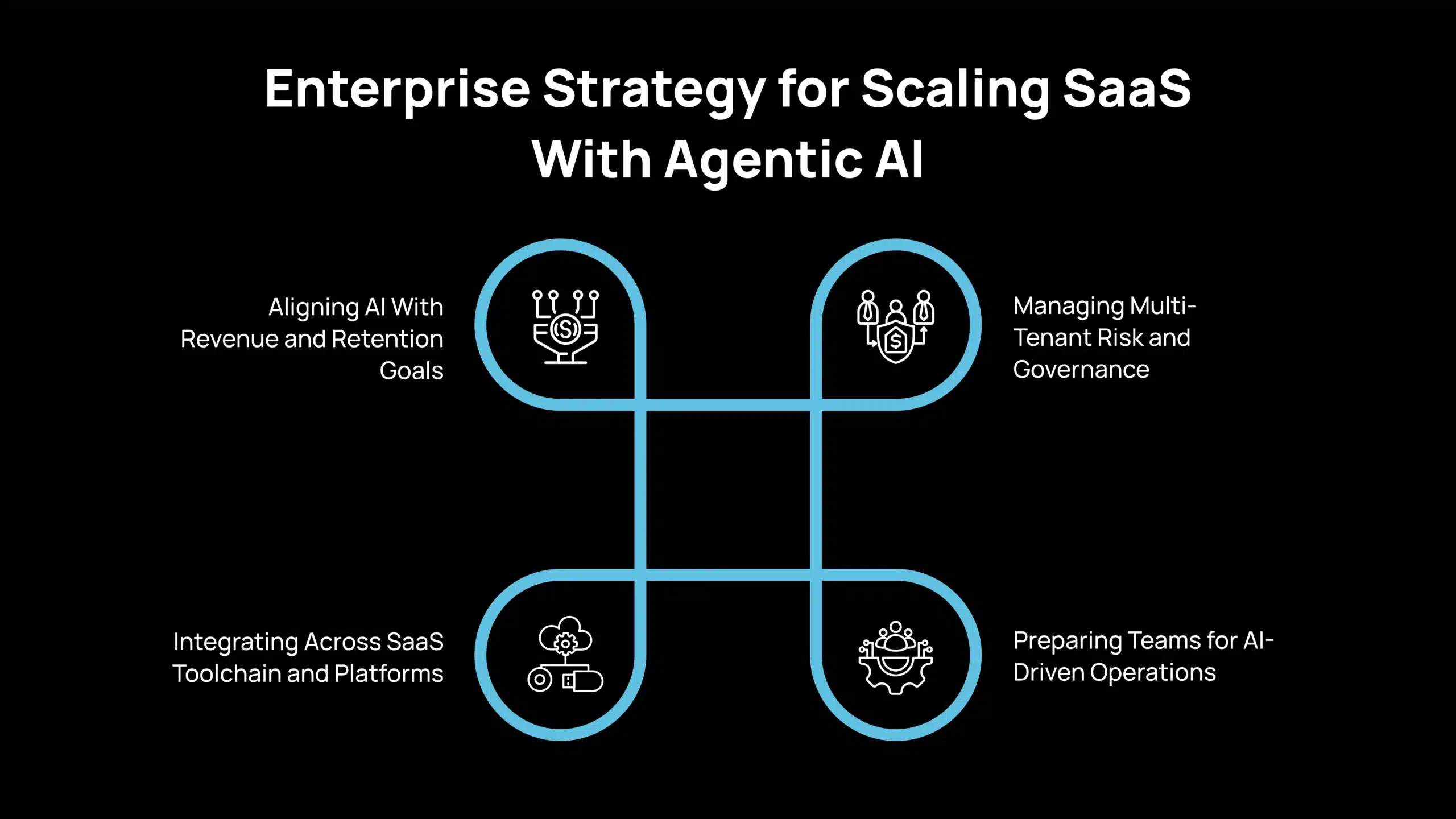
Scaling SaaS operations with agentic AI requires more than deploying intelligent systems. It demands alignment between technology, business objectives, and organizational structure. Without a clear strategy, even advanced AI capabilities can remain isolated and fail to deliver measurable impact. Enterprises must approach agentic AI as a core operational layer that supports growth, improves efficiency, and strengthens long-term scalability.
Aligning AI With Revenue and Retention Goals
Agentic AI should be implemented with a clear connection to business outcomes. Improvements in system performance, deployment speed, and operational efficiency must translate into measurable gains such as increased revenue, reduced churn, and higher customer lifetime value.
SaaS platforms are highly sensitive to performance and reliability. Even small improvements in uptime and response times can significantly influence customer retention. Faster issue resolution reduces friction in the user experience, while more efficient deployment processes accelerate feature delivery. Agentic systems can also contribute to revenue growth by identifying usage patterns, optimizing pricing models, and improving billing accuracy.
Organizations that align AI initiatives with these outcomes are better positioned to justify investment and scale adoption. AI becomes a driver of business performance rather than a standalone technical capability.
Managing Multi-Tenant Risk and Governance
Multi-tenant environments introduce unique risks that must be carefully managed when implementing agentic AI. Autonomous systems interacting with shared infrastructure must ensure strict tenant isolation, consistent performance, and adherence to compliance requirements.
Governance frameworks are essential for maintaining control. Policy-based execution ensures that agents operate within defined boundaries, preventing unintended actions that could impact multiple tenants. Role-based access control further limits what each agent can do, reducing risk across environments.
Auditability plays a critical role in enterprise adoption. Every action taken by an agent should be logged and traceable, enabling organizations to investigate decisions and maintain compliance. This level of transparency builds trust in autonomous systems and supports regulatory requirements.
Integrating Across SaaS Toolchain and Platforms
Agentic AI depends on seamless integration across the SaaS ecosystem. Systems such as source control, CI/CD pipelines, observability platforms, billing systems, and customer support tools must be able to exchange data and trigger actions in real time.
Fragmented toolchains limit the effectiveness of agentic systems. Without integration, agents lack the context required for accurate decision-making and cannot execute workflows across systems. This results in isolated automation rather than coordinated operations.
Organizations should prioritize API-first architectures and unified data layers. Internal developer platforms or centralized orchestration frameworks can serve as the foundation for connecting systems. This enables agents to access consistent data, coordinate actions, and operate across environments without friction.
Preparing Teams for AI-Driven Operations
The introduction of agentic AI reshapes how teams operate. Traditional roles focused on manual execution and coordination have changed into roles centered on oversight, system design, and continuous optimization. Engineers shift from managing processes to defining how systems behave.
This transition requires investment in skills and organizational readiness. Teams must develop expertise in AI monitoring, governance, and performance evaluation. Understanding how agents make decisions and how to refine those decisions becomes a core capability.
New roles may emerge, including AI operations specialists, automation architects, and governance leads. Clear communication is also critical to ensure alignment across teams and to position AI as an enabler of productivity rather than a replacement for human expertise.
A well-prepared workforce ensures that agentic AI delivers sustained operational improvements, enabling organizations to scale SaaS operations efficiently while maintaining control and accountability.
Challenges and Risks in Agentic SaaS Adoption
The challenges of adopting Agenctic SaaS are:
- Data Quality and Fragmentation: Inconsistent data reduces effectiveness.
- Security and Tenant Isolation Risks: Autonomous systems must operate within strict boundaries.
- Governance and Explainability: Organizations must maintain visibility into AI decisions.
- Over-Automation Without Control: Excessive autonomy without safeguards can introduce risk.
The Future of SaaS Operations: Autonomous Platforms
SaaS platforms are evolving toward autonomous systems in which AI continuously manages operations. This shift reduces reliance on manual coordination and enables organizations to scale efficiently.
As complexity increases, the ability to coordinate systems becomes more valuable than the ability to build them. Agentic AI represents the next stage in this evolution.
How Avahi Helps You Turn AI Into Real Business Results?
If your goal is to apply AI in practical ways that deliver measurable business impact, Avahi offers solutions designed specifically for real-world challenges. Avahi enables organizations to quickly and securely adopt advanced AI capabilities, supported by a strong cloud foundation and deep AWS expertise.
Avahi AI solutions delivers business benefits such as:
- Round-the-Clock Customer Engagement
- Automated Lead Capture and Call Management
- Faster Content Creation
- Quick Conversion of Documents Into Usable Data
- Smarter Planning Through Predictive Insights
- Deeper Understanding of Visual Content
- Effortless Data Access Through Natural Language Queries
- Built-In Data Protection and Regulatory Compliance
- Seamless Global Communication Through Advanced Translation and Localization
By partnering with Avahi, organizations gain access to a team with extensive AI and cloud experience committed to delivering tailored solutions. The focus remains on measurable outcomes, from automation that saves time and reduces costs to analytics that improve strategic decision-making to AI-driven interactions that elevate the customer experience.
Discover Avahi’s AI Platform in Action
At Avahi, we empower businesses to deploy advanced Generative AI that streamlines operations, enhances decision-making, and accelerates innovation, all with zero complexity.
As your trusted AWS Cloud Consulting Partner, we empower organizations to harness the full potential of AI while ensuring security, scalability, and compliance with industry-leading cloud solutions.
Our AI Solutions Include
- AI Adoption & Integration – Leverage Amazon Bedrock and GenAI to Enhance Automation and Decision-Making.
- Custom AI Development – Build intelligent applications tailored to your business needs.
- AI Model Optimization – Seamlessly switch between AI models with automated cost, accuracy, and performance comparisons.
- AI Automation – Automate repetitive tasks and free up time for strategic growth.
- Advanced Security & AI Governance – Ensure compliance, detect fraud, and deploy secure models.
Want to unlock the power of AI with enterprise-grade security and efficiency?
Start Your AI Transformation with Avahi Today!
Frequently Asked Questions
1. What is agentic AI in SaaS operations?
Agentic AI refers to autonomous systems that can analyze data, make decisions, and execute workflows across SaaS environments without constant human intervention. Unlike traditional automation, which follows predefined rules, agentic AI systems operate with goal-driven logic, allowing them to manage multi-step processes such as incident response, scaling infrastructure, and coordinating deployments. This enables SaaS platforms to move from reactive operations to continuous, self-optimizing systems.
2. How does agentic AI improve SaaS scalability?
Agentic AI improves scalability by reducing the need for manual coordination across systems, teams, and workflows. It automates complex operational processes, adapts to changing system conditions in real time, and enables parallel execution of tasks. This allows organizations to scale users, infrastructure, and services without proportional increases in operational costs or engineering overhead.
3. What infrastructure is required for agentic AI?
Organizations need a strong technical foundation that includes real-time observability systems, reliable data pipelines, API-driven integrations, and orchestration frameworks. In addition, governance layers such as access control, policy engines, and monitoring systems are critical to ensure that agentic systems operate securely and within defined boundaries. Without this infrastructure, autonomous execution cannot scale effectively.
4. Is agentic AI secure for enterprise SaaS platforms?
Agentic AI can operate securely in enterprise environments when implemented with proper governance frameworks. This includes role-based access controls, policy validation before execution, encrypted data environments, and complete audit trails for every action. With these controls in place, organizations can ensure that autonomous systems remain compliant, transparent, and aligned with enterprise security standards.
5. How can SaaS companies start adopting agentic AI?
SaaS companies should begin with AI-assisted workflows, such as automated monitoring, incident analysis, or support automation, while keeping humans in the loop. Once systems are validated, organizations can gradually introduce controlled autonomy for low-risk tasks. Over time, this can expand into fully agentic workflows that manage operations end to end, supported by strong governance and continuous performance monitoring.