




TL;DR
|
Product delivery was once constrained by engineering capacity. Today, the constraint looks very different. Modern CTOs operate across distributed teams, complex architectures, and constantly shifting priorities, all while being expected to release faster and more reliably. Conventional automation has improved efficiency at a task level, yet delivery cycles still slow down due to coordination gaps, dependency management, and fragmented decision-making across systems and teams.
A new approach is beginning to take hold. Agentic AI introduces systems that can plan, act, and adapt with minimal human intervention, moving beyond static automation or content generation. These systems actively participate in product workflows, orchestrating tasks, resolving blockers, and maintaining continuity throughout the development lifecycle.
Adoption is already accelerating, with 52% of enterprises now deploying AI agents, signaling a clear shift toward more autonomous execution models.
CTOs are using this shift to rethink how delivery happens at a systems level. Instead of relying on manual coordination and reactive processes, they are introducing agentic layers that drive execution across planning, development, testing, and release. To build this infrastructure without disrupting live product pipelines, engineering leaders frequently validate these integrations through a targeted AWS proof of concept first.
Why Product Delivery Is Slowing Down Despite Better Tools
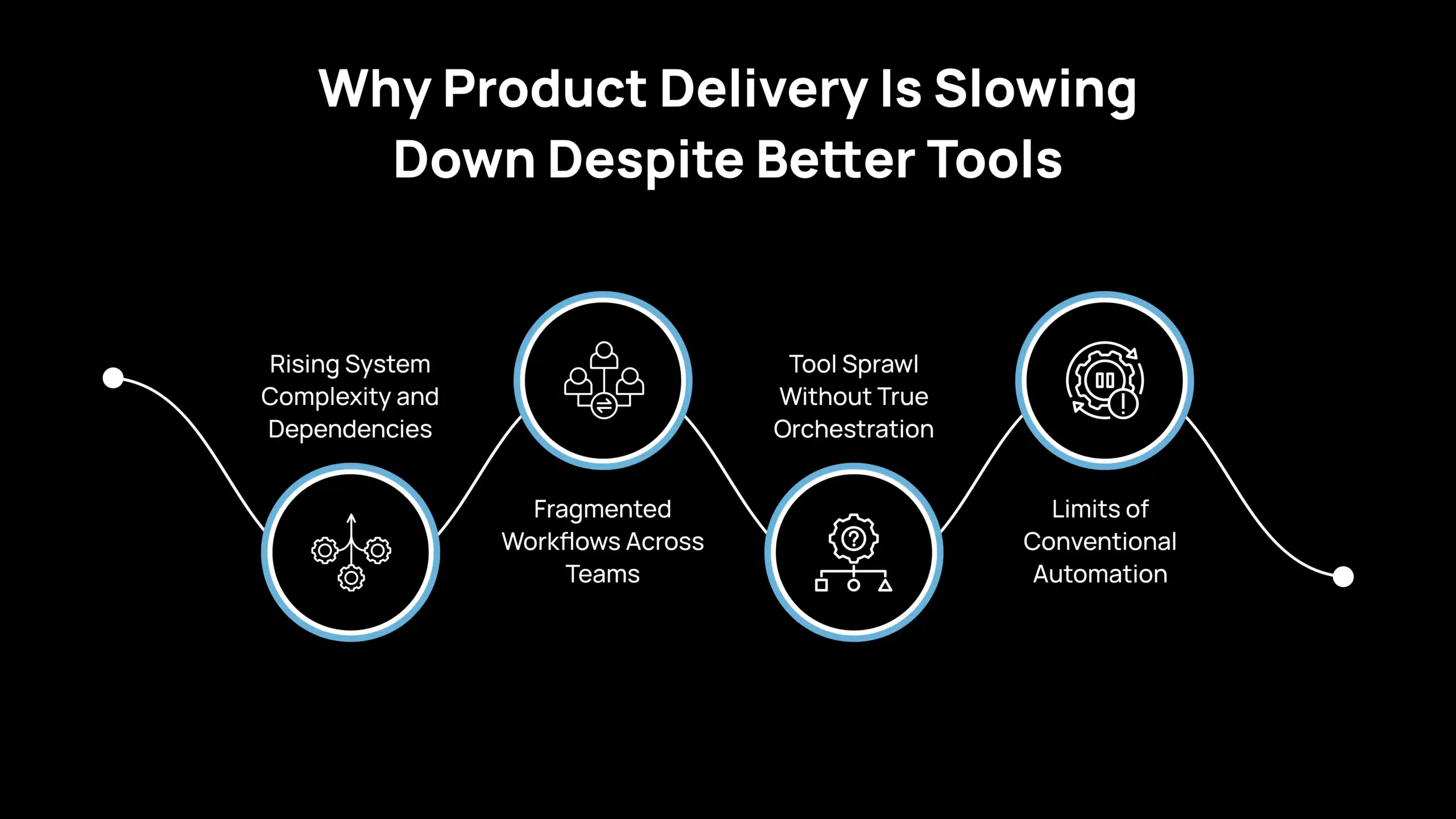
Modern engineering teams operate with advanced tooling, including CI/CD pipelines, automated testing frameworks, and observability platforms. On paper, delivery should be faster than ever. AI has also become deeply embedded in development workflows, with developers estimating that 42% of the code they produce is now AI-assisted. Yet delivery cycles remain slow, unpredictable, and difficult to scale.
Rising System Complexity and Dependencies
Applications no longer exist as single, contained systems. Microservices, APIs, cloud infrastructure, and third-party integrations must all align for a successful release. Each dependency introduces a potential delay. A feature might be complete in one service but blocked by another, turning delivery into a chain of interdependent steps rather than a streamlined flow.
Fragmented Workflows Across Teams
Product, engineering, QA, and DevOps often operate in separate environments with different priorities and varying levels of data visibility. Information does not move seamlessly across these layers, leading to repeated status checks, misalignment, and manual coordination. Engineers frequently switch contexts to track progress instead of advancing work, which gradually slows overall delivery.
Tool Sprawl Without True Orchestration
Organizations continue to adopt new tools to solve specific problems, but these tools rarely function as a unified system. Each platform optimizes a narrow slice of the workflow, leaving gaps in between. Without orchestration, teams end up stitching processes together manually, which introduces delays and increases the risk of errors.
Limits of Conventional Automation
Automation has improved execution at the task level, running tests, deploying builds, and triggering alerts. But it does not address decision-making or coordination. Systems follow predefined rules and require human input when conditions change or conflicts arise. This keeps teams in a reactive mode, where progress depends on constant oversight.
A clear pattern emerges. Speed is no longer limited by how quickly teams can write code. It is constrained by how effectively they can coordinate across systems, teams, and workflows that were never designed to operate as a single, intelligent unit.
What Agentic AI Means in a Product Engineering Context
Agentic AI can be understood in practical terms as a system of goal-driven, autonomous agents that do more than assist. These agents interpret objectives, break them into actionable steps, make decisions, and execute tasks across the product lifecycle with minimal human intervention. Rather than waiting for instructions at every stage, they operate with a degree of independence, continuously adjusting based on context, feedback, and changing conditions within the system.
A clearer perspective emerges when comparing agentic AI with earlier approaches:
| Approach | Core Function | How It Operates | Limitations |
| Traditional Automation (Rule-Based) | Executes predefined tasks | Follows fixed rules and workflows | Cannot adapt to change, lacks context awareness |
| Generative AI (Content-Focused) | Produces content (code, text, designs) | Responds to prompts and user input | Reactive, does not manage workflows or decisions |
| Agentic AI (Decision + Execution) | Drives tasks toward goals | Interprets objectives, makes decisions, and executes autonomously | Requires strong data context and governance to function effectively |
What makes agentic AI particularly valuable in product engineering lies in its core capabilities:
- Task Decomposition: Agents can take complex product goals and break them into smaller, manageable tasks, assigning priorities and sequencing execution without manual planning.
- Context Awareness: They maintain an understanding of system states, dependencies, and historical data, allowing them to make informed decisions rather than isolated actions.
- Autonomous Execution: Agents move work forward independently, coordinating across tools, teams, and environments to reduce delays and manual intervention.
- Continuous Learning Loops: Feedback from each action is used to refine future decisions, improving accuracy, efficiency, and reliability over time.
Taken together, these capabilities position agentic AI as more than a feature within existing tools. It functions as a system-level intelligence layer that sits across the product ecosystem, connecting workflows, aligning execution with goals, and enabling a more adaptive and coordinated approach to product delivery.
Where Agentic AI Fits in Enterprise Strategy
Enterprise AI strategies are shifting from isolated model deployments to systems that operate across business functions. Early AI initiatives typically focus on experimentation, where organizations deploy chatbots, analytics models, or generative tools to validate use cases. These efforts generate insights and improve productivity at a task level but remain limited in operational impact.
As organizations mature, AI becomes embedded within workflows. Systems begin to support decision-making, automate repetitive processes, and integrate with enterprise platforms such as CRM, ERP, and data pipelines. This stage improves efficiency but still relies heavily on human coordination to connect actions across systems. Industry trends reflect this shift, with Gartner predicting that 40% of enterprise applications will embed AI agents by 2026, showing the move toward more integrated, autonomous systems.
Agentic AI represents the next phase in this progression. Instead of supporting individual tasks or decisions, agentic systems operate across workflows, coordinating actions, managing dependencies, and executing processes end to end. This shifts AI from a supporting capability to an operational layer within enterprise architecture.
Within a growth roadmap, agentic AI enables organizations to scale beyond fragmented automation. It allows enterprises to move toward continuous execution models, where decisions and actions occur in real time across systems. This capability becomes critical for organizations aiming to increase speed, maintain consistency, and operate effectively in complex, data-driven environments.
Core Architecture of Agentic AI Systems
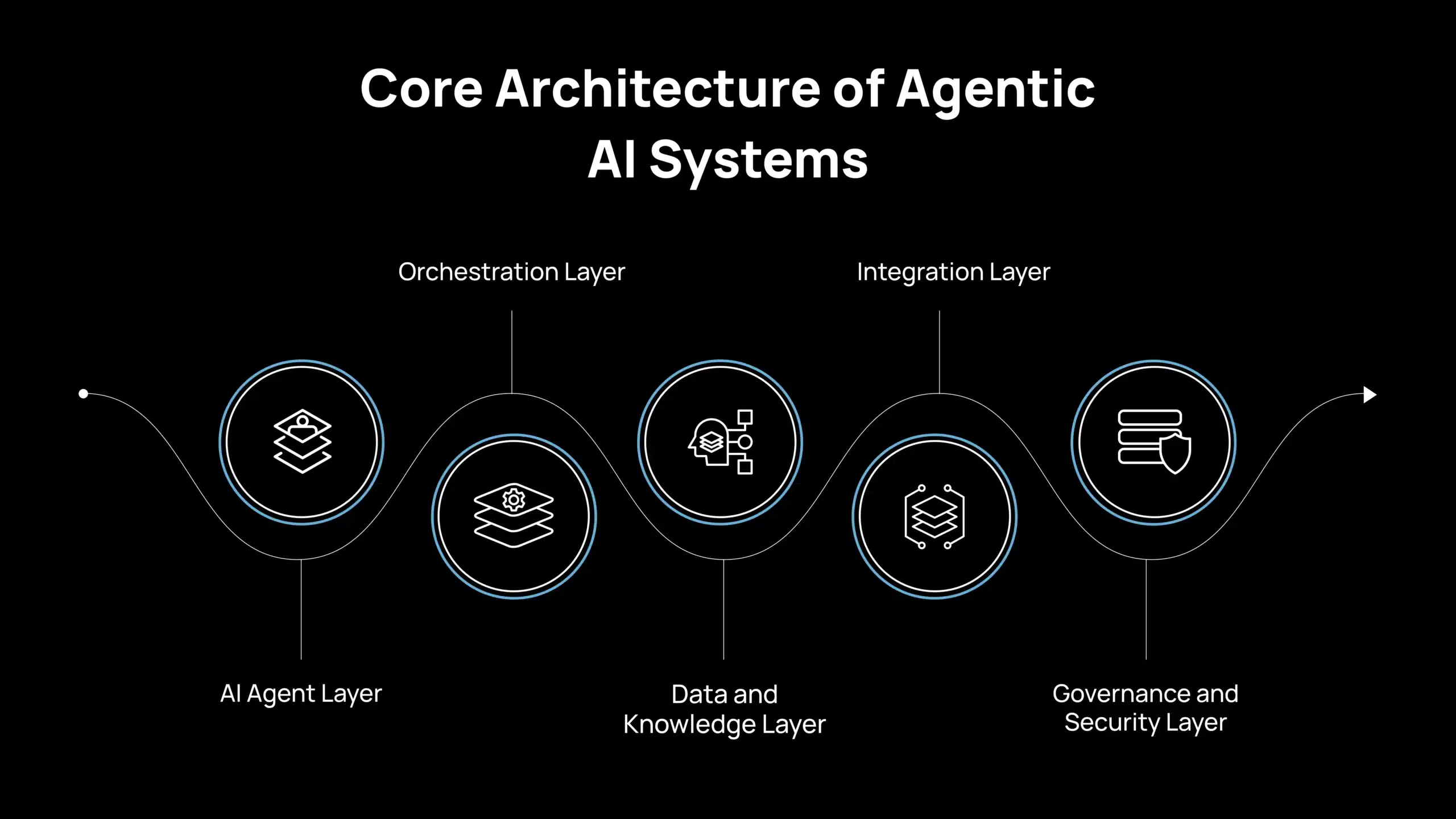
Agentic AI systems rely on a layered architecture that enables autonomous decision-making and coordinated execution across enterprise environments. Each layer plays a distinct role in ensuring that agents can operate reliably, securely, and at scale.
AI Agent Layer
This layer comprises specialized agents responsible for functions such as customer interactions, system monitoring, and financial analysis. Each agent interprets data, makes decisions within its scope, and executes tasks aligned with defined objectives.
Orchestration Layer
The orchestration layer coordinates activities across multiple agents and systems. It manages task sequencing, distributes workloads, and ensures that workflows execute in the correct order. This layer enables agents to function as part of a unified system rather than isolated components.
Data and Knowledge Layer
Agents depend on consistent access to structured and unstructured data. This layer includes enterprise data pipelines, knowledge bases, and vector databases that provide contextual information required for accurate decision-making and reasoning.
Integration Layer
This layer connects agents to enterprise systems such as ERP, CRM, DevOps tools, and external APIs. It allows agents to trigger actions, retrieve data, and interact with operational platforms in real time.
Governance and Security Layer
Enterprise adoption requires strong control mechanisms. This layer ensures access management, compliance, monitoring, and explainability. It allows organizations to maintain oversight, enforce policies, and ensure that agentic systems operate within defined boundaries. This is increasingly critical as Gartner forecasts that at least 15% of day-to-day business decisions will be made autonomously by 2028, requiring robust governance and accountability frameworks.
Together, these layers transform agentic AI from a model-driven capability into a coordinated system that integrates intelligence, execution, and governance across enterprise operations.
Real-World Impact That CTOs Are Seeing
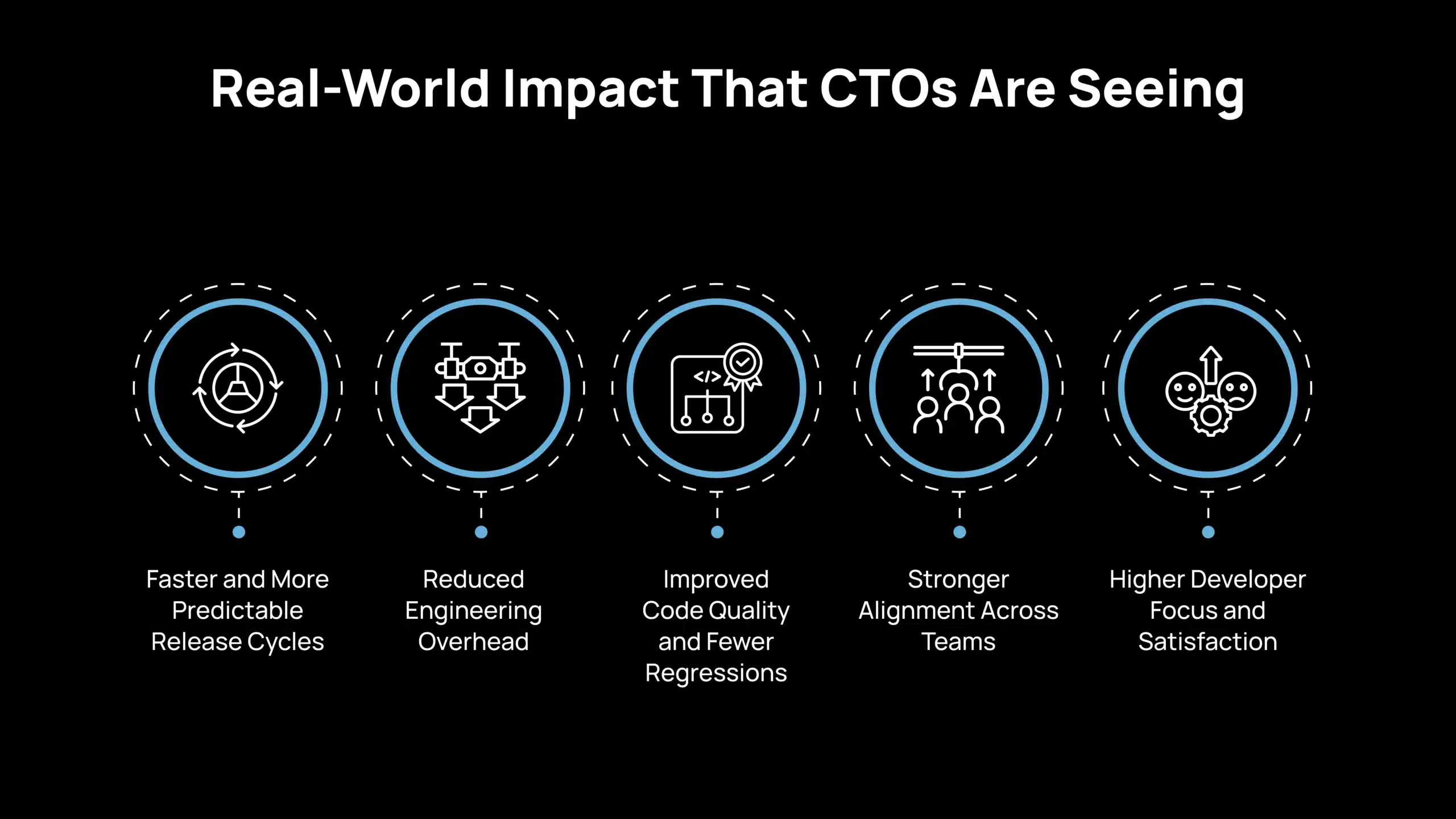
Adoption of agentic AI is moving beyond experimentation and into measurable outcomes. CTOs are observing tangible improvements across delivery speed, engineering efficiency, and system reliability.
AI-driven systems can improve productivity by up to 40%, particularly when applied across end-to-end workflows rather than isolated tasks. These gains are less about incremental improvements and more about how entire workflows begin to function with greater continuity and intelligence.
Faster and More Predictable Release Cycles
Product releases are becoming more consistent as agentic systems reduce dependency-related delays. Work progresses in parallel rather than waiting for sequential approvals or manual coordination. This shift improves not only speed but also predictability, allowing teams to plan releases with greater confidence.
Reduced Engineering Overhead
Routine coordination tasks, such as status tracking, dependency management, and workflow handoffs, are increasingly handled by agents. This is significant given that developers spend up to 25% of their time on low-value or repetitive tasks. By reducing this overhead, engineering teams can focus more on building and refining products, resulting in greater productivity gains.
Improved Code Quality and Fewer Regressions
Continuous testing, automated reviews, and real-time feedback loops help identify issues earlier in the development cycle. Agents can flag inconsistencies, suggest fixes, and even initiate corrections before problems reach production. This results in cleaner releases and fewer post-deployment issues.
Stronger Alignment Across Teams
Agentic AI acts as a connective layer across product, engineering, QA, and operations. Shared context and synchronized workflows reduce misalignment, ensuring that teams move in the same direction without constant manual updates or follow-ups.
Higher Developer Focus and Satisfaction
Engineers are able to concentrate on complex problem-solving rather than repetitive coordination tasks. Reduced context switching and clearer workflows create a more focused development environment, which often translates into better output and improved team morale.
A consistent theme emerges across these outcomes. Acceleration is not coming from working faster in isolation, but from creating a system where work flows smoothly, decisions happen closer to execution, and teams are supported by intelligent, adaptive processes.
How CTOs Should Approach Building an Agentic AI Strategy
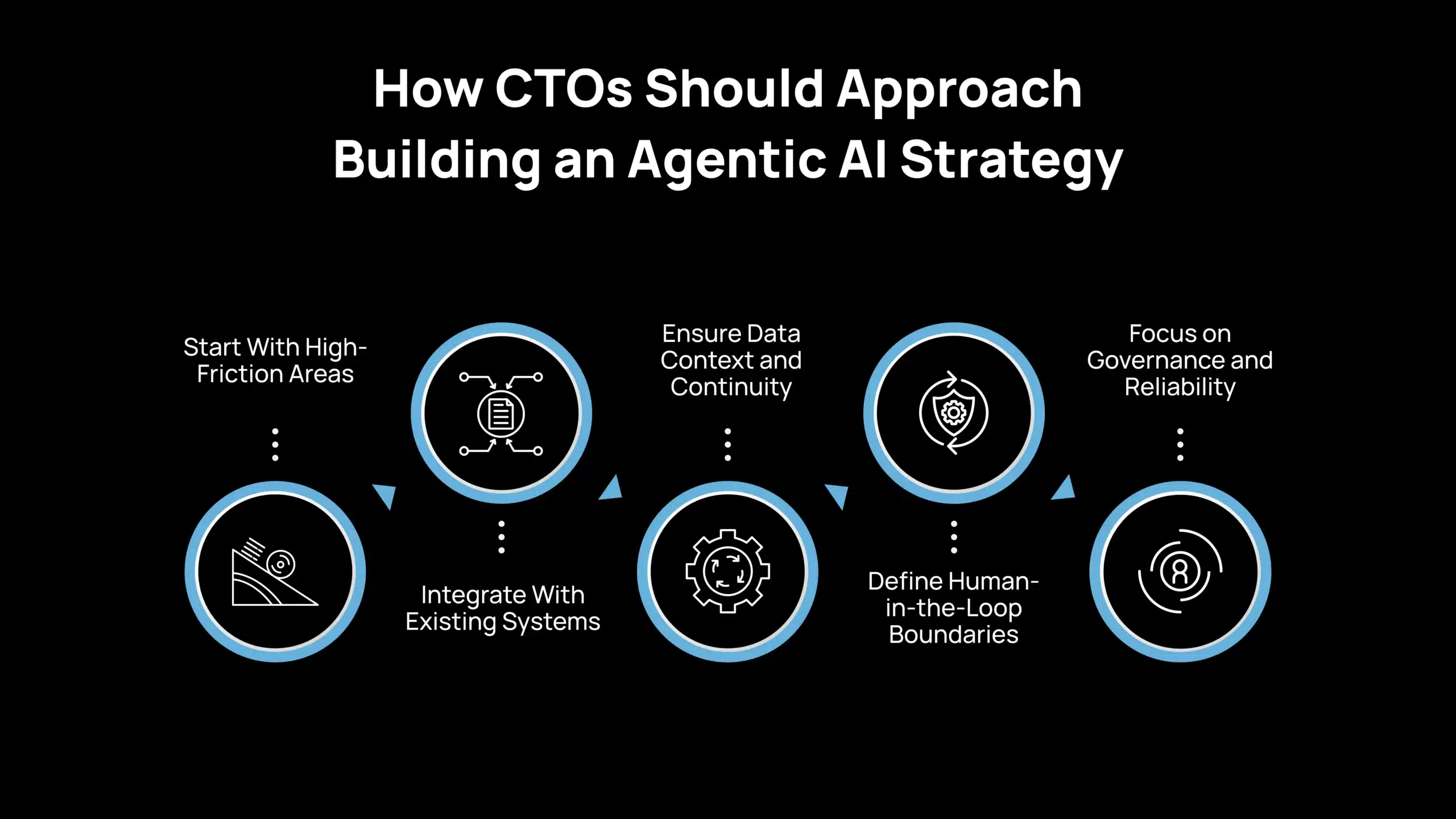
Successful adoption of agentic AI does not begin with a large-scale transformation. CTOs who see meaningful results take a focused, systems-oriented approach that aligns with existing workflows and business priorities. Careful planning ensures that agentic capabilities enhance delivery rather than introduce new complexity.
Start With High-Friction Areas
A practical starting point is to identify where delivery consistently slows. Bottlenecks often appear in areas such as dependency management, testing delays, or release coordination. These friction points provide the clearest opportunities for agentic AI to create immediate impact. Targeted implementation allows teams to validate outcomes early and build confidence before expanding usage.
Integrate With Existing Systems
Replacing established tools rarely delivers the expected value and often disrupts workflows. A more effective approach focuses on orchestration across the current tech stack. Agentic AI should sit above existing systems, connecting them and enabling smoother coordination. This approach preserves prior investments while improving how tools work together.
Ensure Data Context and Continuity
Agentic systems depend on accurate, structured, and continuously available data. Without consistent context, decision-making becomes unreliable. CTOs must ensure that data flows seamlessly across platforms, enabling agents to understand dependencies, track progress, and adapt actions based on real-time information. Persistent context is essential for maintaining continuity across the delivery lifecycle.
Define Human-in-the-Loop Boundaries
Autonomy does not eliminate the need for human oversight. Strategic decisions, critical approvals, and exception handling still require human judgment. Clear boundaries help balance efficiency with control, ensuring that agents operate independently where appropriate while escalating decisions that require expertise or accountability.
Focus on Governance and Reliability
Systems must deliver accurate outcomes, maintain traceability, and align with organizational standards. Governance frameworks should address monitoring, validation, and compliance requirements. Reliable performance builds confidence among teams and supports long-term scalability of agentic AI initiatives.
A thoughtful strategy turns agentic AI into a coordinated layer that strengthens delivery systems rather than complicating them. Careful alignment with workflows, data, and governance ensures that adoption leads to sustained, measurable improvements.
What Are the Common Challenges in Agentic AI Adoption?
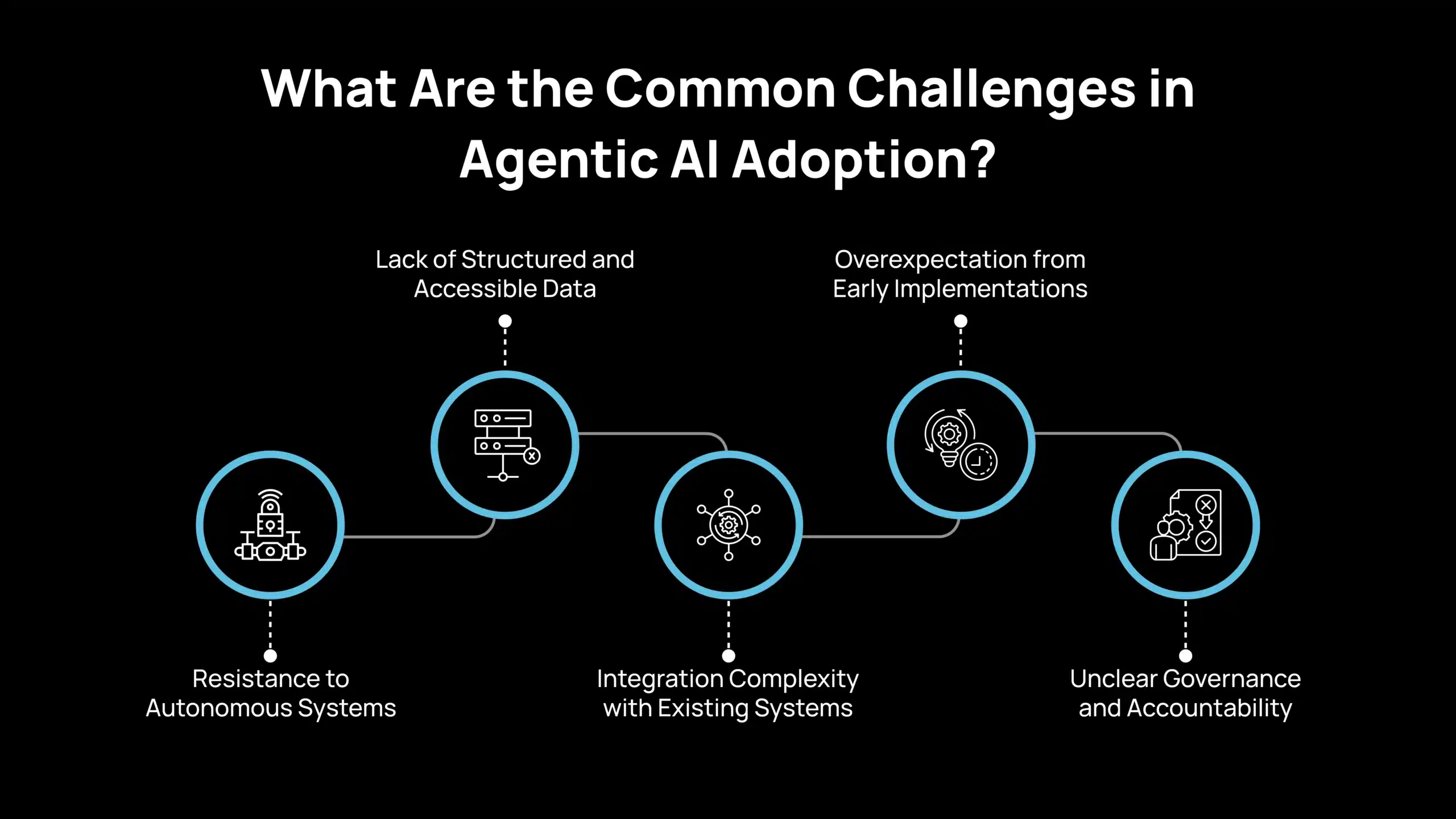
Adopting agentic AI introduces a new way of operating, and with that comes a distinct set of challenges. CTOs often find that the difficulty is not in the technology itself, but in aligning systems, teams, and expectations around a more autonomous model. Early-stage implementations can surface gaps in data, workflows, and governance that were previously manageable but become more visible as systems take on greater responsibility.
- Resistance to Autonomous Systems: Teams may hesitate to trust decision-making beyond human control. Clear communication, gradual rollout, and visible success in low-risk areas help build confidence over time.
- Lack of Structured and Accessible Data: Agentic AI depends on clean, connected data across systems. Fragmented or inconsistent data limits effectiveness. Establishing strong data pipelines and standardization becomes a foundational step.
- Integration Complexity with Existing Systems: Legacy infrastructure and disconnected tools can make orchestration challenging. A phased approach that connects high-impact systems first reduces disruption and simplifies adoption.
- Overexpectation from Early Implementations: Initial deployments may be expected to deliver immediate, large-scale transformation. Setting realistic goals and focusing on incremental improvements ensures sustainable progress.
- Unclear Governance and Accountability: Questions around decision ownership, traceability, and compliance can slow adoption. Defining governance frameworks early creates clarity and reduces risk.
Addressing these challenges requires a measured approach rather than a rapid overhaul. CTOs who focus on incremental adoption, strong data foundations, and clear operational boundaries are better positioned to turn early friction into long-term advantage.
The Future of Product Delivery With Agentic AI
Product delivery is moving toward systems that operate with far greater autonomy. Agentic AI is shifting development models away from linear pipelines and toward continuously adaptive workflows that can plan, execute, and refine in real time. This evolution reduces reliance on manual coordination and allows delivery processes to respond dynamically to changing priorities and conditions.
Engineering environments are beginning to function as interconnected systems rather than collections of tools. Agentic layers bring context, decision-making, and execution into a unified flow, enabling work to progress without constant intervention. As a result, delays caused by handoffs, dependencies, and misalignment become less frequent, and delivery cycles grow more stable.
The role of the CTO is also constantly upgrading. Greater focus is placed on designing systems that can operate independently while maintaining control through governance and oversight. Instead of managing workflows step by step, leadership shifts toward shaping how intelligent systems interact, learn, and improve over time.
A clear competitive advantage is emerging. Organizations that adopt agentic AI effectively are able to deliver faster, adapt more quickly, and maintain consistency at scale. Product delivery becomes less about reacting to challenges and more about operating within a system that continuously optimizes itself.
How Avahi Helps You Turn AI Into Real Business Results?
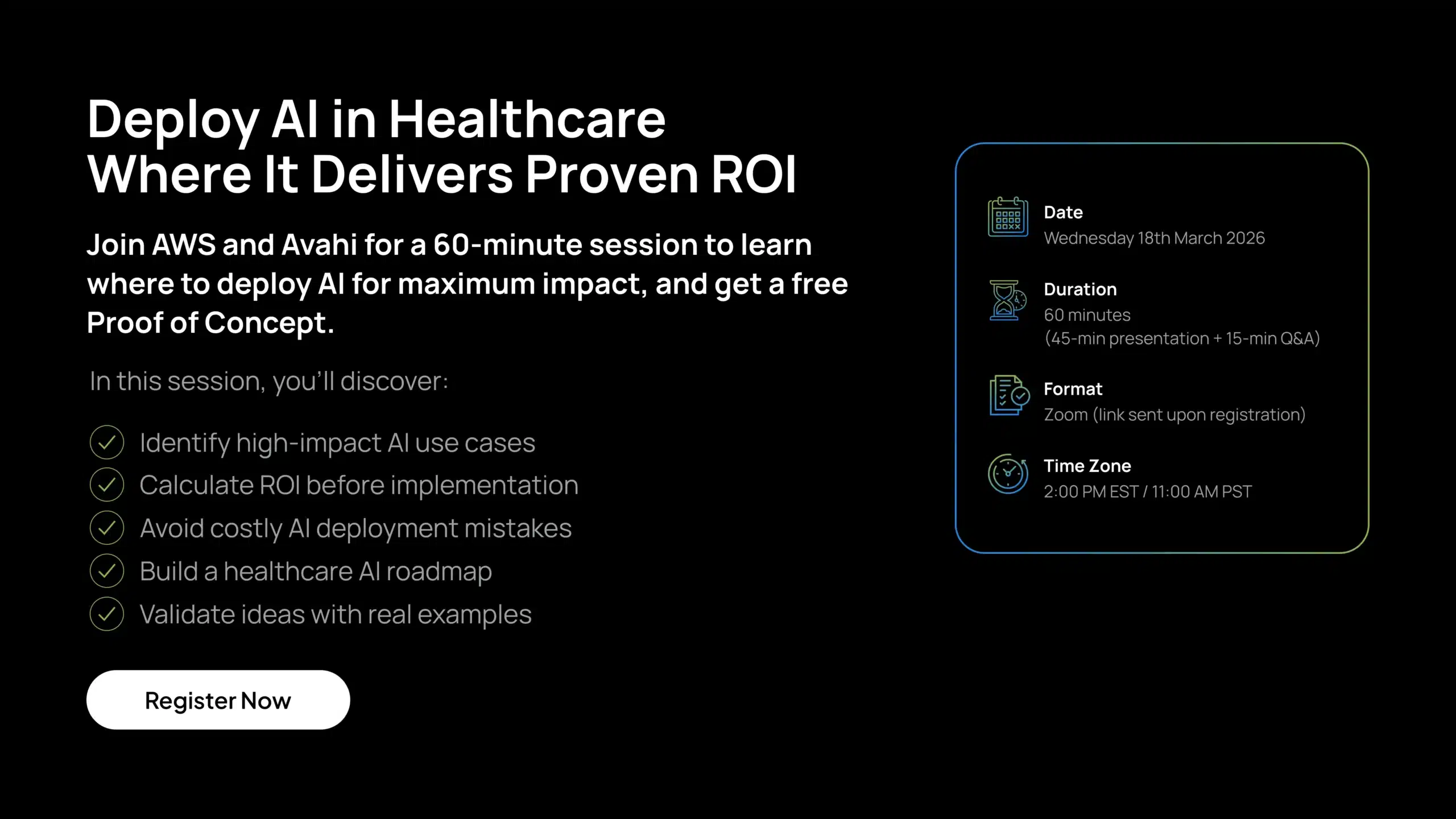
If your goal is to apply AI in practical ways that deliver measurable business impact, Avahi offers solutions designed specifically for real-world challenges. Avahi enables organizations to quickly and securely adopt advanced AI capabilities, supported by a strong cloud foundation and deep AWS expertise.
Avahi AI solutions deliver business benefits such as:
- Round-the-Clock Customer Engagement
- Automated Lead Capture and Call Management
- Faster Content Creation
- Quick Conversion of Documents Into Usable Data
- Smarter Planning Through Predictive Insights
- Deeper Understanding of Visual Content
- Effortless Data Access Through Natural Language Queries
- Built-In Data Protection and Regulatory Compliance
- Seamless Global Communication Through Advanced Translation and Localization
By partnering with Avahi, organizations gain access to a team with extensive AI and cloud experience committed to delivering tailored solutions. The focus remains on measurable outcomes, from automation that saves time and reduces costs to analytics that improve strategic decision-making to AI-driven interactions that elevate the customer experience.
Discover Avahi’s AI Platform in Action
At Avahi, we empower businesses to deploy advanced Generative AI that streamlines operations, enhances decision-making, and accelerates innovation, all with zero complexity.
As your trusted AWS Cloud Consulting Partner, we empower organizations to harness the full potential of AI while ensuring security, scalability, and compliance with industry-leading cloud solutions.
Our AI Solutions Include
- AI Adoption & Integration – Leverage Amazon Bedrock and GenAI to Enhance Automation and Decision-Making.
- Custom AI Development – Build intelligent applications tailored to your business needs.
- AI Model Optimization – Seamlessly switch between AI models with automated cost, accuracy, and performance comparisons.
- AI Automation – Automate repetitive tasks and free up time for strategic growth.
- Advanced Security & AI Governance – Ensure compliance, detect fraud, and deploy secure models.
Want to unlock the power of AI with enterprise-grade security and efficiency?
Start Your AI Transformation with Avahi Today!
Frequently Asked Questions
1. What is agentic AI in a product engineering context?
Agentic AI refers to systems of autonomous agents that can interpret goals, make decisions, and execute tasks across the product lifecycle. Unlike traditional tools, these systems coordinate workflows, manage dependencies, and continuously adapt based on real-time data.
2. How does agentic AI improve product delivery speed?
Agentic AI reduces delays caused by manual coordination and fragmented workflows. Managing task sequencing, resolving blockers, and synchronizing activities across systems, it enables faster and more predictable delivery cycles.
3. How is agentic AI different from traditional automation?
Traditional automation executes predefined rules for specific tasks, while agentic AI combines reasoning and execution. It can evaluate context, plan multi-step workflows, and take actions across systems without requiring constant human input.
4. What infrastructure is required to implement agentic AI?
Organizations need cloud-based AI platforms, integrated data pipelines, orchestration layers, and secure connections to enterprise systems. Strong governance and monitoring frameworks are also essential to ensure reliability and control.
5. What challenges should organizations expect when adopting agentic AI?
Common challenges include data fragmentation, integration complexity, unclear governance, and resistance to autonomous systems. A phased implementation approach with strong data and governance foundations helps address these issues.
6. Is agentic AI suitable for all product teams?
Agentic AI is most effective in environments with complex workflows, multiple dependencies, and high coordination overhead. Teams working with distributed systems, frequent releases, and cross-functional collaboration benefit the most.