




TL;DR
|
Autonomous agents, not just software, will drive the future of enterprise operations.
For decades, enterprise software has helped organizations digitize workflows, but it has always depended on human input to operate. Agentic AI introduces a fundamental shift. Instead of waiting for instructions, autonomous agents can plan, make decisions, execute tasks, and continuously improve outcomes independently.
This is not an incremental improvement. It is a structural change in how enterprises operate.
The momentum behind this shift is already clear. Gartner predicts that 33% of enterprise software applications will include agentic AI by 2028, up from less than 1% in 2024. Enterprises are no longer using AI only for insights. They are deploying AI to perform real operational work.
However, the success of agentic AI in the enterprise depends heavily on one foundational decision: choosing the right framework.
The agentic AI framework determines how agents scale, how securely they integrate with enterprise systems, how reliably they execute tasks, and how effectively they operate in production environments. Because the wrong choice creates major integration challenges, many engineering leaders use an AWS proof of concept to benchmark framework performance under real-world conditions. Choosing the right foundation enables enterprises to build scalable, secure, and autonomous systems that transform operations.
This blog provides a clear, enterprise-focused approach to choosing the right agentic AI framework, helping organizations lay the foundation for reliable, scalable autonomous operations.
Understanding the Role of AI Frameworks in Simplifying Development
An AI framework is a collection of tools, libraries, and pre-built functionalities that make it easier to develop and implement artificial intelligence solutions. It provides the necessary components to build, train, and deploy AI models effectively.
For enterprises, using a framework can significantly simplify the development process by reducing the need for starting from scratch. Here is why AI frameworks are important:
- Streamlining Development: They offer standardized building blocks, saving time and effort.
- Improved Efficiency: With pre-built algorithms and models, frameworks can enhance the speed and performance of AI projects.
- Scalability: Frameworks support the growth of AI applications, making it easier to scale your solutions as the business evolves.
- Consistency: They provide a structured approach to AI development, ensuring consistency and reducing errors.
Fundamental Criteria for Selecting the Right Agentic AI Framework
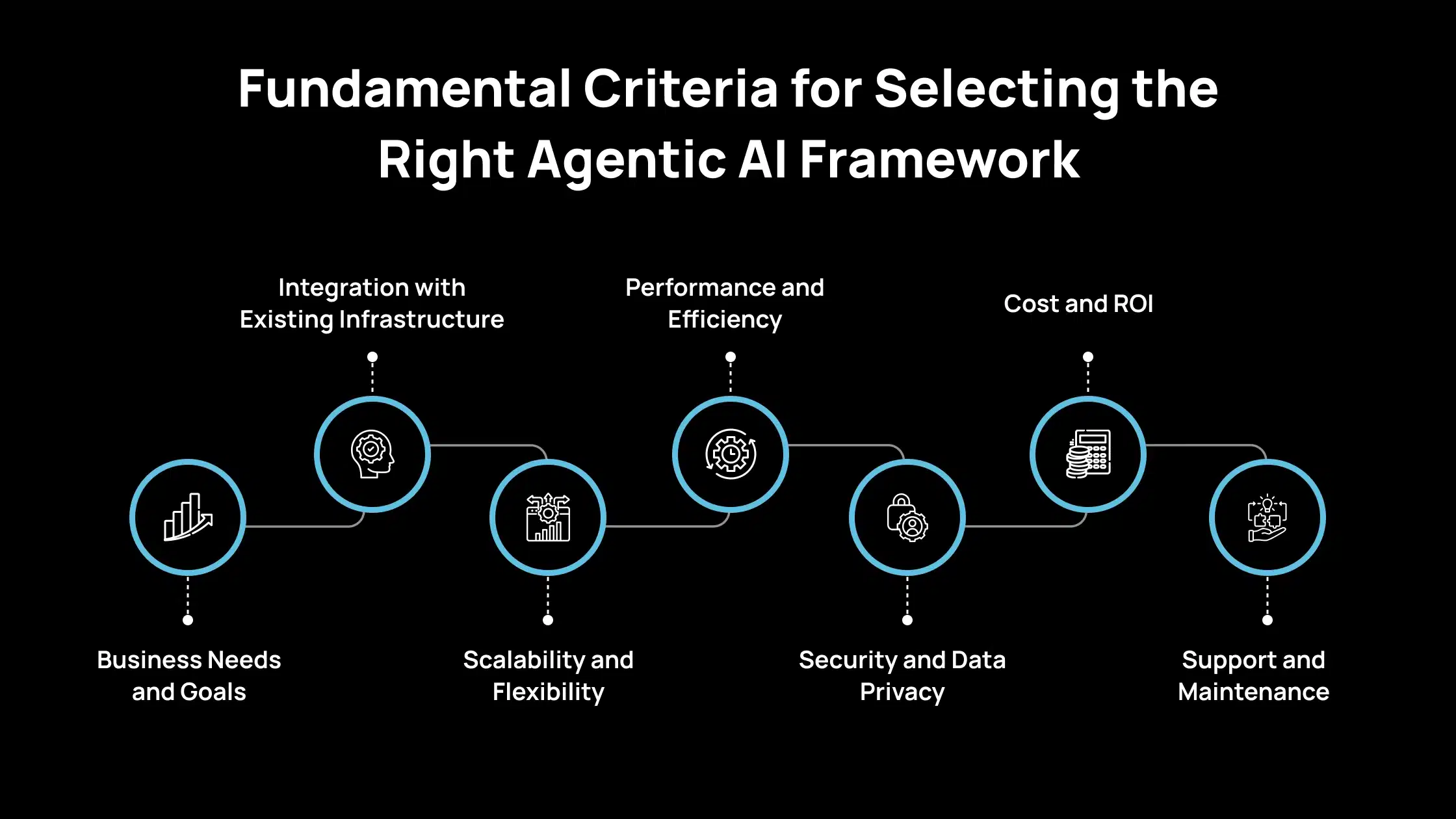
Choosing the right Agentic AI framework requires a clear understanding of your enterprise’s needs and the framework’s ability to meet those needs efficiently. Here are the critical criteria to guide your decision-making process:
1. Business Needs and Goals
Before selecting a framework, define the scope of Agentic AI within your enterprise. What do you want the AI to achieve? Whether it’s automation, decision-making, or problem-solving, the framework must align with your specific business needs.
- Automation: Identify which processes can be automated to save time and resources.
- Decision-Making: Determine how AI can assist in making informed, data-driven decisions.
- Problem-Solving: Assess whether the AI framework can address ongoing challenges in your business.
Once the scope is defined, ensure the AI framework aligns with your business objectives,, such as cost reduction, increased productivity, and scalability. Choose a framework that helps achieve measurable results in these areas, ensuring a tangible impact on your business operations.
2. Integration with Existing Infrastructure
For smooth adoption, the AI framework must be compatible with your current systems. Consider the following:
- ERP and CRM Systems: Ensure the framework can integrate with your existing enterprise resource planning (ERP) and customer relationship management (CRM) systems.
- Cloud Platforms and Data Warehouses: The framework should seamlessly integrate with cloud-based tools, data storage, and other technologies used within your organization.
The easier the integration, the less disruption there will be to your ongoing operations. Look for frameworks that support standard integration protocols, APIs, and pre-built connectors to simplify this process.
3. Scalability and Flexibility
As your business grows, your AI framework should scale with it. Consider how the framework handles:
- Growth: Will it be able to manage an increasing volume of data, transactions, or users?
- Changing Business Requirements: As your enterprise evolves, the AI framework should be flexible enough to adapt to new business needs and challenges.
The right framework should also allow customization, enabling you to adapt the AI’s functionality to new tasks or industries and ensuring the system remains relevant as your business evolves.
4. Performance and Efficiency
The performance of the AI framework directly impacts your operations. Consider the following factors:
- Processing Speed: How quickly can the AI framework process data and make decisions?
- Resource Usage: Ensure the framework operates efficiently without overloading system resources.
- Response Time: Evaluate the framework’s ability to respond promptly to requests, especially in time-sensitive environments.
Ultimately, the AI framework should not only perform well but also optimize system resources to maintain overall system performance and reduce operational overhead.
5. Security and Data Privacy
Given increasing concerns about data breaches and privacy, your chosen AI framework must comply with security standards and data protection regulations. Key areas to consider include:
- Regulatory Compliance: Ensure the framework complies with data protection laws such as GDPR, CCPA, and other relevant regulations in your region.
- Security Features: Look for built-in security measuressuch ase encryption, access controls, and user authentication to protect sensitive data.
A secure AI framework not only protects your enterprise but also safeguards customer trust by ensuring privacy and compliance.
6. Cost and ROI
The cost of implementing an AI framework is a critical consideration. Evaluate the following:
- Implementation Cost: Understand the initial investment required, including software, hardware, and personnel costs.
- Long-Term Operational Costs: Consider ongoing expenses, including maintenance, updates, and potential infrastructure upgrades.
- Expected ROI: Compare the costs with the potential return on investment (ROI). Does the framework offer enough value in terms of automation, efficiency gains, or new capabilities to justify the expense?
Be sure to assess the long-term financial impact to ensure the framework delivers a positive return on your investment.
7. Support and Maintenance
An effective AI framework requires continuous support and maintenance. Look for:
- Technical Support: Ensure that the framework provider offers robust support, including troubleshooting, updates, and issue resolution.
- Community Support: A strong user community can be an invaluable resource for troubleshooting and sharing best practices.
- Documentation and Tutorials: Well-documented frameworks with detailed tutorials can help your team get up to speed quickly and handle any challenges that arise.
By considering these support elements, you ensure that the framework remains operational and optimized over time.
Challenges in Implementing Agentic AI Frameworks
Implementing an Agentic AI framework involves several challenges that must be carefully considered and addressed. Understanding these challenges is essential for successful adoption and integration within an enterprise.
1. Complexity in Integrating AI Frameworks with Legacy Systems
One of the biggest hurdles enterprises face is integrating Agentic AI frameworks with existing legacy systems. Many businesses rely on older technologies that may not be compatible with modern AI solutions, requiring significant effort to connect and synchronize data across different platforms.
Modifying both the legacy systems and AI frameworks to communicate effectively. Ensuring that historical data can be transferred to the new system without data loss or errors.
2. Managing and Processing Vast Amounts of Data
Agentic AI systems require large volumes of data to function effectively. The challenge here is processing and analyzing this data in real time, especially for enterprises with vast amounts of unstructured or complex data.
AI requires high-quality data, so enterprises need to invest time in data preparation and cleaning.
AI systems need to process data quickly for timely decision-making. Slow processing can limit the effectiveness of the AI framework.
3. Bias in AI Decision-Making and Its Impact on Fairness
AI systems, including Agentic AI, are only as good as the data they are trained on. Bias in training data can lead to unfair or discriminatory decision-making by AI systems, affecting outcomes in areas such as hiring, lending, or customer service. Ethical concerns arise when AI systems:
AI may perpetuate discrimination against certain groups, leading to unfair practices. Many AI systems operate as “black boxes,” making it difficult to understand how decisions are made, thereby undermining fairness.
4. Ensuring the Framework Meets Legal Standards
AI frameworks must comply with various legal standards and data protection regulations, such as the GDPR (General Data Protection Regulation), the CCPA (California Consumer Privacy Act), and other local and international laws.
Non-compliance can lead to heavy fines for the enterprise. Failure to protect user data and respect privacy can damage your company’s reputation.
5. Overcoming Internal Resistance to AI Adoption
Adopting Agentic AI can meet resistance within an organization. Employees may fear job displacement, worry about the complexity of the new systems, or feel overwhelmed by the rapid technological change.
Highlight how AI can complement, not replace, human workers. Involve employees in the decision-making process to gain their buy-in and ensure they feel included in the transformation.
6. Balancing Automation with Human Oversight
While AI can automate many tasks, it is important to maintain human oversight to ensure accountability. Some decisions may require human judgment, especially in complex or ambiguous situations.
AI handles repetitive, time-consuming tasks. AI decision-making is monitored by human operators to catch potential errors or unethical outcomes.
Best Practices for Successfully Integrating Agentic AI in Enterprises
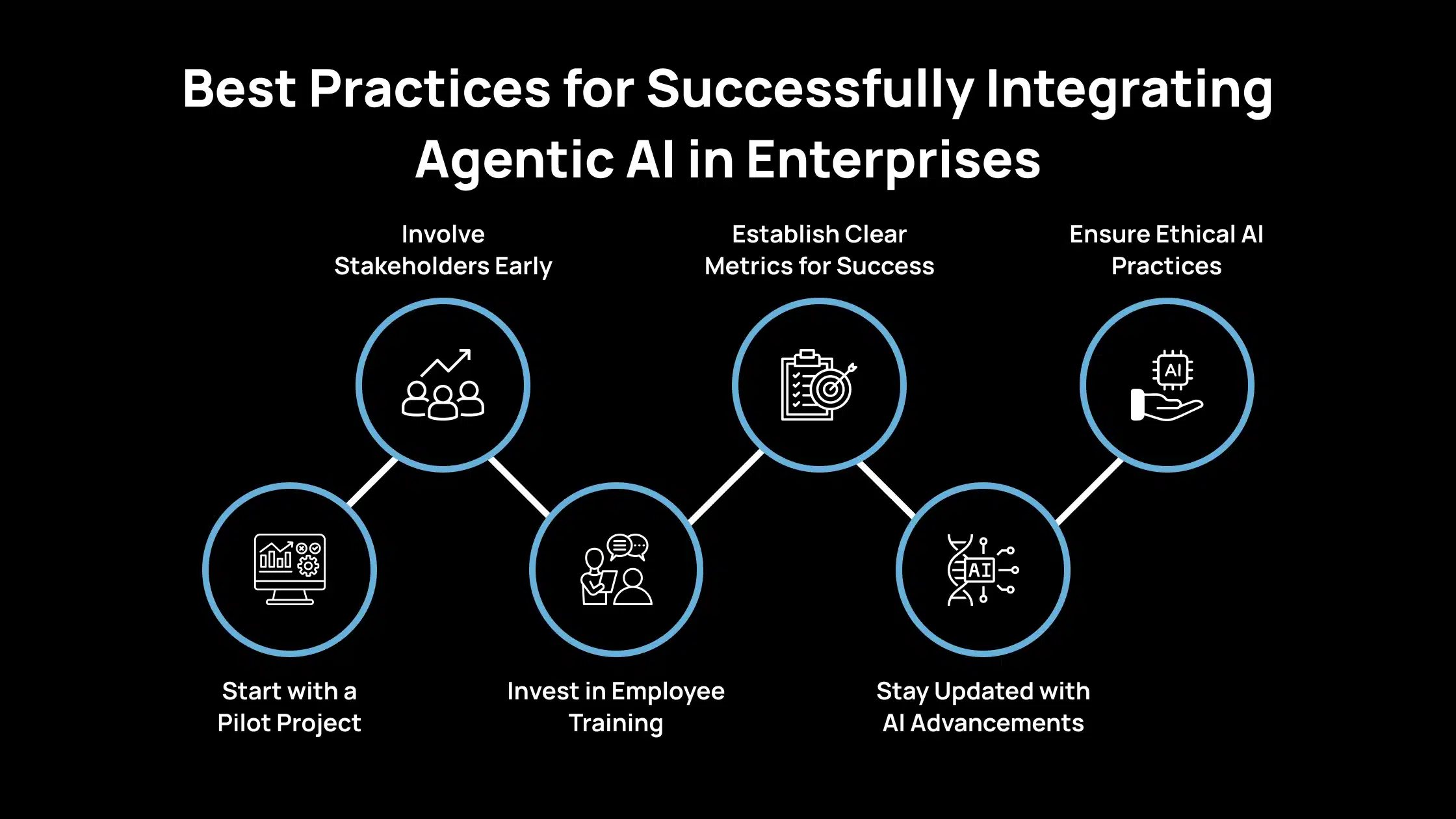
Successfully implementing Agentic AI requires strategic planning, collaboration, and a clear roadmap. Here are the best practices for smooth adoption and integration.
1. Start with a Pilot Project
Begin with a pilot project to test the framework’s effectiveness before full-scale implementation. Ensure that the framework meets your business needs in real-world scenarios.
Spot potential issues early and resolve them before the full rollout. Use insights gained from the pilot to fine-tune the AI system for broader use. This phased approach reduces risk and enables a smoother transition to a fully AI-driven system.
2. Involve Stakeholders Early
Engage key stakeholders, including executives, IT teams, and end-users, early in the decision-making process. The AI framework will be implemented to align with strategic objectives.
Stakeholders are more likely to support the AI initiative if they are involved from the outset.
Involvement of all relevant parties also helps mitigate resistance and ensures a more collaborative transition.
3. Invest in Employee Training
Proper training is essential for successful adoption. Ensure employees understand how the framework works and how to use it efficiently. It helps employees navigate changes to workflows, roles, and responsibilities. A well-trained workforce will be more likely to embrace AI and use it to its full potential.
4. Establish Clear Metrics for Success
Define key performance indicators (KPIs) to measure the success of your AI framework. These metrics should be tied to your business goals and may include improved process speed and reduced operational costs, return on investment from implementing AI, and enhanced customer experiences due to more accurate or timely decisions. Clear metrics provide a basis for evaluating AI’s impact and identifying areas for further improvement.
5. Stay Updated with AI Advancements
AI is a rapidly evolving field, so staying up to date with new advancements and emerging technologies is essential. Regularly assess the latest trends, tools, and best practices to ensure your enterprise remains competitive and that your AI framework is continuously optimized.
6. Ensure Ethical AI Practices
Prioritize ethics in AI development and decision-making. This includes ensuring AI processes are transparent and understandable, ensuring AI decisions are unbiased and equitable, and holding both the AI system and human operators accountable for their decisions.
Ethical AI practices not only ensure compliance but also foster trust with customers, employees, and stakeholders.
How Avahi Helps You Turn AI Into Real Business Results?
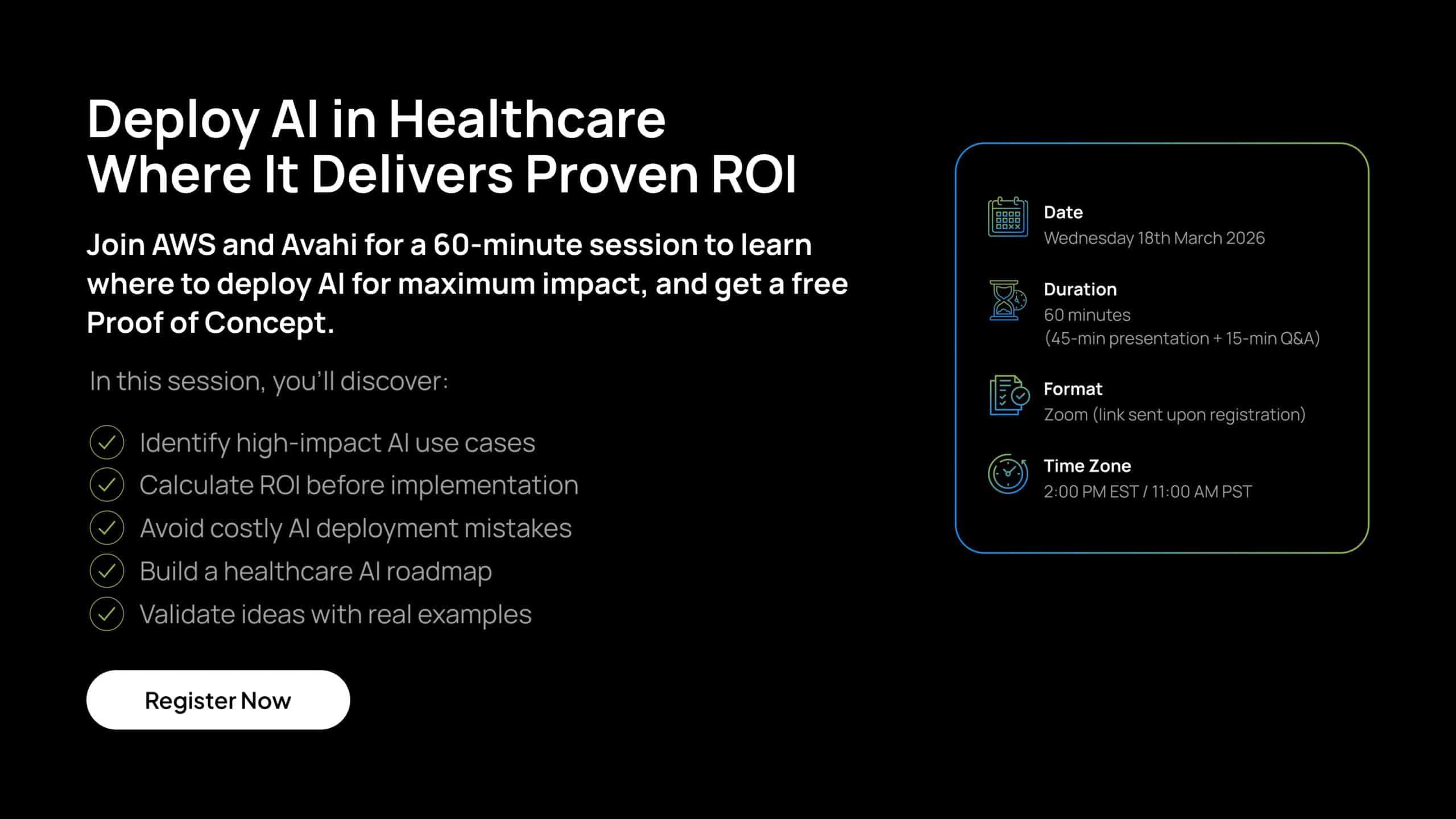
If your goal is to apply AI in practical ways that deliver measurable business impact, Avahi offers solutions designed specifically for real-world challenges. Avahi enables organizations to quickly and securely adopt advanced AI capabilities, supported by a strong cloud foundation and deep AWS expertise.
Avahi AI solutions deliver business benefits such as:
- Round-the-Clock Customer Engagement
- Automated Lead Capture and Call Management
- Faster Content Creation
- Quick Conversion of Documents Into Usable Data
- Smarter Planning Through Predictive Insights
- Deeper Understanding of Visual Content
- Effortless Data Access Through Natural Language Queries
- Built-In Data Protection and Regulatory Compliance
- Seamless Global Communication Through Advanced Translation and Localization
By partnering with Avahi, organizations gain access to a team with extensive AI and cloud experience committed to delivering tailored solutions. The focus remains on measurable outcomes, from automation that saves time and reduces costs to analytics that improve strategic decision-making to AI-driven interactions that elevate the customer experience.
Discover Avahi’s AI Platform in Action
At Avahi, we empower businesses to deploy advanced Generative AI that streamlines operations, enhances decision-making, and accelerates innovation, all with zero complexity.
As your trusted AWS Cloud Consulting Partner, we empower organizations to harness the full potential of AI while ensuring security, scalability, and compliance with industry-leading cloud solutions.
Our AI Solutions Include
- AI Adoption & Integration – Leverage Amazon Bedrock and GenAI to Enhance Automation and Decision-Making.
- Custom AI Development – Build intelligent applications tailored to your business needs.
- AI Model Optimization – Seamlessly switch between AI models with automated cost, accuracy, and performance comparisons.
- AI Automation – Automate repetitive tasks and free up time for strategic growth.
- Advanced Security & AI Governance – Ensure compliance, detect fraud, and deploy secure models.
Want to unlock the power of AI with enterprise-grade security and efficiency?
Start Your AI Transformation with Avahi Today!
Frequently Asked Questions
1. How can an Agentic AI framework drive business growth?
An Agentic AI framework enhances business growth by automating decision-making, improving operational efficiency, and enabling scalable solutions. It allows executives to focus on strategic initiatives while AI handles routine tasks and optimizes workflows, resulting in cost savings, productivity gains, and better resource allocation.
2. What are the key considerations for implementing Agentic AI in an enterprise?
When implementing Agentic AI, executives should prioritize alignment with business goals, integration with existing systems, scalability, and security. The chosen framework must support growth, comply with regulatory standards, and ensure seamless integration with current infrastructure while driving measurable outcomes.
3. How do I ensure the ROI of an Agentic AI framework?
To ensure ROI from an Agentic AI framework, executives should clearly define success metrics such as cost savings, efficiency improvements, and business outcomes. Regularly assess performance, measure impact, and compare results against pre-implementation benchmarks to ensure the framework delivers substantial returns over time.
4. What are the common risks associated with adopting Agentic AI, and how can they be mitigated?
Common risks of adopting Agentic AI include integration challenges, data privacy concerns, and resistance to change within the organization. These risks can be mitigated through careful planning, pilot testing, employee training, and ensuring compliance with data protection regulations to minimize disruptions during implementation.
5. How can I align Agentic AI with my company’s long-term strategic goals?
Aligning Agentic AI with your company’s long-term strategic goals involves identifying the specific business objectives you want to achieve (e.g., improved customer experiences, automation, or data-driven decision-making). Choose an AI framework that adapts to your evolving needs, integrates well with your existing technology, and supports your enterprise’s vision for growth and innovation.