




TL;DR
|
The adoption of AI agents is accelerating rapidly. Industry reports show that over 80% of organizations are investing in AI-driven automation, yet many AI initiatives fail to deliver production value due to performance, integration, and maintenance challenges.
You can connect a model, define a prompt, and get impressive results quickly. But production environments expose real challenges: unpredictable inputs, system failures, scaling demands, and constantly changing data. This is where most AI agents break down and why forward-thinking teams use an AWS proof of concept to expose and fix these system vulnerabilities before going live.
Building a production-ready agent requires more than intelligence. It requires reliability, scalability, and strong system design.
At the same time, companies that successfully deploy AI agents are reducing operational workload, improving response times, and scaling workflows without increasing team size.
This creates a clear opportunity. If you build your agent correctly, it can operate continuously, execute tasks autonomously, and support critical business workflows. But to achieve this, you must understand how AI agents work, the challenges of production deployment, and the systems required to maintain performance over time.
This blog explains exactly what you need to design, deploy, and maintain AI agents that work reliably in real production environments.
Understanding the Core Components of an AI Agent
An AI agent is a software system that can perform tasks on your behalf with minimal or no manual intervention. Unlike static automation scripts, agents can interpret inputs, make decisions, and adjust their behavior in response to changing conditions.
You use AI agents to reduce manual effort, handle repetitive workflows, and improve operational efficiency. These agents can operate across customer support, sales operations, internal workflows, data analysis, and system orchestration.
Common examples include:
- Customer support agents who automatically resolve tickets.
- Sales agents who qualify leads and update CRM systems.
- Research agents that gather and summarize information.
- Workflow agents that move data across tools and trigger processes.
To function effectively, every AI agent relies on four core components: perception, decision-making, action, and learning.
1. Perception
Perception is how your agent receives and interprets information from its environment. Without accurate input, the agent cannot make reliable decisions. You define perception by connecting your agent to relevant data sources, such as:
- APIs (CRM systems, databases, internal tools)
- User inputs (chat messages, forms, commands)
- Documents (PDFs, knowledge bases, emails)
- System events (workflow triggers, status changes)
- External data sources (web data, product catalogs)
For example, if you build a customer support agent, its perception layer may include incoming support tickets, customer history from your CRM, knowledge base articles, and product documentation. The quality, completeness, and structure of this data directly affect the agent’s performance. Poor perception leads to incorrect or incomplete decisions.
2. Decision-Making
Decision-making is the intelligence layer of your agent. This is where the agent analyzes inputs and determines the appropriate response or action. This component includes:
- Large language models (LLMs) for reasoning and interpretation
- Decision logic and rules that enforce constraints
- Retrieval systems that provide relevant context
- Algorithms that evaluate multiple possible actions
For example, when your support agent receives a ticket, they must decide whether the request is billing, technical, or a general inquiry, whether it can be resolved automatically, and whether it needs to be escalated to a human.
The agent uses models and logic to evaluate context and select the most appropriate outcome.
Your responsibility is to define clear instructions, guardrails, and access to relevant context so the agent can make accurate decisions.
3. Action
Action is where your agent converts decisions into real outcomes. This is the execution layer.
Your agent can perform actions such as sending responses to users, updating records in your CRM, and triggering workflows in other tools.
For example, a sales agent may qualify a lead based on company size and engagement, update the lead status in your CRM, assign the lead to a sales representative, and send a personalized follow-up email. Without the ability to act, your agent remains merely informational. Action capabilities make it operational.
4. Learning
Learning aenablesyour agent to improve accuracy, efficiency, and reliability bthroughfeedback and new data. This improvement can happen through model updates and fine-tuning, feedback loops from human reviewers, monitoring errors and correcting behavior, and updating instructions and system prompts.
For example, if your agent incorrectly classifies support tickets, you can review failures, adjust the logic, and retrain components to improve future decisions. Your role is to monitor performance, collect feedback, and continuously refine the system.
Challenges in Building AI Agents for Production
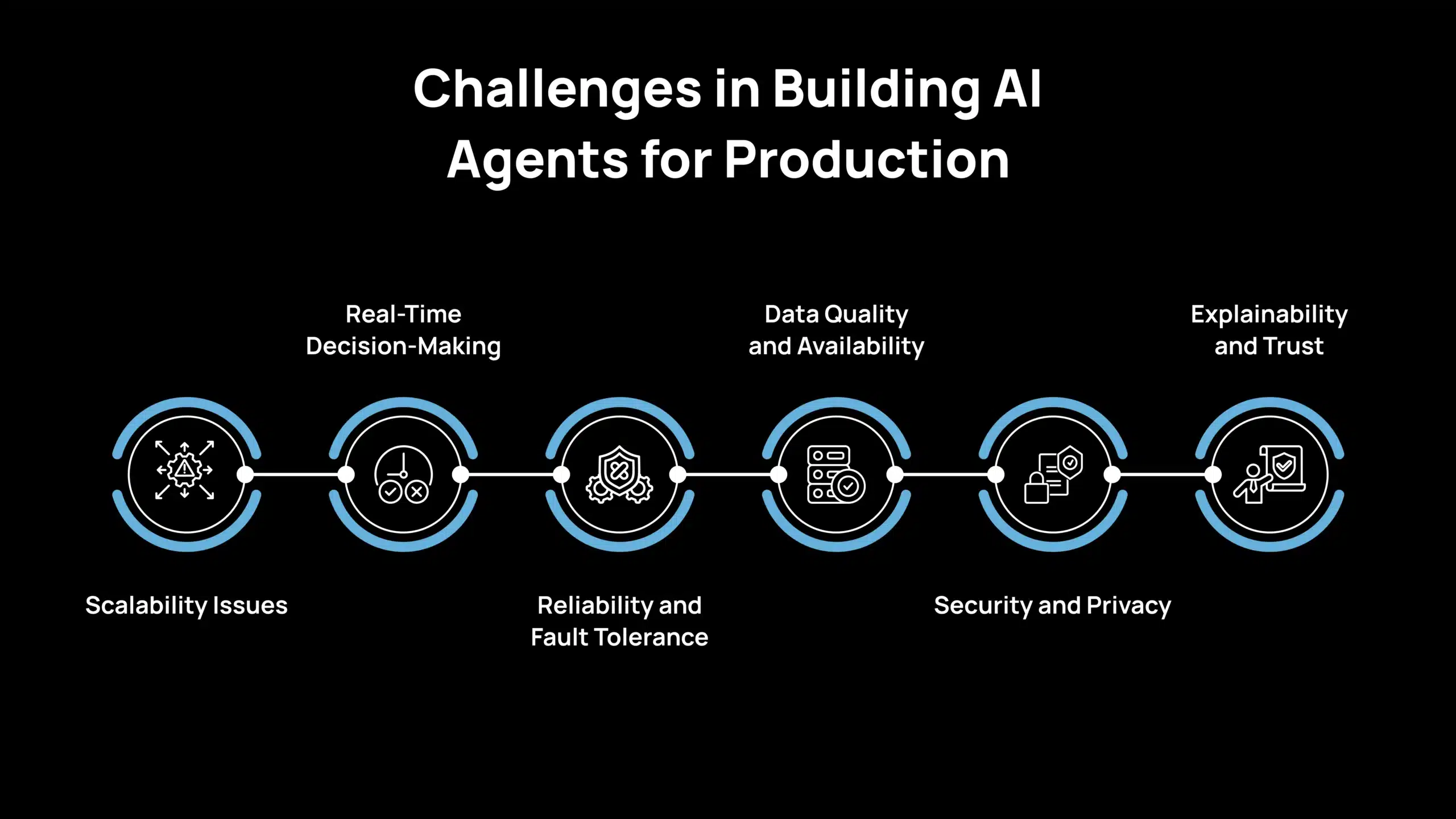
Here is the list of challenges that you might face while building AI agents:
1. Scalability Issues
An AI agent that performs well in testing may struggle in production due to higher volume, greater concurrency, and increased system complexity. As usage increases, bottlenecks such as slow response times, API rate limits, infrastructure constraints, and increased latency from repeated model calls can affect performance.
For example, an agent handling dozens of daily tasks may operate efficiently, but the same agent may fail or slow down significantly when handling thousands of requests without a scalable infrastructure.
2. Real-Time Decision-Making
Production agents must respond quickly to support real workflows. Delays caused by inefficient data retrieval, excessive API calls, large context sizes, or blocking processes reduce usability and operational effectiveness.
For instance, delayed responses in sales or customer support workflows can result in lost opportunities and poor user experience.
3. Reliability and Fault Tolerance
Production environments introduce failures such as API outages, malformed inputs, and infrastructure disruptions. Without proper safeguards, these failures can interrupt workflows, produce incorrect outputs, or cause system crashes.
To maintain operational continuity, your agent must include retry mechanisms, fallback logic, input validation, and comprehensive monitoring and logging.
4. Data Quality and Availability
An agent’s performance depends entirely on the quality, accuracy, and availability of its data sources. Incomplete, outdated, or inconsistent data can lead to incorrect decisions and unreliable outputs.
For example, accessing outdated documentation can cause an agent to provide inaccurate responses. To maintain reliability, you must ensure that data is clean, structured, regularly updated, and retrieved efficiently.
5. Security and Privacy
AI agents often interact with sensitive business and customer data, making security a critical requirement. Risks include unauthorized access, data leakage, and compliance violations.
To mitigate these risks, you should implement role-based access controls, secure integrations, authentication mechanisms, and data protection practices.
6. Explainability and Trust
For agents to be adopted successfully, users must trust their decisions and outputs. Lack of transparency, inconsistent behavior, or incorrect actions can reduce confidence in the system.
Providing structured outputs, maintaining audit logs, enabling human oversight for critical actions, and clearly defining operational boundaries help improve transparency and accountability.
Designing AI Agents for Reliable and Scalable Production Environments
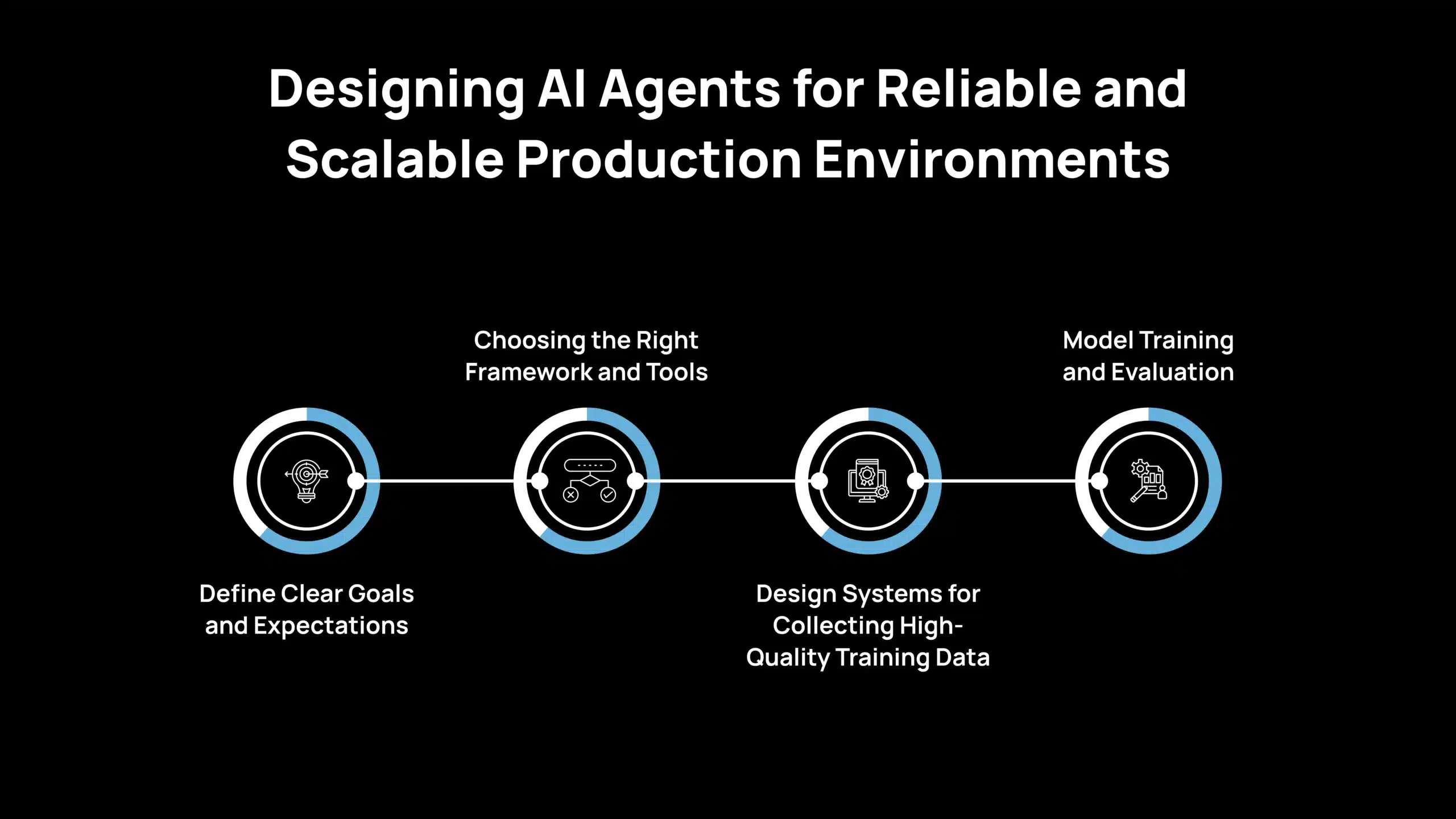
Let’s break down what it really takes to build AI agents that perform reliably in production.
1. Define Clear Goals and Expectations
The first step in designing an AI agent is to define what tasks it needs to accomplish. For example, if you’re building an AI agent for customer support, tasks might include answering frequently asked questions, handling live chat interactions, or routing tickets to human agents.
Important Questions to Ask:
- What are the specific objectives of the agent (e.g., decision-making, predictions, automation)?
- How will it add value to business processes (e.g., customer satisfaction, operational efficiency)?
- What measurable outcomes are expected (e.g., response time, accuracy)?
Consider how the AI agent will integrate with the existing technical stack. For instance, an AI agent built for a retail store might need to interact with inventory management, CRM systems, and payment gateways. Important questions involve:
- Does it need to interface with databases, APIs, or third-party systems?
- How will it handle error reporting and logging in the production environment?
Crucial to ensuring the AI agent meets all business, technical, and user-experience expectations. Work closely with engineering, product, and business teams to align goals and avoid silos in the development process. Important participants include:
- Product Team: Defines user requirements, use cases, and success criteria.
- Engineering Team: Ensures technical feasibility, infrastructure support, and scalability.
- Business Team: Provides insights into market needs, ROI expectations, and business goals.
2. Choosing the Right Framework and Tools
Different learning approaches enable AI agents to understand data, recognize patterns, and improve decision-making, depending on the task and available training data.
| Learning Type | Description | Best Used For | Example |
| Supervised Learning | Trains the agent using labeled data to learn input-output relationships. | Classification, regression, and prediction tasks | Fraud detection, spam classification |
| Unsupervised Learning | Identifies patterns and structure in unlabeled data without predefined outcomes. | Clustering, anomaly detection, segmentation | Customer segmentation, anomaly detection |
| Reinforcement Learning | Learns optimal actions through trial and error using rewards and penalties. | Autonomous decision-making and optimization | Robotics, game AI, workflow automation |
Choose between traditional machine learning models (e.g., decision trees, logistic regression) for simpler problems, or deep learning models (e.g., CNNs, RNNs) for more complex tasks like image recognition or natural language processing (NLP).
For example, use decision trees for structured data analysis, but deep learning models like CNNs or transformers for images or unstructured data such as text.
Frameworks & Libraries
- TensorFlow: A popular deep learning framework, TensorFlow is highly scalable and used to develop production-level AI applications, especially in computer vision, NLP, and time-series forecasting.
- PyTorch: Known for its flexibility and dynamic computation graph, PyTorch is widely used in academia and research to develop complex models such as transformers, GANs, and reinforcement learning systems.
- OpenAI Gym: A toolkit for developing and comparing reinforcement learning algorithms. It is essential for developing AI agents that learn from their environment.
- Scikit-learn: A library for traditional machine learning algorithms, Scikit-learn is optimal for classification, regression, and clustering tasks.
- Hugging Face: If working with NLP, Hugging Face offers pre-trained transformer models like BERT and GPT that can be easily fine-tuned for various use cases (e.g., text generation, summarization).
3. Design Systems for Collecting High-Quality Training Data
Quality data is the foundation of a successful AI agent. Data should be relevant, accurate, and representative of real-world scenarios the agent will face. Methods of data collection involve:
- Automated Data Collection: Set up systems to automatically gather relevant data from sensors, databases, or web scraping.
- Crowdsourcing: When large, labeled datasets are needed, consider platforms like Amazon Mechanical Turk for manual labeling.
- Real-time Data: For tasks such as predictive maintenance, the agent may need to ingest data from IoT devices or live user interactions in real time.
For tasks such as NLP or image classification, ensure the data includes a variety of examples to improve generalization. Clean the collected data by removing inconsistencies, handling missing values, and eliminating irrelevant features.
Normalize or scale data (e.g., Min-Max scaling or Z-score normalization) to ensure that all features are on a similar scale and to improve model convergence. Select and engineer features based on domain knowledge, adding new variables to improve the model’s performance (e.g., by creating interaction terms or extracting date-time features).
For specific use cases, such as computer vision or NLP, generate synthetic data to train models when real data is limited. Techniques include using generative models (GANs) or applying image transformations such as rotations, flips, or cropping.
In certain production environments, data is constantly changing (e.g., stock prices, website traffic). Implementing real-time data pipelines allows the AI agent to adapt to new trends and scenarios dynamically.
4. Model Training and Evaluation
Implement training techniques such as:
- Cross-validation: Implement cross-validation (e.g., k-fold) to assess the model’s generalization ability and prevent overfitting by training the model on different subsets of the dataset.
- Hyperparameter Tuning: Use grid or random search to optimize hyperparameters and improve model performance.
- Transfer Learning: In cases of limited data, use pre-trained models and fine-tune them for the specific task, especially in deep learning applications like NLP and computer vision.
Evaluation metrics help you measure how accurately your AI agent performs tasks and ensure it delivers reliable results in production environments.
| Evaluation Type | Purpose | Key Metrics |
| Classification Metrics | Measure how accurately the agent classifies or predicts categories. | Accuracy, Precision, Recall, F1 Score |
| Regression Metrics | Evaluate how closely predicted values match actual outcomes. | MSE, RMSE, R² |
| A/B Testing | Compare the performance of different agent versions in real environments. | Conversion rate, accuracy, task success rate |
Handling Overfitting
- Regularization: Use techniques like L1 and L2 regularization to prevent overfitting by penalizing large coefficients in linear models.
- Dropout: In deep learning, dropout randomly deactivates neurons during training, helping prevent overfitting by forcing the model to learn robust features.
- Early Stopping: Monitor validation loss and stop training when performance starts to degrade to avoid overfitting on the training set.
- Data Augmentation: For deep learning tasks such as image recognition, data augmentation serves as a form of regularization by artificially increasing the dataset size through transformations.
Best Practices for Ensuring Continuous Performance in Production
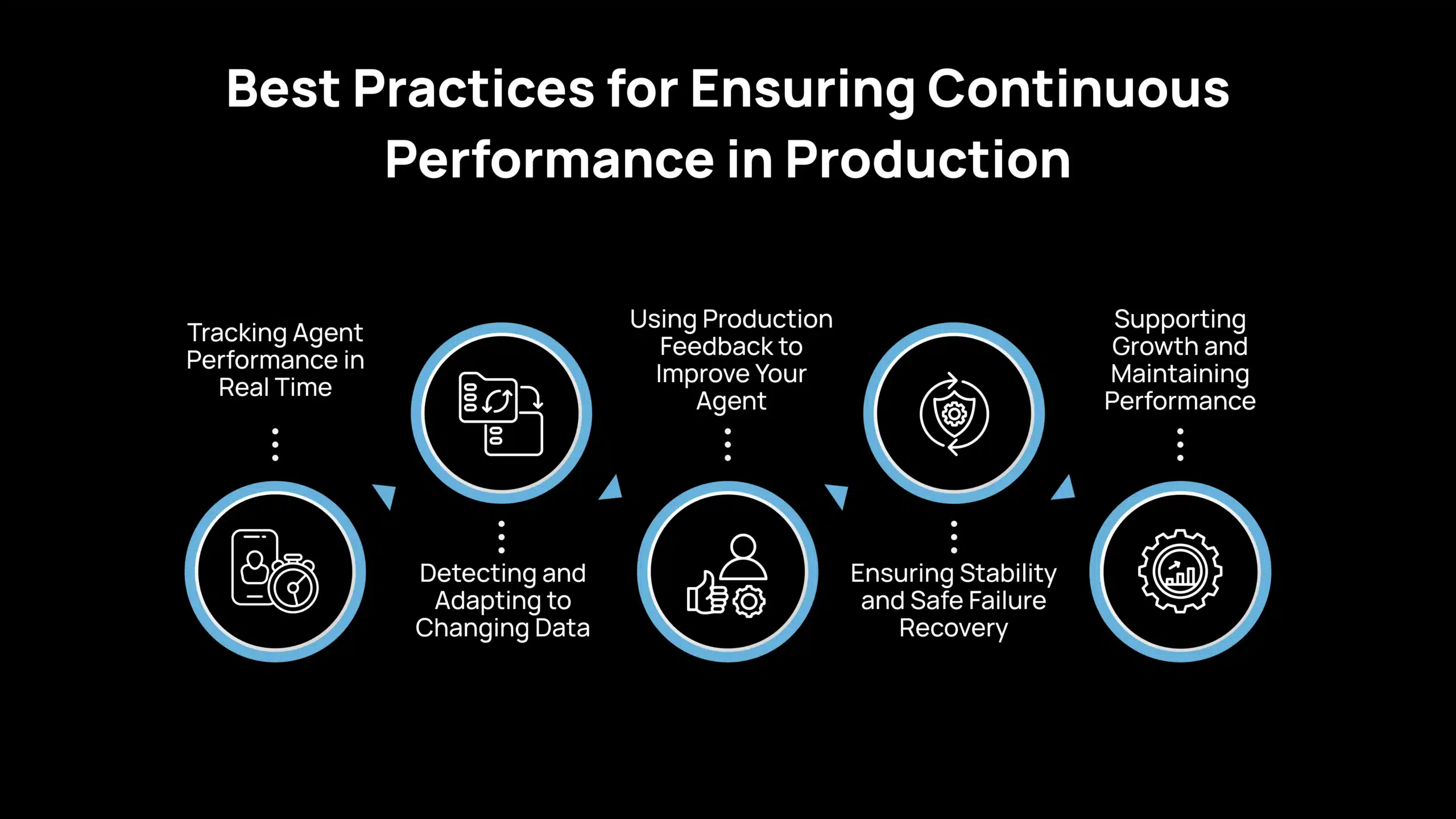
Below are the essential best practices you should implement to ensure your AI agent maintains reliable, accurate, and scalable performance in production environments.
1. Tracking Agent Performance in Real Time
Once your agent is live, you must continuously monitor its behavior to ensure it performs as expected. You need visibility into key metrics, including response accuracy, latency, error rates, and system usage.
This helps you detect performance degradation, system bottlenecks, or abnormal behavior early. You should implement structured logging to record inputs, outputs, decisions, and failures. Monitoring tools such as MLflow and TensorBoard help you track model performance across versions, compare results, and identify regressions. Real-time dashboards allow you to observe trends and take corrective action before issues affect production workflows.
2. Detecting and Adapting to Changing Data
Your agent’s performance will decline if production data changes over time. This is known as model drift. Data drift occurs when the structure or distribution of input data changes. Concept drift occurs when the relationship between input and correct output changes. Both affect decision accuracy.
You must detect drift by monitoring input patterns, output consistency, and performance metrics. To mitigate drift, implement automated retraining pipelines that update your model with recent production data. This ensures your agent remains accurate and aligned with current conditions.
3. Using Production Feedback to Improve Your Agent
Your agent improves when you continuously collect and use feedback from real-world usage. You should capture feedback from users, system outcomes, and human reviewers. This helps you identify incorrect predictions, edge cases, and areas requiring improvement.
You must store and analyze this feedback to refine decision logic, update prompts, or retrain models. A structured feedback loop ensures your agent adapts to real workflows and becomes more reliable over time.
4. Ensuring Stability and Safe Failure Recovery
Production environments introduce unexpected inputs, integration failures, and infrastructure issues. Your agent must handle these failures without disrupting operations. You should implement retry mechanisms, fallback workflows, and escalation paths to human operators when necessary.
Proper error logging helps you diagnose and resolve issues quickly. Automated detection and recovery mechanisms allow your system to recover from failures without manual intervention. This ensures your agent remains stable even under unpredictable conditions.
5. Supporting Growth and Maintaining Performance
Your agent must operate reliably as workloads increase. You should deploy your agent on scalable cloud platforms such as AWS, Azure, or Google Cloud. These platforms allow your system to scale compute and storage resources in response to demand.
Containerization using Docker ensures consistent deployment across environments. Orchestration tools such as Kubernetes automatically manage scaling, load balancing, and system availability. This infrastructure ensures your agent remains responsive, reliable, and capable of handling production-scale workloads.
How Avahi Helps You Turn AI Into Real Business Results?
If your goal is to apply AI in practical ways that deliver measurable business impact, Avahi offers solutions designed specifically for real-world challenges. Avahi enables organizations to quickly and securely adopt advanced AI capabilities, supported by a strong cloud foundation and deep AWS expertise.
Avahi AI solutions deliver business benefits such as:
- Round-the-Clock Customer Engagement
- Automated Lead Capture and Call Management
- Faster Content Creation
- Quick Conversion of Documents Into Usable Data
- Smarter Planning Through Predictive Insights
- Deeper Understanding of Visual Content
- Effortless Data Access Through Natural Language Queries
- Built-In Data Protection and Regulatory Compliance
- Seamless Global Communication Through Advanced Translation and Localization
By partnering with Avahi, organizations gain access to a team with extensive AI and cloud experience committed to delivering tailored solutions. The focus remains on measurable outcomes, from automation that saves time and reduces costs to analytics that improve strategic decision-making to AI-driven interactions that elevate the customer experience.
Discover Avahi’s AI Platform in Action
At Avahi, we empower businesses to deploy advanced Generative AI that streamlines operations, enhances decision-making, and accelerates innovation, all with zero complexity.
As your trusted AWS Cloud Consulting Partner, we empower organizations to harness the full potential of AI while ensuring security, scalability, and compliance with industry-leading cloud solutions.
Our AI Solutions Include
- AI Adoption & Integration – Leverage Amazon Bedrock and GenAI to Enhance Automation and Decision-Making.
- Custom AI Development – Build intelligent applications tailored to your business needs.
- AI Model Optimization – Seamlessly switch between AI models with automated cost, accuracy, and performance comparisons.
- AI Automation – Automate repetitive tasks and free up time for strategic growth.
- Advanced Security & AI Governance – Ensure compliance, detect fraud, and deploy secure models.
Want to unlock the power of AI with enterprise-grade security and efficiency?
Start Your AI Transformation with Avahi Today!
Frequently Asked Questions
1. What does it mean to build AI agents for production?
Building AI agents for production means designing systems that operate reliably at scale, integrate with business tools, and execute tasks autonomously. Production agents require strong architecture, error handling, monitoring, and secure integrations to ensure consistent performance in real-world environments.
2. What are the key components required to build AI agents that work reliably?
Production AI agents require four core components: perception (data access), decision-making (models and logic), action (tool and system integrations), and learning (feedback and continuous improvement). These components work together to enable accurate, autonomous, and scalable task execution.
3. Why do most AI agents fail in production environments?
Most AI agents fail due to poor system design rather than model limitations. Common causes include unreliable integrations, poor data quality, insufficient scalability, inadequate monitoring, and weak error handling. Without proper infrastructure and governance, agents cannot perform consistently under real workloads.
4. How can organizations ensure AI agents remain accurate and reliable over time?
Organizations must implement continuous monitoring, performance evaluation, feedback loops, and automated retraining pipelines. Tracking metrics such as accuracy, latency, and error rates helps identify issues early and ensures the agent adapts to changing data and business requirements.
5. What infrastructure is needed to deploy AI agents at scale?
Production AI agents require scalable cloud infrastructure, API integrations, databases, monitoring systems, and containerized deployment using tools like Docker and Kubernetes. This infrastructure ensures reliability, performance, and the ability to handle increasing workloads without system failures.