TL;DR
|




Thais Rebequi
Published February 21, 2026

AI systems are no longer just responding to prompts. They are making decisions, using tools, and executing tasks independently.
This shift marks the rise of agentic AI, systems designed to reason, plan, and act with a level of autonomy that traditional AI applications were never built to handle.
According to industry research, more than 90% of enterprise AI initiatives now involve autonomous or semi-autonomous agents, and this number continues to grow as organizations look to automate complex workflows, not just generate content.
At the same time, many of these initiatives fail to move beyond pilots due to unpredictable behavior, rising costs, and lack of control. The challenge is not the models’ intelligence.
The challenge is architecture.
Agentic AI systems behave very differently from conventional AI applications. They require clear structures for reasoning, coordination, decision-making, and governance. Without well-defined design patterns, even the most advanced models can become unreliable and difficult to scale. To prevent this, engineering teams frequently deploy an AWS proof of concept to test these structural patterns under real-world cloud conditions before entering production.
In this blog, we break down the core design patterns that shape agentic AI behavior and the multi-agent system patterns that define how agents work together. The focus is on clarity, real-world applicability, and architectural decisions that matter when building agentic systems at scale.
As organizations move from experimentation to deployment, many agentic AI systems begin to fail in ways that are difficult to predict and even harder to control. These failures are rarely caused by the underlying models. Instead, they stem from naive system design that does not account for how autonomous agents behave at scale.
Production environments demand reliability, predictability, and governance, qualities that ad-hoc agent implementations often lack. Here are some of the common challenges in production agentic systems:
Without clear constraints and validation mechanisms, agents may generate incorrect or fabricated information. In production systems, this can lead to inaccurate outputs, poor user trust, and operational risk.
Agents designed to reason iteratively can become stuck repeating the same actions without reaching completion. This often occurs when exit conditions or evaluation criteria are poorly defined.
Autonomous agents can trigger excessive model calls, tool usage, or retries. Without safeguards, costs can grow rapidly and unpredictably, making systems financially unsustainable.
When reasoning, planning, and execution are tightly coupled in a single agent, small changes in inputs can produce widely different outcomes. This lack of consistency makes systems difficult to test, debug, and scale.
Agents with unrestricted access to tools or data can unintentionally expose sensitive information or perform unsafe actions. This risk increases as agents gain more autonomy and access to external systems.
Agentic architecture patterns provide structured approaches to designing systems that balance autonomy with control. They introduce clear boundaries between reasoning, execution, coordination, and oversight.
Before designing agentic architectures, it is important to understand the tools and frameworks that enable agents to reason, act, and collaborate. These frameworks provide the foundational infrastructure required to move from experimental agents to systems that can operate reliably in real-world environments.
LangChain is a modular framework for building agents that can interact with external tools, data sources, and APIs in a structured way. It enables:
LangChain provides a flexible foundation for building both single-agent and early-stage multi-agent systems. It helps teams move beyond static prompts by enabling agents to decide when and how to use tools during execution.
LangChain is commonly used for task automation, knowledge retrieval, workflow-driven assistants, and prototyping agentic behaviors with clear control
LlamaIndex is a data-focused framework that connects agents to enterprise and domain-specific knowledge sources. It enables:
What it enables
Agentic systems are only as effective as the information they can access. LlamaIndex ensures agents can reason over trusted, up-to-date, and proprietary data, rather than relying solely on model knowledge.
LlamaIndex is particularly useful for enterprise knowledge assistants, research and analysis tools, customer support systems, and systems requiring data accuracy and traceability.
AutoGen is a framework designed specifically for multi-agent collaboration and coordination. It enables:
As agentic systems grow in complexity, a single agent becomes insufficient. AutoGen enables teams to design systems where specialized agents work together, mirroring how human teams collaborate.
AutoGen is well-suited for multi-agent workflows, complex problem-solving tasks, systems requiring planning, execution, and review, and collaborative reasoning scenarios.
Multi-agent systems are built around how agents are organized and how they interact to complete tasks. The right interaction pattern determines scalability, reliability, and clarity of responsibility within the system.
Below are the most commonly used multi-agent design patterns, focusing on what each pattern does, when to use it, and what problem it solves in real-world systems.
In the Parallel Pattern, multiple agents work simultaneously on different subtasks of the same overall goal. Each agent is assigned an independent task and runs concurrently. Once all agents complete their work, the results are collected for further processing.
This pattern reduces overall execution time and improves throughput. It is commonly used when systems need to process multiple inputs or modalities at once, such as text analysis, image processing, or data extraction.
In the Sequential Pattern, agents work one after another, where each agent depends on the output of the previous one. The output from one agent becomes the input for the next agent in the sequence. Each agent has a clearly defined role in the pipeline.
This pattern ensures clarity and control in complex workflows. It is widely used in data processing pipelines, content workflows, and analytical systems, where each stage must be completed correctly before moving to the next.
The Loop Pattern allows an agent (or a group of agents) to repeat actions until a defined condition is met. The agent evaluates its output, checks against a completion or quality condition, and repeats the task if necessary.
This pattern enables continuous improvement and self-correction. It is especially useful in scenarios such as drafting, problem-solving, and iterative reasoning, where a single pass is insufficient.
The Router Pattern uses a central agent to direct tasks to the most appropriate specialized agent.
The router agent analyzes the incoming task and routes it to the agent best suited to handle it.
This pattern improves efficiency and accuracy by ensuring that ethe right agent handles each task It is commonly used in customer support systems, request classification, and multi-domain automation.
The Aggregator Pattern focuses on combining outputs from multiple agents into a single, coherent result. Multiple agents work independently, and an aggregator agent collects, evaluates, and merges their outputs.
This pattern improves decision quality and completeness. It is often used in research, analysis, and evaluation tasks where no single agent has the full picture.
In the Network Pattern, agents operate as peers, sharing information and collaborating dynamically. Agents communicate freely with each other, exchanging context, insights, and intermediate results without a strict hierarchy.
This pattern supports flexible problem-solving and adaptability. It is useful for exploratory tasks, simulations, and environments where agents continuously learn from each other.
The Hierarchical Pattern organizes agents into levels of responsibility, similar to a human organizational structure. Higher-level agents define goals and delegate tasks, while lower-level agents execute specific actions and report results to their superiors.
This pattern improves oversight, scalability, and alignment with business processes. It is commonly used in enterprise systems, long-running workflows, and regulated environments.
Agentic AI design patterns define how agents think, decide, and act within a system. Rather than focusing on individual prompts or models, these patterns provide architectural templates that guide agent behavior in a controlled and repeatable way.
By applying these patterns, teams can build agentic systems that are modular, predictable, scalable, and easier to govern, all essential qualities for production environments.
The Reflection Pattern enables an agent to evaluate and refine its own output before finalizing a response. After producing an initial result, the agent reviews its output against defined criteria such as accuracy, completeness, or clarity. If the output does not meet expectations, the agent revises it and repeats the process.
This pattern reduces errors and improves output quality without requiring human intervention. It introduces a form of self-correction, which is critical for tasks that require precision and consistency.
Where it is used
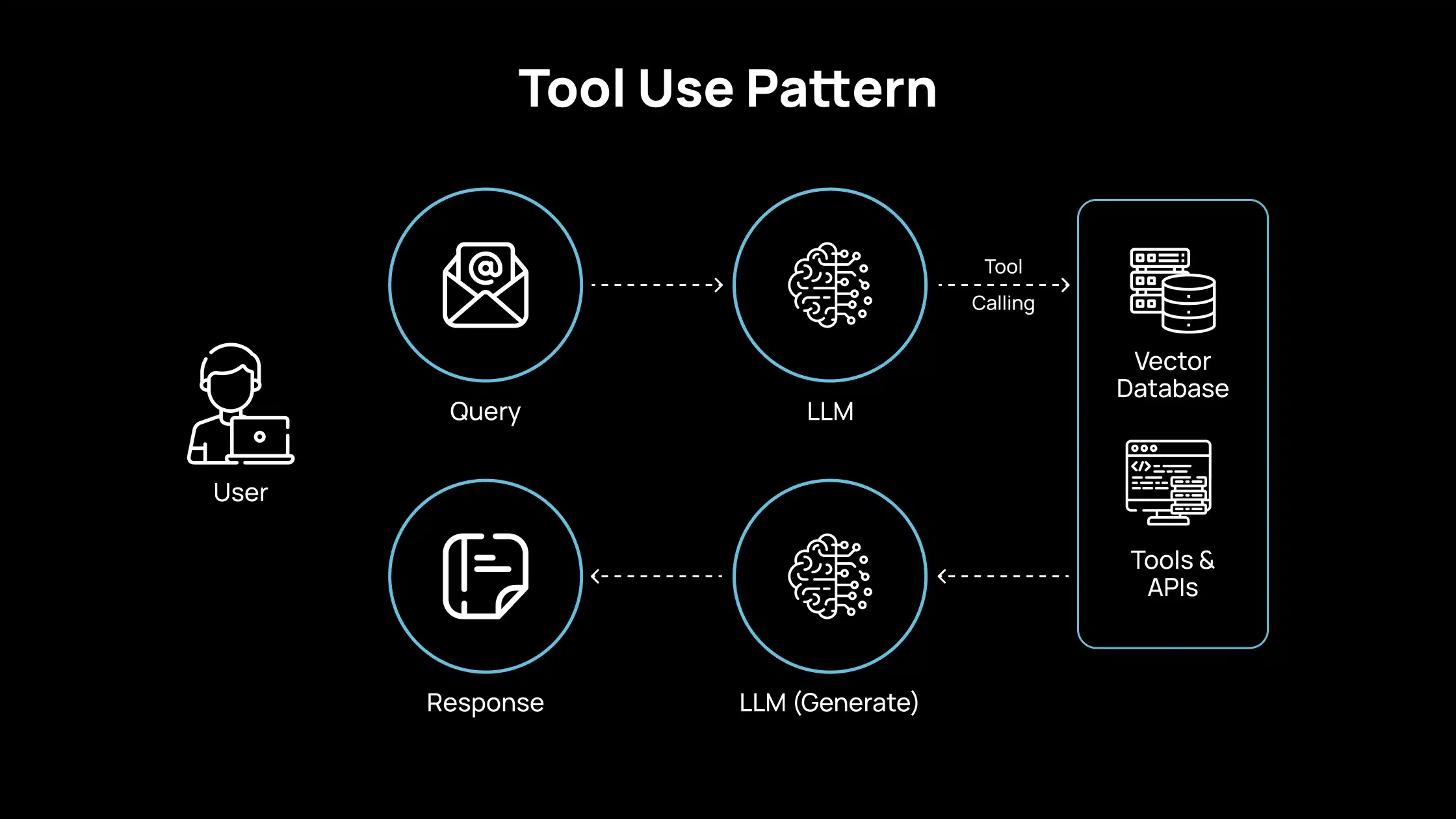
The Tool Use Pattern allows agents to interact with external systems such as APIs, databases, search engines, or calculators. The agent determines when external information or action is required and invokes the appropriate tool during its reasoning process.
Language models alone are limited to the data used for their training. Tool use extends agent capabilities into the real world, enabling systems to retrieve live data, perform actions, and produce grounded results.
Where it is used
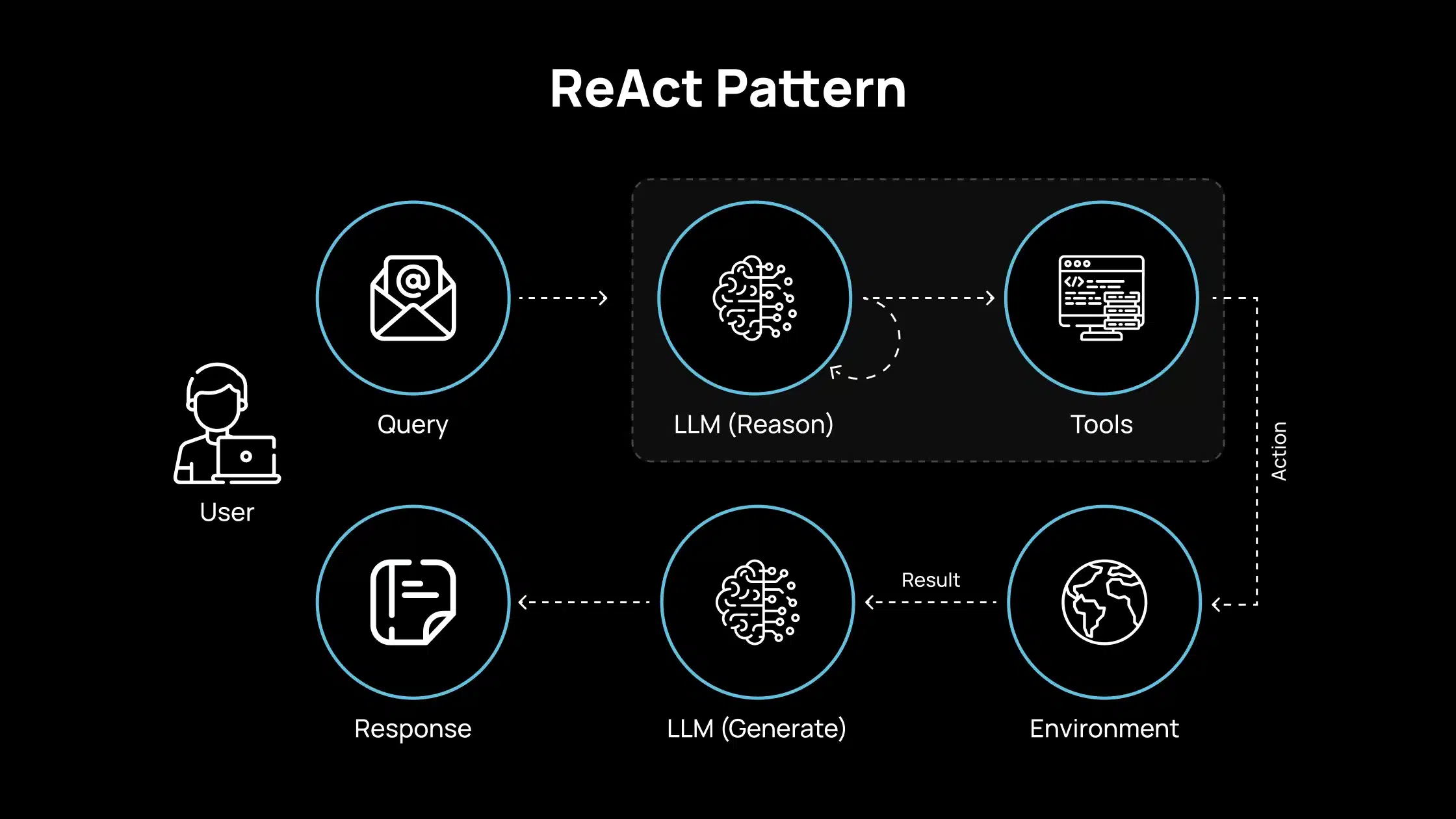
The ReAct Pattern combines reasoning and action in a single loop, allowing agents to think through a problem while actively interacting with tools. The agent alternates between reasoning steps and tool execution. Each action informs the next reasoning step, enabling dynamic decision-making.
This pattern allows agents to adapt in real time as new information becomes available. It is especially effective for tasks that cannot be fully planned.
Where it is used
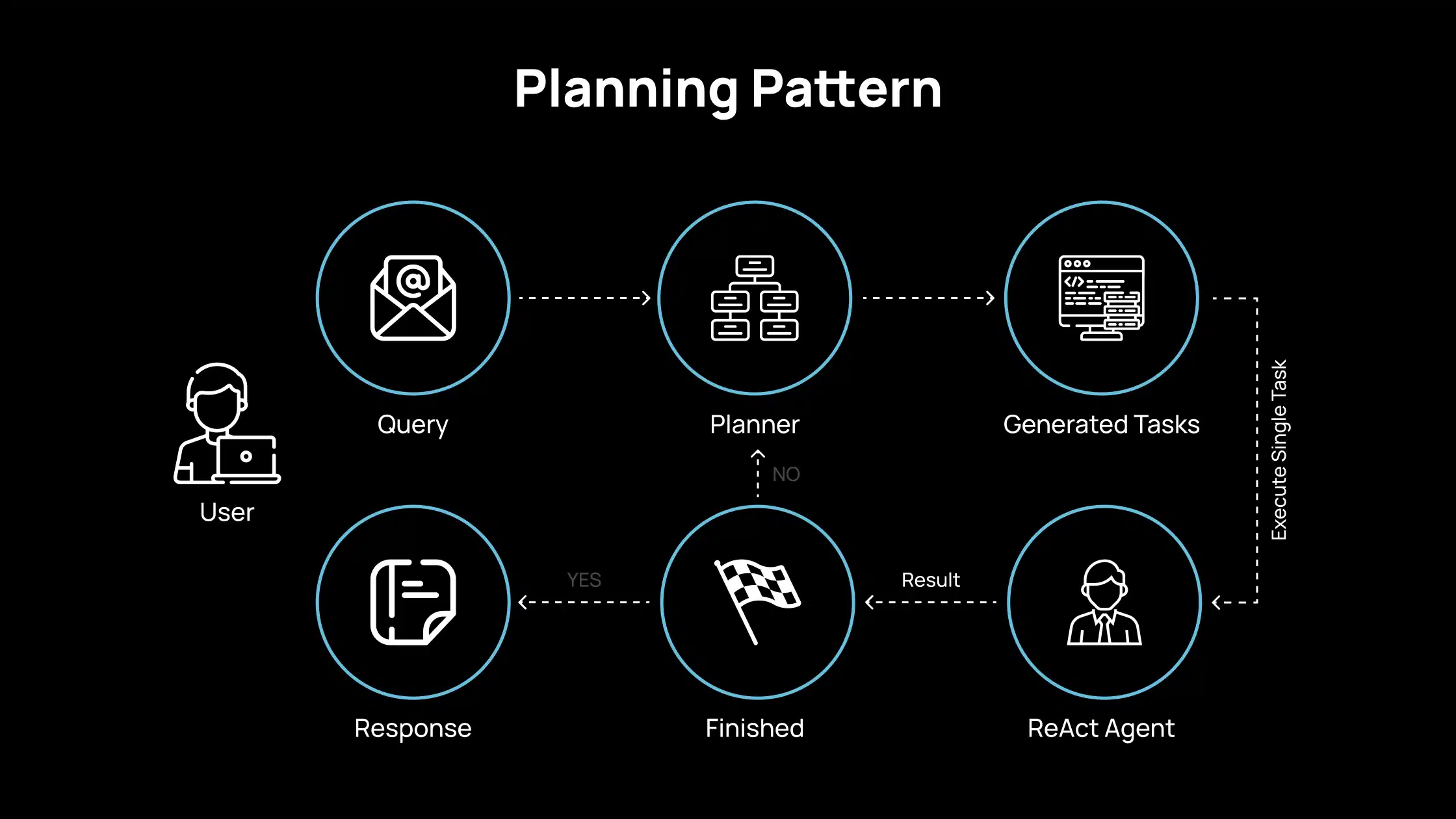
The Planning Pattern introduces a dedicated step in which agents break complex goals into smaller, ordered subtasks. A planner component defines the task sequence, while execution components carry out each step in order. Progress is tracked throughout the workflow.
This pattern brings structure to long-running or multi-step processes. It improves reliability, reduces missed steps, and makes agent behavior easier to understand and audit.
Where it is used
The Multi-Agent Collaboration Pattern involves multiple specialized agents working together toward a shared objective. Each agent is assigned a specific role, such as planning, execution, review, or validation. Agents communicate and coordinate to complete the task.
This pattern mirrors how human teams operate. By distributing responsibilities, systems become more robust, scalable, and easier to maintain.
Where it is used
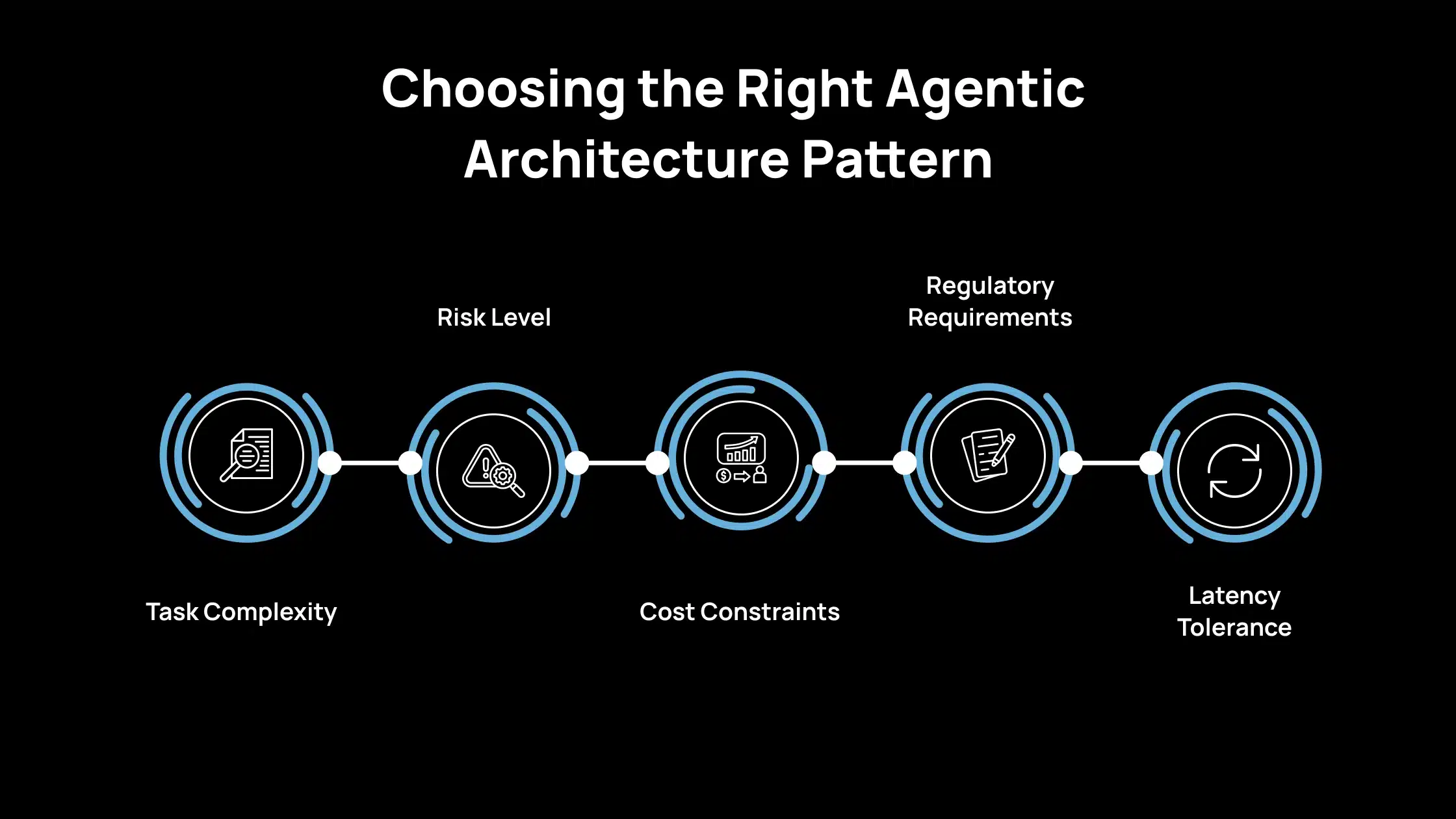
There is no single “best” agentic architecture pattern. The right choice depends on what the system needs to achieve, the risks involved, and the constraints under which it must operate.
This section provides a practical framework for teams to evaluate and select agentic architecture patterns suitable for production use.
Start by assessing how complex the task is.
As task complexity increases, separating planning, execution, and evaluation becomes essential.
Risk refers to the potential impact of incorrect or unsafe agent behavior.
Higher risk favors architectures with guardrails, approval flows, and hierarchical or supervisor-based patterns.
Agentic systems can generate unpredictable costs if not designed carefully.
Cost-sensitive systems benefit from explicit limits on retries, execution depth, and concurrency.
Regulated environments impose additional constraints on system behavior.
In these cases, patterns that support observability, traceability, and human-in-the-loop control are essential.
Latency requirements influence architectural design.
Balancing responsiveness with reliability is a key architectural trade-off.
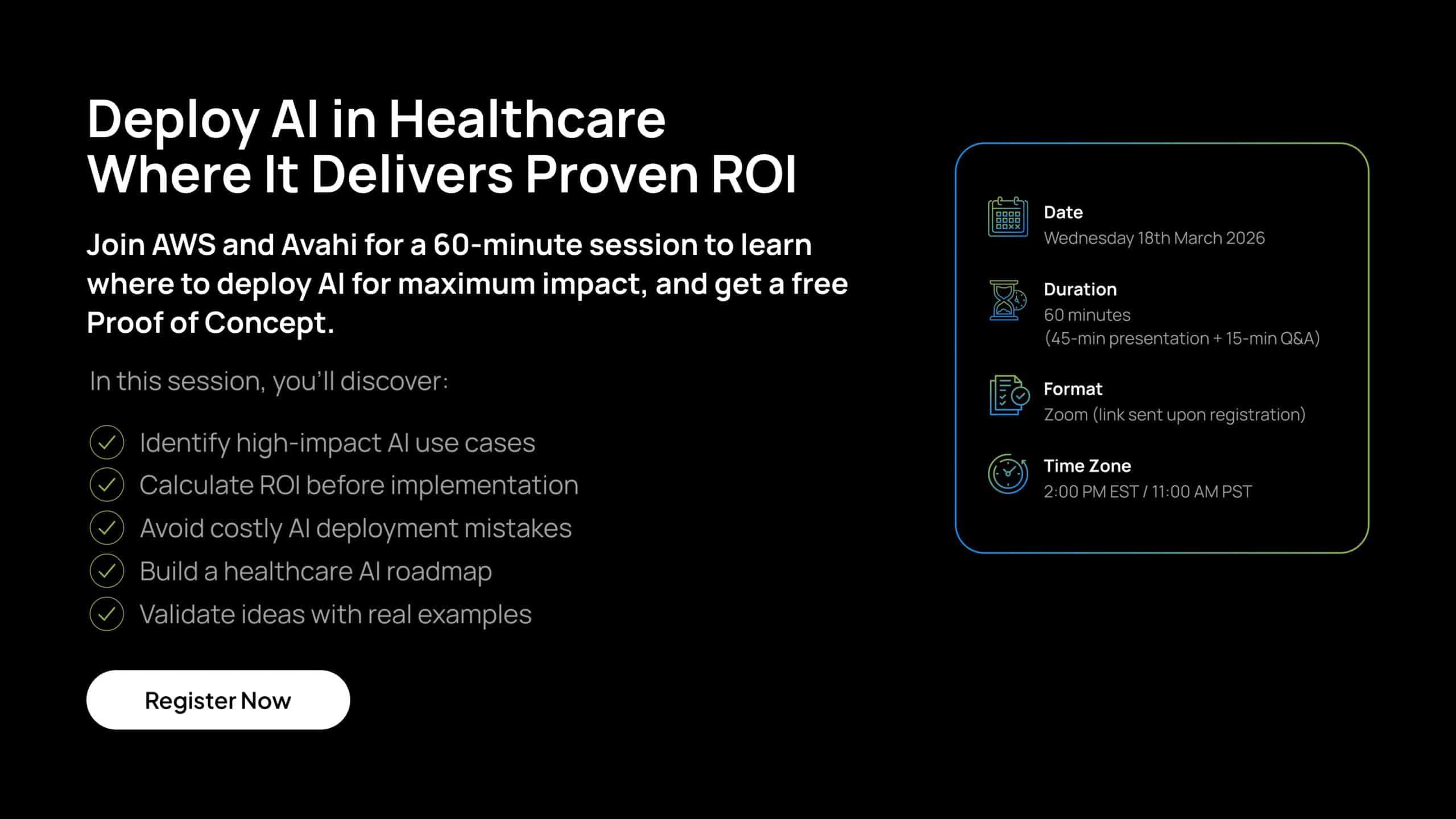
If your goal is to apply AI in practical ways that deliver measurable business impact, Avahi offers solutions designed specifically for real-world challenges. Avahi enables organizations to quickly and securely adopt advanced AI capabilities, supported by a strong cloud foundation and deep AWS expertise.
Avahi AI solutions deliver business benefits such as:
By partnering with Avahi, organizations gain access to a team with extensive AI and cloud experience committed to delivering tailored solutions. The focus remains on measurable outcomes, from automation that saves time and reduces costs to analytics that improve strategic decision-making to AI-driven interactions that elevate the customer experience.
At Avahi, we empower businesses to deploy advanced Generative AI that streamlines operations, enhances decision-making, and accelerates innovation, all with zero complexity.
As your trusted AWS Cloud Consulting Partner, we empower organizations to harness the full potential of AI while ensuring security, scalability, and compliance with industry-leading cloud solutions.
Our AI Solutions Include
Want to unlock the power of AI with enterprise-grade security and efficiency?
Start Your AI Transformation with Avahi Today!
Because architecture determines whether agentic AI delivers value or creates risk. Without clear patterns, autonomous systems become unpredictable, expensive, and difficult to govern, making them unsuitable for enterprise deployment.
They enable organizations to scale automation safely, control operational costs, reduce errors, and ensure consistent outcomes across complex workflows. This makes agentic AI viable beyond pilots and experiments.
Yes, but only when designed with the right architecture patterns. Guardrails, observability, and deterministic components are essential to meet compliance, auditability, and risk management requirements.
Well-defined patterns prevent excessive model usage, reduce rework, and limit uncontrolled agent behavior. This directly improves cost predictability and increases the return on AI investments.
Treating agentic AI as a model or prompt problem instead of an architecture problem. Successful organizations focus on system design first, ensuring agents operate within clear boundaries and measurable outcomes.