TL;DR
|




Thais Rebequi
Published February 20, 2026

Most AI systems today can generate answers, but they still depend on you to decide what to do next. That limitation is becoming a challenge.
According to industry research, more than 74% of enterprise AI initiatives fail to deliver long-term value, not because models are inaccurate, but because they cannot operate independently within real workflows.
To bridge this gap, organizations are launching an AWS proof of concept to safely test how these models execute multi-step tasks under live operational conditions. This approach ensures the system can handle autonomous decisions, not just simple insights.
Agentic AI represents a fundamental change in how AI systems are designed and used. Instead of responding to isolated prompts, these systems plan, act, evaluate results, and adapt over time. You define objectives and constraints, and the system takes responsibility for execution. This shift moves AI from a passive assistant to an active operational component.
The adoption curve reflects this change. Enterprise adoption of autonomous and semi-autonomous agents is accelerating as teams look to reduce operational overhead, increase execution speed, and scale decision-making across complex environments. Agentic systems are now being used to manage workflows, coordinate tools, optimize processes, and operate continuously with minimal supervision.
However, building agentic AI is not simply about adding autonomy. This blog breaks down the agentic AI fundamentals and design to give you a clear, practical understanding of what it takes to design agentic AI systems that work reliably in real-world conditions.
Agentic AI refers to AI systems that can act with intent to achieve defined goals rather than simply responding to inputs. When you work with an agentic system, you are not just receiving outputs; you are delegating objectives. The system decides how to proceed, which actions to take, and when to adjust its approach. Agency in AI systems means the system can:
The difference between AI tools and AI agents lies in control and responsibility. AI tools respond to direct prompts and produce isolated outputs. You guide every step. AI agents operate within a loop of thinking, acting, and learning. You define the objective; the agent manages execution.
Semi-autonomous agents require your approval at critical steps. You remain actively involved in decisions and execution. Autonomous agents operate independently within predefined boundaries. They plan, act, and adapt without human intervention, escalating only when constraints are violated or objectives change.
To understand what makes an AI system truly agentic, focus on these foundational characteristics:
Understanding this distinction helps you choose the right system for your use case. The table below summarizes the differences clearly:
| Aspect | Conventional AI Systems | Agentic AI Systems |
| Core behavior | Reacts to inputs and stops after producing an output | Proactively decides next actions based on goals |
| Interaction model | Prompt–response-based | Continuous decision and execution loop |
| Task execution | Completes a single task per prompt | Executes multi-step tasks until the goal is achieved |
| Reasoning flow | One-time reasoning per input | Ongoing reasoning, action, observation, and adjustment |
| Output type | Static responses (text, predictions, classifications) | Dynamic execution (actions, workflows, system interactions) |
| Use of tools | Limited or manually triggered | Autonomous tool selection and execution |
| Memory and context | Minimal or session-bound | Persistent memory across tasks and interactions |
| Human involvement | Required at every step | Required mainly for goal definition and oversight |
| System responsibility | Provides information | Takes responsibility for outcomes |
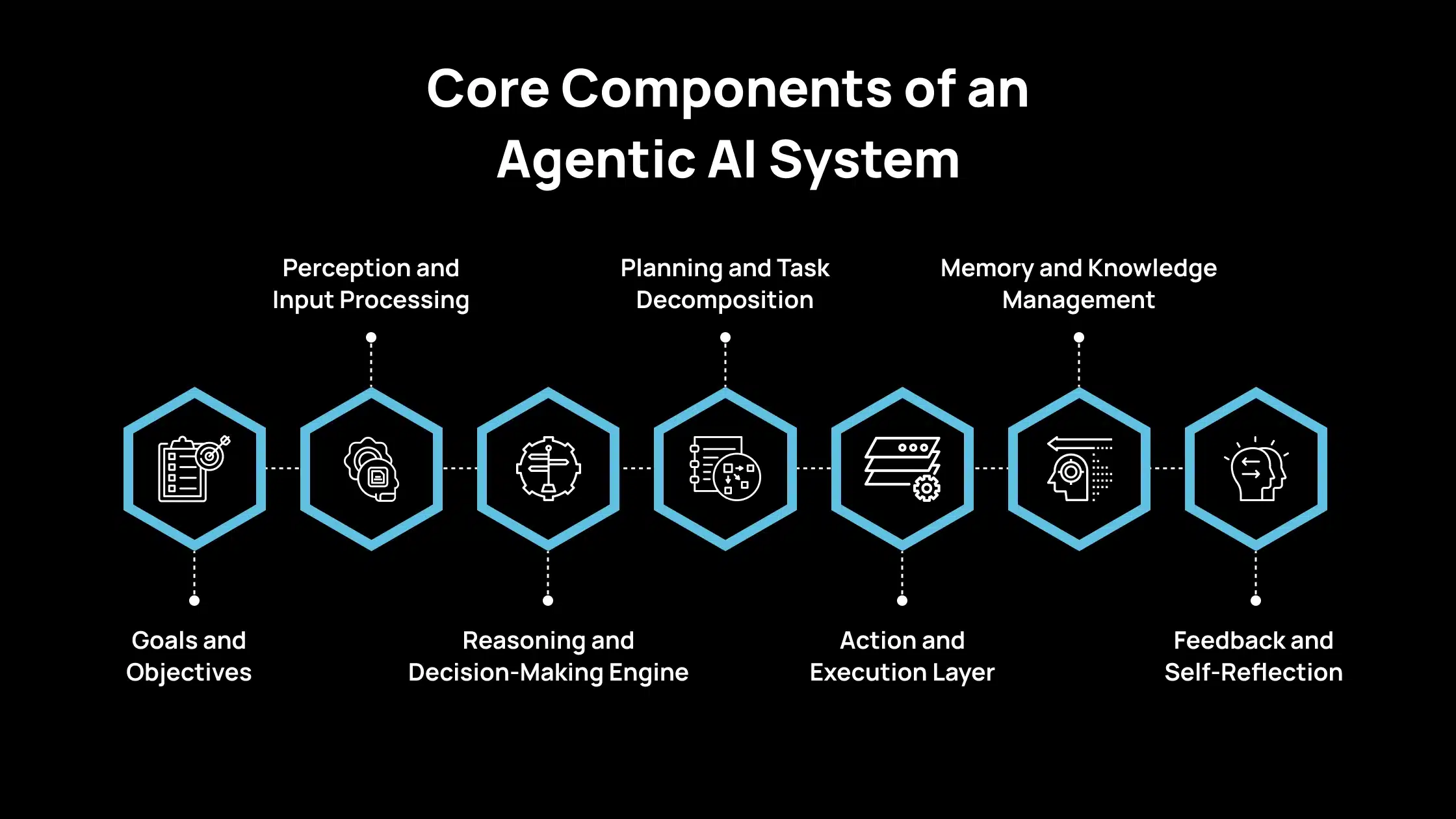
When you design or evaluate an agentic AI system, you need to understand the components that allow it to operate independently, reliably, and safely. Each component serves a distinct purpose, and together they enable the agent to move from intent to execution without constant supervision.
Goals define why the agent acts. If goals are unclear or poorly structured, the system will produce inconsistent or misaligned outcomes.
You start by defining clear objectives and constraints. Goals must be specific, measurable, and bounded to prevent unintended behavior. Prioritization ensures the agent knows which objective to pursue when multiple tasks compete for resources.
Short-term goals guide immediate actions, such as completing a task or retrieving information. Long-term goals provide direction over time, such as optimizing performance, reducing cost, or improving accuracy. The agent balances both to avoid short-sighted decisions.
You define high-level goals and constraints. The agent may generate sub-goals autonomously to support execution. These system-generated goals must remain aligned with the original intent you set.
Perception allows the agent to understand its environment before acting. You enable the agent to receive input from APIs, internal tools, databases, sensors, or direct user interaction. Reliable input pipelines are essential for accurate decision-making.
The agent must interpret inputs within context. This includes understanding the current state, prior actions, and external conditions that affect outcomes.
You design the system to operate even when data is missing or ambiguous. The agent uses probabilistic reasoning, fallback strategies, or requests clarification when confidence is low.
This component determines what the agent should do next. LLMs act as the core reasoning engine. They interpret goals, analyze context, and propose actions based on learned patterns and logic.
The agent reasons through problems step by step. This structured thinking improves decision quality and reduces errors in complex tasks. You define which tools the agent can use and when. The agent evaluates available tools and selects the most appropriate one based on the task and constraints.
Rules, thresholds, and policies guide decision-making. These constraints prevent unsafe actions and ensure alignment with business or system requirements.
Planning connects high-level intent to concrete execution. The agent decomposes complex objectives into smaller, executable tasks. Each step is evaluated for feasibility and impact.
Some tasks must occur in order, while others can run simultaneously. The agent determines the most efficient execution strategy based on dependencies and resource availability.
When conditions change or actions fail, the agent revises its plan. This adaptability is critical for real-world environments where outcomes are unpredictable.
This layer allows the agent to act beyond text generation. The agent interacts with APIs, databases, scripts, and applications to perform tasks. You control access and permissions to reduce risk.
The agent integrates with existing workflows, services, and platforms. This enables automation across multiple systems without manual intervention. Before execution, actions are validated against rules and constraints. This step prevents invalid, redundant, or harmful operations.
Memory ensures continuity and learning over time. The agent retains recent context, current tasks, and intermediate results. This allows it to operate coherently within a session.
You store persistent knowledge using vector databases or knowledge graphs. This enables recall of past decisions, user preferences, and historical outcomes.
The agent uses stored experiences to improve future decisions. This reduces repetition of mistakes and increases efficiency. The agent retrieves verified information from trusted sources before generating responses or actions. This improves accuracy and reliability.
Feedback enables continuous improvement. You track whether actions achieve intended results. Metrics and logs provide visibility into agent behavior.
When outcomes deviate from expectations, the agent identifies errors and adjusts its approach rather than repeating failures. The agent refines strategies over time by learning from feedback. This closed-loop process is essential for maintaining performance in dynamic environments.
When you design an agentic AI system, its architecture determines how effectively it reasons, scales, and adapts. This section explains when to use different agent setups and how common design patterns support reliable execution.
A single-agent architecture uses one agent to handle the entire decision and execution process.
When a single agent is sufficient
You should use a single agent when tasks are well-defined, the scope is limited, and dependencies are minimal. This approach works best for focused workflows such as task automation, data retrieval, or guided decision-making.
| Strengths | Limitations |
| Simple to design, deploy, and maintain | Limited scalability for complex or parallel tasks |
| Lower computational and operational costs | Higher cognitive load on a single reasoning engine |
| Easier to monitor, debug, and control behavior | Reduced robustness when tasks require diverse expertise |
In multi-agent systems, responsibilities are distributed across specialized agents. Each agent focuses on a specific role, improving performance and reliability in complex environments.
Role-based agents
You assign agents distinct roles, such as:
This separation of responsibilities reduces errors and improves decision quality. Agents share context, results, and feedback through defined communication channels. Coordination mechanisms ensure agents work toward the same objective rather than duplicating or conflicting efforts.
Multi-agent systems are most effective when tasks are complex, long-running, or require multiple perspectives.
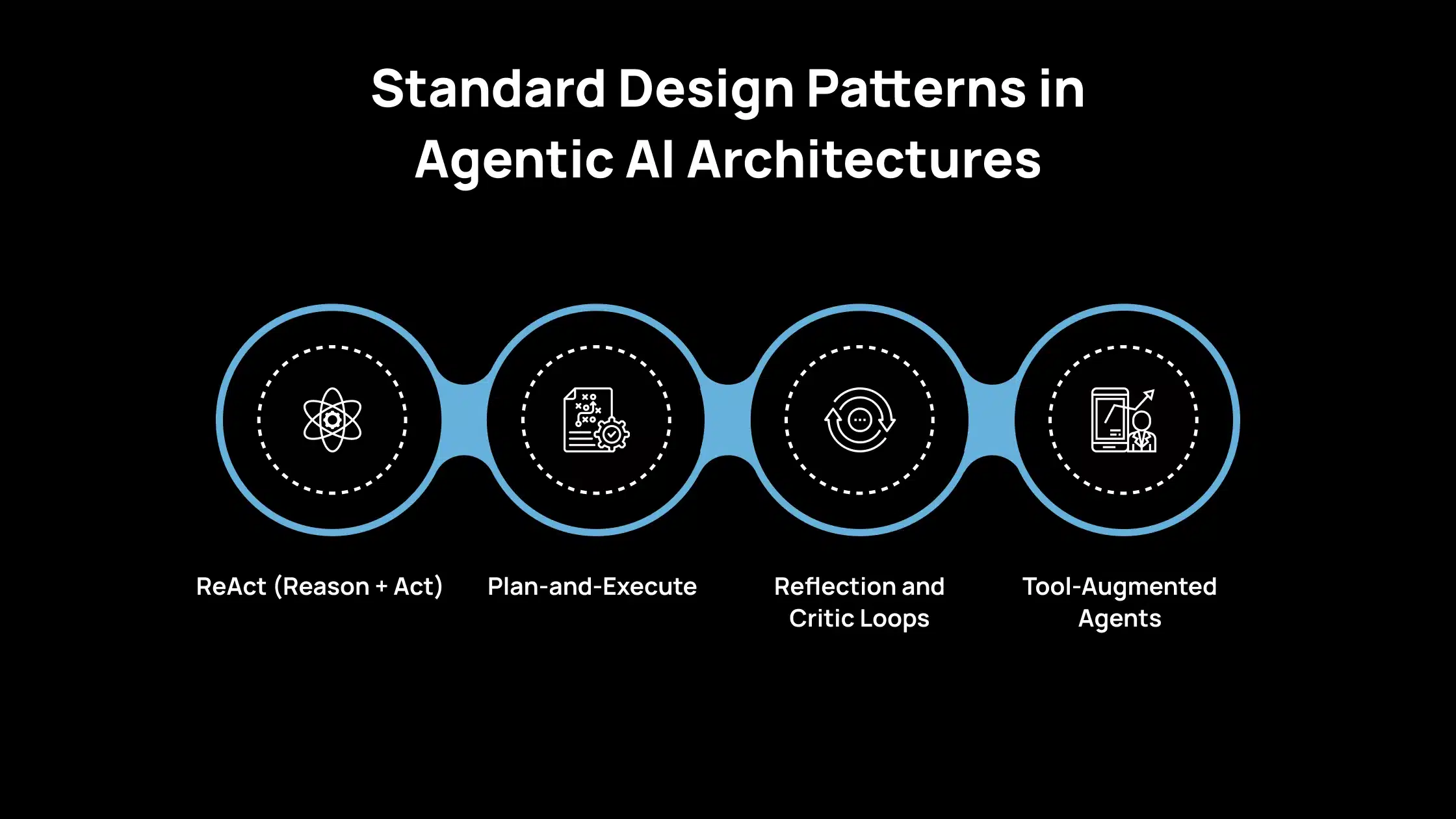
Design patterns provide reusable structures that guide how agents reason and act. You select patterns based on task complexity and risk tolerance.
You enable the agent to alternate between reasoning and action. The agent thinks through the problem, takes a step, observes the result, and repeats the cycle. This pattern works well for exploratory or tool-heavy tasks.
The agent first creates a complete plan before acting. It then executes each step in order, adjusting only when necessary. This pattern is effective when goals are clear and dependencies are known.
You add an evaluation phase where the agent reviews its own outputs. The agent identifies mistakes, improves reasoning, and refines results before final delivery. This reduces errors in high-stakes or complex tasks.
The agent extends its capabilities by using external tools. You define when and how tools are invoked, ensuring actions are efficient and constrained. This pattern is essential for real-world automation and system integration.
To deploy agentic AI responsibly, you must address safety and ethical considerations from the start. Control mechanisms ensure agents act within acceptable boundaries and remain aligned with human intent.
Alignment ensures the agent’s behavior matches your goals and values. You specify rules, constraints, and policies that govern what the agent can and cannot do. These guardrails define permissible actions, data usage, and escalation conditions.
You limit how goals evolve. Regular validation, bounded autonomy, and explicit constraints prevent the agent from optimizing for unintended outcomes.
Risk management addresses failures before they cause harm.Excessive independence can lead to actions that are misaligned with intent. You mitigate this by setting clear boundaries, approval thresholds, and fallback mechanisms.
You restrict access to sensitive data and enforce secure handling practices. Authentication, authorization, and encryption are essential for protecting information. You assess training data, decision logic, and outcomes for bias. Regular audits and fairness checks help ensure equitable and compliant behavior.
Monitoring provides visibility into how agents operate over time. You record inputs, reasoning steps, tool usage, and outcomes. Detailed logs enable debugging, accountability, and compliance review.
You ensure the agent can explain why actions were taken. Transparent reasoning builds trust and supports regulatory and internal review requirements.
If your goal is to apply AI in practical ways that deliver measurable business impact, Avahi offers solutions designed specifically for real-world challenges. Avahi enables organizations to quickly and securely adopt advanced AI capabilities, supported by a strong cloud foundation and deep AWS expertise.
Avahi AI solutions deliver business benefits such as:
By partnering with Avahi, organizations gain access to a team with extensive AI and cloud experience committed to delivering tailored solutions. The focus remains on measurable outcomes, from automation that saves time and reduces costs to analytics that improve strategic decision-making to AI-driven interactions that elevate the customer experience.
At Avahi, we empower businesses to deploy advanced Generative AI that streamlines operations, enhances decision-making, and accelerates innovation, all with zero complexity.
As your trusted AWS Cloud Consulting Partner, we empower organizations to harness the full potential of AI while ensuring security, scalability, and compliance with industry-leading cloud solutions.
Our AI Solutions Include
Want to unlock the power of AI with enterprise-grade security and efficiency?
Start Your AI Transformation with Avahi Today!
Agentic AI fundamentals refer to the core principles that enable AI systems to act with intent. These include goal definition, reasoning, planning, execution, memory, feedback loops, and safety controls that allow AI agents to operate autonomously within defined boundaries.
Single-agent architectures work best for focused, well-defined tasks with limited complexity. Multi-agent systems are better suited for complex workflows that require specialization, parallel execution, and collaboration. Choosing the right architecture is a key part of agentic AI system design.
Large language models act as the reasoning engine in agentic AI systems. They help interpret goals, analyze context, select tools, and guide decisions. However, agentic AI fundamentals go beyond LLMs and require planning, memory, and execution layers.
Memory enables agentic AI systems to retain context, learn from past interactions, and reduce the likelihood of repeating errors. Long-term memory and retrieval-augmented generation are critical agentic AI fundamentals for accuracy and reliability.
Yes, fully autonomous agentic AI systems can operate independently within predefined constraints. However, human-in-the-loop or human-on-the-loop models are often preferred for higher-risk or regulated environments.