




TL;DR
|
The biggest limitation in enterprise AI today is not intelligence; it is architecture.
Most organizations have already adopted AI. They use it for reporting, automation, analysis, and decision support. But as workflows become more complex, a single AI agent quickly becomes a bottleneck. It cannot continuously monitor systems, execute multiple workflows simultaneously, reliably validate outputs, or scale across enterprise environments without performance breakdowns.
This is not a model problem. It is a structural problem.
Enterprises operate in distributed, high-volume, and real-time environments. Your compliance systems must track thousands of controls. Your security infrastructure must monitor millions of events. Your operations teams must coordinate across dozens of tools and workflows. A single agent cannot efficiently manage this level of complexity.
This is why enterprises are rapidly shifting toward multi-agent AI systems.
Multi-agent systems solve this problem by distributing responsibilities across specialized agents. Each agent performs a focused role, planning, execution, monitoring, validation, or coordination, while working together toward a shared goal. Because coordinating these agents requires a highly scalable architecture, enterprise teams frequently validate their orchestration layers first via an AWS proof of concept.
This allows your systems to operate faster, more accurately, more scalably, and with greater resilience. This blog explains how multi-agent AI systems work, why single-agent systems fail at scale, and how enterprises use multi-agent architectures to automate complex operations.
What Is a Multi-Agent AI System?
A multi-agent AI system is an architecture composed of multiple autonomous AI agents that work together to achieve complex objectives. Instead of relying on a single monolithic AI model to handle every task, the system distributes responsibilities across several specialized agents.
Each agent has its own reasoning ability, goals, and operational logic, and they collaborate through structured communication and coordination. This mirrors how human teams operate in organizations.
For example, in a company, researchers gather information, planners design strategies, executors perform tasks, and reviewers ensure quality. Similarly, in a multi-agent AI system, different agents perform specific roles while sharing information and aligning toward a common goal.
Core Characteristics of Multi-Agent AI Systems
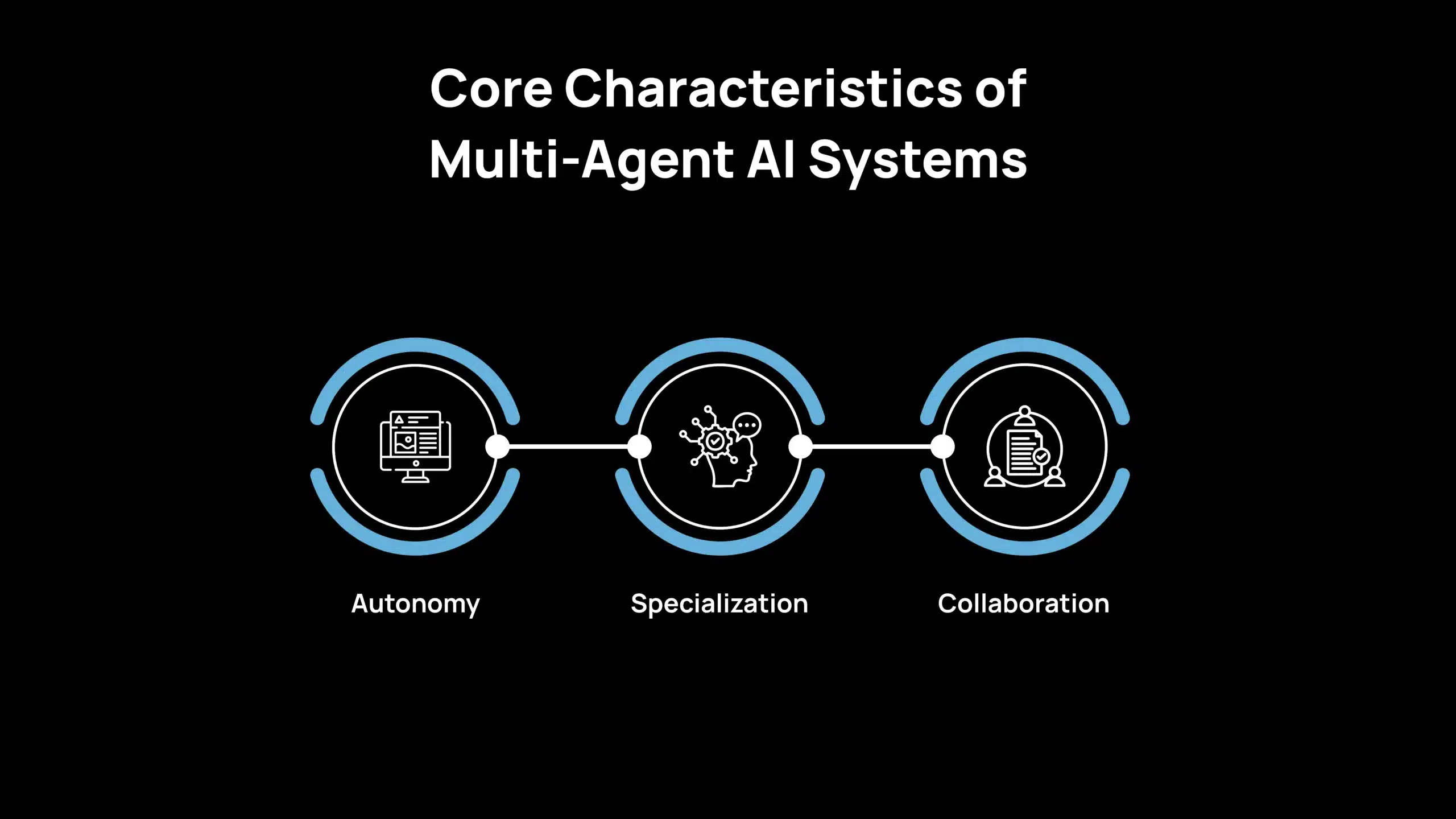
Here are the core characteristics that define how Multi-Agent AI Systems operate, collaborate, and scale effectively in enterprise environments.
1. Autonomy
Autonomy refers to each agent’s ability to operate independently without constant human supervision or centralized control. Each agent has its own internal logic, decision-making capabilities, and reasoning process, allowing it to evaluate situations and take appropriate actions. An autonomous agent can:
- Analyze inputs and contextual information
- Make decisions based on predefined policies, learned models, or goals.
- Execute tasks without external intervention.n
- Adapt its behavior based on feedback and outcomes.
For example, in an automated compliance system, one agent may continuously monitor system logs. If it detects unusual activity, it can independently flag the event, initiate an investigation, or notify other agents responsible for remediation.
2. Specialization
Specialization means that each agent is designed to perform a specific function or role within the system. Instead of a single general-purpose agent handling everything, responsibilities are divided among multiple agents with specialized expertise.
3. Collaboration
Collaboration is the ability of agents to work together by sharing information, coordinating actions, and aligning toward common goals. Agents communicate using structured messages, shared memory, or coordination protocols.
Why Single-Agent Systems Break Down in Complex Environments
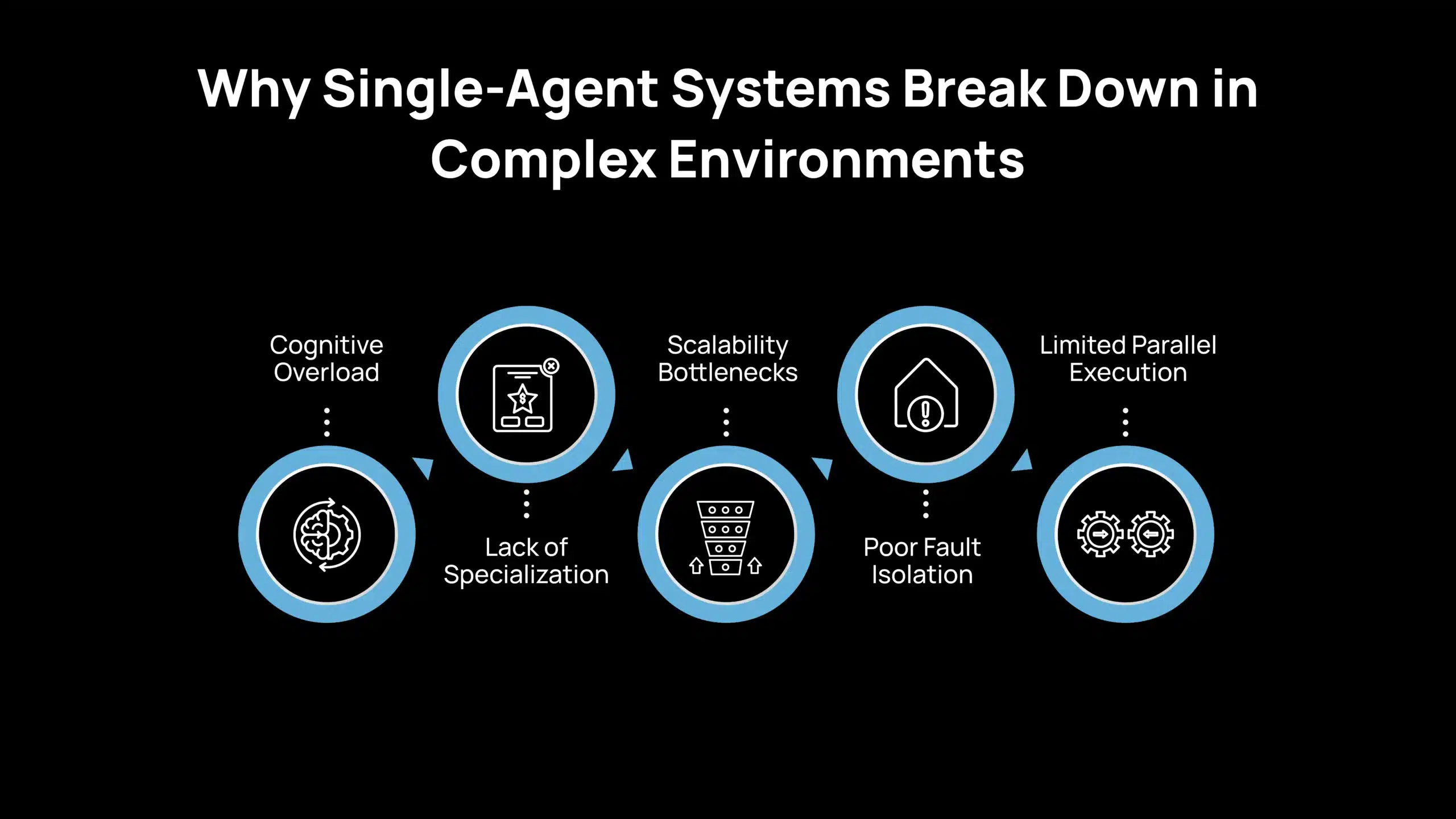
As your systems grow in complexity, relying on a single AI agent to manage everything becomes a structural limitation. The following limitations explain where single-agent systems break down.
1. Cognitive Overload
When you assign too many responsibilities to one agent, its reasoning capacity becomes overloaded. The agent must collect data, interpret context, make decisions, execute tasks, and validate outcomes simultaneously. This creates cognitive strain. As complexity increases, you will notice:
- Increased reasoning errors due to excessive task switching.
- Loss of context as the agent struggles to track multiple objectives.
- Decline in decision quality due to overloaded processing.
For example, if one compliance agent must collect evidence, validate controls, monitor systems, and generate reports, it will eventually miss gaps or produce inaccurate outputs. The agent cannot maintain consistent accuracy across all responsibilities.
2. Lack of Specialization
When you rely on a single agent, it must act as a generalist. It cannot develop deep expertise in every function. This leads to:
- Reduced accuracy in specialized tasks.
- Poor optimization because the agent uses generic strategies.
- Inefficient execution due to a lack of focused capability.
You can compare this to assigning one person to act as a developer, security analyst, auditor, and operations manager simultaneously. Each role requires different expertise. A generalist cannot perform all roles with the same level of precision and efficiency as specialists.
3. Scalability Bottlenecks
As your environment grows, the workload increases. A single agent becomes a bottleneck because it can only process a limited number of tasks at a time. You will encounter challenges such as:
- Slower performance when handling large datasets.
- Increased latency in decision-making and execution.
- Inability to manage multiple systems simultaneously.
- Delays in completing concurrent workflows.
This limits your ability to scale automation. The agent becomes a central constraint that slows down the entire system.
4. Poor Fault Isolation
When your system depends on one agent, it creates a single point of failure. If the agent fails, stalls, or produces incorrect outputs, the entire system is affected. This results in:
- Complete workflow interruption.
- No redundancy or backup support.
- Increased operational risk.
- Longer recovery times.
You cannot isolate failures because all responsibilities are concentrated in one component.
5. Limited Parallel Execution
A single agent executes tasks sequentially. It must finish one task before starting another. This limits efficiency in environments where multiple operations must run simultaneously. As a result, you will experience:
- Slower task completion.
- Reduced operational efficiency.
- Delays in monitoring, execution, and validation.
You cannot achieve true parallel execution with a single agent.
Core Components of Multi-Agent AI Architecture
When you implement a multi-agent AI system, you must structure it with clearly defined components. The following components form the foundation of a multi-agent AI architecture.
1. Planner Agent
The Planner Agent is responsible for translating your high-level goals into structured, executable tasks. It acts as the strategic decision-maker that determines how objectives should be achieved.
Its core responsibilities include:
- Breaking complex goals into smaller, manageable tasks.
- Creating step-by-step execution plans.
- Determining task dependencies and priorities.
- Assigning tasks to the appropriate executor agents.
For example, if your goal is to assess compliance readiness, the Planner Agent will divide the objective into tasks such as collecting evidence, validating controls, identifying gaps, and generating reports. It ensures that each task is assigned to the right agent in the correct order.
This component ensures your system operates with clear direction and structured execution.
2. Executor Agents
Executor Agents are responsible for performing the actual work. They carry out tasks assigned by the Planner Agent and interact directly with systems, tools, and external environments. Their core responsibilities include:
- Executing specific assigned tasks.
- Interacting with APIs, databases, and enterprise systems.
- Collecting, processing, or modifying data.
- Performing automated actions based on defined instructions.
Common examples include:
- Evidence Collection Agent: Retrieves compliance evidence from systems and databases
- Monitoring Agent: Tracks system activity, logs, and security events
- Remediation Agent: Fixes detected issues by updating configurations or triggering corrective actions
Executor Agents ensure that your system can perform operational tasks efficiently and at scale.
3. Observer or Monitoring Agent
The Observer Agent continuously monitors the system and tracks agent activity. It ensures that all agents operate correctly and that workflows proceed as expected. Its core responsibilities include:
- Tracking the performance of other agents.
- Monitoring task execution and progress.
- Detecting failures, delays, or abnormal behavior.
- Providing real-time feedback to the system.
If an execution agent fails or produces unexpected results, the Observer Agent detects the issue and alerts the appropriate agents for corrective action. This component ensures system visibility, reliability, and operational awareness.
4. Validator Agent
The Validator Agent ensures the accuracy, correctness, and reliability of outputs generated by other agents. It acts as a quality control layer that prevents errors and incorrect conclusions. Its core responsibilities include:
- Verifying outputs against defined requirements.
- Preventing hallucinations and incorrect reasoning.
- Ensuring compliance with policies and standards.
- Confirming task completion accuracy.
For example, if an Executor Agent generates a compliance report, the Validator Agent verifies the evidence, confirms completeness, and ensures accuracy before final delivery. This component protects your system from incorrect outputs and maintains trust in automated decisions.
5. Coordinator or Orchestrator Agent
The Coordinator Agent manages communication and coordination between all agents. It ensures that agents work together efficiently and that workflows remain aligned with your goals. Its core responsibilities include:
- Managing communication between agents
- Ensuring tasks are executed in the correct sequence
- Maintaining workflow consistency
- Resolving conflicts or execution gaps
- Ensuring overall goal completion
The Coordinator Agent ensures that your system operates as a unified, synchronized architecture rather than disconnected components.
The Main Architecture Types That Power Multi-Agent Systems
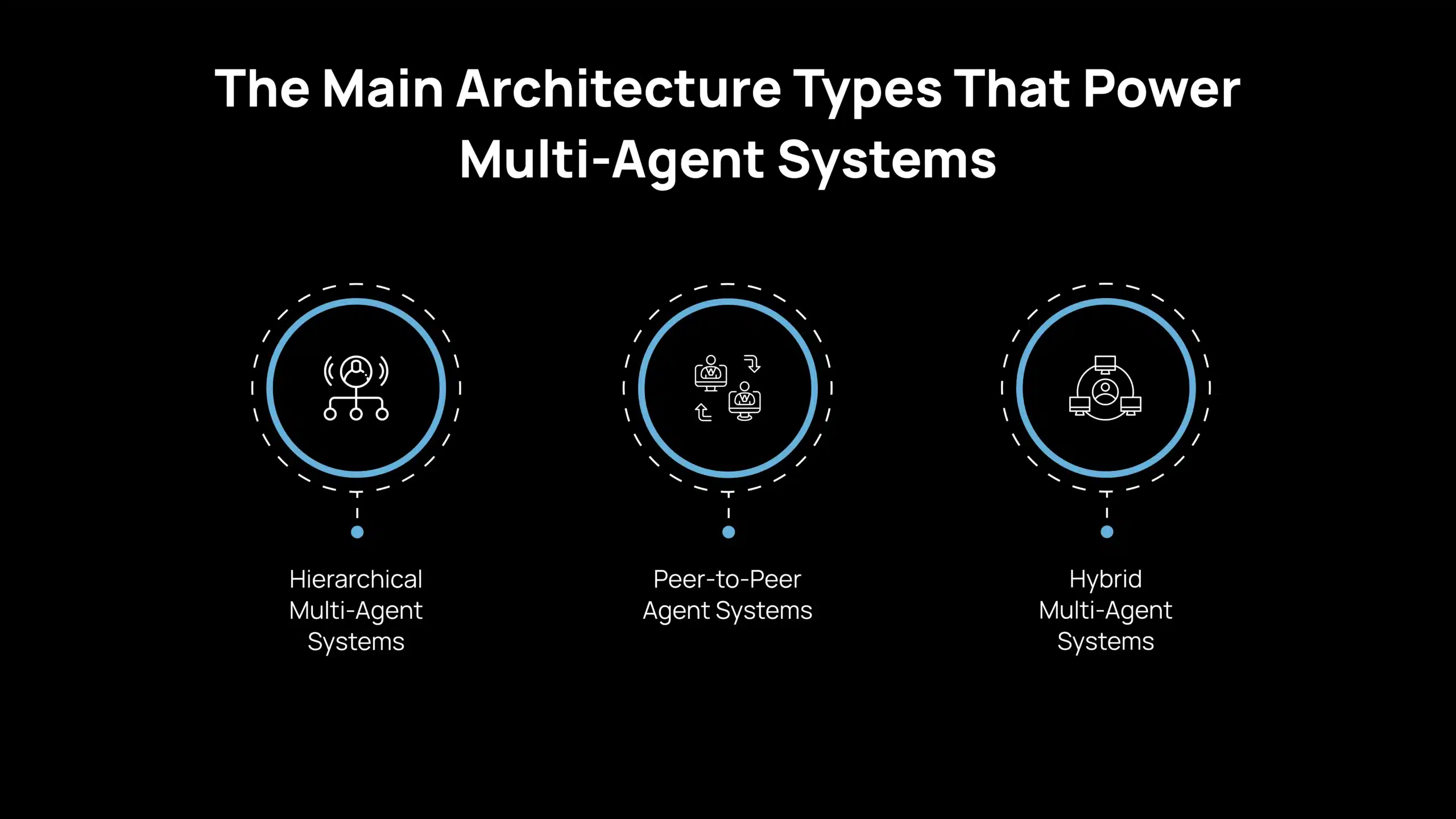
When you design a multi-agent system, you must choose an architecture that aligns with your operational needs, control requirements, and scalability goals. The following are the most common multi-agent architecture patterns.
1. Hierarchical Multi-Agent Systems
In a hierarchical architecture, you structure agents in a clear chain of command. A central leader agent manages planning and coordination, while worker agents execute assigned tasks. Structure:
- A leader or coordinator agent defines goals and assigns tasks.
- Worker agents execute tasks based on instructions.s
- Validator and monitoring agents provide feedback and verification.
- Communication flows from top to bottom and back through reporting.
This architecture is widely used in enterprise workflow automation, compliance systems, security operations, and IT infrastructure management. It is ideal when you need centralized control, clear task assignment, and consistent, predictable execution across multiple agents and workflows.
2. Peer-to-Peer Agent Systems
In a peer-to-peer architecture, agents operate as equals. There is no central controller. Agents communicate directly with one another and collectively coordinate decisions.
Structure:
- Agents share information directly with other agents.
- No single agent controls the entire system.
- Decisions emerge through collaboration.n
- Agents operate independently while contributing to shared goals.
This architecture is commonly used in distributed intelligence systems, swarm intelligence environments, autonomous robotics, and large-scale monitoring networks. It is ideal when you need high flexibility, strong resilience, and decentralized decision-making across independent agents.
3. Hybrid Multi-Agent Systems
A hybrid architecture combines centralized coordination with decentralized execution. You use a coordinator agent for high-level planning while allowing agents to operate independently when needed.
Structure:
- A central planner or coordinator manages the overall goal.ls
- Executor agents operate autonomously within defined boundaries. i
- Agents collaborate directly when required.
- Decision-making is shared between central and distributed agents.
This architecture is widely used in enterprise AI automation, compliance and audit systems, cloud infrastructure management, and agentic AI orchestration platforms. It is the most common enterprise architecture because it balances centralized control with scalability, flexibility, and operational resilience.
Real-World Use Cases of Multi-Agent Systems
The following examples show how multi-agent systems operate in real-world enterprise scenarios.
1. Compliance Automation
When you automate compliance processes, multi-agent systems handle the entire audit readiness lifecycle. Evidence collection agents continuously gather data from your infrastructure, applications, and access control systems.
Validator agents verify whether controls meet regulatory requirements such as SOC 2, ISO 27001, or HIPAA. Reporting agents then generate structured compliance reports with verified evidence and readiness status.
This allows you to maintain continuous audit readiness without relying on manual evidence collection or periodic assessments. Your compliance process becomes faster, more accurate, and scalable across multiple systems and regulatory frameworks.
2. Cybersecurity Operations
In cybersecurity environments, multi-agent systems help you detect, analyze, and respond to threats in real time. Monitoring agents continuously scan logs, network traffic, and system activity to identify anomalies.
Threat detection agents analyze suspicious behavior and determine potential risks. Incident response agents can automatically isolate affected systems, trigger alerts, or initiate remediation actions.
This allows you to reduce response time, prevent threat escalation, and maintain continuous security monitoring without depending entirely on manual intervention.
3. Customer Support Automation
Multi-agent systems improve your customer support operations by automating query handling and resolution workflows. Query resolution agents analyze customer requests and provide accurate responses using knowledge bases and historical data.
Escalation agents identify complex issues and route them to human support teams when necessary. Knowledge retrieval agents continuously update and retrieve relevant information to improve response quality.
This allows you to handle high volumes of customer requests efficiently while maintaining response accuracy and reducing support workload.
4. Software Development Automation
In software development environments, multi-agent systems accelerate development and improve code quality. Code-generation agents generate functional code based on defined requirements.
Testing agents automatically validate functionality, detect errors, and ensure reliability. Debugging agents identify issues, analyze root causes, and suggest or implement fixes.
This allows you to accelerate development cycles, reduce manual testing effort, and maintain higher software quality with continuous validation.
5. Autonomous Business Operations (Agentic Enterprise)
In modern enterprise operations, multi-agent systems automate critical business functions across finance, operations, and vendor management.
Finance agents monitor transactions, generate financial reports, and support revenue forecasting. Revenue intelligence agents analyze sales data and predict future performance. Vendor management agents track vendor performance, monitor contracts, and ensure operational compliance.
How Avahi Helps You Turn AI Into Real Business Results?
If your goal is to apply AI in practical ways that deliver measurable business impact, Avahi offers solutions designed specifically for real-world challenges. Avahi enables organizations to quickly and securely adopt advanced AI capabilities, supported by a strong cloud foundation and deep AWS expertise.
Avahi AI solutions deliver business benefits such as:
- Round-the-Clock Customer Engagement
- Automated Lead Capture and Call Management
- Faster Content Creation
- Quick Conversion of Documents Into Usable Data
- Smarter Planning Through Predictive Insights
- Deeper Understanding of Visual Content
- Effortless Data Access Through Natural Language Queries
- Built-In Data Protection and Regulatory Compliance
- Seamless Global Communication Through Advanced Translation and Localization
By partnering with Avahi, organizations gain access to a team with extensive AI and cloud experience committed to delivering tailored solutions. The focus remains on measurable outcomes, from automation that saves time and reduces costs to analytics that improve strategic decision-making to AI-driven interactions that elevate the customer experience.
Discover Avahi’s AI Platform in Action
At Avahi, we empower businesses to deploy advanced Generative AI that streamlines operations, enhances decision-making, and accelerates innovation, all with zero complexity.
As your trusted AWS Cloud Consulting Partner, we empower organizations to harness the full potential of AI while ensuring security, scalability, and compliance with industry-leading cloud solutions.
Our AI Solutions Include
- AI Adoption & Integration – Leverage Amazon Bedrock and GenAI to Enhance Automation and Decision-Making.
- Custom AI Development – Build intelligent applications tailored to your business needs.
- AI Model Optimization – Seamlessly switch between AI models with automated cost, accuracy, and performance comparisons.
- AI Automation – Automate repetitive tasks and free up time for strategic growth.
- Advanced Security & AI Governance – Ensure compliance, detect fraud, and deploy secure models.
Want to unlock the power of AI with enterprise-grade security and efficiency?
Start Your AI Transformation with Avahi Today!
Frequently Asked Questions
1. Why is one AI agent not enough for enterprise automation?
One AI agent cannot manage complex workflows, multiple systems, and continuous monitoring at scale. Multi-Agent AI Systems distribute tasks across specialized agents, improving scalability, accuracy, and reliability.
2. How do Multi-Agent AI Systems work in real enterprise environments?
Multi-Agent AI Systems break your goal into tasks. Planner agents create execution plans, executor agents perform tasks, validator agents verify outputs, and monitoring agents ensure everything runs correctly.
3. What problems do Multi-Agent AI Systems solve that single agents cannot?
Multi-Agent AI Systems solve scalability bottlenecks, reduce reasoning errors, enable parallel execution, improve fault tolerance, and ensure continuous monitoring across distributed enterprise systems.
4. Are Multi-Agent AI Systems more accurate and reliable?
Yes. Multi-Agent AI Systems use specialized agents for validation, monitoring, and execution. This reduces hallucinations, improves decision accuracy, and ensures reliable automation outcomes.
5. Do enterprises already use Multi-Agent AI Systems?
Yes. Enterprises use Multi-Agent AI Systems for compliance automation, cybersecurity monitoring, customer support automation, software development, and autonomous business operations to improve efficiency and scalability.