




TL;DR
|
The future of work is no longer about tools that help you think; it’s about systems that think and act for you. This is not just a vision, it’s happening right now.
Across industries, artificial intelligence is no longer confined to answering questions or generating content on demand. Businesses are moving toward a new category of AI that continuously observes data, makes independent decisions, and executes complex tasks without constant human oversight. This shift, from passive assistance to autonomous action, is what we call agentic AI.
AI adoption has reached a tipping point across the corporate world. Recent research shows that 78% of organizations now use AI in at least one business function, up sharply from just a year earlier, demonstrating how rapidly companies are embedding AI into core processes rather than treating it as an experiment.
At the same time, companies that strategically integrate AI are achieving measurable outcomes. Some large enterprises report double-digit productivity improvements and deeper operational efficiency when AI is applied beyond simple tasks to decisions and workflows.
Agentic AI promises to accelerate this transformation by turning data into action, enabling systems that learn, adapt, and operate independently. To transition safely to this new architectural model, many enterprises initiate an AWS proof of concept to test independent data loops within a secure environment.
In this blog, you will see how this new form of AI is reshaping engineering design, operations, security, business processes, and more, delivering speed, insight, and consistency that traditional automation cannot achieve.
How Agentic AI Is Reshaping Modern Workflows?
Most organizations use AI today as a support layer; it answers questions, generates content, and summarizes information.
Agentic AI goes much further. Agentic AI systems are built to observe, decide, and act autonomously. They continuously process live data, apply reasoning, and execute tasks without waiting for constant human input. By combining learning models, memory, and contextual awareness, these systems move beyond assistance and become active participants in how your operations run.
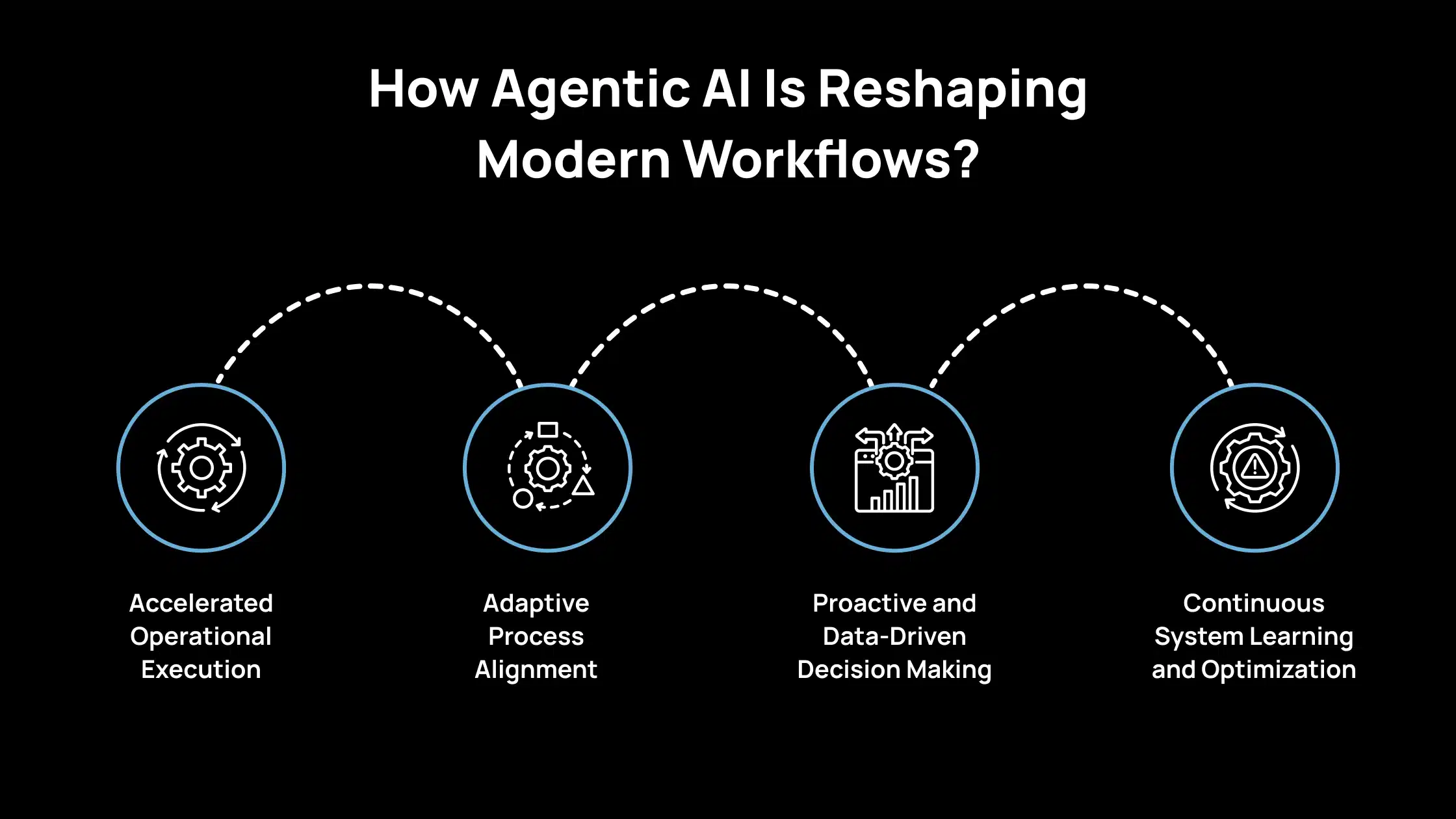
This marks a fundamental shift in how work gets done. Instead of managing every step manually, you delegate entire decision-making and execution flows to intelligent systems that operate alongside your teams. Here is how your workflow changes with Agentic AI:
Accelerated Operational Execution
Routine tasks such as organizing communications, pulling reports, tracking metrics, and managing schedules are handled automatically. Your team gains time to focus on strategic work that drives business outcomes.
Adaptive Process Alignment
Your AI learns your priorities, working style, and decision patterns. Over time, it adjusts workflows to match how your organization actually operates instead of forcing rigid procedures.
Proactive and Data-Driven Decision Making
Instead of waiting for reviews or reports, you detect changes as they happen. Live data analysis allows you to spot trends, anticipate risks, and respond while opportunities are still open.
Continuous System Learning and Optimization
Information flows across departments, tasks are automatically assigned, and priorities remain visible. This reduces miscommunication and removes the need for constant coordination meetings.
Agentic AI evolves with your business. As it observes results and outcomes, its recommendations become more precise and more relevant to your specific challenges.
8 High-Impact Agentic AI Examples Transforming Engineering, Operations, and Security
Below are eight practical examples showing how agentic AI is being applied today across engineering, operations, and security.
1. Autonomous Robotics in Engineering Operations
Autonomous robotics powered by agentic AI is already changing how you plan, build, and operate engineering projects.
Instead of relying solely on manual processes, you can now deploy intelligent machines that sense their environment, make real-time decisions, and complete tasks with minimal human supervision.
This shift is most visible in construction, manufacturing, and infrastructure development, where speed, precision, and safety are critical.
Construction and Infrastructure
You can use autonomous drones to survey land and construction sites, create high-resolution maps and 3D models, track project progress, and inspect bridges, towers, and pipelines without putting workers at risk.
These drones analyze images and sensor data independently and adjust their flight paths and scanning patterns based on site conditions.
Manufacturing and Industrial Facilities
On factory floors, you can deploy autonomous robots to handle assembly, welding, painting, material transport, and quality inspection
These robots continuously learn from production data. They adapt to product changes, identify defects, and optimize movement without constant reprogramming.
Maintenance and Monitoring
You can also use autonomous robots for equipment inspection, fault detection, predictive maintenance, and monitoring hazardous environments such as high-temperature zones or confined spaces. This allows you to detect problems earlier and reduce unplanned downtime.
Challenges
Despite the clear benefits, integrating autonomous robotics into your operations requires careful planning.
- You face technical barriers, including high initial investment, system maintenance requirements, and the need for specialized expertise to manage AI-driven equipment.
- Regulatory constraints can also affect deployment, especially around drone operations, machine safety standards, and data protection requirements.
- In addition, integration into existing workflows can be complex.
2. Predictive Maintenance in Manufacturing Operations
Predictive maintenance powered by agentic AI is changing how you manage manufacturing assets and production reliability. Instead of reacting to breakdowns after they occur, you can now anticipate equipment issues and take corrective action before they disrupt operations.
This approach is increasingly adopted across manufacturing plants, industrial facilities, and heavy engineering environments, where equipment reliability directly impacts productivity and cost.
Equipment Health Monitoring
You use AI-driven systems to continuously monitor machines such as motors, pumps, compressors, conveyors, and turbines. These systems collect sensor data, including vibration, temperature, pressure, acoustic signals, and operating loads.
The AI analyzes this data in real time to identify early warning signs of component wear, imbalance, overheating, or abnormal behavior.
Failure Prediction and Maintenance Planning
Based on detected patterns, the system predicts when specific components are likely to fail.
You receive maintenance recommendations that let you schedule repairs during planned downtime rather than responding to emergency breakdowns. This helps you maintain stable production schedules and avoid sudden operational disruptions.
Challenges
- The effectiveness of predictive maintenance depends heavily on data quality. If sensor data is inconsistent, incomplete, or inaccurate, predictions become unreliable.
- You also face initial setup costs related to sensor deployment, data infrastructure, AI platforms, and workforce training.
- Integrating predictive maintenance systems with legacy machinery and existing enterprise software can be complex and requires careful technical and organizational coordination.
3. Intelligent Decision Support in Engineering Design
Intelligent decision support powered by agentic AI is transforming how you approach product design and engineering decisions. Instead of relying only on manual analysis and experience, you can now use AI systems that process large volumes of data and simulations to guide your design choices with greater speed and confidence.
This capability is becoming increasingly important across product development, mechanical design, civil engineering, and industrial engineering, where design accuracy, performance, and time-to-market are critical.
Data-Driven Design Recommendations
You use AI systems that analyze historical project data, design specifications, performance results, and simulation outputs. Based on this information, the AI provides recommendations on optimal design parameters, component configurations, and risk factors. This allows you to evaluate design alternatives faster and with greater technical insight.
Material Selection and Structural Analysis
AI tools help you select appropriate materials by comparing strength, durability, weight, cost, and environmental performance across multiple options. They also support structural analysis by identifying stress points, load distribution issues, and performance limitations early in the design process.
Design Optimization Through Simulation
By running thousands of simulations in a short time, AI helps you optimize designs for strength, efficiency, safety, and cost. You can quickly test multiple configurations and identify the most effective solution before committing to physical prototypes.
Challenges
- The reliability of AI-driven design support depends on the quality and completeness of its training data.
- Without comprehensive and accurate datasets, recommendations may be limited or misleading.
- You must also recognize that current AI systems have limited creativity.
- While they excel at optimizing within existing patterns and constraints, they cannot fully replace human innovation, intuition, and creative problem-solving.
4. Automated Process Optimization in Operations
Automated process optimization powered by agentic AI is reshaping how you manage large-scale operational systems. Instead of manually adjusting processes based on periodic reports, you can now deploy AI agents that continuously monitor operations and make real-time improvements across logistics, supply chain, and manufacturing environments.
This capability is especially valuable in complex, high-volume operations where even small inefficiencies can lead to high costs and performance impacts.
Logistics and Transportation Optimization
You use AI agents within logistics platforms to analyze delivery schedules, traffic conditions, fuel usage, weather data, and shipment priorities. Based on this information, the system autonomously optimizes delivery routes, fleet allocation, and scheduling decisions to reduce delays and transportation costs.
Inventory and Supply Chain Management
AI-driven systems monitor inventory levels, demand patterns, supplier performance, and warehouse operations. They automatically adjust reorder points, optimize stock placement, and balance supply with demand to prevent shortages and overstocking.
Manufacturing Process Optimization
Within manufacturing plants, AI agents continuously analyze production data, machine performance, energy consumption, and throughput. They identify bottlenecks and adjust operating parameters to improve output while minimizing waste and resource usage.
Challenges
- The success of automated optimization depends on access to accurate real-time data and adaptive AI models that can respond to continuous change.
- Without reliable data streams, optimization decisions may be delayed or incorrect.
- You must also manage the complexity of multi-agent systems.
- As multiple AI agents coordinate across different operational areas, ensuring stability, transparency, and control becomes increasingly important.
5. Autonomous Workflow Management in Business Operations
Autonomous workflow management powered by agentic AI is transforming how you run business operations. Instead of manually coordinating tasks, approvals, and communications across departments, you can rely on AI agents to orchestrate workflows with minimal human intervention.
This capability is particularly valuable in organizations with complex processes, high transaction volumes, and strict compliance requirements.
Document and Approval Routing
You deploy AI tools that automatically route documents, contracts, and requests to the appropriate stakeholders based on predefined rules and real-time context. The system tracks approvals, escalates delays, and ensures that tasks move forward without manual follow-ups.
Task and Communication Management
AI agents manage emails, tickets, and internal requests by prioritizing tasks, assigning ownership, and scheduling follow-ups. They coordinate work across departments and keep projects progressing according to defined timelines.
Cross-Department Process Automation
You use AI-driven workflows to automate processes such as onboarding, procurement, finance approvals, and compliance reporting. These systems connect multiple teams and systems into a single, coordinated operating flow.
Challenges
- AI agents must accurately understand the context and nuances of your business processes.
- If workflows are poorly defined or inconsistent, automation can introduce confusion instead of efficiency.
- You must also address security concerns, especially when handling sensitive data such as contracts, financial records, and personal information.
- Strong governance, access controls, and monitoring are essential to protect organizational data and maintain trust.
6. Cybersecurity and Threat Detection
Cybersecurity powered by agentic AI is changing how you protect digital infrastructure and sensitive information.
Instead of relying only on static rules and manual monitoring, you can deploy AI agents that continuously analyze network activity and respond to threats in real time. This approach is now central to security operations in enterprises, cloud environments, and critical infrastructure systems.
Network Behavior Monitoring
You use AI-powered security systems to monitor traffic patterns, login behavior, data access, and system activity across your networks. The AI identifies unusual behavior that may indicate intrusions, malware, or insider threats.
Autonomous Threat Response
When potential threats are detected, AI agents automatically initiate corrective actions such as isolating affected systems, blocking malicious traffic, and preventing unauthorized access.
This reduces your exposure time and limits the impact of cyber incidents.
Continuous Risk Assessment
AI systems continuously evaluate vulnerabilities, patch levels, and system configurations. They help you identify weaknesses before attackers can exploit them.
Challenges
- You must manage false positives that can disrupt legitimate operations if not carefully controlled.
- Adversarial attacks against AI models also require constant vigilance and defensive strategies.
- Continuous training is essential, as threat patterns evolve rapidly and models must adapt to new attack techniques.
7. Fraud Detection in Financial Systems
Fraud detection powered by agentic AI is transforming how you protect financial transactions and customer accounts.
Instead of relying on manual reviews and static rules, you can use AI agents that continuously analyze transaction behavior and intervene when risks arise. This capability is now widely used across banking, payments, and digital finance platforms.
Real-Time Transaction Monitoring
You deploy AI systems that monitor transactions as they occur, evaluating spending patterns, location data, device behavior, and account activity. The AI flags unusual behavior, such as sudden large purchases, abnormal login attempts, or activity inconsistent with a user’s history.
Identity and Account Protection
AI agents help identify fake accounts, identity theft, and account takeovers by detecting abnormal registration patterns and behavioral anomalies.
Automated Risk Scoring
Each transaction is assigned a risk score that determines whether it proceeds, is challenged, or is blocked for review.
Challenges
- You must carefully balance detection accuracy with user experience to avoid unnecessary transaction declines or customer friction.
- Managing extremely large datasets also requires robust data infrastructure and efficient processing systems.
8. Autonomous Security Systems in Smart Cities
Autonomous security systems powered by agentic AI are becoming essential to modern urban management.
Instead of relying solely on human monitoring, you can deploy AI agents that continuously analyze city environments and respond to potential threats. This capability supports public safety, emergency management, and city operations in connected urban environments.
Intelligent Surveillance and Monitoring
You use AI-powered cameras and sensors to monitor public spaces, traffic flow, and critical infrastructure. These systems identify suspicious behavior, unattended objects, crowd anomalies, and safety risks.
Incident Detection and Reporting
When incidents occur, AI agents automatically generate alerts, notify emergency services, and provide real-time situational data.
Integrated Emergency Response
AI systems coordinate across transportation, utilities, law enforcement, and emergency services to support faster, more effective responses.
Challenges
- You must address privacy concerns by establishing clear data usage policies and transparent governance. Protecting sensitive data from breaches is essential.
- You must also ensure that AI systems operate within ethical and legal guidelines and that accountability mechanisms are in place.
How to Implement Agentic AI in Your Organization?
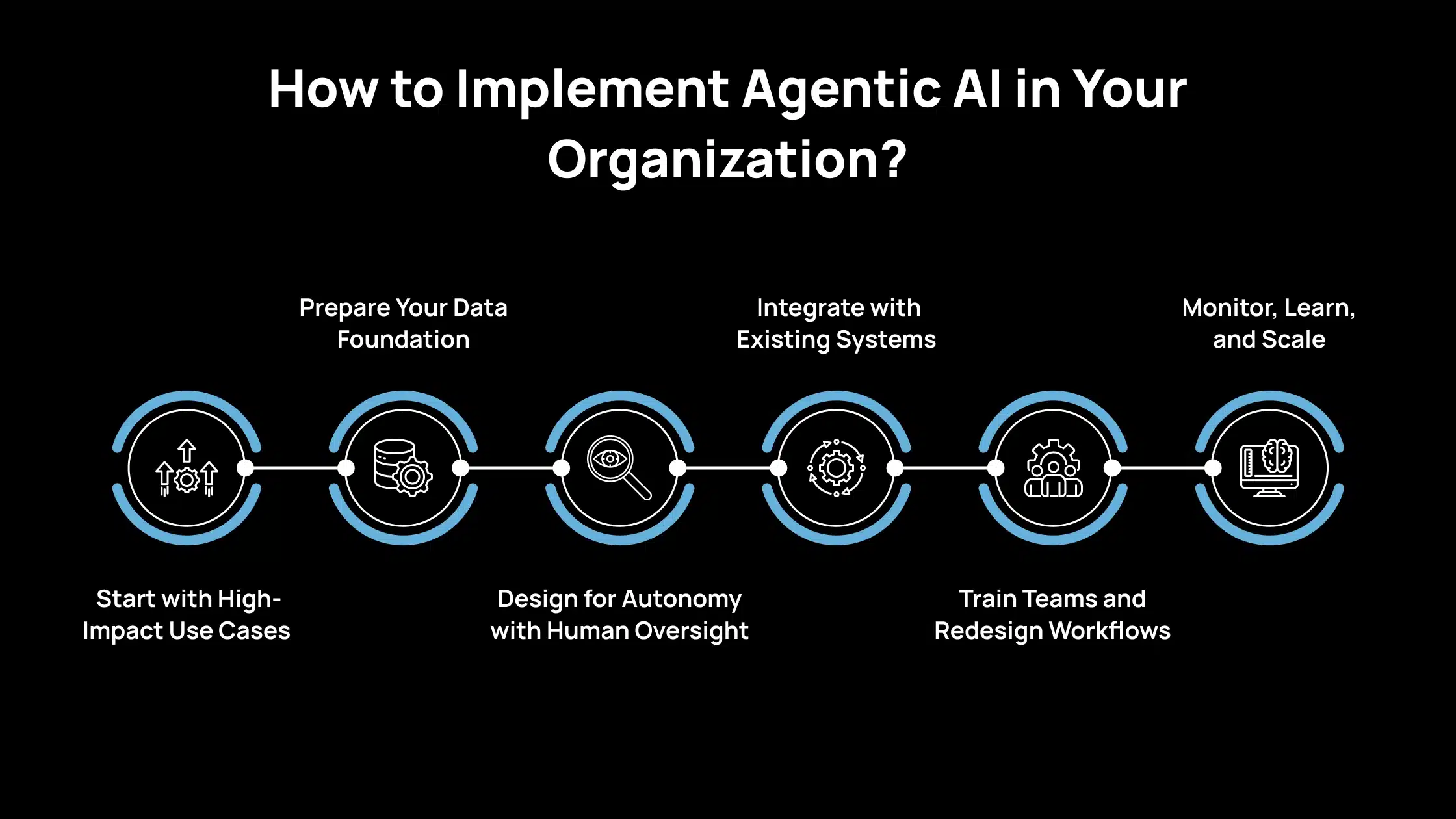
Implementing agentic AI is not about deploying a single tool. It requires a thoughtful approach that aligns technology, data, people, and processes. When done correctly, it allows you to move from experimentation to real operational impact.
1. Start with High-Impact Use Cases
Begin by identifying processes where autonomy will create immediate value. Focus on areas with high manual effort, frequent delays, or complex decision-making. Common starting points include predictive maintenance, workflow automation, cybersecurity response, and operational optimization. Selecting the right use cases ensures early success and measurable results.
2. Prepare Your Data Foundation
Agentic AI depends on continuous, high-quality data. Ensure your systems can collect, integrate, and process real-time information from relevant sources. Address data gaps, inconsistencies, and governance issues before deployment. A strong data foundation directly determines the accuracy and reliability of your AI agents.
3. Design for Autonomy with Human Oversight
Define clearly what decisions the AI can make independently and where human validation is required. Establish escalation rules, audit trails, and performance metrics. This balance ensures safety, accountability, and trust while still enabling meaningful automation.
4. Integrate with Existing Systems
Agentic AI delivers value only when it connects seamlessly with your current infrastructure. Integrate AI agents with enterprise systems, including ERP, CRM, project management, and operational platforms. This allows the AI to execute decisions directly within your workflows rather than operating in isolation.
5. Train Teams and Redesign Workflows
Prepare your teams to work alongside AI systems. Provide training on supervising, interpreting, and improving AI-driven processes. Redesign workflows to remove redundant steps and clarify responsibilities between humans and AI agents.
6. Monitor, Learn, and Scale
Once deployed, continuously monitor performance, outcomes, and risks. Use real-world feedback to refine models, improve decision quality, and expand agentic AI into additional functions. Over time, your system becomes more accurate, more valuable, and more deeply embedded in operations.
How Avahi Helps You Turn AI Into Real Business Results?
If your goal is to apply AI in practical ways that deliver measurable business impact, Avahi offers solutions designed specifically for real-world challenges. Avahi enables organizations to quickly and securely adopt advanced AI capabilities, supported by a strong cloud foundation and deep AWS expertise.
Avahi AI solutionsdelivers business benefits such as:
- Round-the-Clock Customer Engagement
- Automated Lead Capture and Call Management
- Faster Content Creation
- Quick Conversion of Documents Into Usable Data
- Smarter Planning Through Predictive Insights
- Deeper Understanding of Visual Content
- Effortless Data Access Through Natural Language Queries
- Built-In Data Protection and Regulatory Compliance
- Seamless Global Communication Through Advanced Translation and Localization
By partnering with Avahi, organizations gain access to a team with extensive AI and cloud experience committed to delivering tailored solutions. The focus remains on measurable outcomes, from automation that saves time and reduces costs to analytics that improve strategic decision-making to AI-driven interactions that elevate the customer experience.
Discover Avahi’s AI Platform in Action
At Avahi, we empower businesses to deploy advanced Generative AI that streamlines operations, enhances decision-making, and accelerates innovation—all with zero complexity.
As your trusted AWS Cloud Consulting Partner, we empower organizations to harness the full potential of AI while ensuring security, scalability, and compliance with industry-leading cloud solutions.
Our AI Solutions Include
- AI Adoption & Integration – Leverage Amazon Bedrock and GenAI to Enhance Automation and Decision-Making.
- Custom AI Development – Build intelligent applications tailored to your business needs.
- AI Model Optimization – Seamlessly switch between AI models with automated cost, accuracy, and performance comparisons.
- AI Automation – Automate repetitive tasks and free up time for strategic growth.
- Advanced Security & AI Governance – Ensure compliance, detect fraud, and deploy secure models.
Want to unlock the power of AI with enterprise-grade security and efficiency?
Start Your AI Transformation with Avahi Today!
Frequently Asked Questions
1. What is agentic AI, and how is it different from conventional AI?
Agentic AI refers to intelligent systems that can operate with a high degree of independence. Unlike conventional AI tools that wait for user instructions, agentic AI continuously monitors information, makes decisions, and performs actions autonomously. This allows organizations to move from simple automation toward fully autonomous execution of complex workflows.
2. What are some real-world agentic AI examples?
Common agentic AI examples include autonomous robotics in engineering, predictive maintenance systems in manufacturing, AI-driven fraud detection in financial services, real-time cybersecurity threat response, and automated workflow management in business operations. These systems actively manage tasks and decisions without requiring constant human oversight.
3. How does agentic AI improve business and operational efficiency?
Agentic AI improves efficiency by reducing manual effort, minimizing errors, and enabling faster, data-driven decisions. It helps organizations prevent downtime, optimize resources, streamline workflows, and respond to changing conditions in real time, leading to measurable productivity gains.
4. What industries benefit the most from agentic AI?
Industries with complex operations and large data volumes benefit most, including manufacturing, engineering, logistics, finance, cybersecurity, and smart city management. These sectors rely on continuous monitoring, rapid decision-making, and coordinated systems, all areas where agentic AI delivers strong value.
5. What are the main challenges of adopting agentic AI?
Key challenges include ensuring high-quality data, integrating AI with existing systems, maintaining security and regulatory compliance, managing operational risks, and continuously training models to adapt to evolving conditions and threats.