




TL;DR
|
What slows hiring teams today isn’t a lack of applicants; it’s the nonstop cycle of screening calls, follow-ups, and scheduling that never seems to end.
If you manage recruitment, you already know how quickly these tasks consume your day.
A report highlights that recruiters spend a large portion of their time on administrative tasks, with one analysis showing that up to two work days (about 17.7 hours) per vacancy are spent on manual tasks such as reviewing applications, scheduling interviews, and processing notes, work that can be automated to free up recruiter capacity.
Hiring hasn’t become harder; managing hiring at scale has. Recruiters want to focus on conversations that matter. Candidates wish for quick, clear responses. But conventional workflows cannot support both, especially when the volume grows faster than the team.
This is where recruitment automation with AI voice calling steps in, not as a replacement for human judgment, but as a practical system that handles the tasks that slow you down: screening calls, qualification checks, scheduling, reminders, and movement between interview stages. Often, the easiest way to test this integration is through an AWS proof of concept that maps directly to your existing tools.
In this blog, we break down how AI voice calling fits into the recruitment workflow, what it can automate reliably, and how teams can implement it without disrupting their current systems.
Understanding Recruitment Automation with AI Voice Calling
Recruitment automation refers to using technology to streamline various tasks in the hiring process. This can include everything from screening resumes to scheduling interviews, all designed to reduce manual effort and increase efficiency.
AI voice calling, specifically, refers to the use of artificial intelligence to conduct phone calls that a recruiter would make. These calls are pre-programmed but designed to mimic natural human conversations, allowing AI to interact with candidates as if it were a human recruiter.
How AI Voice Calling Works in the Recruitment Process?
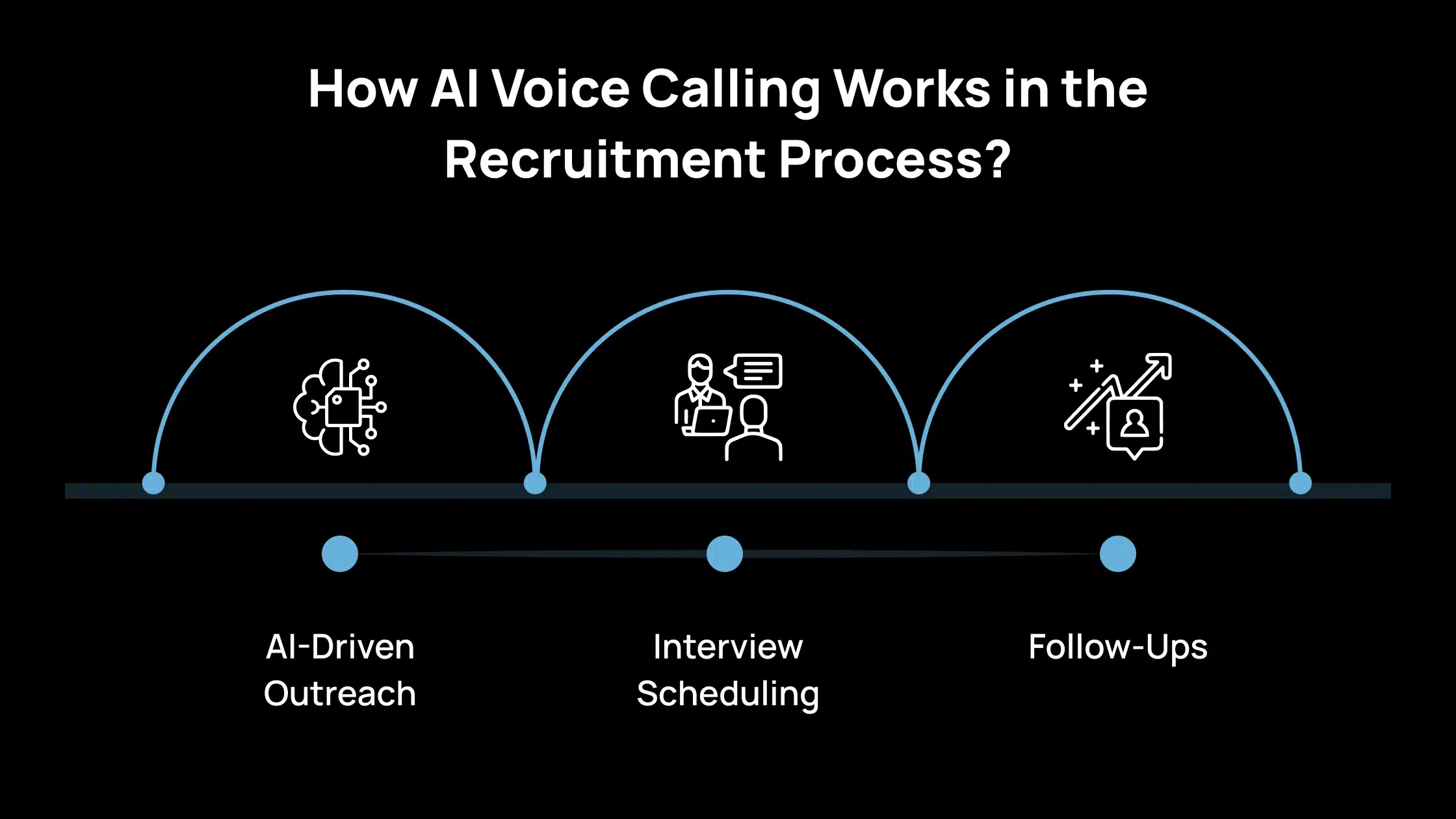
Here’s how AI voice calling fits into each phase of the recruitment process and supports core hiring tasks.
1. AI-Driven Outreach
AI voice calling streamlines the initial stages of candidate outreach. Instead of recruiters manually reaching out to each candidate, AI can automatically contact an extensive list of applicants. It uses pre-recorded scripts and responses that adjust based on the candidate’s answers.
This is particularly useful for first-contact interactions, where AI can introduce the job opportunity, gather basic candidate information, and even assess whether the candidate is a good fit for the role. This eliminates the need for recruiters to make repetitive introductory calls.
2. Interview Scheduling
Once AI voice calling has conducted the initial outreach and assessed a candidate’s fit, it can proceed to schedule interviews.
The AI can ask the candidate about their availability, suggest suitable times, and automatically schedule the interview in the system. This eliminates the back-and-forth that often occurs between candidates and recruiters when trying to find a convenient time for both. AI voice calling ensures that the process runs smoothly and that no time slots are missed.
3. Follow-Ups
AI voice calling doesn’t stop after the interview. It can be used to follow up with candidates at various stages of the recruitment process.
For example, after an interview, AI can reach out to thank the candidate for their time and inform them of the next steps. It can also send reminders about upcoming assessments or re-engage candidates who may have dropped off during the process.
This ensures that candidates are always kept in the loop, and nothing is overlooked. AI follow-ups can happen automatically, without additional effort from human recruiters, allowing them to focus on higher-value tasks.
AI Voice Calling vs Conventional Recruitment Methods
Here’s how AI voice calling compares to conventional recruitment methods across speed, efficiency, and candidate experience.
| Aspect | AI Voice Calling | Conventional Methods |
| Recruitment Process Speed | Significantly faster, automates outreach, scheduling, and follow-ups, reducing delays. | Slow due to manual outreach, coordination, and follow-up processes. |
| Volume of Candidates | Can handle a high volume of candidates automatically without additional effort. | Limited by the number of recruiters available to manage candidates. |
| Availability | 24/7 availability, can contact candidates anytime across different time zones. | Limited to business hours, requires scheduling and coordination. |
| Consistency in Communication | Standardized messages ensure consistency in tone and information. | Variesbye recruiter, leading to potential inconsistencies. |
| Human Interaction | Minimal human interaction, focuses on efficiency and automation. | Extensive human interaction often leads to delays and potential bias. |
| Candidate Engagement | Personalized, real-time responses, improving engagement, and reducing wait times. | Delayed responses often leave candidates disengaged or frustrated. |
| Error Rate | Low error rate, as AI follows programmed scripts and processes. | Higher error rate due to manual input and human oversight. |
How AI Voice Calling Enhances the Full Recruitment Funnel?
Here’s how AI voice calling strengthens every stage of the recruitment funnel, from first contact to final selection.
Top-of-Funnel Screening
AI voice calling strengthens the first stage of recruitment by handling the initial interaction with every applicant. It performs consistent screening and captures key information that helps recruiters decide who should move forward.
1. Pre-qualification Questions
The system asks direct questions that help confirm whether the candidate meets the minimum requirements. This step removes profiles that are clearly not a match. This confirms basic fit, filters out irrelevant applications, and reduces manual workload early in the process.
2. Salary Expectations
It collects the candidate’s expected salary and compares it with the predefined range. Clear expectations at this stage prevent misalignment later. It captures expected compensation and flags candidates outside the budget, and helps maintain transparent communication.
3. Eligibility Checks
The AI must verify must-have eligibility criteria, such as work authorization, shift timing, proximity to the location, or language proficiency. This ensures candidates meet mandatory requirements and avoids scheduling interviews with ineligible applicants.
4. Must-Have Skills Validation
Key skills are checked early through direct screening questions. This prevents time spent on candidates lacking essential abilities. This confirms foundational skills, supports objective early filtering, and improves the overall quality of the shortlist.
Mid-Funnel Scheduling Automation
Once a candidate passes the initial screen, AI voice calling manages interview scheduling. This reduces delays and avoids the typical back-and-forth between recruiters and candidates.
1. Automated Coordination of Calendars
The system reads recruiter availability and offers open slots to candidates. This creates a predictable and quick scheduling process. It eliminates manual coordination, prevents double-booking, and provides clear time options instantly.
2. Intelligent Rescheduling
If an interview is cancelled, the AI immediately suggests new timings based on updated calendars. This minimizes disruptions in the hiring pipeline. It handles cancellations automatically, keeps candidates engaged, and maintains steady momentum throughout the process.
3. Reminder Workflows
The AI also sends reminders ahead of interviews to reduce no-shows. These reminders improve completion rates without requiring additional effort from recruiters. They ensure timely communication through calls, SMS, or email and help maintain consistent candidate engagement.
Integration With Video Interview Software
AI voice calling works well with video interview software, enabling a smooth transition from voice screening to deeper assessment.
1. AI Voice Calling and Scheduling
After the voice screen, the system schedules the candidate’s video interview and sends the required instructions. This creates a unified flow from one stage to the next, reduces manual steps for recruiters, and ensures candidates receive clear and timely next steps.
2. AI Transcribes, Evaluates, and Summarizes Video Responses
The video interview tool then generates transcripts and structured summaries. This allows recruiters to review responses quickly without watching the entire recording. The summaries are standardized, the evaluation process becomes faster, and documentation is more precise for future comparison.
3. Adds Another Layer of Objective Screening at Scale
Video interviews also add another layer of objective screening at scale. They capture communication skills, role understanding, and behavioral indicators that are difficult to assess solely from voice. The AI highlights key points while leaving final decisions to human reviewers, thereby improving early-stage clarity, making comparisons straightforward, and supporting more reliable shortlisting.
Transition to AI Recruiter Workflows
After voice and video screening, candidates move into the AI recruiter workflow. This stage focuses on structured data processing and ranking to help recruiters prioritize their efforts.
1. Resume Parsing
AI extracts relevant experience, skills, and keywords from each resume, creating a consistent dataset without manual reading. This leads to faster resume reviews, a uniform data structure, and immediate identification of important information.
2. Candidate Scoring
Each candidate is then scored based on predefined job criteria. This helps recruiters focus on the strongest profiles first. The scoring process remains objective, supports clear prioritization, and promotes transparent selection.
3. Automated Job Matching
AI also compares candidate profiles with available openings and identifies potential matches, even for roles the candidate did not initially apply for. This allows better use of the existing talent pool, reduces sourcing time, and increases the chances of finding suitable fits across departments.
4. Outreach Sequences
The system automatically sends follow-ups, updates, and reminders throughout the hiring process. This keeps candidates informed without increasing recruiters’ communication workload. It ensures consistent communication, improves the overall candidate experience, and helps maintain engagement at every stage.
Steps to Integrate AI Voice Calling Into Your Recruitment Workflow
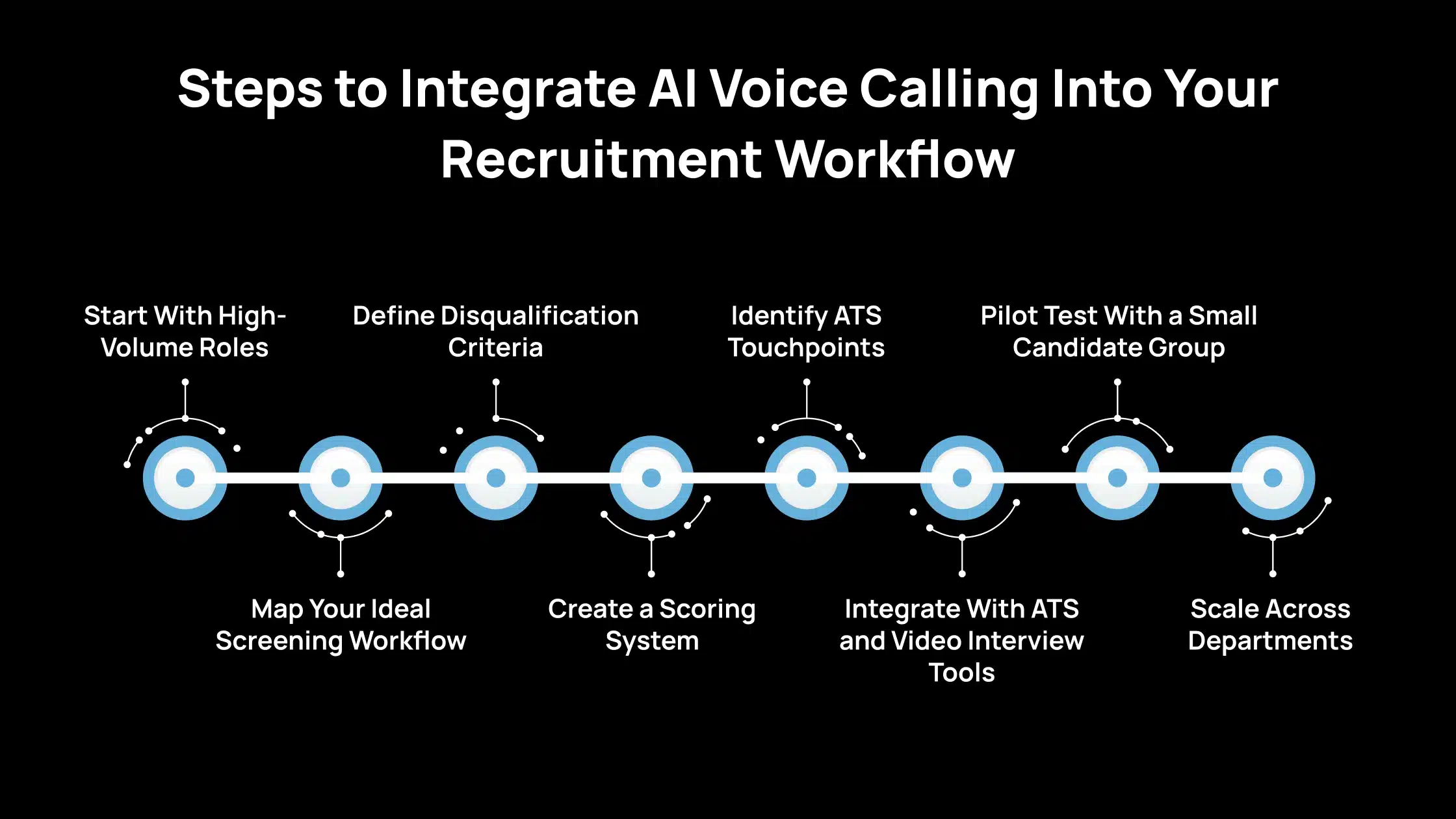
Here is how you can introduce AI voice calling into your recruitment process in a structured and manageable way.
1. Start With High-Volume Roles
Begin by selecting roles where you receive the most significant number of applications. These positions usually follow predictable screening steps, which makes them suitable for automation. Focusing on high-volume roles first helps you see immediate efficiency gains and reduces the manual workload on your team.
- Choose 2–3 roles with repetitive screening.
- Prefer roles with precise eligibility requirements.
- Ensure job expectations are well-defined.
2. Map Your Ideal Screening Workflow
Before deploying AI voice calling, outline the complete screening workflow. This clarifies what the AI must ask, evaluate, and record. A clear workflow prevents confusion later and ensures the system produces reliable outputs.
List the exact questions you want the AI to ask during the initial screen. These should be simple, direct, and tied to real job requirements.
- Keep questions short and precise.
- Align them with must-have criteria.
- Avoid unnecessary or ambiguous questions.
3. Define Disqualification Criteria
Define conditions that instantly disqualify a candidate. The AI uses these rules to filter applicants before they reach a recruiter.
Examples: location, shift timing, certification, and minimum experience. Use binary yes/no criteria where possible. Document these rules clearly.
4. Create a Scoring System
Create a score range for responses. This allows the AI to produce structured candidate ratings that recruiters can use to prioritize applicants.
Assign points to key answers. Give more weight to must-have skills. Keep scoring transparent and easy to interpret.
5. Identify ATS Touchpoints
Look where the AI should update or interact with your ATS. This ensures information moves automatically without manual data entry. This includes shortlist update and candidate status change.
and interview scheduling triggers
6. Integrate With ATS and Video Interview Tools
Once your workflow is defined, integrate AI voice calling with your ATS and video interview software. This creates a continuous hiring path from voice screening to deeper assessments.
- Voice screening results move directly into the ATS.
- Qualified candidates are automatically scheduled for a video interview.
- Recruiters receive consolidated data instead of separate files.
Smooth integration reduces manual steps and maintains consistent tracking across all stages.
7. Pilot Test With a Small Candidate Group
Start with a limited rollout to identify gaps early. A pilot helps you understand how candidates respond to the voice experience and whether the screening flow works as intended.
Gather candidate feedback. Ask candidates about clarity, comfort, and ease of use. Track drop-off points. Note any repeated confusion or misinterpretations. Use pilot findings to refine the system. Reword questions that confuse. Update disqualification rules based on real outcomes
8. Scale Across Departments
Once the workflow is stable and your team is confident in the results, expand AI voice calling to more roles and departments. Scaling should be gradual to ensure consistency remains intact.
- Introduce automation to additional job families.
- Train hiring managers on interpreting AI output.s
- Monitor performance regularly and adjust as needed.d
A phased expansion ensures the system adapts well to different hiring patterns and maintains accuracy across varied role types.
Core Features to Look for in Recruitment Automation Tools
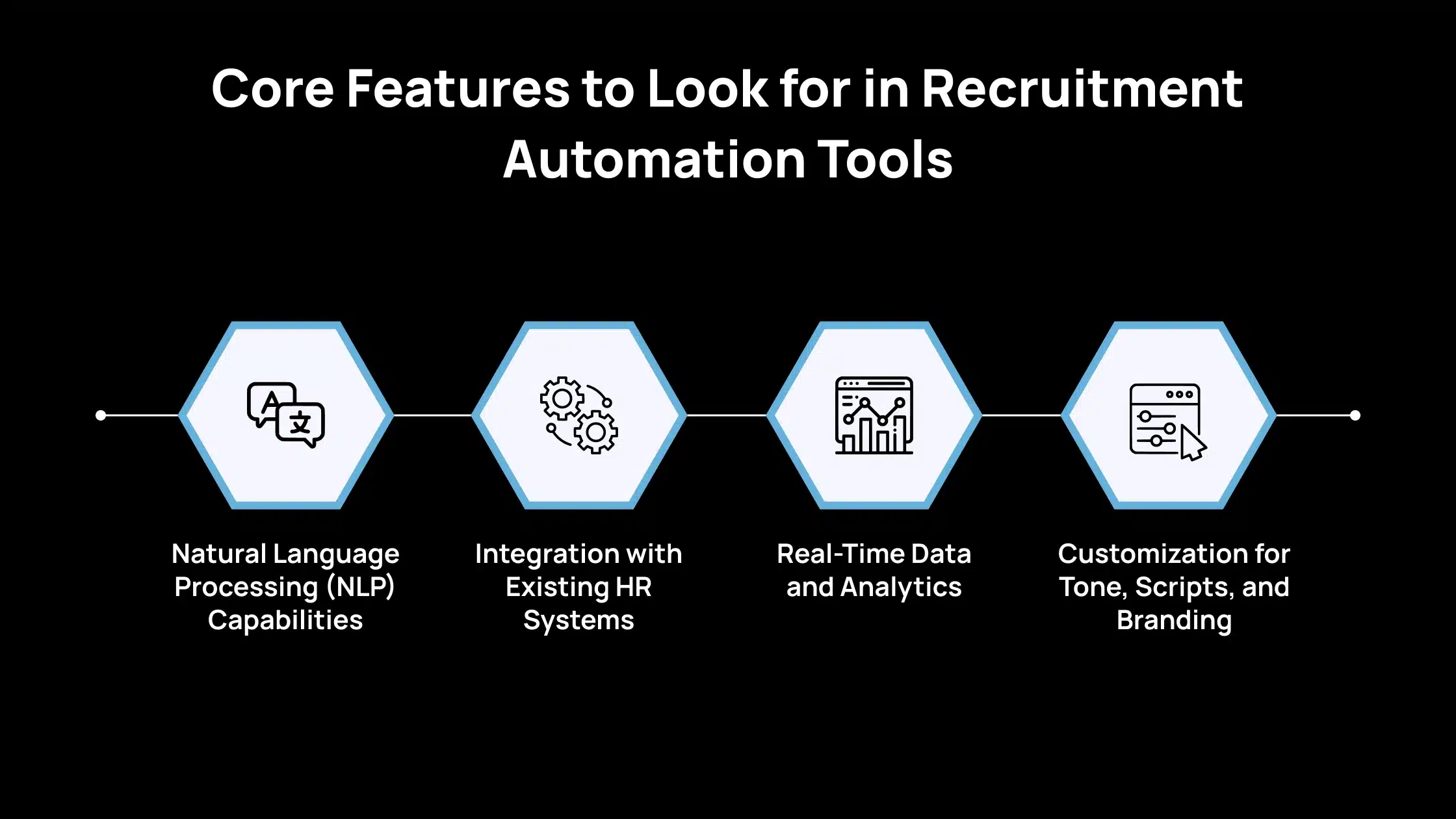
Here is a list of features to evaluate when choosing recruitment automation tools.
1. Natural Language Processing (NLP) Capabilities
NLP enables AI voice-calling systems to understand and respond to human language accurately, even when candidates speak informally or phrase their answers differently. It helps the system interpret intent, assess qualifications, and recognize tone or sentiment, leading to more natural and reliable interactions.
2. Integration with Existing HR Systems
Recruitment automation tools should connect smoothly with your ATS and CRM. Integration ensures that candidate data updates automatically, reduces manual entry, and keeps information consistent across platforms. This makes tracking progress and managing communication easier for recruiters.
3. Real-Time Data and Analytics
AI tools should provide real-time metrics on outreach, scheduling, and candidate movement. These insights help recruiters identify bottlenecks, measure response rates, and refine their hiring strategies based on actual performance data.
4. Customization for Tone, Scripts, and Branding
The system should allow customization of voice tone, messaging, and scripts to match your company’s communication style. This ensures interactions feel consistent, professional, and aligned with your brand. It also allows tailoring scripts for different roles or candidate groups.
Challenges and Ethical Considerations of AI in Recruitment

Here are the main challenges and ethical considerations to keep in mind when using AI in recruitment.
1. AI Bias and Fairness
One of the biggest concerns with AI in recruitment is the potential for bias in candidate selection.
AI systems are trained on data, and if that data contains biases, such as gender, racial, or age biases, these biases can be reflected in the hiring decisions made by AI.
It’s essential to ensure that AI tools are built and tested with fairness in mind. Regular audits of AI systems can help detect and correct biases in decision-making, ensuring that recruitment processes remain fair and inclusive.
2. Ensuring Transparency
AI decision-making processes should be transparent to both candidates and recruiters.
Candidates should have a clear understanding of how decisions are made, especially when AI is involved in evaluating their qualifications or suitability.
Transparency ensures that candidates feel their applications are assessed fairly and understand the criteria used to evaluate them. For recruiters, transparent AI systems provide a clear rationale for why specific candidates were selected or rejected, helping maintain trust in the system.
3. Maintaining a Human Touch
Even though AI can handle many tasks, human involvement is still critical to the recruitment process. Candidates value human interaction, especially in the later stages of the hiring process, such as interviews and final selection.
While AI can streamline administrative tasks and provide valuable data, recruiters should maintain a human presence for relationship-building and final decision-making. This helps ensure that candidates feel valued and that the process remains empathetic, balancing efficiency with personal engagement.
What Makes Avahi’s AI Voice Agent Effective for Modern Hiring Teams?
For talent acquisition teams, speed, consistency, and secure handling of candidate data matter at every stage. Avahi’s AI Voice Agent helps HR teams keep hiring moving without adding compliance risk.
- Always-on candidate support: Candidates get instant answers and scheduling help, reducing missed calls and slow follow-ups.
- Secure data flow: Conversations and candidate details are imported into your ATS or CRM in a controlled, compliant manner.
- Less admin work: Screening, scheduling, reminders, and FAQs are automated so that recruiters can focus on decision-making.
- Audit-ready records: Every interaction is logged and traceable, making compliance reviews easier.
- Stronger candidate experience: Candidates stay informed and engaged, while your team avoids repetitive coordination.
With Avahi, teams can scale hiring faster while maintaining trust and compliance.
Discover Avahi’s AI Platform in Action
At Avahi, we empower businesses to deploy advanced Generative AI that streamlines operations, enhances decision-making, and accelerates innovation—all with zero complexity.
As your trusted AWS Cloud Consulting Partner, we empower organizations to harness the full potential of AI while ensuring security, scalability, and compliance with industry-leading cloud solutions.
Our AI Solutions Include
- AI Adoption & Integration – Leverage Amazon Bedrock and GenAI to Enhance Automation and Decision-Making.
- Custom AI Development – Build intelligent applications tailored to your business needs.
- AI Model Optimization – Seamlessly switch between AI models with automated cost, accuracy, and performance comparisons.
- AI Automation – Automate repetitive tasks and free up time for strategic growth.
- Advanced Security & AI Governance – Ensure compliance, detect fraud, and deploy secure models.
Want to unlock the power of AI with enterprise-grade security and efficiency? Start Your AI
Transformation with Avahi Today!
Frequently Asked Questions
1. How does AI voice calling improve the speed of the recruitment process?
AI voice calling automates initial screening, outreach, scheduling, and reminders, which removes manual delays. It contacts candidates instantly, collects required information, and updates the system immediately, allowing recruiters to move qualified candidates forward faster.
2. Can AI voice calling handle high-volume hiring without reducing quality?
Yes. AI follows predefined workflows, asks consistent questions, and applies the same evaluation criteria to every candidate. This ensures quality and fairness remain stable even when the number of applicants increases.
3. Will AI voice calling replace human recruiters?
No. AI handles repetitive tasks like screening and scheduling, but human recruiters are still needed for interviews, judgment-based decisions, negotiations, and maintaining personal connections with candidates.
4. How does AI voice calling integrate with existing ATS or video interview tools?
Most AI systems connect directly to an ATS to sync candidate data, update statuses, and trigger next steps. They can also schedule video interviews automatically and send candidates instructions, creating a seamless workflow from voice screening to final interviews.
5. What if candidates prefer speaking with a human instead of an AI system?
AI voice calling is designed for early-stage interactions where information-gathering is routine. Candidates who need clarification or prefer human support can be transferred or followed up by a recruiter. This ensures the process remains flexible and candidate-friendly.