



TL;DR
|
The first minute of a hiring process sets the tone for the entire candidate experience, and most candidates make up their mind about the company in that short window.
This is especially true in high-volume hiring, where speed and clarity matter. According to LinkedIn’s Future of Recruiting Report, recruiters spend up to 35% of their time on initial phone screenings. For roles that receive hundreds of applications per opening, this step quickly becomes a bottleneck.
To ease this pressure, many companies have adopted voice AI interviews as their first screening layer. These automated phone interviews allow candidates to respond naturally over a call, without apps, logins, or scheduling delays.
This makes them one of the simplest and most accessible forms of AI-driven screening, especially for frontline, shift-based, or gig roles where candidates often prefer mobile-first communication.
A poorly designed voice AI experience can create stress, confusion, and unnecessary drop-off, hurting both candidate satisfaction and hiring outcomes. This is why starting with an AWS proof of concept is essential to test your integration under real-world conditions. In this blog, you’ll learn how AI phone screening interviews work and how to design them in a way that supports candidates rather than overwhelming them.
Understanding the Voice AI Interview and Its Core Components
A voice AI interview is an automated phone screening in which a conversational AI system calls the candidate (or receives their call), asks job-related questions, listens to their answers, and evaluates them using speech recognition and natural language processing. It replaces the traditional first-round phone screening done by recruiters for high-volume roles.
Core Components of Voice AI Interview
A voice AI interview involves four functional components:
1. Telephony System
The telephony system connects the AI to the candidate through a standard phone call. It runs on regular mobile networks, so candidates do not need an app, login, or internet access. This makes the interview accessible for a wide range of users.
2. Speech Recognition (ASR)
Speech Recognition converts the candidate’s spoken words into text in real time. A well-trained ASR engine can handle different accents, speaking speeds, and common background noise, ensuring that candidates are evaluated fairly.
3. Natural Language Processing (NLP)
Natural Language Processing interprets the meaning, intent, skills, and relevance within the candidate’s responses. It identifies indicators such as experience level, job fit, and behavioral patterns based on how the candidate explains past tasks or decisions.
4. Scoring and Summary Engine
The scoring and summary engine generates a structured evaluation that highlights strengths, gaps, and overall suitability for the role. It compiles this information into a clear summary and sends it to the recruiter instantly, enabling faster, more consistent screening decisions.
How Voice AI Interviews Differ from Chat-Based AI Interviews?
Below is a comparison that explains how voice AI interviews differ from chat-based AI interviews.
| Category | Voice AI Interview | Chat-Based AI Interview |
| Mode | Phone call, spoken responses | Text chat, typed responses |
| Accessibility | Works on any phone, no internet needed | Requires typing and a stable internet |
| Speed | Faster—speaking is 2–3× quicker than typing | Slower typing takes longer |
| Candidate Comfort | Feels like a natural recruiter call | Feels like a chatbot or form |
| Use Cases | Roles where speaking ability matters | Roles requiring written clarity |
| Challenges | Background noise, accent handling | Typing skills, spelling limitations |
Voice AI interviews mimic the real-world environment of many jobs, where communication happens over calls, especially in support, sales, and field roles.
The Working Process of an AI Phone Screening Interview
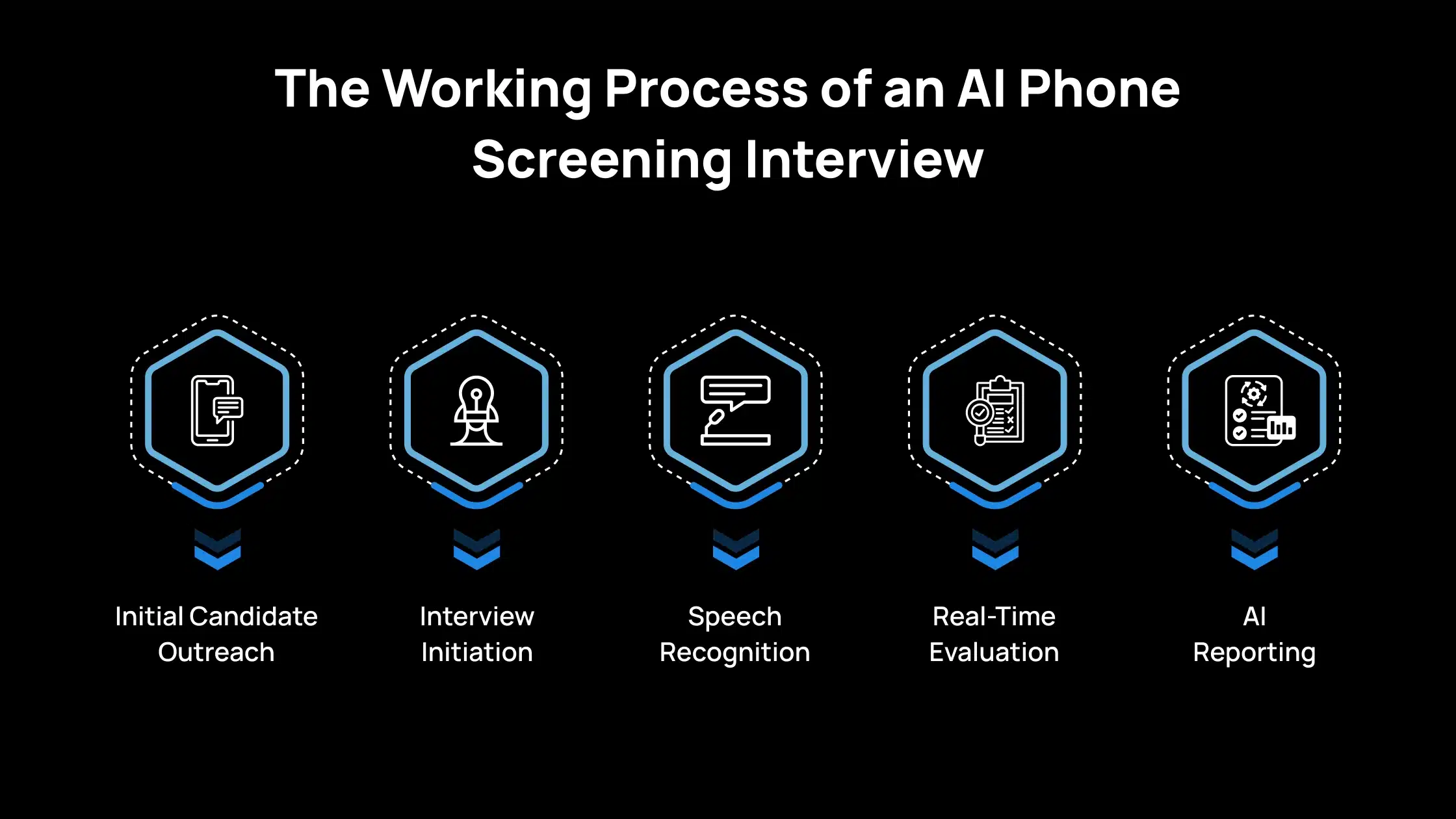
A phone-based voice AI interview follows a transparent and predictable workflow. Below are the five steps that show precisely how the system operates and what happens at each stage.
1. Initial Candidate Outreach
The process begins when the candidate is invited to complete the phone screening. The system sends a simple SMS or email that includes the interview’s purpose, the expected duration, and instructions to start the call.
There is no login, no app download, and no account creation. This reduces friction and increases completion rates, especially in frontline and high-volume roles where candidates prefer immediate access over complex sign-in flows.
2. Interview Initiation
The interview starts when the candidate either dials a provided number or receives an automated call from the AI system. Telephony platforms connect the AI to the candidate through a regular phone call.
Once the call connects, the system begins with a warm, natural-sounding introduction that explains who is calling and what to expect. A clear greeting helps candidates relax and sets the right tone, especially for first-time AI interview users.
3. Speech Recognition
The candidate speaks naturally, and the AI captures their answers in real time. Automatic Speech Recognition (ASR) converts the candidate’s spoken words into text with high accuracy. Modern ASR systems handle different accents, speaking speeds, and everyday background noise.
Accent adaptation and noise handling are essential because they ensure fairness; candidates are evaluated on what they say, not how they sound or the environment from which they are calling. This step is the foundation of an accurate evaluation later.
4. Real-Time Evaluation
Once answers are transcribed, the AI analyzes them for relevance and job fit. Natural Language Processing (NLP) models examine the candidate’s responses for job-related keywords, clarity, intent, and the presence of experience indicators.
The system also picks up behavioral patterns such as problem-solving structures or example-based storytelling (similar to STAR-style responses). Importantly, voice AI interviews do not use facial data or identity-based indicators, reducing the risk of appearance bias that can influence video interviews. The goal is to focus on the content and meaning of the candidate’s answers.
5. AI Reporting
After the interview ends, the system prepares a structured report for the hiring team. The AI produces a scorecard that highlights strengths, gaps, and job-specific indicators. It also includes a clear summary and quotable lines taken from the candidate’s own responses.
Recruiters receive this report instantly, enabling them to make quick, informed decisions without having to listen to the full call. This reduces manual screening time and brings consistency to the assessment process.
Principles of Designing a Candidate-Friendly Voice AI Interview
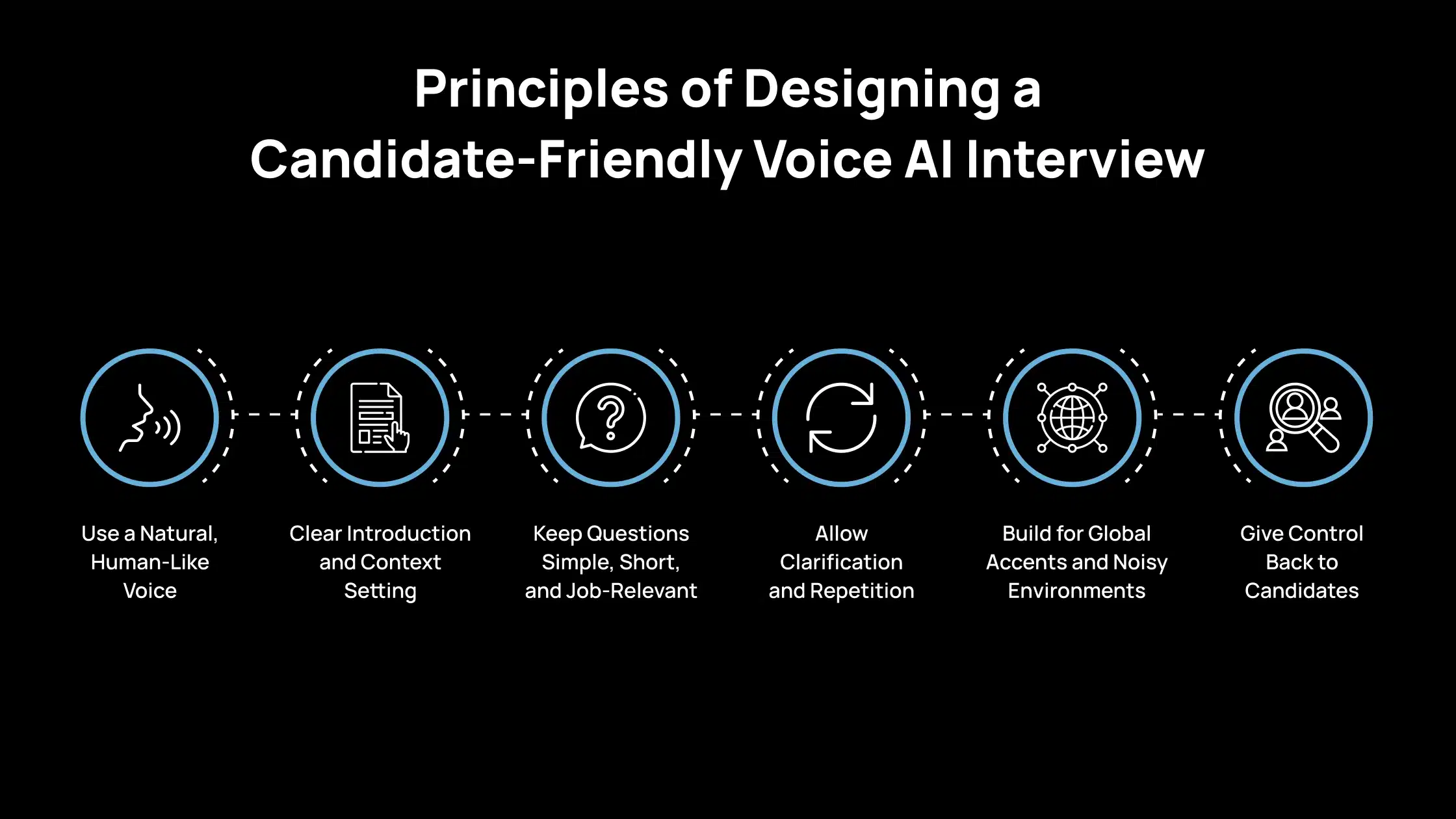
A strong candidate experience relies on thoughtful design. Each principle below addresses a specific pain point candidates commonly face during automated phone screenings.
1. Use a Natural, Human-Like Voice
A candidate’s first impression is shaped by how the AI sounds. Avoid robotic TTS and choose a realistic voice. The AI should use a tone that feels calm, clear, and conversational.
Robotic or monotone text-to-speech makes candidates uncomfortable and increases drop-off. A natural voice encourages candidates to speak more openly and confidently. The tone should also match the company’s culture, formal for regulated industries, or casual for customer-facing roles.
2. Clear Introduction and Context Setting
Candidates need clarity before they begin answering questions. Explain the purpose, duration, expectations, and data handling. Before the interview starts, the AI must clearly state why the call is taking place, how long it will last, and what the candidate is expected to do.
It should also communicate that their responses are recorded and handled securely. Simple context-setting reduces confusion and lowers anxiety, especially for candidates interacting with automated systems for the first time.
3. Keep Questions Simple, Short, and Job-Relevant
Candidates perform best when they understand the question immediately. Ask one question at a time and stay focused on the job requirements. Questions should be short, direct, and limited to the skills and experience needed for the role. Avoid multi-part questions that require candidates to remember several elements at once. Trick questions, personality test items, or overly abstract prompts add no real value and often hurt the candidate experience.
4. Allow Clarification and Repetition
Not every candidate will hear or understand the question the first time. Offer built-in prompts for repeating or clarifying questions.
A candidate-friendly system gives options such as: “Can you repeat that?, “Let me say that again,” or “Take your time.” These cues make the interview more accessible for candidates with diverse linguistic backgrounds, speech styles, or internet/telephony limitations.
5. Build for Global Accents and Noisy Environments
Candidates shouldn’t be penalized for factors outside their control. Use accent-inclusive ASR and noise-reduction features. The speech recognition engine should be trained on a wide range of accents and dialects.
It must also handle common background noise, such as traffic, household sounds, or shared spaces. Providing a pause-and-resume option helps candidates who need a quieter moment to continue. These elements ensure a fair and consistent evaluation, regardless of the candidate’s location.
6. Give Control Back to Candidates
Flexibility matters, especially for candidates who work shifts or have limited availability. Allow scheduling options and provide a backup channel.s
Candidates should be able to choose a convenient time to take the interview or request a reschedule directly through the system. For areas with poor network quality, offering an SMS-based backup or a callback option reduces drop-off. When candidates feel in control, they are more likely to complete the process and view the hiring experience positively.
The Complete Structure of a Well-Planned Voice AI Interview
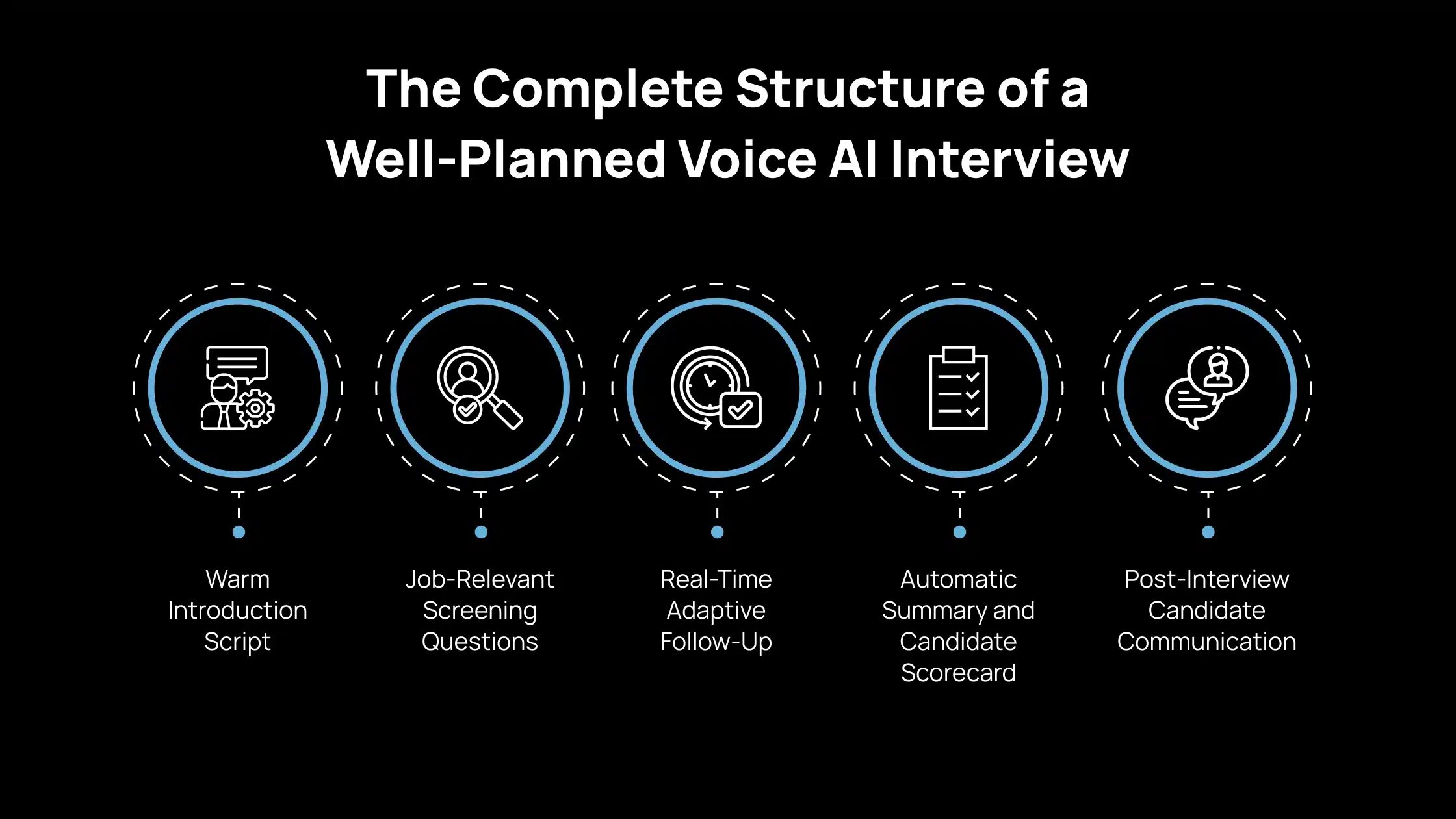
A clear interview structure helps candidates stay comfortable and gives recruiters consistent, high-quality information. The framework below can be applied to most high-volume roles.
1. Warm Introduction Script
A short and clear opening sets expectations and reduces friction.
- The introduction should last around 20–30 seconds. It must state who is calling, why the interview is happening, and what the candidate should expect in the next few minutes.
- A simple, friendly tone helps the candidate settle in before questions begin. This is especially important because many candidates are new to AI-driven phone interviews.
2. Job-Relevant Screening Questions
Structured questioning ensures the AI collects information that actually matters for the role.
The interview should only include questions directly tied to job performance. These
fall into five categories:
- Experience-based: Understand past roles, responsibilities, and achievements.
- Behavior-based: Assess how candidates handle challenges or teamwork situations.
- Scenario-based: Present realistic job situations to evaluate decision-making.
- Availability & logistics: Confirm shift preferences, location, notice period, and workload capacity.
- Compliance (if required): Verify certifications, background requirements, or legal eligibility.
Keeping questions within these categories ensures the evaluation remains consistent, fair, and relevant to the actual position.
3. Real-Time Adaptive Follow-Up
Follow-up questions help the system gather depth without overwhelming the candidate.
- When a candidate mentions essential details, such as specific tools, tasks, or achievements, the AI should ask a brief follow-up question to clarify that point.
- At the same time, the system should avoid unnecessary probing, which can make the interview feel long or repetitive.
4. Automatic Summary and Candidate Scorecard
Recruiters need a clear, structured output they can review quickly.
- After the call, the system should generate a summary that includes key strengths, highlights of experience, and any notable concerns.
- Behavioral indicators, such as clarity or problem-solving patterns, must be presented in simple terms without over-interpreting the candidate.
- A suitability score can be included, but it should not auto-reject anyone.
- Recruiters should still make the final decision using both the scorecard and the candidate’s spoken responses. This balance keeps the process fair and transparent.
5. Post-Interview Candidate Communication
Clear communication after the interview maintains trust and reduces uncertainty.
- Once the interview ends, candidates should receive a short SMS or email confirming that their responses were received.
- This message should also share what happens next and where they can reach out for support if needed.
This simple step lowers drop-off rates and prevents negative candidate sentiment, especially in high-volume hiring where applicants often feel left in the dark.
Common Pitfalls That Create Candidate Frustration and How to Fix Them
A candidate-friendly voice AI interview depends on removing friction at every step. The issues below are the most common reasons candidates drop off or form negative impressions.
1. Overly Long Interviews
Long calls increase fatigue and reduce completion rates. Voice AI interviews should be concise. The ideal duration is 6–10 minutes, with a clear upper limit of 12 minutes.
Anything beyond this feels demanding, especially for frontline candidates who often take interviews between shifts or during limited breaks. A shorter format respects their time and keeps the focus on essential job-related information.
2. Robotic Tone or Scripted Flow
An unnatural tone makes the interaction feel impersonal and stressful. Candidates can sense when questions are delivered rigidly or repetitively.
Using flexible, generative conversation branching helps the system respond more naturally. This doesn’t add complexity; it simply ensures the AI adapts its tone and phrasing to the candidate’s responses rather than sticking to a fixed script. A more conversational flow reduces pressure and encourages candidates to speak freely.
3. Lack of Transparency
Candidates become uncomfortable when they don’t understand who, or what, they are talking to.
The system should clearly state, at the beginning, that AI is conducting the interview and that recruiters will review the responses.
Transparent communication builds trust and sets the right expectations. Hiding the presence of AI can lead to confusion, skepticism, and unnecessary stress. Simple, honest wording prevents these issues.
4. Non-Inclusive Questioning
Questions that ignore cultural, gender, or accessibility differences can disadvantage specific candidates. All questions must be tested for inclusivity. This includes checking for cultural assumptions, gendered phrasing, and potential challenges for people with disabilities.
The system should avoid idioms, local slang, or references not universally understood. Inclusive design ensures candidates from different backgrounds can answer comfortably without feeling judged or excluded.
5. Poor ASR Handling
If the AI struggles to understand the candidate, the experience quickly becomes frustrating.
Speech recognition should be trained on a wide range of accents and speaking styles. Still, issues can happen, such as network noise, background sounds, or unclear audio.
To reduce frustration, the system should offer alternatives, such as allowing typing for critical questions or enabling a slower speaking mode. These options ensure the candidate is assessed fairly and not impacted by technical limitations.
Why Avahi AI Voice Agents Are Valuable for Modern Hiring Teams?
In 2025, speed and availability are critical in recruitment. Missed candidate calls, delayed responses, or scheduling bottlenecks can result in lost great hires.
This is where Avahi’s AI Voice Agent becomes a valuable tool for talent acquisition teams.
- It acts as an extension of your recruiting process, qualifying candidate inquiries, scheduling interviews, and routing calls to recruiters when needed, all while ensuring a seamless, human-like experience.
- For recruitment teams handling high volumes or operating across multiple time zones, Avahi’s voice AI helps maintain consistent engagement, even outside of business hours.
- It reduces administrative load by managing repetitive candidate interactions, including confirming availability, handling FAQs, logging candidate data into your CRM or ATS, and sending reminders.
Recruiters spend more time on meaningful conversations and less on coordination, while candidates get fast, professional responses anytime they call.
Discover Avahi’s AI Platform in Action
At Avahi, we empower businesses to deploy advanced Generative AI that streamlines operations, enhances decision-making, and accelerates innovation—all with zero complexity.
As your trusted AWS Cloud Consulting Partner, we empower organizations to harness the full potential of AI while ensuring security, scalability, and compliance with industry-leading cloud solutions.
Our AI Solutions Include
- AI Adoption & Integration – Leverage Amazon Bedrock and GenAI to Enhance Automation and Decision-Making.
- Custom AI Development – Build intelligent applications tailored to your business needs.
- AI Model Optimization – Seamlessly switch between AI models with automated cost, accuracy, and performance comparisons.
- AI Automation – Automate repetitive tasks and free up time for strategic growth.
- Advanced Security & AI Governance – Ensure compliance, detect fraud, and deploy secure models.
Want to unlock the power of AI with enterprise-grade security and efficiency? Start Your AI Transformation with Avahi Today!
Frequently Asked Questions
1. What is a voice AI interview, and how does it work?
A voice AI interview is an automated phone screening in which candidates answer job-related questions via a call powered by conversational AI. The system uses speech recognition to understand responses, applies natural language processing to analyze them, and generates a structured summary for recruiters. It removes scheduling delays and keeps the process simple for candidates.
2. Is a voice AI interview fair for candidates with different accents or speaking styles?
Yes, a voice AI interview can be fair when the system uses ASR models trained on diverse accents, speaking speeds, and background conditions. Fairness also improves when candidates can repeat questions, speak at their own pace, or pause and resume. Well-designed systems focus only on content, not tone, accent, or speaking fluency.
3. Can a voice AI interview replace human recruiters in the screening process?
No, a voice AI interview cannot and should not replace human judgment. It speeds up the first round by collecting structured information, but the recruiter still reviews the summary, listens to key snippets, and makes the final decision. AI handles the repetitive part of screening; humans handle evaluation and selection.
4. Is a voice AI interview suitable for high-volume frontline and shift-based roles?
Yes, a voice AI interview is particularly effective for high-volume hiring in customer support, retail, logistics, healthcare, and gig or shift-based roles. Candidates can complete the interview anytime on their phone without needing apps, logins, or stable internet. This reduces drop-off and helps teams shortlist qualified candidates faster.
5. How can companies make a voice AI interview more candidate-friendly?
Companies can improve the candidate experience by using a natural voice, offering clear instructions, keeping interviews under 10 minutes, and asking only job-relevant questions. Transparent communication (“This is an AI interviewer; recruiters will review your responses”) and inclusive language also help build trust and reduce anxiety during the interview.