




If you’re leading talent acquisition today, your biggest challenge isn’t finding candidates, it’s reaching them fast enough.
Most enterprise hiring teams agree that the first 24 hours after an application are crucial in determining whether you win or lose a qualified hire.
Yet with rising application volumes, repetitive screening calls, and shrinking team bandwidth, even the best TA teams struggle to maintain speed and consistency. You’re expected to move faster, reduce costs, and improve candidate experience, all at the same time.
52% of applicants never hear back after applying, causing early-stage drop-offs. AI-based recruiting tools have already helped companies cut hiring time by 50% and reduce cost-per-hire by up to 60%.
Manual screening workflows can’t keep up with today’s hiring demands. This is why more organizations are turning to the Voice AI Recruiter, an automated, voice-based system that calls candidates, screens them, answers questions, and schedules interviews in real time. It works alongside your team, taking over the high-volume, repetitive tasks so recruiters can focus on meaningful conversations and better hiring decisions.
In this blog, you’ll see how voice AI fits into enterprise hiring, what real call flows look like, and the outcomes companies are achieving as they evaluate these systems through a targeted AWS proof of concept to scale their talent operations.
TL;DR
|
How a Voice AI Recruiter Differs from Chatbots and IVR Systems?
A Voice AI Recruiter is an AI-powered system that conducts phone conversations with candidates using natural, human-like language. Instead of relying on human recruiters to manually call, screen, and qualify applicants, a voice AI recruiter can automate these tasks at scale.
It can answer candidate questions, conduct screening interviews, check eligibility, capture applicant information, and even schedule interviews with hiring managers. Everything happens through a two-way voice conversation, just like a regular phone call, but powered by artificial intelligence.
The goal is to automate repetitive, time-consuming tasks, allowing your team to focus on decision-making, nurturing top talent, and refining the overall hiring strategy.
How Is a Voice AI Recruiter Different From Chatbots or IVR Systems?
Here is a table that outlines how a Voice AI Recruiter differs from chatbots and IVR systems:
| Feature | Chatbots / IVR Systems | Voice AI Recruiter |
| Interaction Style | Scripted menus or rigid flows (“Press 1 for…”) | Understands intent and responds dynamically |
| Conversation Ability | Keyword-based and limited to introductory text or fixed prompts | Handles natural, free-flowing voice conversations |
| Dialogue Flow | Only replies when prompted. | Guides full two-way conversations with follow-up questions |
| Qualification Logic | Records inputs but cannot evaluate them in real time | Assesses answers and applies hiring criteria instantly |
How a Voice AI Recruiter Integrates With Your Applicant Tracking System?
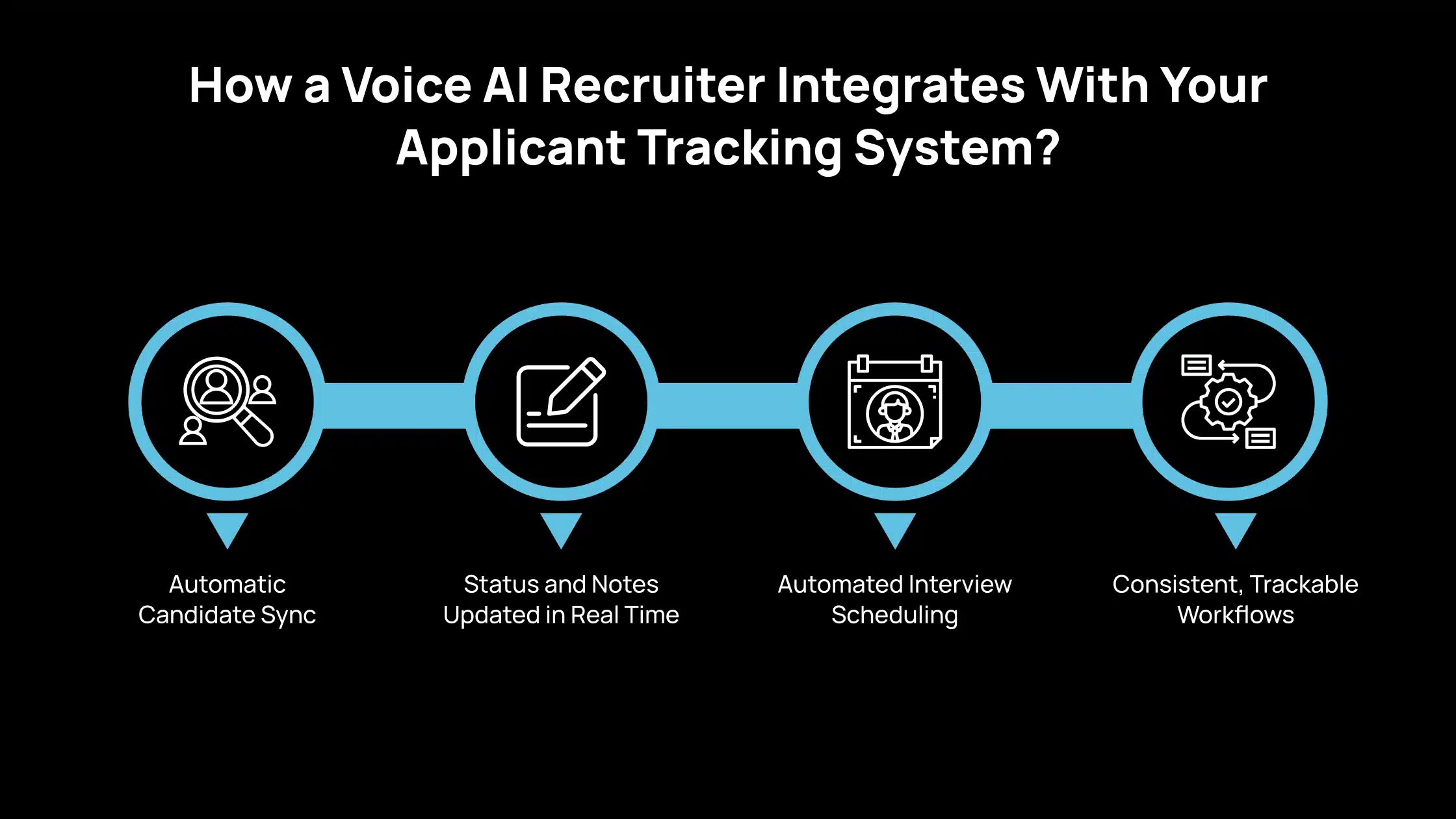
A voice AI recruiter is designed to fit into the talent acquisition ecosystem you already use. Most systems integrate smoothly with major ATS platforms. Here’s how the integration works:
- Automatic Candidate Sync: Applicants from job boards or career pages are pushed directly into the AI system for immediate outreach or screening.
- Status and Notes Updated in Real Time: The AI automatically updates candidate stages, screening results, and conversation notes directly within your ATS, eliminating the need for manual work.
- Automated Interview Scheduling: The AI reads calendar availability and books interviews without human involvement.
- Consistent, Trackable Workflows: Every action from calls made to outcomes recorded syncs instantly, keeping your ATS as the single source of truth.
This makes adoption easy because hiring teams don’t need to change their systems or workflows; the AI simply enhances what’s already there.
Core Features HR Teams Expect in a Voice AI Recruiter
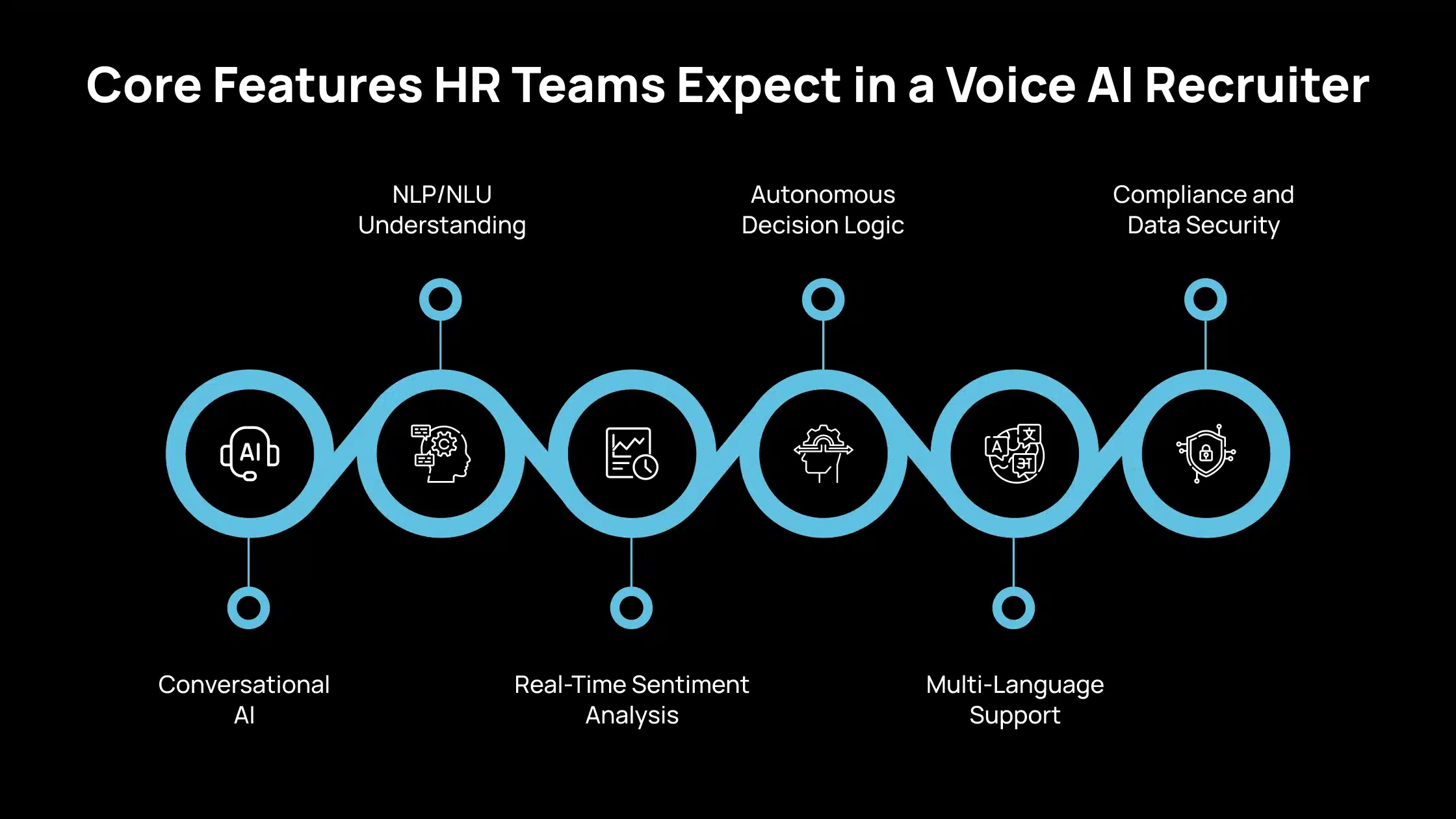
Below is a clear breakdown of the essential features that HR teams and TA leaders evaluate when selecting a voice AI recruiter.
1. Conversational AI
This is the technology that enables AI to speak naturally, understand pauses and tone shifts, and respond in a human-like manner. It creates a smooth, engaging interaction instead of a robotic experience. Candidates feel like they’re talking to a real recruiter, which improves trust and completion rates.
2. NLP/NLU Understanding
NLP (Natural Language Processing) and NLU (Natural Language Understanding) enable AI to interpret meaning, not just words. This means the system can understand different accents, ways of speaking, incomplete sentences, and real-world conversational patterns that candidates use. It makes the interactions flexible and realistic.
3. Real-Time Sentiment Analysis
The AI doesn’t just hear what candidates say, it also detects how they say it. Sentiment analysis detects cues such as confidence, hesitation, enthusiasm, or uncertainty, enabling the system to adapt its responses accordingly. This keeps conversations productive and ensures qualified candidates don’t get lost due to tone or communication style.
4. Autonomous Decision Logic
This feature allows the AI to make decisions during the call based on your hiring criteria.
For example, if a role requires weekend availability, the AI can automatically move qualified candidates forward and politely decline those who don’t meet the requirement with no human intervention required.
5. Multi-Language Support
Companies hiring across regions benefit from AI that can speak multiple languages and understand local accents. A voice AI recruiter can switch languages, handle bilingual candidates, and scale globally without needing separate teams for each region.
6. Compliance and Data Security
Hiring involves sensitive information. A good voice AI recruiter adheres to data protection requirements, such as GDPR or SOC 2, encrypts conversations, and stores candidate data securely. It also maintains consistent and fair communication, which supports diversity and compliance goals.
The Impact of AI Voice Recruiters on Hiring Operations
Here is how AI voice recruiters streamline hiring workflows and create measurable improvements across screening, scheduling, and candidate engagement.
1. Saves Time on First-Level Screening
A voice AI recruiter can handle first-level screening for thousands of applicants at the same time. Instead of recruiters spending hours calling candidates, leaving voicemails, and waiting for responses, the AI completes these steps automatically and immediately.
For example, recent reports indicate that AI helps recruiters save up to 23 hours per hire on resume screening and interviews.
This removes the slowest part of the hiring funnel: getting candidates on the phone and gathering basic information. It also reduces delays caused by missed calls or limited recruiter availability.
2. Reduction in Recruiting Costs
Automating first-level interactions (calls, voicemails, scheduling, and follow-up) means fewer recruiter hours are spent on repetitive tasks, which lowers the cost-per-hire. Studies show that firms using AI in recruitment report significant cost reduction.
According to a recent study, companies utilizing AI in recruitment are witnessing a remarkable 27% reduction in cost-per-hire.
For decision-makers, this translates into budget relief: you can either hire more efficiently with your current resources or redeploy the budget into strategic talent initiatives rather than focusing on screening volume.
3. Eliminates Recruiter Burnout
Recruiters spend a large portion of their day asking the same questions: availability, experience level, shift preference, location, and eligibility. These repetitive tasks accumulate and contribute to burnout, particularly during peak hiring periods.
A voice AI recruiter handles these routine conversations consistently and efficiently, allowing human recruiters to focus on candidate engagement, relationship building, and strategic decision-making rather than repetitive screening work.
4. Reduces Time-to-Hire
Screening often delays the entire hiring cycle. When qualification happens instantly over a voice AI call, candidates move to interviews within minutes instead of days.
Automated scheduling connects directly to recruiter calendars, filling open interview slots without any coordination or manual back-and-forth. This creates a faster and more predictable hiring flow, reducing the risk of losing strong candidates to competing offers.
5. Real-Time Analytics for HR Leaders
Voice-enabled screening systems generate structured data from each conversation, including call timestamps, candidate scores, question responses, sentiment cues, and scheduling outcomes. This provides real-time visibility into the funnel.
For instance, one guide recommends a measurement framework capturing time-to-fill, cost-per-hire, conversion rates, and talent-pipeline insights.
From an HR/TA leader’s perspective, that means you can monitor which job families are lagging, which screening questions correlate with success, and where candidates drop off, all with near-live data. That supports continuous improvement of the hiring process.
6. Ensures a Fair, Bias-Free Experience
A voice AI recruiter evaluates every applicant using the same criteria and the same questions. It doesn’t make assumptions based on names, accents, or backgrounds. For example, one source notes that automated voice-based outreach doubles response rates and reduces drop-off in early hiring stages.
This consistency helps ensure candidates are judged solely on their responses and job-related qualifications. It also provides HR teams with precise, reviewable data that supports fair hiring practices and compliance standards.
Practical Call Flow Examples of a Voice AI Recruiter in Real Hiring Scenarios
Here are a few examples that show how an AI voice recruiter works in real conversations:
Inbound Call Flow Example
How it works:
- The AI greets the candidate, introduces its role, and explains the purpose of the call.
- It asks which job the candidate is interested in or pulls up their existing application.
- The AI asks eligibility and qualification questions based on the role.
- It records and scores responses in real time.
- The AI provides clear next steps: schedule an interview, request missing information, or decline if criteria aren’t met.
Possible outcomes:
- The candidate is automatically scheduled for the next interview slot.
- Candidate is redirected to a more suitable open role.
- The candidate has declined due to missing requirements, such as certifications or availability.
Outbound Call Flow Example
How the process runs:
- The AI automatically reaches out to applicants who applied through job boards or the company’s career page.
- It confirms their interest in the position before continuing.
- It asks key qualification questions such as experience level, shift availability, or work authorization.
- If the applicant qualifies, the AI books an interview based on calendar availability.
Outcomes:
- More applicants reconnect because the call occurs quickly after they submit their application.
- Fewer candidates drop off between the application and screening stages.
- Recruiters save hours since the AI manages all first-contact outreach.
High-Volume Hiring Flow
Typical conversation flow:
- The AI asks direct questions about shift preference, preferred location, and immediate start availability.
- It checks practical details like commute distance, shift timings, and expected pay.
- Based on the responses, the AI schedules the candidate for a walk-in or virtual interview.
Outcomes:
- The system can screen thousands of applicants per day with consistent quality.
- Automatic reminders help reduce no-shows at interviews and improve attendance.
How Companies Can Implement a Voice AI Recruiter Successfully?
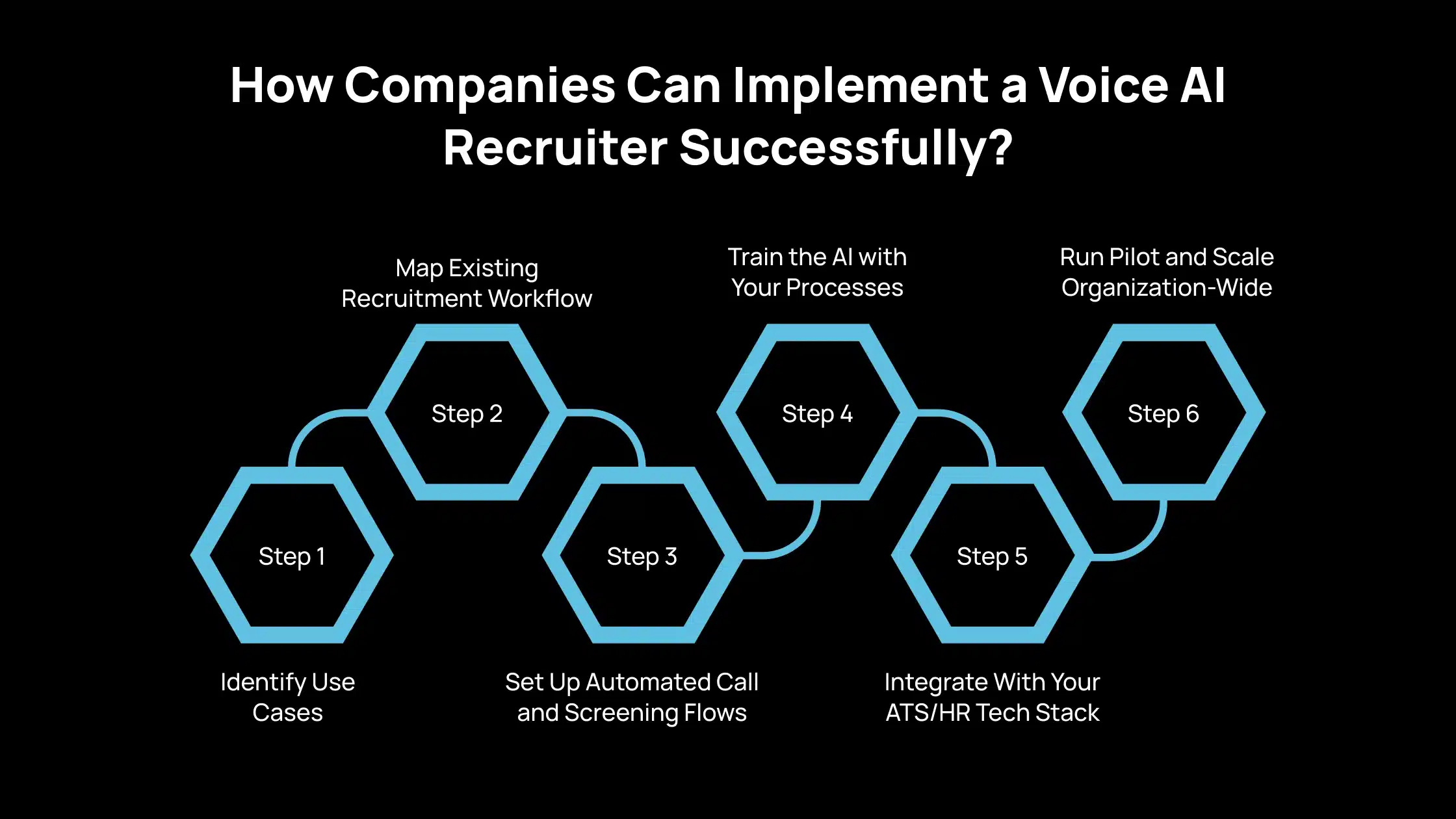
Successful implementation depends on selecting the proper use cases, preparing internal workflows, and deploying the system in a structured manner. Here is how AI fits naturally into existing hiring operations.
Step 1: Identify Use Cases
Start by identifying where the AI will have the most impact. High-volume roles, shift-based positions, and high-turnover functions benefit the most because they require constant screening and quick decision-making.
Technical roles can also use AI for first-level qualification to reduce the manual time spent on basic skill checks. Seasonal hiring teams gain value by handling spikes in applications without adding temporary recruiting staff.
Step 2: Map Existing Recruitment Workflow
Before deploying AI, outline how your current recruitment process works. Document where applications come from, how candidates move through ATS stages, and what screening criteria your team uses.
Review recruiter workloads and identify where delays typically happen, such as scheduling or missed follow-ups. Mapping these steps helps determine where AI can automate tasks without disrupting existing systems.
Step 3: Set Up Automated Call and Screening Flows
Once workflows are clear, create automated call flows that match your hiring requirements. Define the qualification logic for each job family, set scoring rules for responses, and plan redirection paths for candidates who are better suited to other roles.
Configure triggers such as “application received,” “reminder,” or “follow-up” to ensure candidates are contacted at the right time. This makes the AI consistent with your internal processes.
Step 4: Train the AI with Your Processes
AI performs best when trained with accurate, role-specific information. Provide FAQs, compliance guidelines, and HR policies so it can answer questions accurately. Supply job-specific scripts that reflect your organization’s requirements, from certifications to work conditions.
If your hiring process spans multiple regions, consider including language preferences and accent considerations to make conversations more natural for candidates.
Step 5: Integrate With Your ATS/HR Tech Stack
Integrating the AI with systems ensures smooth data flow. The integration lets the AI sync applications, update candidate stages, and add screening notes automatically.
Calendar connections allow the AI to book interviews without manual coordination. Automated email and SMS follow-ups help maintain consistent communication without requiring intervention from recruiters.
Step 6: Run Pilot and Scale Organization-Wide
Begin with a small pilot covering one or two job functions. Track results, including screening completion rates, time-to-hire improvements, interview attendance, and recruiter time saved. Use the insights to adjust call flows or scoring if needed.
Once the process is stable, expand the AI to additional roles and departments. Scaling gradually reduces risk and ensures each team is ready for the transition.
Why Avahi Is the Perfect Fit for Modern Talent Acquisition Teams?
For HR and talent acquisition teams, speed, consistency, and trust are everything. Whether you’re coordinating interviews across time zones or handling a surge of candidate inquiries, your systems must not only move fast, but also operate securely and in line with your organization’s compliance standards.
This is where Avahi’s AI Voice Agent becomes a valuable tool for talent acquisition teams. Here’s how this supports modern HR and Talent Acquisition teams:
- Always-on responsiveness
No missed calls or delayed replies. Candidates receive instant, human-like support, which is critical for fast-moving hiring pipelines that rely on secure and reliable service availability. - Secure handling of candidate data
With compliance-aligned processes, the AI agent ensures candidate information flows through your ATS/CRM safely and consistently, reducing the risk of data mishandling. - Reduced administrative workload
Repetitive tasks like scheduling, reminders, and initial screening are automated—helping teams meet recruitment SLAs without sacrificing data governance. - Improved audit readiness
Every interaction is logged, traceable, and aligned with the security controls required by modern compliance frameworks. - Better candidate experience, powered by secure automation
Candidates receive timely answers, while your team stays focused on meaningful conversations, rather than paperwork or coordination.
For HR leaders operating in competitive hiring markets, pairing AI automation with strong compliance foundations (such as ISO 27001 or SOC 2) ensures both speed and trust, so your team delivers great candidate experiences without creating new security risks.
Discover Avahi’s AI Platform in Action
At Avahi, we empower businesses to deploy advanced Generative AI that streamlines operations, enhances decision-making, and accelerates innovation—all with zero complexity.
As your trusted AWS Cloud Consulting Partner, we empower organizations to harness the full potential of AI while ensuring security, scalability, and compliance with industry-leading cloud solutions.
Our AI Solutions Include
- AI Adoption & Integration – Leverage Amazon Bedrock and GenAI to Enhance Automation and Decision-Making.
- Custom AI Development – Build intelligent applications tailored to your business needs.
- AI Model Optimization – Seamlessly switch between AI models with automated cost, accuracy, and performance comparisons.
- AI Automation – Automate repetitive tasks and free up time for strategic growth.
- Advanced Security & AI Governance – Ensure compliance, detect fraud, and deploy secure models.
Want to unlock the power of AI with enterprise-grade security and efficiency? Start Your AI Transformation with Avahi Today!
Frequently Asked Questions
1. What is a Voice AI Recruiter?
A Voice AI Recruiter is an automated system that conducts natural, human-like phone conversations with candidates. It screens applicants, asks qualification questions, verifies details, and schedules interviews without requiring manual effort from recruiters. Companies utilize it to expedite hiring, manage high application volumes, and minimize time spent on repetitive screening tasks.
2. How does a Voice AI Recruiter help reduce time-to-hire?
A Voice AI Recruiter contacts candidates instantly after they apply, conducts first-level screening in minutes, and automatically books interviews based on your team’s calendar. This eliminates delays caused by missed calls, manual coordination, and recruiter availability, helping companies reduce their time-to-hire by 50–70%.
3. Can a Voice AI Recruiter integrate with our existing ATS?
Yes. Most AI voice recruiter platforms integrate with major ATS systems such as Greenhouse, Lever, Workday, and BambooHR. This allows candidate data, notes, screening outcomes, and interview schedules to sync automatically, so your hiring workflow remains intact.
4. Will a Voice AI Recruiter replace human recruiters?
No. AI voice recruiters handle repetitive tasks, such as screening calls, follow-ups, and scheduling. Human recruiters still make final decisions, lead interviews, and manage candidate relationships. The AI acts as an assistant, not a replacement, so teams can focus on high-value interactions instead of administrative work.
5. Is a Voice AI Recruiter accurate in understanding different accents or languages?
Modern Voice AI systems use advanced speech recognition and natural language understanding to interpret various accents, languages, and speaking styles. Companies can also customize the AI with region-specific vocabulary and pronunciation to improve accuracy for local or global hiring.